R22 For Feedstock Market Size, Share & Demand Report By Type (Industrial-Grade R22, High-Purity R22), By Application (Fluoropolymer Production, Specialty Chemical Synthesis, Others), By End-Use Industry (Chemical Manufacturing, Electronics, Automotive, Aerospace, Others), By Region & Segment Forecasts, 2026–2034
USD 3950
Market Overview
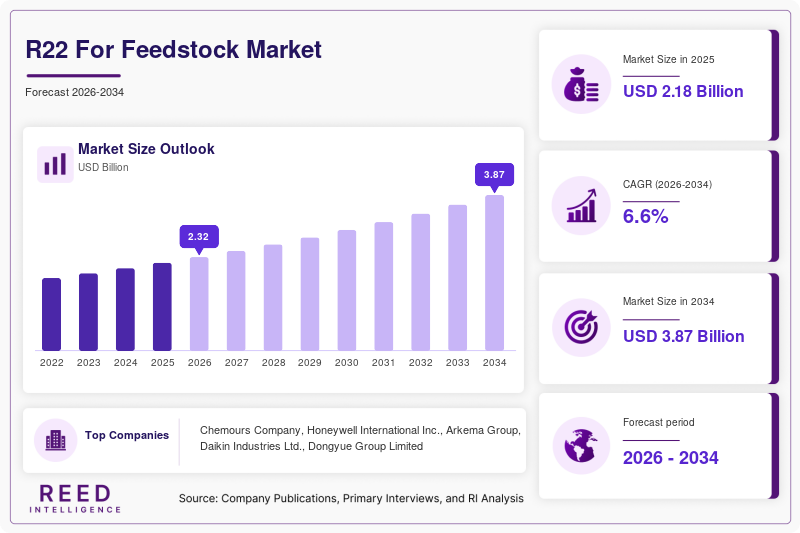
The global R22 For Feedstock Market was valued at approximately USD 2.18 billion in 2026 and is projected to reach USD 3.64 billion by 2034, expanding at a compound annual growth rate (CAGR) of 6.6% during 2026–2034. R22, traditionally used as a refrigerant, has increasingly found application as a feedstock in the production of fluoropolymers such as polytetrafluoroethylene (PTFE). The transition from direct refrigerant usage toward feedstock applications has supported steady demand, particularly in regions with stringent environmental regulations.
One key global factor supporting market growth is the gradual phase-out of hydrochlorofluorocarbons (HCFCs) under international environmental frameworks. While R22 usage in refrigeration is declining, its role as an industrial intermediate remains viable and regulated differently, allowing manufacturers to repurpose production capacity toward feedstock applications. This shift has helped maintain supply-demand balance while supporting downstream industries such as electronics, automotive, and chemical manufacturing.
Key Highlights
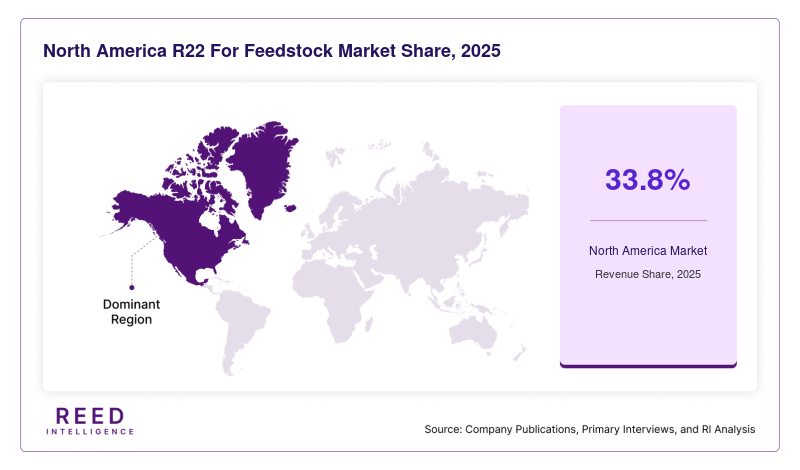
- North America dominated the market with a 33.8% share in 2025.
- Asia Pacific is expected to grow at the fastest CAGR of 7.4% during 2026–2034.
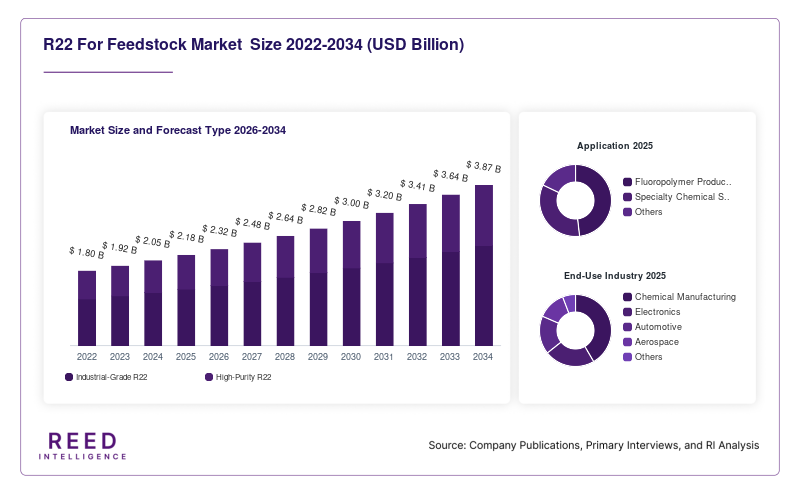
- By type, industrial-grade R22 accounted for the largest share of 57.6%.
- while high-purity grade is projected to grow at a CAGR of 7.9%.
- By application, fluoropolymer production led with a 46.2% share, whereas specialty chemical synthesis is expected to expand at a CAGR of 7.2%.
- The United States remained the dominant country, with market values of USD 480 million in 2024 and USD 515 million in 2025.
Market Trends
Shift Toward High-Purity Feedstock Applications
A notable trend in the R22 for feedstock market is the increasing demand for high-purity grades used in advanced manufacturing processes. Industries such as semiconductors, electronics, and specialty coatings require consistent chemical composition and minimal impurities, which has driven investment in purification technologies. Producers are focusing on refining production processes to meet strict quality requirements, especially in Asia Pacific and North America. This shift has also encouraged vertical integration, where manufacturers control both upstream R22 production and downstream fluoropolymer synthesis. As industries demand better performance materials, high-purity R22 is becoming a preferred input, influencing pricing structures and supplier competitiveness.
Capacity Realignment in Response to Environmental Policies
Another important trend is the strategic realignment of production capacities due to environmental regulations targeting HCFC emissions. Manufacturers are transitioning facilities previously dedicated to refrigerant-grade R22 toward feedstock production, ensuring regulatory compliance while maintaining revenue streams. This transition is particularly evident in Europe and North America, where strict environmental policies have accelerated industry adaptation. Companies are also investing in emission control technologies and sustainable manufacturing practices to reduce their environmental footprint. This trend not only supports long-term market stability but also enhances the reputation of R22 as a controlled industrial input rather than a phased-out product.
Market Drivers
Growing Demand for Fluoropolymers in High-Performance Applications
The rising demand for fluoropolymers such as PTFE, FEP, and PVDF is a major driver of the R22 for feedstock market. These materials are widely used in industries requiring chemical resistance, thermal stability, and electrical insulation, including automotive, aerospace, and electronics. As electric vehicles and renewable energy systems gain traction, the need for advanced materials continues to increase. R22 serves as a key intermediate in the production of these polymers, ensuring consistent demand. Additionally, infrastructure development and industrial expansion in emerging economies further amplify the need for durable materials, indirectly boosting R22 consumption as a feedstock.
Continued Industrialization in Emerging Economies
Rapid industrialization in regions such as Asia Pacific and Latin America has significantly contributed to market growth. Expanding manufacturing bases, increasing investments in chemical processing, and rising demand for specialty materials have created a favorable environment for R22 consumption. Governments in these regions are supporting domestic production capabilities to reduce reliance on imports, which has encouraged local manufacturers to scale operations. This industrial growth also drives demand for downstream applications such as coatings, seals, and insulation materials, all of which rely on fluoropolymers derived from R22.
Market Restraint
Regulatory Pressure and Environmental Concerns
One of the primary restraints affecting the R22 for feedstock market is the ongoing regulatory pressure associated with HCFCs. Although feedstock use is generally exempt from phase-out schedules, regulatory scrutiny remains high due to environmental concerns related to ozone depletion and greenhouse gas emissions. Governments and environmental agencies continue to monitor production and usage, which can lead to operational constraints and compliance costs for manufacturers.
In addition, the availability of alternative feedstocks and evolving chemical processes presents a competitive challenge. Some companies are investing in next-generation materials and production methods that reduce or eliminate reliance on R22. For example, alternative fluorination techniques are being explored to enhance sustainability. These developments could gradually reduce demand for R22 in certain applications.
The combined impact of regulatory uncertainty and technological shifts creates a cautious investment environment. Manufacturers must balance compliance requirements with operational efficiency, which may limit capacity expansion and affect long-term growth prospects.
Market Opportunities
Expansion of Specialty Chemical Manufacturing
The expansion of specialty chemical manufacturing presents a significant opportunity for the R22 for feedstock market. As industries increasingly require customized materials with specific properties, the demand for specialty chemicals continues to rise. R22 plays a crucial role as an intermediate in the synthesis of various fluorinated compounds used in pharmaceuticals, agrochemicals, and advanced coatings. This growing demand encourages manufacturers to invest in research and development, leading to new product innovations and improved process efficiencies. Emerging markets, in particular, offer untapped potential for expanding production capacities and establishing new supply chains.
Technological Advancements in Emission Control and Recycling
Technological advancements in emission control and recycling processes offer another promising opportunity for market growth. Companies are developing systems to capture and reuse R22 during production, reducing environmental impact and improving cost efficiency. These innovations align with global sustainability goals and help manufacturers meet regulatory requirements. Additionally, advancements in process optimization enable higher yields and better resource utilization, making R22-based production more competitive. As sustainability becomes a key focus across industries, companies that adopt these technologies are likely to gain a competitive advantage and expand their market presence.
Segmental Analysis
By Type
Industrial-grade R22 dominated the market, accounting for 57.6% share in 2024. This segment benefits from its widespread use in large-scale chemical manufacturing processes, where cost efficiency and availability are critical factors. Industrial-grade R22 is commonly used in the production of fluoropolymers and other bulk chemicals, making it a preferred choice for manufacturers. Its relatively lower cost compared to high-purity variants also contributes to its dominance. The segment’s stability is supported by consistent demand from established industries, ensuring steady growth despite regulatory challenges.
High-purity R22 is the fastest-growing subsegment, projected to expand at a CAGR of 7.9%. This growth is driven by increasing demand from industries requiring precise chemical composition, such as electronics and pharmaceuticals. High-purity R22 ensures better performance and reliability in critical applications, making it essential for advanced manufacturing processes. The segment’s growth is further supported by technological advancements in purification and quality control, enabling manufacturers to meet stringent industry standards.
By Application
Fluoropolymer production accounted for the largest share of 46.2% in 2024, driven by the extensive use of materials such as PTFE in various industries. These materials offer unique properties, including chemical resistance and thermal stability, making them essential in demanding applications. The growth of sectors such as automotive, aerospace, and electronics further supports the demand for fluoropolymers, indirectly boosting R22 consumption.
Specialty chemical synthesis is the fastest-growing application, with a projected CAGR of 7.2%. This segment benefits from the increasing demand for customized chemical products used in pharmaceuticals, agrochemicals, and coatings. R22 serves as a key intermediate in the synthesis of these chemicals, enabling manufacturers to produce high-value products. The segment’s growth is also driven by ongoing research and development efforts aimed at creating innovative chemical solutions.
By End-Use Industry
The chemical manufacturing industry dominated the market, holding a 52.8% share in 2024. This dominance is attributed to the extensive use of R22 as a feedstock in the production of various chemical compounds. The industry’s large-scale operations and continuous demand for raw materials ensure steady consumption of R22. Additionally, the integration of production processes enhances efficiency and reduces costs, supporting market growth.
The electronics industry is the fastest-growing end-use segment, expected to expand at a CAGR of 7.6%. This growth is driven by the increasing demand for advanced electronic components and devices, which require high-performance materials. R22-derived fluoropolymers are widely used in insulating materials and protective coatings, making them essential for electronics manufacturing. The segment’s growth is further supported by the expansion of semiconductor and consumer electronics industries.
Regional Analysis
North America
North America held a 33.8% market share in 2025 and is expected to grow at a CAGR of 5.9% during the forecast period. The region’s established chemical manufacturing base and strong demand for fluoropolymers contribute to its dominant position. Regulatory frameworks encourage controlled usage of R22 for feedstock purposes, supporting stable market conditions. The presence of advanced production technologies further enhances operational efficiency and ensures consistent product quality.
The United States remains the dominant country in this region, driven by its robust industrial infrastructure. A key growth factor is the increasing demand for high-performance materials in aerospace and electronics sectors. The country’s focus on innovation and sustainability has led to investments in emission control technologies, which support the continued use of R22 as a feedstock while minimizing environmental impact.
Europe
Europe accounted for approximately 26.4% of the market share in 2025 and is projected to grow at a CAGR of 5.5%. The region’s stringent environmental regulations have reshaped the market, encouraging the transition from refrigerant use to feedstock applications. Manufacturers are focusing on compliance and sustainability, which has led to the adoption of advanced production processes.
Germany leads the European market, supported by its strong chemical industry and technological expertise. A unique growth factor is the region’s emphasis on circular economy practices, including recycling and resource efficiency. These initiatives enable manufacturers to optimize R22 usage while reducing waste, supporting long-term market growth.
Asia Pacific
Asia Pacific held a 24.7% market share in 2025 and is expected to register the fastest CAGR of 7.4% during the forecast period. Rapid industrialization and increasing demand for fluoropolymers in electronics and automotive sectors drive market expansion. The region’s growing manufacturing base provides significant opportunities for capacity expansion.
China dominates the Asia Pacific market due to its large-scale chemical production capabilities. A key growth factor is the government’s support for domestic manufacturing and infrastructure development. This has encouraged investments in advanced production facilities, boosting R22 consumption for feedstock applications.
Middle East & Africa
The Middle East & Africa region accounted for 8.1% of the market share in 2025 and is projected to grow at a CAGR of 6.1%. The region’s expanding petrochemical industry and increasing investments in industrial development contribute to market growth. Availability of raw materials and favorable government policies further support the market.
Saudi Arabia is the leading country in this region, driven by its strong petrochemical sector. A unique growth factor is the integration of upstream and downstream operations, which enhances production efficiency and reduces costs. This integration supports the use of R22 as a feedstock in various chemical processes.
Latin America
Latin America held a 7.0% market share in 2025 and is expected to grow at a CAGR of 6.3%. The region’s developing industrial base and increasing demand for specialty chemicals drive market growth. Governments are focusing on strengthening domestic production capabilities, which supports R22 consumption.
Brazil leads the market in Latin America, supported by its expanding chemical industry. A key growth factor is the rising demand for fluoropolymers in construction and automotive sectors. This demand encourages manufacturers to invest in production facilities, boosting market growth.
Competitive Landscape
The R22 for feedstock market is moderately consolidated, with several key players focusing on capacity expansion, technological advancements, and strategic partnerships. Leading companies are investing in research and development to improve product quality and meet evolving regulatory requirements.
Chemours Company is a prominent leader in the market, known for its extensive portfolio of fluorochemical products. The company has recently invested in advanced manufacturing technologies to enhance production efficiency and reduce emissions. Other major players are also focusing on sustainability initiatives and exploring alternative production methods to remain competitive.
Companies are adopting strategies such as mergers, acquisitions, and collaborations to strengthen their market position. The emphasis on innovation and compliance with environmental regulations continues to shape the competitive landscape.
Key Players List
- Chemours Company
- Honeywell International Inc.
- Arkema Group
- Daikin Industries Ltd.
- Dongyue Group Limited
- Gujarat Fluorochemicals Limited
- SRF Limited
- Navin Fluorine International Limited
- Linde plc
- Solvay S.A.
- Asahi Glass Co., Ltd.
- Mexichem S.A.B. de C.V.
- Sinochem Group
- Zhejiang Juhua Co., Ltd.
- Shandong Huaan New Material Co., Ltd.
Recent Developments
- In 2025, Chemours expanded its fluorochemical production capacity to support increasing demand for feedstock applications.
- In 2024, Honeywell introduced an upgraded emission control system to improve sustainability in R22 production facilities.
- In 2025, Gujarat Fluorochemicals announced a new investment in high-purity R22 production technology to cater to electronics manufacturers.
R22 For Feedstock Market Segments
Type
- Industrial-Grade R22
- High-Purity R22
Application
- Fluoropolymer Production
- Specialty Chemical Synthesis
- Others
End-Use Industry
- Chemical Manufacturing
- Electronics
- Automotive
- Aerospace
- Others
By Region
- North America
- Europe
- APAC
- Middle East and Africa
- LATAM