Racket Sports Market Size, Share & Trends Analysis Report By Sport (Tennis, Badminton, Padel, Table Tennis, Squash, Pickleball), By Product Type (Rackets & Paddles, Balls & Shuttlecocks, Strings & Grips, Bags & Protective Equipment, Apparel & Footwear), By Distribution Channel (Online, Specialty Sports Stores, Sporting Goods Retailers, Clubs & Academies) Forecasts, 2026–2034
USD 3950
Racket Sports Market Size
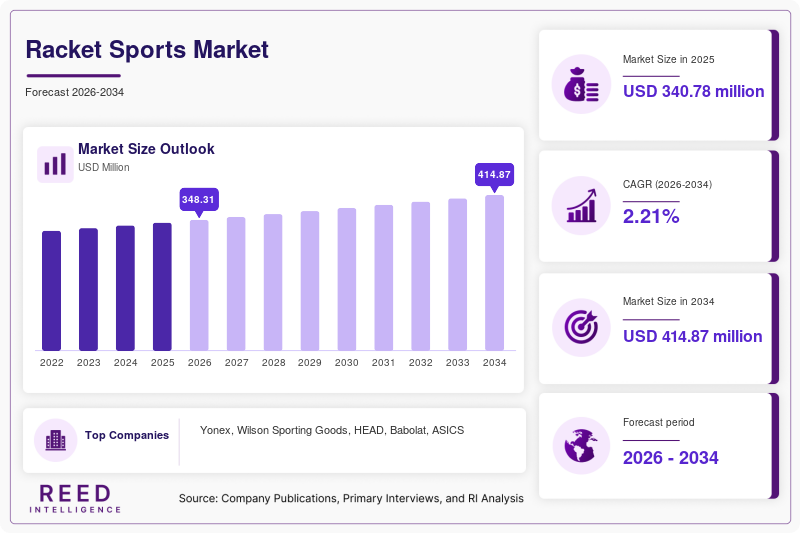
The global racket sports market size was valued at USD 340.78 million in 2025 and is projected to grow from USD 348.31 million in 2026 to USD 414.87 million by 2034, registering a CAGR of 2.21% during the forecast period from 2026 to 2034.
The racket sports market covers equipment and associated products used across tennis, badminton, padel, table tennis, squash, pickleball and related racket-based disciplines. Demand is being shaped by participation growth, greater recreational engagement, expansion of courts and clubs, youth development programs and product innovation.
Tennis provides a large established participation base. The ITF's latest global report identified more than 106 million tennis players across 199 countries, up 25.6% from 2019. The U.S. market has continued expanding, reaching 27.3 million tennis players in 2025, with 4.9 million people trying tennis for the first time during the year.
Padel is creating an additional equipment-demand pool. The International Padel Federation reported more than 35 million active players in 2025, while its June 2026 update placed the global player population at 38 million across 100 affiliated federations.
Badminton also provides a substantial participation base, with BWF reporting approximately 300 million participants worldwide in 2025. Table tennis is receiving continued grassroots investment: ITTF's 2026 participation program followed 133 activities reaching 9,802 participants across 76 member associations in 2025.
Racket Sports Market Drivers
Expansion of racket-sport participation
Participation is the fundamental demand mechanism for racket equipment because every new player requires at least one racket or paddle, while regular players generate replacement demand for strings, grips, balls, shuttlecocks, footwear and bags. Global tennis participation reached more than 106 million players, and the ITF is targeting 120 million players by 2030 through its development strategy. The U.S. provides a recent example of the equipment-demand mechanism: tennis participation reached 27.3 million in 2025, with 4.9 million first-time players. Badminton adds another large base, with BWF citing approximately 300 million participants worldwide. The commercial impact extends across entry-level and premium equipment because participation growth creates demand at multiple price points. Increasing participation among women and younger players also expands demand for appropriately sized rackets, lighter equipment and differentiated apparel.
Padel and pickleball are expanding the addressable equipment base
Emerging and rapidly expanding racket-based sports are adding new equipment demand rather than merely shifting players between established disciplines. FIP reported more than 35 million active padel players in 2025 and 38 million in June 2026, alongside strong increases in clubs and courts. In the U.S., SFIA reported 24.3 million pickleball participants in 2025, compared with 4.2 million in 2020. Each sport requires distinct equipment specifications, creating opportunities for manufacturers to introduce dedicated product portfolios rather than relying on traditional tennis products. DECATHLON's KUIKMA brand illustrates this strategy: initially developed around padel, it has expanded its expertise across tennis, badminton, pickleball, table tennis, squash and beach tennis. This cross-sport portfolio approach allows manufacturers and retailers to capture spending from consumers participating in several racket sports.
Product innovation supports replacement and premiumization
Racket manufacturers increasingly compete through frame geometry, materials, weight distribution, vibration control, spin generation and durability. Yonex's eighth-generation EZONE introduced a larger sweet spot, updated frame geometry and vibration-damping materials, while its eighth-generation VCORE focused on spin generation and aerodynamic improvements. Wilson has similarly introduced technology-led tennis and padel products, including its Defyer tennis racket and ENDURE padel franchise. Product innovation creates a replacement mechanism even when total participation grows slowly: existing players can upgrade equipment because new models promise improved power, control, spin, comfort or durability. Premium equipment also allows manufacturers to increase revenue per active participant without requiring equivalent increases in player numbers.
Racket Sports Market Restraints
Mature sports have relatively long equipment replacement cycles
Racket equipment is durable compared with many other sporting consumables. A recreational tennis or squash player may retain the same racket for several seasons, particularly when the frame remains structurally sound. This limits the direct relationship between participation and annual equipment sales. Replacement frequency is higher for strings, grips, balls and shuttlecocks, but these categories generally have lower unit values than rackets. Consequently, manufacturers depend on product upgrades, technology launches, competitive players and improved recreational engagement to accelerate replacement. The modest overall market CAGR of 2.21% reflects this mature underlying replacement structure despite stronger participation growth in individual sports.
Equipment demand is fragmented across sports and regional preferences
Racket sports have different equipment specifications, playing environments and purchasing behaviors. Tennis players purchase rackets, strings and balls; badminton players require lightweight rackets and shuttlecocks; table tennis players use blades, rubbers and balls; padel and pickleball use distinct racket or paddle designs. Manufacturers therefore need multiple product architectures and distribution strategies. ITTF's participation programs span 76 member associations across Africa, the Americas and Asia, illustrating the geographic diversity of the table-tennis ecosystem. This fragmentation can increase product-development and inventory complexity, particularly for retailers that need to stock equipment across multiple sports while maintaining sufficient depth in each category.
Racket Sports Market Opportunities
Cross-sport participation creates opportunities for multi-category equipment brands. Consumers increasingly participate in more than one racket sport, particularly where facilities combine tennis, padel, pickleball, badminton or table tennis. DECATHLON's KUIKMA expansion from padel into multiple racket sports reflects how manufacturers can use technology, distribution and brand infrastructure across disciplines. Retailers can also increase basket size by combining rackets with footwear, bags, strings, grips, balls and apparel. Digital product-finder tools provide another opportunity by helping players select equipment according to playing level, swing characteristics and sport.
Women's and youth participation creates additional equipment demand. USTA reported that female tennis participation increased by 1.1 million in 2025, while 4.9 million U.S. players picked up a racket for the first time. ITF's Junior Tennis Initiative also introduced more than 318,000 unique players in 2024, with 45% female participation. These trends create demand for junior rackets, lighter frames, beginner equipment, women-specific apparel and accessible price points. Similar development programs in table tennis and badminton can extend equipment adoption in emerging markets.
Segmental Analysis
By Sport
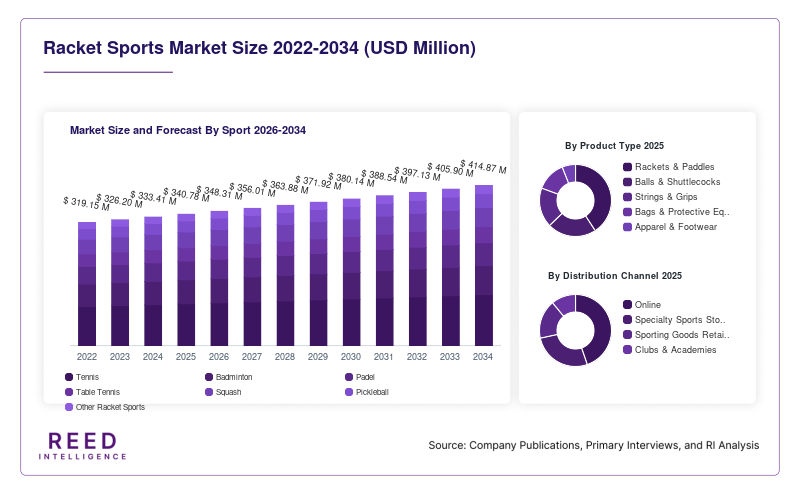
Tennis represents approximately 38% of the global market in 2025, making it the largest sport segment. Its scale is supported by more than 106 million global players and continued participation expansion in major markets. Tennis also generates recurring spending across rackets, strings, balls, bags, footwear and apparel. The U.S. reached 27.3 million players in 2025, demonstrating that participation remains capable of expanding in mature markets. Established tournament structures, extensive club networks and junior-development programs provide manufacturers with multiple channels for player acquisition and product replacement.
Padel is the fastest-growing sport segment at approximately 11.6% CAGR. FIP reported more than 35 million active players in 2025 and 38 million in 2026, alongside increases in clubs, courts and registered federation members. The sport creates a dedicated equipment category because padel rackets, balls and accessories differ from conventional tennis products. Manufacturers are increasing product investment accordingly; Wilson has introduced dedicated Premier Padel balls and ENDURE rackets, while HEAD and DECATHLON maintain dedicated padel portfolios.
By Product Type
Rackets and paddles account for approximately 44% of the market in 2025. They represent the core equipment purchase across tennis, badminton, squash, padel and pickleball. Product differentiation is extensive, with manufacturers targeting power, spin, control, maneuverability, vibration absorption and player-specific characteristics. Yonex's EZONE and VCORE launches demonstrate how manufacturers use frame geometry and materials to create reasons for equipment upgrades.
Balls and shuttlecocks are the fastest-growing product category at approximately 3.4% CAGR. Unlike rackets, these products have a natural recurring consumption cycle because they deteriorate through play. Padel is also adding demand for dedicated balls, with Wilson launching two Premier Padel ball formats designed around different playing conditions. Tournament, club and academy activity further increases recurring consumption.
By Distribution Channel
Specialty sports stores represent approximately 42% of the market in 2025, benefiting from the need for equipment selection, grip sizing, stringing and sport-specific advice. Tennis and badminton players often require assistance selecting racket weight, balance and string configuration, while competitive players may require customized setup.
Online is the fastest-growing distribution channel at approximately 5.2% CAGR. E-commerce provides broader product selection and makes specialized equipment accessible beyond major sporting cities. Manufacturers are also improving digital product discovery. HEAD offers racket-finder tools across its racquet-sports portfolio, while ITF's World Tennis Number demonstrates the broader use of digital platforms to connect players with appropriate competition and playing opportunities.
By Player Type
Recreational players account for approximately 61% of the market in 2025. Their large population creates the broadest addressable equipment base, including beginner rackets, balls, shuttlecocks, footwear, bags and accessories. Tennis, badminton and pickleball participation programs are expanding access beyond traditional competitive players. ITF, for example, is targeting participation across ages, genders and playing abilities through its global development strategy.
Junior players are the fastest-growing player category at approximately 4.6% CAGR. Youth development programs create equipment demand while also establishing long-term customer relationships. ITF reported 318,107 unique participants in its Junior Tennis Initiative in 2024, with 45% female participation. ITTF also places youth development at the center of its 2026 participation program.
Regional Analysis
North America Racket Sports Market
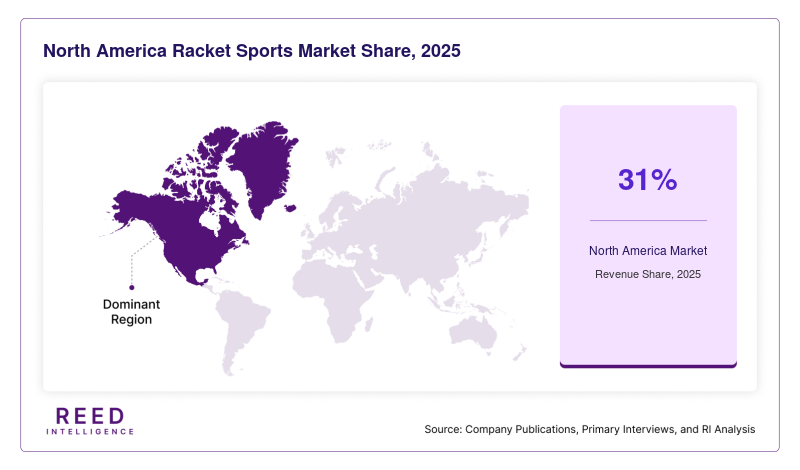
North America represents approximately 31% of the global racket sports market in 2025, supported by strong tennis and pickleball participation, developed sporting-goods retail infrastructure and extensive club and recreational facilities.
The U.S. tennis market reached a record 27.3 million players in 2025, up 54% from 2019. The USTA also recorded 4.9 million first-time tennis players and 14.5 million core players who played at least 10 times during the year. These figures create demand across both entry-level and premium racket categories.
Pickleball is an additional growth mechanism. SFIA reported 24.3 million U.S. pickleball participants in 2025, up from 4.2 million in 2020, while core players reached 7.5 million. This has expanded demand for paddles, balls, footwear, bags and accessories.
The region also benefits from strong brand and retail infrastructure. Wilson, HEAD, Yonex, Babolat, Prince and other brands have established distribution networks, while specialty retailers provide racket fitting, stringing and customization services.
North America's main constraint is market maturity in tennis and the relatively durable nature of racket equipment. Nevertheless, strong pickleball participation and continued tennis acquisition support approximately 3.1% CAGR through 2034.
Europe Racket Sports Market
Europe accounts for approximately 30% of the global market in 2025. Tennis has a deep recreational and professional base, while badminton and squash remain established across Northern and Western Europe. Padel is providing the strongest incremental equipment-demand mechanism.
FIP reported 38 million global padel players in June 2026 and 100 affiliated federations, demonstrating how the sport is expanding beyond its traditional markets. Spain remains a central padel market, while Italy, France, the Netherlands, Sweden, Portugal and the UK have developed significant club ecosystems.
European manufacturers and retailers are responding with dedicated product ranges. HEAD identifies tennis, padel and pickleball as part of its broader racquet-sports portfolio, while Wilson and other manufacturers continue to release sport-specific products.
Digital engagement is also becoming more important. ITF's World Tennis Number has expanded as a tool for connecting players with suitable opponents and competitions, with Tennis Ireland integrating it into clubs and competitions during 2025.
Europe is projected to expand at approximately 2.7% CAGR.
APAC Racket Sports Market
APAC represents approximately 27% of the global racket sports market in 2025 and is the fastest-growing region, with a CAGR of approximately 4.8%.
The region has a particularly broad racket-sports ecosystem. Badminton has deep participation in China, Indonesia, India, Japan, Malaysia and other Asian markets, while table tennis has a strong base in China and across East Asia. BWF reported approximately 300 million badminton participants worldwide, while ITTF continues to expand grassroots participation programs across Africa, the Americas and Asia.
Table tennis also has substantial cultural and digital visibility in China. ITTF reported that table tennis was China's most-followed sport on Weibo in 2025, with more than 10,000 appearances on the platform's main trending list.
India is another important demand market because badminton and tennis participation continue to expand alongside investments in sports facilities and organized competitions. Japan and South Korea provide mature premium-equipment markets, particularly for badminton and tennis.
APAC's competitive advantage is its combination of enormous participation bases and strong domestic equipment manufacturing. The primary constraints are wide differences in purchasing power and market maturity between countries.
Middle East and Africa Racket Sports Market
Middle East and Africa account for approximately 5% of the global market in 2025 and are projected to grow at approximately 3.9% CAGR.
The region's racket-sports market is supported by expanding sports infrastructure, international competitions, school programs and investments in recreational facilities. Gulf countries are increasing sports participation infrastructure, while African federations continue to use racket sports for youth development and community participation.
ITTF's participation program provides a direct example of this development mechanism. In 2025, 76 member associations across Africa, the Americas and Asia delivered 133 activities reaching 9,802 participants, with 45% female participation. ITTF also invested USD 3 million in worldwide development in 2024.
Badminton and table tennis are particularly suited to indoor and community facilities, while tennis and padel are expanding in higher-income urban markets. The principal constraints are equipment affordability, court availability and distribution infrastructure.
Latin America Racket Sports Market
LATAM represents approximately 7% of the global market in 2025 and is projected to grow at approximately 3.8% CAGR.
Tennis has an established presence in Argentina, Brazil, Mexico, Chile and other markets, while padel is providing an important incremental growth channel. FIP's international expansion has increased the number of federations and active players, while Argentina remains one of the sport's important historical markets.
ITF's development programs are also designed to broaden participation in under-resourced markets. The organization has invested more than USD 50 million in tennis development since 2017, supporting participation, facilities, education and performance programs.
Price sensitivity remains an important constraint, particularly among recreational players. Local distributors, sporting-goods chains and online channels therefore play an important role in making equipment available across different income groups.
Competitive Landscape
The racket sports market has a concentrated group of international brands alongside specialist manufacturers and large sporting-goods retailers. Competition is increasingly organized around sport-specific technology, athlete partnerships, product breadth, distribution and price segmentation.
HEAD maintains one of the broadest racquet-sports portfolios, covering tennis, padel and pickleball as well as associated footwear, bags and accessories. Its padel portfolio includes multiple racket families and professional athletes.
Yonex has strong positions in badminton and tennis and continues to use material and frame innovation to differentiate premium products. Its 2025 EZONE and VCORE launches demonstrate the use of frame geometry, sweet-spot engineering, vibration damping and aerodynamic design as product differentiators.
Wilson competes across tennis, padel and other racket categories, combining athlete partnerships with sport-specific product launches. Its 2025 Roland-Garros collection included rackets, balls, bags and accessories, while its padel portfolio has expanded through Premier Padel partnerships and dedicated products.
Key Market Players
Recent Market Developments
- June 2026 – FIP: The International Padel Federation reported 38 million padel players and 100 affiliated federations, reinforcing the sport's expansion as a global racket-sports category.
- June 2026 – SFIA: The Sports & Fitness Industry Association reported 24.3 million U.S. pickleball participants in 2025, up from 4.2 million in 2020, while core participants reached 7.5 million.
Racket Sports Market Segments
By Sport
- Tennis
- Badminton
- Padel
- Table Tennis
- Squash
- Pickleball
- Other Racket Sports
By Product Type
- Rackets & Paddles
- Balls & Shuttlecocks
- Strings & Grips
- Bags & Protective Equipment
- Apparel & Footwear
By Distribution Channel
- Online
- Specialty Sports Stores
- Sporting Goods Retailers
- Clubs & Academies
By Player Type
- Recreational Players
- Competitive & Professional Players
- Junior Players
- School & Institutional Players
By Region
- North America
- Europe
- APAC
- Middle East and Africa
- LATAM