Radiation Cured Market Size, Share & Demand Report By Type (UV Curing Systems, Electron Beam Curing Systems), By Application (Coatings, Inks, Adhesives, Composites), By End-Use Industry (Packaging, Automotive, Electronics, Healthcare, Industrial Manufacturing, Aerospace), By Region & Segment Forecasts, 2026–2034
USD 3950
Market Overview
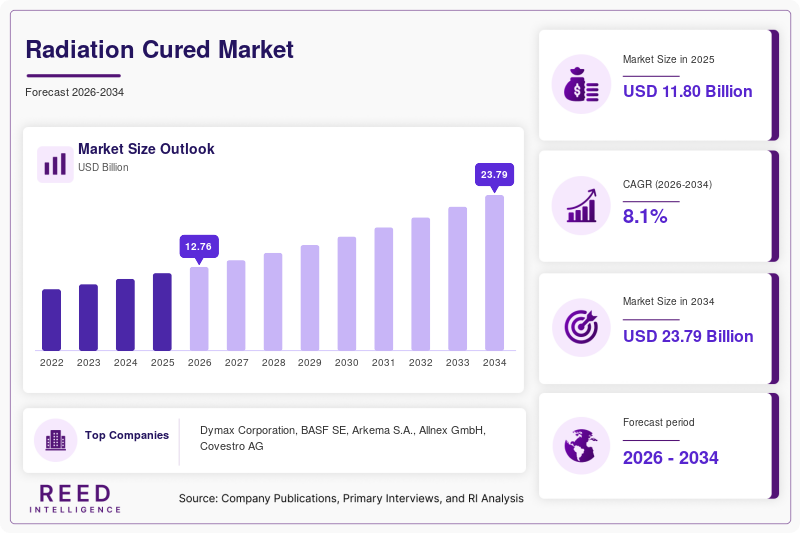
The global Radiation Cured Market size was valued at USD 11.8 billion in 2026 and is projected to reach USD 21.9 billion by 2034, expanding at a CAGR of 8.1% during the forecast period from 2026 to 2034. Radiation curing technologies use ultraviolet (UV) and electron beam (EB) energy to rapidly cure coatings, inks, adhesives, and composites without requiring extensive thermal processing. The market continues to gain traction across packaging, automotive, electronics, healthcare, and industrial manufacturing sectors due to its operational efficiency and lower volatile organic compound emissions. Manufacturers are increasingly adopting radiation-cured materials to improve productivity, reduce energy consumption, and meet evolving environmental regulations related to solvent-based systems.
A major global factor supporting market growth is the rising shift toward sustainable manufacturing practices. Governments and industrial operators are emphasizing low-emission production technologies, especially in packaging and electronics manufacturing. Radiation curing systems provide fast curing speeds, reduced waste generation, and improved surface performance, making them suitable for high-throughput industrial operations. In addition, the increasing demand for durable coatings in automotive interiors, wood finishes, and flexible packaging applications has accelerated the adoption of UV-curable and EB-curable technologies worldwide.
Key Highlights
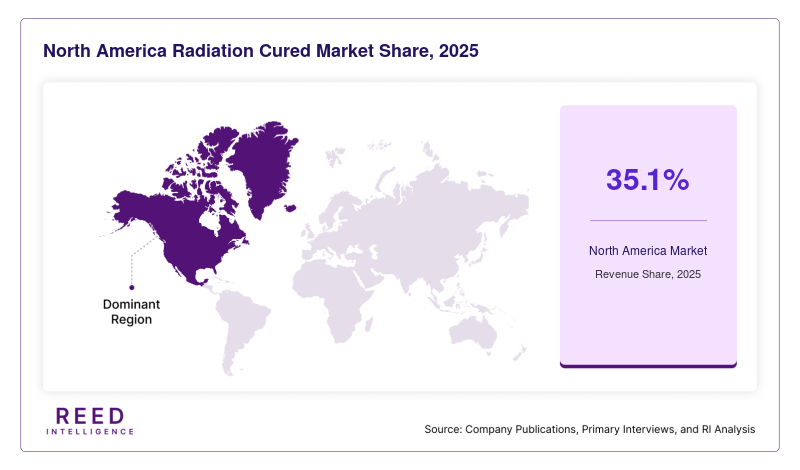
- North America dominated the market with a 35.1% share in 2025, while Asia Pacific is expected to grow at the fastest CAGR of 9.8% during 2026–2034.
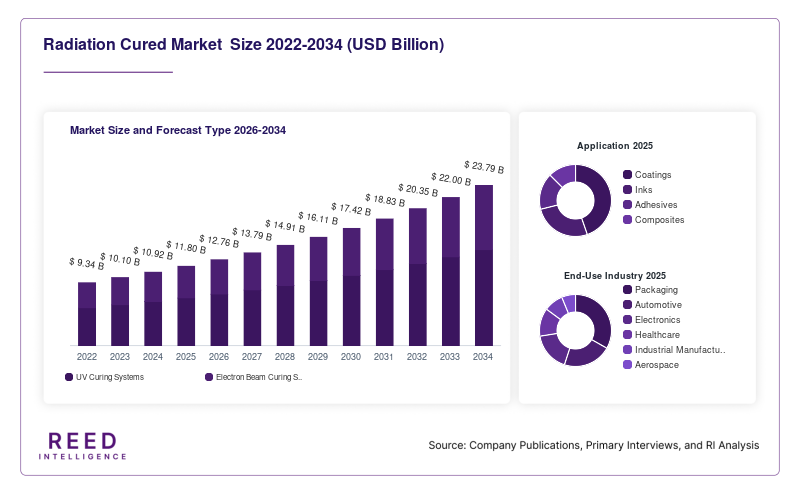
- By type, UV curing systems accounted for the largest share of 67.4%, while electron beam curing systems are projected to grow at a CAGR of 9.6%.
- By application, coatings led with a 43.8% share, whereas adhesives are expected to expand at a CAGR of 9.3%.
- By end-use industry, packaging accounted for the highest market share of 31.5%, while electronics is forecast to grow at a CAGR of 10.1%.
- The United States remained the dominant country, with market values of USD 3.4 billion in 2024 and USD 3.7 billion in 2025.
Market Trends
Expansion of UV LED Curing Technologies Across Industrial Manufacturing
The Radiation Cured Market is witnessing increasing adoption of UV LED curing systems across printing, packaging, automotive, and electronics industries. UV LED systems offer improved energy efficiency, longer operational life, and lower maintenance costs compared to conventional mercury vapor lamps. Manufacturers are integrating LED curing units into high-speed production lines to improve process consistency and reduce downtime. The technology also supports instant curing at lower temperatures, which is suitable for heat-sensitive substrates used in flexible packaging and electronic components. As sustainability targets become more important, industrial facilities are transitioning toward UV LED systems to reduce electricity consumption and eliminate mercury-related disposal concerns. The trend is particularly strong in developed economies where environmental compliance standards continue to tighten across manufacturing sectors.
Growing Demand for Radiation-Cured Materials in Flexible Packaging Applications
Flexible packaging manufacturers are increasingly using radiation-cured coatings and inks due to the need for high-speed printing and improved product appearance. UV-curable formulations provide superior gloss retention, abrasion resistance, and rapid curing performance, making them suitable for food packaging, pharmaceutical labeling, and consumer goods applications. The rise of e-commerce and packaged food consumption has significantly increased the production of flexible packaging materials worldwide. Radiation curing technologies also support shorter production cycles and reduced operational costs for converters and packaging suppliers. In addition, advancements in low-migration UV inks for food-safe packaging applications are encouraging wider adoption among global packaging companies. The trend is expected to remain strong as brands continue investing in visually appealing and sustainable packaging formats.
Market Drivers
Increasing Environmental Regulations Supporting Low-Emission Manufacturing
The implementation of stricter environmental regulations related to solvent emissions is a major factor driving the Radiation Cured Market. Traditional solvent-based coatings release volatile organic compounds that contribute to industrial pollution and workplace safety concerns. Radiation-cured materials contain little or no solvents, making them a preferred alternative for environmentally conscious manufacturers. Regulatory agencies across North America and Europe are encouraging industries to adopt cleaner coating and printing technologies. As a result, manufacturers in automotive, wood finishing, and packaging sectors are upgrading their production systems to include UV and electron beam curing technologies. These systems reduce drying time, lower energy usage, and improve production efficiency while supporting compliance with environmental standards. Growing investment in sustainable industrial operations is expected to maintain strong demand for radiation curing technologies throughout the forecast period.
Rising Use of High-Performance Coatings in Automotive and Electronics Industries
The increasing use of advanced coatings in automotive and electronics manufacturing is accelerating market growth. Radiation-cured coatings provide strong chemical resistance, scratch protection, and high surface durability, making them suitable for automotive interiors, electronic displays, printed circuit boards, and optical fibers. Automotive manufacturers are using UV-cured coatings to improve surface aesthetics and reduce processing time during component production. In electronics manufacturing, radiation curing supports precision coating applications that require fast processing and minimal thermal exposure. The rapid expansion of electric vehicles and consumer electronics production has further strengthened demand for reliable coating technologies. In addition, continuous innovation in photoinitiators and resin formulations is improving coating performance, encouraging broader adoption across industrial manufacturing environments.
Market Restraint
High Initial Equipment Costs Limiting Adoption Among Small Manufacturers
The high upfront investment associated with radiation curing systems remains a key restraint for market expansion. UV and electron beam curing equipment require specialized lamps, conveyor systems, cooling infrastructure, and safety mechanisms, which increase installation expenses for manufacturers. Small and medium-sized enterprises often face budget limitations that restrict their ability to transition from conventional thermal curing technologies. In addition, electron beam systems require radiation shielding and trained operators, which further increases operational complexity and maintenance costs. Some industries with limited production volumes continue relying on traditional solvent-based systems due to lower capital requirements. The lack of technical expertise in emerging economies also slows adoption rates among regional manufacturers. Although long-term operational savings can offset initial investment costs, the high entry barrier continues to affect market penetration in cost-sensitive industrial sectors.
Market Opportunities
Rising Adoption of Radiation-Cured Adhesives in Medical Device Manufacturing
The growing medical device industry presents significant opportunities for the Radiation Cured Market. Radiation-cured adhesives are increasingly used in catheters, syringes, wearable sensors, and diagnostic devices due to their rapid curing performance and precise bonding capabilities. Medical manufacturers require materials that support sterilization resistance, low toxicity, and high bonding strength. UV-curable adhesives enable faster assembly processes while reducing production defects in small and complex medical components. In addition, healthcare companies are investing in advanced manufacturing technologies to meet rising global demand for disposable medical products and minimally invasive devices. The expansion of healthcare infrastructure in developing economies is also creating favorable conditions for market growth. Continuous innovation in biocompatible UV-curable materials is expected to further increase adoption across medical manufacturing applications.
Expanding Use of Electron Beam Curing in Advanced Composite Manufacturing
Electron beam curing technologies are gaining attention in aerospace, wind energy, and industrial composite manufacturing applications. EB curing enables rapid polymerization without requiring photoinitiators, making it suitable for thick composite materials and high-performance structural components. Aerospace manufacturers are exploring electron beam systems to reduce production time and improve mechanical strength in lightweight composite structures. Wind turbine blade manufacturers are also evaluating EB curing processes to increase throughput and reduce energy consumption during composite fabrication. As industries continue focusing on lightweight materials and energy-efficient manufacturing methods, demand for advanced curing technologies is expected to rise. Research activities aimed at improving electron beam processing efficiency and reducing equipment costs could create additional growth opportunities for technology providers during the forecast period.
Segmental Analysis
By Type
UV curing systems accounted for the largest share of the Radiation Cured Market in 2024, representing approximately 67.4% of total revenue. The segment dominates due to widespread adoption across coatings, inks, adhesives, and printing applications. UV curing systems provide rapid curing performance, lower energy consumption, and reduced operational downtime compared to traditional thermal curing technologies. Industries such as packaging, automotive, and electronics prefer UV curing technologies because they improve manufacturing efficiency and support high-speed production operations. In addition, UV systems are compatible with various substrates including plastics, paper, glass, and metal surfaces. Continuous advancements in UV LED technology have also improved operational reliability and reduced maintenance requirements. The increasing focus on sustainable industrial practices and low-emission manufacturing processes continues to strengthen demand for UV curing systems across developed and emerging economies.
Electron beam curing systems are expected to register the fastest CAGR of 9.6% during the forecast period. The growth of the segment is primarily driven by increasing adoption in advanced composite manufacturing, aerospace applications, and heavy industrial coatings. EB curing technologies offer deep penetration capabilities and eliminate the need for photoinitiators, making them suitable for thick materials and high-performance industrial applications. Manufacturers are increasingly exploring electron beam systems to reduce curing time and improve production efficiency in composite fabrication processes. In addition, growing demand for lightweight materials in automotive and aerospace industries is encouraging investment in advanced curing technologies. Research initiatives aimed at improving equipment affordability and processing flexibility are expected to support broader commercial adoption of electron beam curing systems during the coming years.
By Application
Coatings represented the dominant application segment in 2024, accounting for approximately 43.8% of the global Radiation Cured Market. Radiation-cured coatings are widely used in automotive parts, wood finishes, industrial equipment, and electronic components due to their excellent abrasion resistance, gloss retention, and chemical stability. Manufacturers are increasingly using UV-curable coatings to improve production throughput and reduce energy costs associated with traditional drying methods. The coatings segment also benefits from strict environmental regulations encouraging the use of low-volatile organic compound technologies. Industrial sectors continue to invest in advanced coating systems to improve product durability and operational efficiency. In addition, the rise of automated manufacturing processes has accelerated the use of fast-curing coating technologies capable of supporting high-speed industrial production lines across multiple end-use industries.
Adhesives are projected to witness the fastest CAGR of 9.3% during the forecast period due to increasing use in medical devices, electronics assembly, and automotive manufacturing. Radiation-cured adhesives provide rapid bonding performance, strong adhesion strength, and precise application control, making them suitable for compact and sensitive components. Medical device manufacturers are increasingly adopting UV-curable adhesives for disposable healthcare products and wearable medical devices. The electronics industry is also expanding the use of radiation-cured adhesives in display panels, optical fibers, and printed circuit board assembly. Growing demand for lightweight electronic products and miniaturized components is encouraging manufacturers to adopt advanced adhesive technologies with fast curing capabilities. Continuous innovation in low-toxicity and biocompatible adhesive formulations is expected to further support segment growth throughout the forecast period.
By End-Use Industry
Packaging emerged as the leading end-use industry in 2024, accounting for approximately 31.5% of global market revenue. The increasing consumption of packaged food, beverages, pharmaceuticals, and consumer goods has significantly strengthened demand for radiation-cured inks and coatings. Packaging manufacturers prefer UV-curable systems because they enable high-speed printing, improved image quality, and lower drying times. The rise of e-commerce and digital printing technologies has further accelerated demand for advanced packaging materials with durable and visually attractive surfaces. In addition, radiation-cured materials support sustainable packaging production by reducing solvent emissions and energy consumption. Flexible packaging converters and label manufacturers are increasingly investing in UV LED curing systems to improve operational efficiency and meet environmental compliance standards. These factors continue to support the strong market position of the packaging segment.
Electronics is anticipated to record the fastest CAGR of 10.1% during the forecast period due to increasing production of consumer electronics, semiconductors, and advanced display technologies. Radiation-cured coatings and adhesives are widely used in electronic devices because they provide excellent thermal stability, chemical resistance, and precision application capabilities. Manufacturers of smartphones, wearable devices, and display panels are increasingly adopting UV-curable materials to improve product reliability and reduce assembly time. The rapid growth of electric vehicles and connected electronic systems is also contributing to rising demand for advanced electronic materials. In addition, the expansion of semiconductor manufacturing operations in Asia Pacific is creating substantial opportunities for radiation curing technology providers. Ongoing innovation in miniaturized electronic components and high-performance display technologies is expected to drive continued segment expansion.
Regional Analysis
North America
North America accounted for 35.1% of the global Radiation Cured Market in 2025 and continues to maintain a leading position due to the strong presence of packaging, automotive, and electronics manufacturing industries. The region is projected to grow at a CAGR of 7.4% during the forecast period. Industrial operators across the United States and Canada are increasingly adopting UV-curable coatings and inks to reduce solvent emissions and improve manufacturing efficiency. The market also benefits from advanced technological infrastructure and widespread availability of high-performance radiation curing systems across commercial production facilities.
The United States remains the dominant country in North America due to rising demand for sustainable coating technologies in industrial manufacturing. A key growth factor supporting the market is the rapid expansion of flexible packaging production for food, beverage, and healthcare applications. Packaging converters are investing in UV LED curing systems to improve printing quality and reduce operational downtime. In addition, the growing use of radiation-cured materials in automotive refinishing and electronic component manufacturing continues to support regional market expansion.
Europe
Europe represented a substantial share of the Radiation Cured Market in 2025 and is expected to expand at a CAGR of 7.1% between 2026 and 2034. The region has experienced increasing adoption of low-emission coating technologies due to strict environmental regulations related to volatile organic compound emissions. Countries such as Germany, France, and Italy are emphasizing sustainable manufacturing practices across industrial sectors. The growing use of UV-curable wood coatings, printing inks, and industrial adhesives is contributing to stable market demand across the region.
Germany remains the leading country in the European market because of its strong industrial manufacturing base and advanced automotive sector. One unique growth factor is the increasing use of radiation-cured coatings in engineered wood products and furniture manufacturing. European furniture producers are adopting UV curing systems to improve scratch resistance, reduce production time, and lower energy consumption. The presence of established coating technology providers and strong research activities related to sustainable materials also supports continued market development in Europe.
Asia Pacific
Asia Pacific is projected to record the fastest CAGR of 9.8% during the forecast period due to rapid industrialization and expanding manufacturing activities. The region is witnessing rising demand for radiation-cured coatings, inks, and adhesives across packaging, electronics, automotive, and consumer goods industries. China, Japan, South Korea, and India are major contributors to regional market growth. Increasing investments in industrial automation and advanced manufacturing technologies are encouraging wider adoption of UV and electron beam curing systems across production facilities.
China dominates the Asia Pacific Radiation Cured Market due to its extensive manufacturing infrastructure and growing packaging industry. A major growth factor is the rapid expansion of electronics manufacturing operations, particularly in printed circuit boards and display panels. Chinese manufacturers are increasingly adopting UV-curable coatings and adhesives to improve production efficiency and product durability. Government support for sustainable industrial technologies and rising export demand for consumer electronics are also contributing to strong market growth across the country.
Middle East & Africa
The Middle East & Africa Radiation Cured Market is expected to grow steadily during the forecast period, supported by infrastructure development and industrial diversification initiatives. The region accounted for a smaller global market share in 2025 but is projected to expand at a CAGR of 6.5% through 2034. Countries in the Gulf region are increasing investments in industrial coatings, packaging production, and advanced manufacturing facilities. Radiation curing technologies are gradually gaining adoption as industries seek efficient and environmentally friendly production processes.
Saudi Arabia remains the dominant country in the regional market due to ongoing industrial development programs and expanding construction activities. A unique growth factor is the increasing demand for durable UV-cured coatings in architectural and industrial applications. Industrial operators are using radiation-cured materials to improve corrosion resistance and surface durability in harsh environmental conditions. The expansion of packaging and printing industries in the Gulf Cooperation Council countries is also supporting demand for UV-curable inks and coatings.
Latin America
Latin America is experiencing gradual growth in the Radiation Cured Market due to increasing industrial production and rising demand for advanced packaging materials. The region is expected to expand at a CAGR of 6.8% during the forecast period. Brazil, Mexico, and Argentina are among the leading contributors to regional demand. Packaging manufacturers are increasingly adopting UV-curable inks and coatings to improve printing speed and product appearance. The growing food processing and consumer goods sectors are also supporting demand for radiation curing technologies across the region.
Brazil dominates the Latin American market due to its large industrial base and expanding packaging industry. One significant growth factor is the increasing use of radiation-cured coatings in wood finishing and furniture manufacturing applications. Brazilian furniture producers are investing in UV curing systems to improve coating consistency and production efficiency. In addition, growing exports of packaged consumer products and rising investment in industrial modernization projects are creating favorable conditions for continued market expansion across the country.
Competitive Landscape
The Radiation Cured Market is moderately consolidated, with leading companies focusing on product innovation, strategic partnerships, and expansion of UV LED technology portfolios. Major market participants are investing in advanced curing systems, sustainable formulations, and application-specific materials to strengthen their competitive position. Companies are also expanding manufacturing capabilities in Asia Pacific and North America to address growing industrial demand across packaging, electronics, and automotive sectors.
Dymax Corporation remains one of the leading participants in the market due to its strong portfolio of UV-curable adhesives and curing equipment. The company recently introduced advanced LED curing systems designed for electronics and medical device manufacturing applications. Other prominent players including BASF SE, Arkema S.A., and Allnex GmbH are investing in sustainable radiation-curable resin technologies to meet increasing environmental compliance requirements. Integration of automation-compatible curing systems and development of low-energy curing solutions are emerging as key competitive strategies among major industry participants.
Key Players
- Dymax Corporation
- BASF SE
- Arkema S.A.
- Allnex GmbH
- Covestro AG
- DIC Corporation
- Ashland Inc.
- Sartomer
- Eternal Materials Co., Ltd.
- Red Spot Paint & Varnish Company
- Hitachi Chemical Co., Ltd.
- IGM Resins
- TOAGOSEI Co., Ltd.
- Michelman, Inc.
- Nippon Gohsei
Recent Developments
- In January 2026, Arkema S.A. expanded its UV-curable resin production capacity in Asia to support growing demand from packaging and electronics manufacturers.
- In September 2025, Dymax Corporation launched a next-generation UV LED curing platform designed for high-speed medical device assembly applications.
- In March 2026, BASF SE introduced new radiation-curable coating formulations focused on low-energy industrial curing applications.
- In November 2025, Allnex GmbH partnered with packaging converters in Europe to develop sustainable UV-curable ink technologies for flexible packaging solutions.
- In April 2026, Covestro AG announced research investments aimed at improving electron beam curing materials for advanced composite manufacturing applications.
Radiation Cured Market Segments
Type
- UV Curing Systems
- Electron Beam Curing Systems
Application
- Coatings
- Inks
- Adhesives
- Composites
End-Use Industry
- Packaging
- Automotive
- Electronics
- Healthcare
- Industrial Manufacturing
- Aerospace
By Region
- North America
- Europe
- APAC
- Middle East and Africa
- LATAM