Radiation Protection Apparels Market Size, Share & Demand Report By Type (Aprons, Gloves, Thyroid Shields, Head Shields, Eyewear, Vests and Skirts, Others), By Material (Lead-Based, Lead-Free, Lightweight Lead Composite, Bismuth-Based Composite, Others), By Application (Hospitals and Clinics, Diagnostic Centers, Research Laboratories, Specialty Clinics, Industrial and Nuclear Facilities), By Region & Segment Forecasts, 2026–2034
USD 3950
Radiation Protection Apparels Market Size
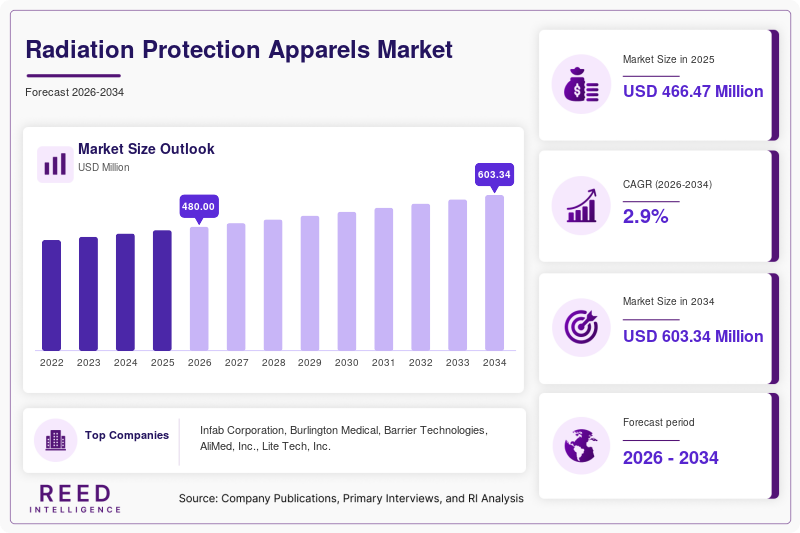
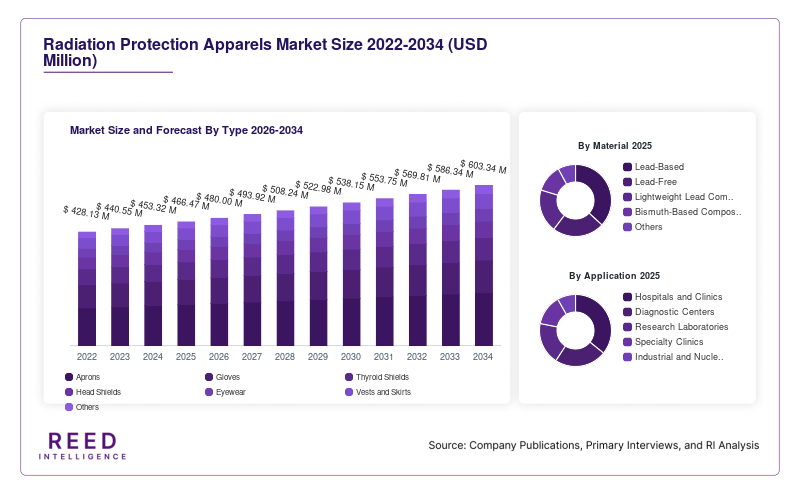
Global Radiation Protection Apparels market size is projected at USD 480 million in 2026 and is expected to hit USD 603.34 million by 2034 with a CAGR of 2.9%. The market is supported by increasing diagnostic imaging volumes, occupational radiation-safety requirements, and demand for lighter and more ergonomic protective garments. Detailed market data, segmentation analysis, production estimates, regional comparisons, and competitive intelligence are increasingly important for manufacturers and healthcare procurement organizations evaluating growth opportunities.
Key takeaways
- North America dominated the global market with an estimated 35% share in 2026, while Asia Pacific is expected to be the fastest-growing regional market at approximately 4.1% CAGR through 2034.
- Aprons represented the largest product category at approximately 48% of 2026 revenue, while gloves and lightweight protective products are gaining adoption in interventional procedures.
- Hospitals and clinics accounted for approximately 57% of global demand in 2026, supported by radiology, cardiology, surgery, and fluoroscopy procedures.
- Lead-free and lightweight composite apparel is among the fastest-growing material categories as healthcare providers prioritize lower garment weight, flexibility, and long-duration wearing comfort.
- India is an emerging high-growth country market, estimated at approximately USD 47 million in 2026 and projected to expand at about 16% CAGR over the medium-to-long term, driven by expansion of diagnostic infrastructure and increasing radiation-safety awareness.
Radiation protection apparels comprise specialized personal protective equipment designed to reduce occupational exposure to ionizing radiation during medical imaging, interventional procedures, nuclear medicine, dental imaging, veterinary applications, and selected industrial activities. Products include aprons, gloves, thyroid shields, head protection, eyewear, vests, skirts, and related accessories manufactured using lead, lead-free composites, and lightweight shielding materials. Global production is estimated at approximately 2.1 million market-equivalent apparel units in 2026, including complete garments and major protective accessories. Healthcare applications represent the majority of consumption, with hospitals and clinics accounting for more than half of total demand. Increasing penetration of fluoroscopy-guided procedures and interventional cardiology is strengthening demand for wraparound and lightweight protective systems.
Radiation Protection Apparels Market Trends
Shift Toward Lightweight and Lead-Free Protection
The market is shifting from conventional heavy lead garments toward lead-free and lightweight composite materials based on bismuth, tungsten, tin, and other shielding formulations. Manufacturers are increasingly combining multilayer shielding structures with ergonomic cuts, improved weight distribution, antimicrobial fabrics, fluid-resistant surfaces, and customized sizing. These developments are particularly relevant to interventional cardiology and radiology professionals who may wear protective apparel for extended periods.
Sector-specific demand is also moving toward integrated radiation-safety systems. Hospitals are increasingly considering apparel alongside ceiling-mounted shields, mobile barriers, suspended protection systems, and digital dose-monitoring technologies. Demand for flexible aprons, vest-and-skirt combinations, thyroid collars, and specialized gloves is therefore increasing as procedure volumes rise and healthcare providers focus on reducing cumulative occupational exposure.
Radiation Protection Apparels Market Drivers
Expansion of Diagnostic and Interventional Imaging
Growing utilization of X-ray, CT, fluoroscopy, interventional cardiology, vascular procedures, and image-guided surgery is a major growth driver. Healthcare professionals working close to radiation sources require protective apparel to minimize occupational exposure, creating recurring replacement and procurement demand. Rising healthcare infrastructure investments in emerging economies further expand the addressable customer base.
Radiation Protection Apparels Market Restraints
High Product Cost and Garment Weight
Conventional lead-based garments can be relatively heavy, costly to transport, and uncomfortable during extended procedures. Repeated use may also contribute to physical fatigue, increasing interest in lightweight alternatives. Higher prices for advanced lead-free and composite products can restrict adoption among smaller hospitals, clinics, and healthcare facilities operating under constrained capital budgets.
Radiation Protection Apparels Market Opportunities
Development of Smart and Ergonomic Protective Apparel
Manufacturers have opportunities to integrate sensor technology, digital inspection records, dose-monitoring capabilities, advanced textiles, and improved ergonomic designs into protective apparel. Customized sizing, antimicrobial materials, fluid-resistant fabrics, and lightweight shielding can create premium product categories. Expansion of diagnostic and interventional healthcare facilities in Asia Pacific, Latin America, and the Middle East also provides significant untapped demand.
Challenges in Radiation Protection Apparels Market
Maintaining Shielding Performance and Product Compliance
Manufacturers must balance radiation attenuation, garment weight, flexibility, durability, and user comfort while maintaining compliance with applicable radiation-safety standards. Product quality can deteriorate when garments are folded, improperly stored, or subjected to repeated mechanical stress. Ensuring consistent shielding performance and educating users about inspection, storage, and replacement requirements remain important industry challenges.
Radiation Protection Apparels Market Segmentation Analysis
By type and application, aprons and hospitals and clinics represent the dominant segments. Aprons accounted for approximately 48% of 2026 market revenue, while hospitals and clinics contributed nearly 57%. Demand for gloves, thyroid shields, lightweight composite garments, diagnostic centers, and research facilities is expected to increase as radiation-intensive procedures and specialized imaging applications expand.
By Type
Aprons represented approximately 48% of global revenue in 2026, making them the largest product segment. Global shipments are estimated at roughly 650,000 equivalent units during the year. Common specifications include 0.25 mm, 0.35 mm, and 0.50 mm lead-equivalent protection, with front, wraparound, vest-and-skirt, and flexible designs available. Hospitals, fluoroscopy suites, dental facilities, and diagnostic centers account for the majority of demand.
Radiation protection gloves represented approximately 14% of revenue, with estimated shipments of around 470,000 pairs in 2026. Products generally emphasize flexibility, tactile sensitivity, and radiation attenuation while minimizing interference with clinical procedures. Demand is strongest in interventional radiology, cardiac catheterization, nuclear medicine, and specialized imaging procedures.
Thyroid shields accounted for approximately 11% of revenue and an estimated 570,000 equivalent units in 2026. They are typically manufactured with lead or lead-free shielding layers and are designed to protect the thyroid from scattered radiation. Increasing awareness of cumulative occupational exposure is encouraging hospitals and imaging centers to include thyroid protection as part of standard protective equipment programs.
By Application
Hospitals and clinics generated approximately 57% of market revenue in 2026, equivalent to about USD 274 million. The segment consumes an estimated 1.25 million apparel and accessory units annually. Radiology, interventional cardiology, surgery, emergency imaging, and oncology-related procedures are the principal demand areas. Large hospitals increasingly favor customized, lightweight, and multi-piece protection systems for different procedure environments.
Diagnostic centers represented approximately 27% of market revenue and an estimated USD 130 million in 2026. These facilities collectively account for roughly 570,000 market-equivalent units annually. X-ray, CT, mammography, and fluoroscopy-related activities generate demand for aprons, thyroid shields, gloves, and protective eyewear. Expansion of private diagnostic networks in developing economies is expected to support above-average growth.
Research laboratories accounted for approximately 16% of revenue in 2026, representing around USD 77 million. Estimated consumption is approximately 280,000 equivalent units. Nuclear research, radiopharmaceutical development, academic imaging programs, and industrial radiation research create specialized demand for protective apparel with application-specific shielding characteristics.
Radiation Protection Apparels Market Regional Analysis
North America Radiation Protection Apparels Market
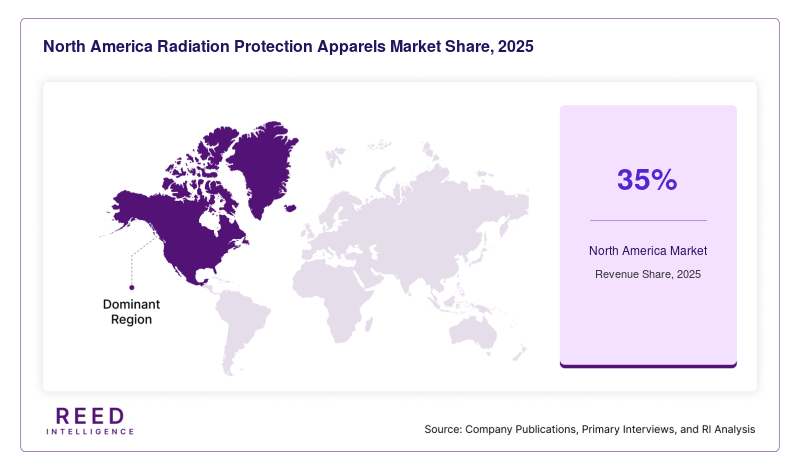
North America held approximately 35% of the global market in 2026. The U.S. contributes the majority of regional revenue through hospitals, cardiovascular centers, imaging facilities, and specialty clinics. Canada provides additional demand through public healthcare infrastructure and diagnostic imaging expansion. The regional market is characterized by high adoption of lightweight aprons, customized protective apparel, and integrated radiation-safety systems.
Europe Radiation Protection Apparels Market
Europe represented approximately 28% of global revenue in 2026, supported by established radiology infrastructure and stringent occupational safety practices. Germany, the U.K., France, and Italy are important contributors. Hospitals and diagnostic imaging centers account for most consumption, while research and nuclear medicine facilities provide specialized demand for gloves, thyroid shields, and advanced composite apparel.
Asia Pacific Radiation Protection Apparels Market
Asia Pacific accounted for approximately 23% of revenue and is expected to be the fastest-growing major region. China, Japan, India, and South Korea are leading contributors. Increasing healthcare expenditure, expansion of private diagnostic networks, rising interventional procedure volumes, and modernization of hospitals are supporting regional demand. India is expected to record particularly strong growth as diagnostic and specialty healthcare capacity expands.
Latin America Radiation Protection Apparels Market
Latin America contributed approximately 8% of global revenue in 2026. Brazil and Mexico represent the largest country markets, supported by hospital modernization and growing private diagnostic services. Demand is concentrated in aprons and thyroid protection, although lightweight composite products are gradually gaining acceptance in higher-end facilities.
Middle East and Africa Radiation Protection Apparels Market
The Middle East and Africa accounted for approximately 6% of global revenue. Gulf countries are major contributors because of investments in advanced hospitals and diagnostic infrastructure, while South Africa represents an important African market. Demand is concentrated in hospitals and diagnostic centers, with future growth supported by healthcare infrastructure development and greater emphasis on occupational radiation safety.
Top Players in the Radiation Protection Apparels Market
- Infab Corporation
- Burlington Medical
- Barrier Technologies
- AliMed, Inc.
- Raysafe
- Lite Tech, Inc.
- Uniray Medical
- Trivitron Healthcare Pvt. Ltd.
- Kiran Medical Systems
- Phillips Safety Products Inc.
- AADCO Medical, Inc.
- RadSafe
- Shielding International
Recent Developments in Radiation Protection Apparels Market
- January 2026: TIDI Products completed the acquisition of Burlington Medical, expanding its healthcare safety portfolio with radiation protection apparel and accessories.
- April 2026: Egg Medical launched EggNest Complete Flex, introducing an apron-free or ultralight-apron approach to radiation protection for interventional clinical environments.
- 2026: INFAB introduced a redesigned 2026 product catalog covering radiation protection aprons, barriers, accessories, and patient-care solutions with expanded digital product information.
- July 2024: Infab Corporation partnered with Smart Textiles to pursue next-generation radiation protection apparel incorporating real-time dose-monitoring capabilities and wireless data transmission.
- May 2024: Barrier Technologies expanded manufacturing capacity through a new Tennessee facility, targeting higher production of lead-free radiation protection equipment and shorter manufacturing lead times.
Radiation Protection Apparels Market Segments
By Type
- Aprons
- Gloves
- Thyroid Shields
- Head Shields
- Eyewear
- Vests and Skirts
- Others
By Material
- Lead-Based
- Lead-Free
- Lightweight Lead Composite
- Bismuth-Based Composite
- Others
By Application
- Hospitals and Clinics
- Diagnostic Centers
- Research Laboratories
- Specialty Clinics
- Industrial and Nuclear Facilities
By Region
- North America
- Europe
- Asia Pacific
- Latin America
- Middle East and Africa
By Region
- North America
- Europe
- APAC
- Middle East and Africa
- LATAM