Radiation Tolerant Microcontroller Market Size, Share & Demand Report By Type (32-Bit Microcontrollers, 64-Bit Microcontrollers, 8/16-Bit Microcontrollers), By Application (Aerospace & Defense, Space Exploration & Satellites, Medical & Scientific Instruments, Nuclear & High-Radiation Facilities), By End-Use Industry (Satellite & Space Applications, Aerospace Electronics, Defense & Military Electronics, Industrial Nuclear Facilities), By Region & Segment Forecasts, 2025–2034
USD 3950
Market Overview
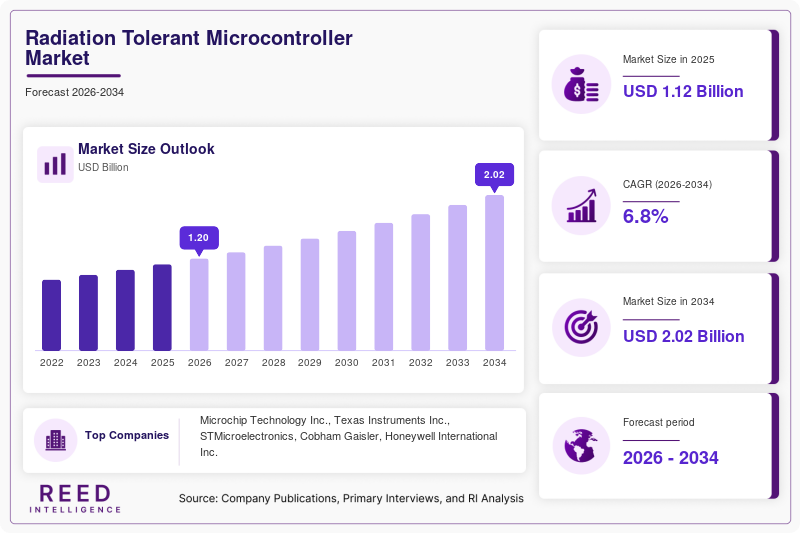
The Radiation Tolerant Microcontroller Market size was valued at USD 1.12 billion in 2024 and is projected to reach USD 2.05 billion by 2033, growing at a CAGR of 6.8% from 2025 to 2034. This growth is primarily driven by the increasing adoption of radiation-hardened microcontrollers in aerospace, defense, and space exploration applications, where exposure to high levels of ionizing radiation is common. The market is also supported by rising demand for reliable and long-lasting embedded systems capable of functioning in extreme conditions, including satellites, deep-space missions, and nuclear energy plants.
One global factor fueling market growth is the surge in space exploration and satellite deployment programs across the globe. Governments and private companies are investing heavily in launching advanced satellites for communication, earth observation, and navigation. These missions require microcontrollers that can withstand cosmic radiation and maintain operational integrity over extended durations, driving demand for radiation-tolerant microcontrollers. Additionally, technological advancements in microcontroller architecture, coupled with improvements in semiconductor manufacturing processes, have improved performance efficiency while ensuring radiation resilience.
Key Highlights
- North America dominated the market with 38.5% share in 2025, while Asia Pacific is projected to register the fastest CAGR of 7.4% during 2025–2034.
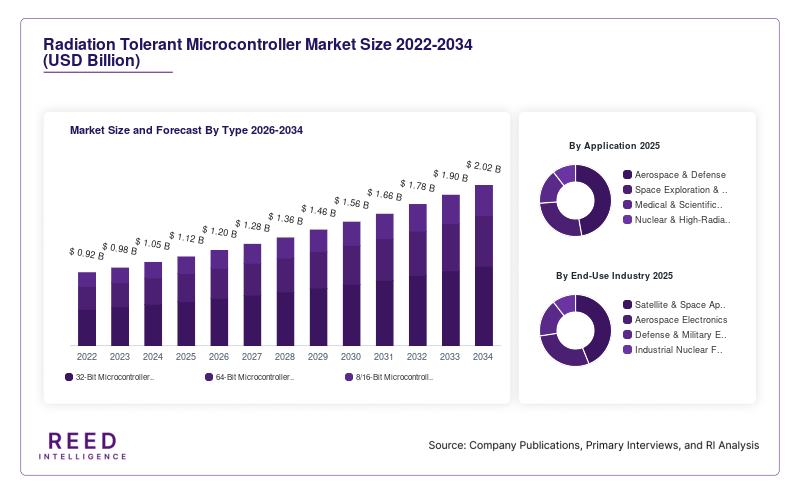
- By Type, 32-bit microcontrollers led the market in 2024, while 64-bit microcontrollers are expected to grow at a CAGR of 7.8%.
- By Application, Aerospace & Defense held the largest share in 2024, while Space Exploration & Satellites will see the fastest growth at 8.1% CAGR.
- United States was the dominant country, with market values of USD 435 million in 2024 and USD 465 million in 2025.
Market Trends
Miniaturization of Radiation-Hardened Components
Microcontrollers are increasingly being designed with smaller footprints and lower power consumption without compromising performance in radiation-heavy environments. This trend is driven by the need to reduce payload weight and energy requirements in satellites and spacecraft. As more nanosatellites and CubeSats enter deployment pipelines, radiation-tolerant microcontrollers are being optimized for compactness while maintaining operational reliability, driving market adoption.
Integration with Advanced IoT and AI Systems
Radiation-tolerant microcontrollers are now being integrated with AI algorithms and IoT-enabled telemetry systems for autonomous spacecraft operations and real-time data analytics. This trend enables precise control, predictive maintenance, and enhanced system reliability in harsh environments. The integration of microcontrollers with smart systems supports the increasing complexity of aerospace and defense electronics, influencing market expansion.
Market Drivers
Growth in Satellite and Space Exploration Programs
The surge in satellite launches and space exploration projects globally is a key driver of the Radiation Tolerant Microcontroller Market size. Microcontrollers designed to endure cosmic and solar radiation are essential for satellite onboard systems, navigation control, and data handling. Government-funded programs and private sector initiatives, including commercial satellite constellations, are driving the adoption of these specialized components.
Rising Demand in Aerospace and Defense Applications
Aerospace and defense sectors require highly reliable electronic systems that maintain performance under high-radiation environments. Radiation-tolerant microcontrollers are increasingly incorporated into avionics, missile guidance systems, and military-grade electronics. As defense modernization programs expand and avionics technology evolves, the demand for radiation-resilient microcontrollers grows steadily, supporting market development.
Market Restraint
High Manufacturing Costs
One of the primary restraints for the Radiation Tolerant Microcontroller Marketis the high cost of producing radiation-hardened components. Specialized fabrication processes, rigorous testing, and strict quality assurance requirements increase production expenses. These higher costs limit widespread adoption in cost-sensitive applications, particularly in commercial electronics where radiation tolerance is not critical.
Market Opportunities
Expansion in CubeSat and Nanosatellite Missions
The growing number of CubeSat and nanosatellite deployments presents a significant opportunity for radiation-tolerant microcontrollers. These satellites operate in space for scientific, commercial, and military purposes, and require compact, low-power, and radiation-resilient microcontrollers. Manufacturers can target small satellite developers with tailored solutions to capture emerging demand.
Adoption in Nuclear Energy and High-Radiation Facilities
Radiation-tolerant microcontrollers are increasingly used in nuclear reactors and high-radiation industrial facilities to monitor critical systems safely. With ongoing expansion of nuclear energy plants worldwide and upgrades to existing facilities, there is an opportunity for microcontroller suppliers to provide robust, radiation-hardened control solutions for industrial automation, safety monitoring, and process optimization.
Segmental Analysis
By Type
32-bit microcontrollers dominated the Radiation Tolerant Microcontroller Market sharein 2024, accounting for 52.4% of revenue. Their balanced performance, moderate power consumption, and proven radiation tolerance made them suitable for a wide range of aerospace and defense applications.
64-bit microcontrollers are projected to grow at a CAGR of 7.8% during 2025–2034. These microcontrollers support high-performance computation and advanced AI-enabled mission control tasks in satellites and spacecraft. As satellite electronics become more sophisticated, the demand for 64-bit radiation-hardened solutions will increase.
By Application
Aerospace & Defense held 44.7% share in 2024. Microcontrollers in avionics, military-grade electronics, and defense satellites are required to operate reliably under radiation exposure.
The Space Exploration & Satellites segment is expected to grow at 8.1% CAGR. Increasing satellite launches, deep-space exploration missions, and small satellite programs will drive adoption of radiation-tolerant microcontrollers designed for long-duration, high-radiation environments.
By End-Use Industry
Satellite and space applications accounted for 41.3% share in 2024. Microcontrollers in satellites are critical for telemetry, navigation, and payload management, where radiation resistance is essential.
The nuclear and high-radiation facility segment will expand at 7.5% CAGR. Radiation-tolerant microcontrollers are increasingly deployed in monitoring and control systems to ensure safety and operational efficiency.
Regional Analysis
North America
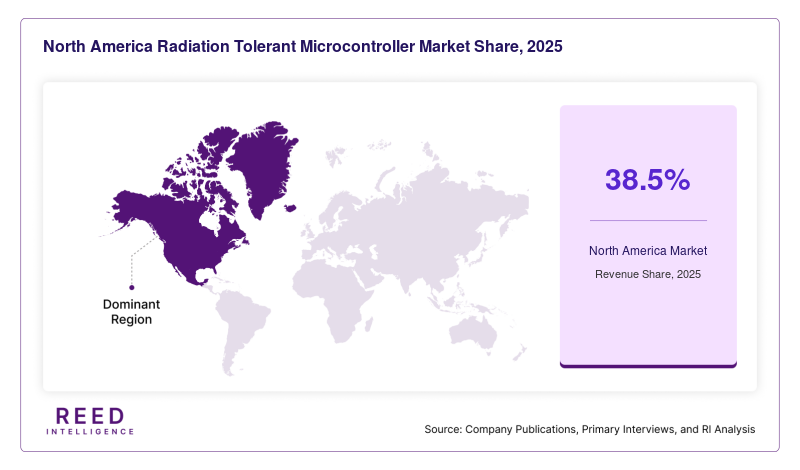
North America accounted for 38.5% of the global Radiation Tolerant Microcontroller Market share in 2025. The region demonstrated stable growth due to advanced aerospace infrastructure and strong government funding for space exploration programs. The market is projected to grow at a CAGR of 6.3% from 2025 to 2034.
The United Stateswas the dominant country. One factor contributing to growth is the presence of major aerospace manufacturers and defense contractors investing heavily in radiation-tolerant microcontroller development. Continuous R&D and partnerships with government agencies, including NASA and the Department of Defense, enhance the deployment of advanced microcontrollers in space and military applications.
Europe
Europe held 24.1% share of the market in 2025. The region exhibited stable growth supported by its aerospace and defense sectors. The market will expand at a CAGR of 5.9% through 2034.
Franceemerged as the dominant country in Europe. The French space agency (CNES) and aerospace firms are developing next-generation satellites and radiation-hardened electronics. These initiatives drive regional demand for radiation-tolerant microcontrollers capable of handling long-duration missions and harsh radiation environments.
Asia Pacific
Asia Pacific represented 21.7% of the global market in 2025. Rapid industrialization and the emergence of domestic aerospace programs contributed to regional growth. The market will grow at a CAGR of 7.4% during 2025–2034.
Chinadominated the regional market. Government-backed space programs, including satellite constellations and lunar exploration missions, are driving the adoption of radiation-tolerant microcontrollers. Domestic manufacturers are investing in R&D to produce high-reliability components that can compete with international suppliers.
Middle East & Africa
The Middle East & Africa accounted for 7.3% share in 2025. Moderate growth was supported by increasing defense procurement and space exploration collaborations. The market is expected to expand at a CAGR of 6.1% through 2034.
United Arab Emiratesled the region, with space exploration initiatives such as Mars probes and satellite deployments. Partnerships with global aerospace firms encourage local adoption of radiation-hardened microcontrollers for mission-critical systems.
Latin America
Latin America held 8.4% share of the market in 2025. Growth has been gradual but steady, driven by aerospace modernization and defense electronics demand. The market will grow at a CAGR of 6.6% during 2025–2034.
Brazildominated the regional market. Investment in satellite development, avionics upgrades, and national defense electronics programs support demand for radiation-tolerant microcontrollers. Collaborative projects with international aerospace firms further strengthen market potential.
Competitive Landscape
The Radiation Tolerant Microcontroller Marketis moderately consolidated, with several global semiconductor and electronics firms supplying high-reliability components.
Microchip Technology Inc.is a leading player, recently launching a new series of 64-bit radiation-hardened microcontrollers for satellite applications. Other key players such as Texas Instruments, STMicroelectronics, Cobham Gaisler, and Honeywell focus on R&D, strategic partnerships, and product innovation to strengthen their presence in aerospace, defense, and space applications.
Key Players List
- Microchip Technology Inc.
- Texas Instruments Inc.
- STMicroelectronics
- Cobham Gaisler
- Honeywell International Inc.
- Northrop Grumman Corporation
- Analog Devices, Inc.
- NXP Semiconductors
- Infineon Technologies AG
- Renesas Electronics Corporation
- Maxim Integrated
- Mitsubishi Electric Corporation
- Rockwell Collins (Collins Aerospace)
- GlobalFoundries Inc.
- Aeroflex Incorporated
Recent Developments
- 2024: Microchip Technology launched a new 64-bit radiation-hardened microcontroller optimized for small satellite platforms.
- 2023: STMicroelectronics expanded its aerospace-grade microcontroller production facility to support space applications.
- 2023: Honeywell introduced advanced radiation-tolerant microcontrollers for defense electronics with improved energy efficiency.
- 2022: Cobham Gaisler released a new RISC-V radiation-hardened microcontroller series for deep-space missions.
- 2022: Texas Instruments collaborated with a European space agency to supply radiation-tolerant microcontrollers for satellite constellations.
Radiation Tolerant Microcontroller Market Segments
By Type
- 32-Bit Microcontrollers
- 64-Bit Microcontrollers
- 8/16-Bit Microcontrollers
By Application
- Aerospace & Defense
- Space Exploration & Satellites
- Medical & Scientific Instruments
- Nuclear & High-Radiation Facilities
By End-Use Industry
- Satellite & Space Applications
- Aerospace Electronics
- Defense & Military Electronics
- Industrial Nuclear Facilities
By Region
- North America
- Europe
- APAC
- Middle East and Africa
- LATAM