Radio Direction Finder Market Size, Share & Demand Report By Type (Fixed, Portable), By Application (Aviation, Maritime, Search and Rescue, Military), By End-Use (Defense, Commercial) By Region & Segment Forecasts, 2025–2034
USD 3950
Market Overview
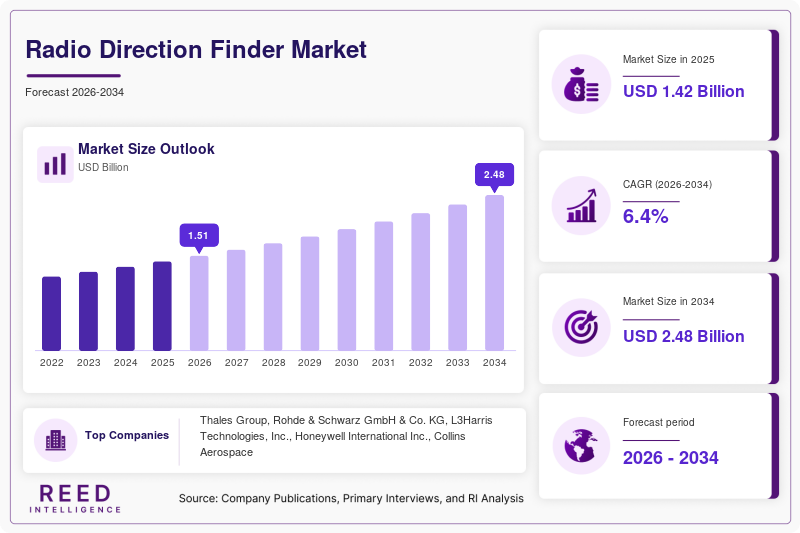
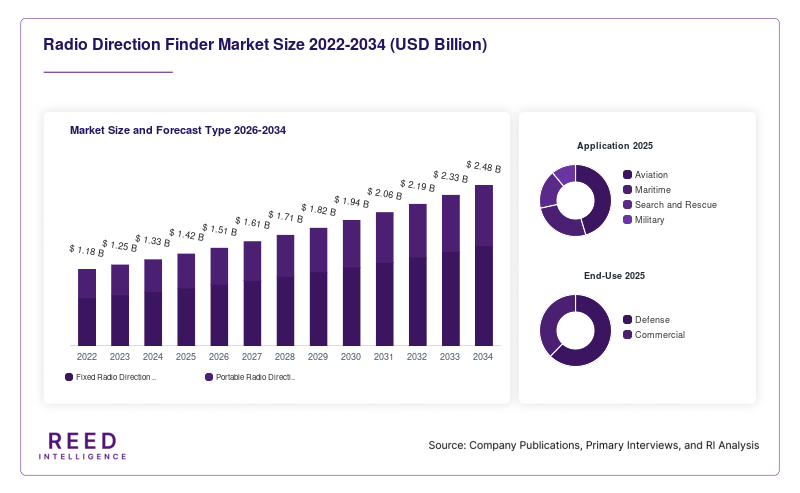
The Radio Direction Finder Market size was estimated at USD 1.42 billion in 2025 and is projected to reach USD 1.51 billion in 2026. Over the forecast period, the market is expected to attain approximately USD 2.48 billion by 2034, registering a compound annual growth rate (CAGR) of 6.4% from 2025 to 2034.
Radio direction finders are essential tools used to determine the direction of radio signal sources. These systems play a key role in aviation navigation, military surveillance, search and rescue operations, and maritime communication. The steady rise in global air traffic and maritime trade is contributing to the demand for reliable navigation aids. Furthermore, the integration of digital signal processing and software-defined radio technologies is improving system accuracy and efficiency, encouraging adoption across sectors.
Key Highlights
- Market size reached USD 1.42 billion in 2025, reflecting steady demand across aviation, defense, and maritime sectors. The market continues to expand as global investments in navigation and communication technologies increase.
- The market is expected to grow at a CAGR of 6.4% from 2025 to 2034, supported by ongoing modernization of infrastructure. Consistent technological advancements are also contributing to long-term growth.
- Aviation and defense sectors remain the primary demand drivers due to their reliance on accurate signal tracking and navigation systems. Increasing safety requirements and security concerns are further boosting adoption.
- There is a rising adoption of digital and software-defined systems, which offer improved accuracy and efficiency. These advanced technologies are replacing traditional analog solutions across multiple industries.
Market Trends
Integration of Digital Signal Processing Technologies
A significant trend shaping the Radio Direction Finder Market is the integration of digital signal processing (DSP) technologies. Traditional analog systems are being replaced by digital solutions that offer higher accuracy, better noise filtering, and improved signal resolution. DSP-enabled direction finders can process multiple frequencies simultaneously, making them more efficient for complex applications such as military intelligence and air traffic management. These systems also support automated calibration and real-time data analysis, which reduces operational errors. As industries demand precise and reliable signal detection, manufacturers are increasingly investing in digital transformation, making DSP a central component of next-generation radio direction finder systems.
Growing Adoption of Portable and Mobile RDF Systems
Another emerging trend is the increasing demand for portable and mobile radio direction finder systems. These compact solutions are widely used in search and rescue operations, law enforcement, and field-based military missions. Portable RDF systems offer flexibility and ease of deployment in remote or challenging environments where fixed installations are not feasible. Advancements in battery technology and miniaturization of components have enabled manufacturers to design lightweight devices without compromising performance. Additionally, mobile systems integrated with GPS and mapping software provide real-time tracking capabilities, enhancing situational awareness. This trend is expected to continue as operational mobility becomes a priority across multiple end-use sectors.
Market Drivers
Rising Defense and Security Investments
The increasing allocation of budgets toward defense and security infrastructure is a key driver for the Radio Direction Finder Market. Governments worldwide are prioritizing surveillance and intelligence capabilities to address evolving security threats. Radio direction finders are widely used for signal interception, electronic warfare, and border monitoring. The demand for advanced systems capable of detecting and locating unauthorized transmissions is growing rapidly. Additionally, modernization programs in military communication systems are encouraging the adoption of advanced RDF technologies. As geopolitical tensions continue to influence defense spending, the market is expected to benefit from sustained investments in secure and reliable signal detection systems.
Expansion of Aviation and Maritime Navigation Systems
The expansion of global aviation and maritime industries is another major driver of market growth. Increasing passenger traffic and cargo transportation are leading to the development of new airports and seaports, particularly in developing regions. Radio direction finders play a crucial role in ensuring safe navigation and communication in these sectors. In aviation, RDF systems are used as backup navigation aids, while in maritime operations, they help in locating distress signals and guiding vessels. Regulatory bodies are also emphasizing the importance of reliable navigation equipment, further boosting demand. This consistent expansion is expected to support long-term growth in the market.
Market Restraint
High Cost of Advanced RDF Systems
One of the key restraints affecting the Radio Direction Finder Market is the high cost associated with advanced systems. Modern RDF equipment that incorporates digital technologies, automation, and multi-frequency capabilities requires significant investment in research, development, and manufacturing. This results in higher pricing, which can limit adoption among small and medium-sized organizations. Additionally, the cost of installation, maintenance, and training further adds to the overall expenditure. For example, upgrading legacy systems in smaller airports or maritime vessels can be financially challenging, leading to delayed adoption. This cost barrier may slow market penetration in price-sensitive regions and industries.
Market Opportunities
Growth in Search and Rescue Operations
The increasing focus on search and rescue operations presents a strong opportunity for the Radio Direction Finder Market. Natural disasters, aviation incidents, and maritime emergencies require efficient location tracking systems to ensure timely response. RDF systems are widely used to locate emergency beacons and distress signals. Governments and international organizations are investing in advanced rescue infrastructure, including portable and mobile direction finders. The integration of RDF systems with satellite communication and GPS technologies further enhances their effectiveness. As disaster management capabilities continue to improve, the demand for reliable direction-finding solutions is expected to grow significantly.
Adoption in Emerging Markets
Emerging economies present significant growth opportunities due to increasing investments in infrastructure and defense modernization. Countries in Asia Pacific, Latin America, and Africa are expanding their aviation and maritime sectors, creating demand for navigation and communication systems. Additionally, governments in these regions are focusing on strengthening border security and surveillance capabilities. The adoption of cost-effective and scalable RDF solutions is expected to rise as manufacturers tailor products to meet regional requirements. This growing demand, combined with favorable economic conditions, is likely to drive market expansion in emerging regions over the forecast period.
Segmental Analysis
By Type
The fixed radio direction finder segment dominated the market in 2024, accounting for approximately 58% of the total share. These systems are widely used in airports, naval bases, and communication stations due to their high accuracy and reliability. Fixed RDF systems provide continuous monitoring and are capable of handling multiple signals simultaneously, making them suitable for large-scale operations. Their integration with existing infrastructure further enhances their efficiency. As industries prioritize stable and long-term solutions, the demand for fixed systems remains strong across key sectors.
The portable radio direction finder segment is expected to witness the fastest growth, with a CAGR of 7.5% during the forecast period. The increasing demand for mobility and flexibility in operations is driving the adoption of portable systems. These devices are widely used in field operations, including search and rescue missions and military applications. Their lightweight design and ease of deployment make them ideal for remote locations. Additionally, advancements in battery technology and wireless communication are enhancing their performance, further supporting segment growth.
By Application
The aviation segment held the largest market share in 2024, accounting for approximately 45% of total revenue. Radio direction finders are essential in aviation for navigation, communication, and safety purposes. They are used as backup systems to ensure accurate positioning, especially in areas with limited GPS coverage. The increasing number of flights and airport expansions are contributing to the dominance of this segment. Regulatory requirements for safety equipment further support the widespread adoption of RDF systems in aviation.
The search and rescue segment is expected to grow at the fastest rate, with a CAGR of 7.2% over the forecast period. The rising number of natural disasters and emergency situations is driving the demand for efficient location tracking systems. RDF systems play a crucial role in detecting distress signals and locating individuals in need of assistance. The integration of advanced technologies such as GPS and satellite communication enhances their effectiveness, making them indispensable in rescue operations.
By End-Use
The defense sector dominated the market in 2024, holding a share of approximately 50%. Radio direction finders are widely used in military applications for signal intelligence, surveillance, and electronic warfare. The need for secure and reliable communication systems is driving the adoption of advanced RDF technologies. Governments are investing heavily in defense modernization programs, further supporting the growth of this segment. The ability of RDF systems to detect and locate enemy signals makes them a critical component of military operations.
The commercial sector is projected to grow at the fastest rate, with a CAGR of 6.9% during the forecast period. The expansion of aviation and maritime industries is driving demand for RDF systems in commercial applications. Airlines and shipping companies are increasingly adopting advanced navigation systems to ensure safety and efficiency. Additionally, the growing focus on regulatory compliance is encouraging the use of reliable communication and tracking solutions, further boosting segment growth.
Regional Analysis
North America
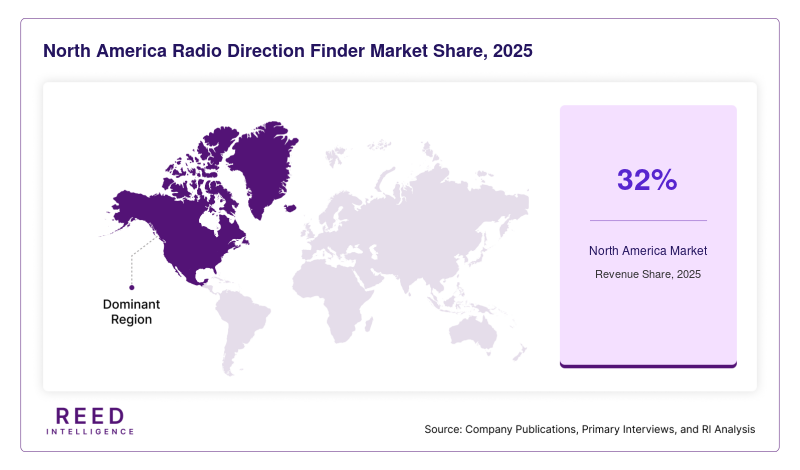
North America accounted for a substantial share of the Radio Direction Finder Market in 2025, contributing approximately 32% of global revenue. The region is expected to maintain steady growth with a CAGR of around 5.8% during the forecast period. Strong investments in defense and aerospace sectors are supporting market expansion. The presence of established manufacturers and advanced technological infrastructure also contributes to the region’s leadership position in the market.
The United States dominates the North American market due to its extensive defense spending and advanced aviation industry. A key growth factor is the increasing adoption of RDF systems in military surveillance and homeland security operations. The focus on modernizing communication and navigation systems further strengthens demand, ensuring continued growth in the region.
Europe
Europe held a significant market share of approximately 25% in 2025 and is expected to grow at a CAGR of 5.6% through 2034. The region benefits from strong regulatory frameworks that emphasize maritime and aviation safety. Investments in upgrading navigation infrastructure are also contributing to market growth, particularly in Western European countries.
Germany is a leading market within Europe, driven by its advanced manufacturing sector and strong focus on technological innovation. A unique growth factor is the increasing adoption of RDF systems in maritime applications, supported by stringent safety regulations. This trend is expected to drive consistent demand across the region.
Asia Pacific
Asia Pacific is the fastest-growing region, with a market share of around 22% in 2025 and a projected CAGR of 7.8%. Rapid economic development and increasing investments in aviation and defense sectors are fueling market growth. The expansion of infrastructure projects further supports demand for advanced navigation systems.
China leads the regional market due to its large-scale investments in defense and transportation infrastructure. A key growth factor is the rapid expansion of airport construction projects, which require reliable navigation systems. This trend is expected to significantly boost market growth in the region.
Middle East & Africa
The Middle East & Africa region accounted for approximately 11% of the market in 2025 and is expected to grow at a CAGR of 6.2%. Increasing investments in aviation infrastructure and defense systems are driving demand for radio direction finders. The region is also focusing on enhancing maritime safety.
Saudi Arabia dominates the market in this region, supported by its strong defense spending and infrastructure development initiatives. A unique growth factor is the modernization of air traffic management systems, which is increasing the adoption of advanced RDF technologies.
Latin America
Latin America held a market share of about 10% in 2025 and is projected to grow at a CAGR of 6.0%. The region is witnessing steady growth due to improvements in aviation and maritime sectors. Government initiatives aimed at enhancing transportation infrastructure are supporting market expansion.
Brazil is the leading country in the region, driven by its large aviation network and growing defense sector. A key growth factor is the increasing investment in airport modernization projects, which is boosting demand for navigation and communication systems.
Competitive Landscape
The Radio Direction Finder Market is moderately competitive, with several established players focusing on technological innovation and strategic partnerships. Companies are investing in research and development to enhance product performance and expand their market presence. The market leader is recognized for its strong portfolio of advanced RDF systems and global distribution network.
One of the leading companies is Thales Group, which has introduced advanced digital direction-finding systems for defense and aviation applications. Recent developments include the launch of integrated solutions that combine RDF capabilities with real-time data analytics. Other major players are also focusing on expanding their product offerings and entering new markets to strengthen their competitive position.
Key Players
- Thales Group
- Rohde & Schwarz GmbH & Co. KG
- L3Harris Technologies, Inc.
- Honeywell International Inc.
- Collins Aerospace
- Leonardo S.p.A.
- Saab AB
- Rockwell Collins
- Raytheon Technologies Corporation
- Garmin Ltd.
- TCI International, Inc.
- Taiyo Corporation
- Skanti A/S
- Aeroflex Limited
- Koden Electronics Co., Ltd.
Recent Developments
- A major industry player launched a new digital radio direction finder system with enhanced multi-frequency tracking capabilities in 2024.
- A defense technology company secured a contract to supply advanced RDF systems for military surveillance applications in 2025.
- A leading manufacturer introduced portable RDF devices integrated with GPS and real-time mapping software to improve search and rescue operations.
Radio Direction Finder Market Segments
Type
- Fixed Radio Direction Finder
- Portable Radio Direction Finder
Application
- Aviation
- Maritime
- Search and Rescue
- Military
End-Use
- Defense
- Commercial
Region
- North America
- Europe
- Asia Pacific
- Middle East & Africa
- Latin America
By Region
- North America
- Europe
- APAC
- Middle East and Africa
- LATAM