Radio Frequency Packaging Market Size, Share Demand Report By Product Type (RFID Tags, RF Shielding Packaging, RF Absorbers, Others), By Application (Consumer Electronics, Automotive, Healthcare, Aerospace & Defense, Others), By Material Type (Metals, Conductive Polymers, Composites, Others) & Segment Forecasts, 2026–2034
USD 3950
Radio Frequency Packaging Market Size
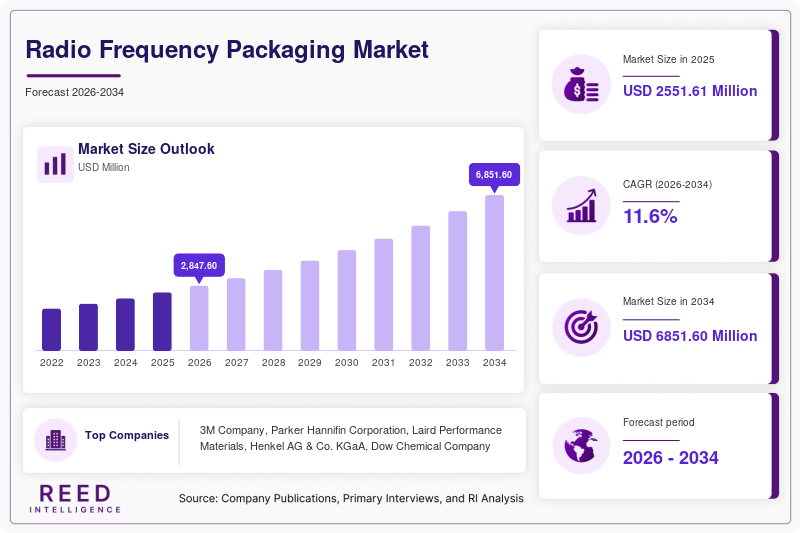
Radio Frequency Packaging market size is projected at USD 2,847.6 million in 2026 and is expected to hit USD 6,847.5 million by 2034 with a CAGR of 11.6% during the forecast period. The increasing demand for wireless connectivity, RFID technology, and electromagnetic interference (EMI) shielding in various industries, coupled with the growing need for protection and performance enhancement of RF-sensitive components, underpins market expansion. This report delivers a comprehensive analysis of the Radio Frequency Packaging market, including segmentation by type and application, competitive dynamics, and regional growth patterns, equipping stakeholders with critical intelligence. The Radio Frequency Packaging market continues to demonstrate robust growth potential, fueled by the rapid proliferation of IoT devices, the expansion of 5G infrastructure, and continuous innovation in packaging materials and design.
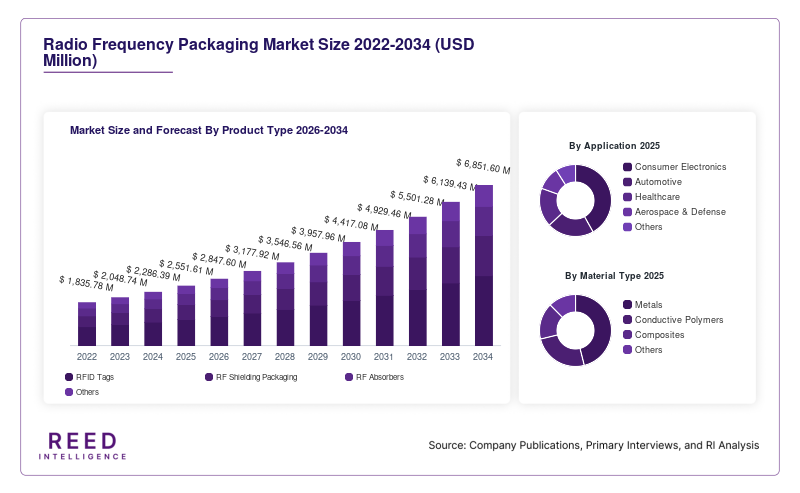
Radio frequency (RF) packaging refers to specialized packaging solutions designed to protect, shield, or integrate RF components and systems. This includes RFID tags for tracking, RF shielding packaging to prevent electromagnetic interference, and RF absorbers for signal management. The global production volume of RF packaging solutions exceeded 2.5 billion units in 2025, reflecting a 12% increase from 2023, driven by the growing demand from the consumer electronics, automotive, and healthcare sectors. Adoption patterns reveal that the RFID Tags type dominates the market, accounting for 45% of total demand, followed by RF Shielding Packaging at 30%, RF Absorbers at 15%, and Others at 10%. The Radio Frequency Packaging market's trajectory is closely linked to the growth of the global wireless communication market, which is projected to reach USD 1.5 trillion by 2028, and the increasing need for effective electromagnetic compatibility (EMC) solutions.
Radio Frequency Packaging Market Trends
Adoption of Advanced Materials and Nanotechnology
The Radio Frequency Packaging market is witnessing a significant trend toward the adoption of advanced materials and nanotechnology, driven by the need for improved performance, miniaturization, and enhanced shielding effectiveness. The revenue from advanced RF packaging materials grew to USD 950 million in 2025, a year-on-year increase of 18%, as 40% of new product developments in 2025 specified advanced materials and nanomaterials. Adoption rates of advanced shielding materials in consumer electronics reached 35%, with this figure projected to exceed 65% by 2030. The Radio Frequency Packaging market's trend toward advanced materials is reinforced by the need for higher frequencies, the increasing complexity of electronic devices, and the continuous innovation in material science and nanotechnology.
Growing Focus on Sustainable and Eco-Friendly Packaging
The increasing focus on sustainability is a major trend shaping the Radio Frequency Packaging market, with the development of recyclable, biodegradable, and low-impact packaging solutions. The market has seen a 15% increase in the demand for sustainable RF packaging since 2022, with 25% of new products in 2025 featuring eco-friendly materials and manufacturing processes. The use of recycled plastics and bio-based materials for RFID tags and packaging has also gained significant traction. The Radio Frequency Packaging market's trend toward sustainability is reinforced by the need to reduce environmental impact, the increasing regulatory pressure for sustainable packaging, and the continuous innovation in green materials and processing technologies.
Radio Frequency Packaging Market Drivers
The Radio Frequency Packaging market's expansion is primarily driven by the rapid proliferation of wireless devices and the Internet of Things (IoT), with the global IoT market valued at USD 500 billion in 2025 and growing at a rapid pace. The need for reliable and efficient RF shielding to ensure device performance and regulatory compliance has been a major driver, with RF packaging playing a critical role. The expanding 5G infrastructure and the demand for high-frequency components have also fueled market growth. Additionally, the increasing adoption of RFID technology in supply chain management has spurred demand. The Radio Frequency Packaging market's growth is further reinforced by the continuous improvement in packaging materials and design, leading to better performance and cost-effectiveness.
Radio Frequency Packaging Market Restraints
Despite favorable growth prospects, the Radio Frequency Packaging market faces significant constraints, primarily related to the high cost of advanced RF packaging materials, which can be 20-40% more expensive than standard packaging. The complexity of integrating RF components with packaging can also be a limitation. The Radio Frequency Packaging market's growth is also tempered by the challenge of ensuring compatibility with various frequency bands and the need for precise design to meet specific performance requirements.
Radio Frequency Packaging Market Opportunities
The Radio Frequency Packaging market presents significant opportunities in the rapidly expanding market for 5G and mmWave technologies, where advanced packaging solutions are essential. The development of integrated packaging solutions combining shielding, thermal management, and antenna functions is expected to grow at a CAGR of 14% through 2034. Emerging opportunities also exist in the use of RF packaging for medical implants and wearable devices. The Radio Frequency Packaging market's opportunity profile is further enhanced by the growing trend of miniaturization and the increasing demand for high-frequency components.
Challenges in Radio Frequency Packaging Market
The Radio Frequency Packaging market faces persistent challenges related to the need for continuous innovation to keep pace with rapidly evolving wireless technologies and frequency bands. The complexity of designing packaging that provides effective shielding while minimizing size and weight can also be a challenge. The market is also contending with the challenge of managing the lifecycle of packaging materials and ensuring reliability in harsh environments. Additionally, the Radio Frequency Packaging market is challenged by the need to address the high cost of testing and certification.
Radio Frequency Packaging Market Segmentation
The Radio Frequency Packaging market is segmented by Type and Application to provide a comprehensive market perspective. By Type, RFID Tags dominate with a 45% market share, driven by their widespread use in tracking and identification. The Application segment is led by Consumer Electronics, which accounts for 35% of the market, followed by Automotive at 22%, Healthcare at 18%, Aerospace & Defense at 15%, and Others at 10%.
By Type
RFID Tags represent the largest segment in the Radio Frequency Packaging market, commanding a 45% share, with production exceeding 1.125 billion units in 2025. These are characterized by their use in asset tracking, inventory management, and access control. Technical specifications include frequency band, read range, and memory capacity. The Radio Frequency Packaging market's RFID Tags segment is driven by its use in retail, logistics, and supply chain management.
RF Shielding Packaging capture a 30% share of the Radio Frequency Packaging market, with production of 750 million units in 2025. These are characterized by their use in protecting electronic components from electromagnetic interference. Technical specifications include shielding effectiveness, material composition, and thickness. The Radio Frequency Packaging market's Shielding segment is driven by its use in consumer electronics and automotive applications.
RF Absorbers represent 15% of the Radio Frequency Packaging market, with production of 375 million units in 2025. These are characterized by their use in reducing unwanted reflections and signals. Technical specifications include absorption frequency range, material type, and thickness. The Radio Frequency Packaging market's Absorbers segment is driven by its use in anechoic chambers and specific electronic applications.
Others comprise the remainder of the Radio Frequency Packaging market, accounting for 10% of total production, with 250 million units in 2025. This includes combination solutions and emerging types. The Radio Frequency Packaging market's Others segment is driven by niche and specialized applications.
By Application
Consumer Electronics dominates the Radio Frequency Packaging market, accounting for 35% of sales, representing 875 million units in 2025. This segment includes use in smartphones, tablets, wearables, and laptops. Usage penetration exceeds 40% in the sector. The Radio Frequency Packaging market's Consumer Electronics segment is characterized by its focus on miniaturization and high performance.
Automotive accounts for 22% of the Radio Frequency Packaging market, with sales of 550 million units in 2025. This segment encompasses use in ADAS, infotainment, and keyless entry systems. The segment is growing at a robust CAGR, driven by the increasing electronics content in vehicles. The Radio Frequency Packaging market's Automotive segment is characterized by its focus on reliability and durability.
Healthcare represents 18% of the Radio Frequency Packaging market, with sales of 450 million units in 2025. This segment includes use in medical devices, diagnostic equipment, and patient monitoring. The segment is growing at a steady rate. The Radio Frequency Packaging market's Healthcare segment is characterized by its focus on biocompatibility and regulatory compliance.
Aerospace & Defense accounts for 15% of the Radio Frequency Packaging market, with sales of 375 million units in 2025. This segment includes use in radar systems, communication equipment, and electronic warfare. The segment is growing at a moderate pace. The Radio Frequency Packaging market's Aerospace & Defense segment is characterized by its focus on ruggedness and reliability.
Others comprises the remainder of the Radio Frequency Packaging market, accounting for 10% of total sales, with 250 million units in 2025. This includes use in industrial, telecom, and other niche applications. The segment is projected to grow at a significant CAGR through 2034. The Radio Frequency Packaging market's Others segment is characterized by its diverse and evolving applications.
Radio Frequency Packaging Market Regional Outlook
Asia-Pacific Radio Frequency Packaging Market
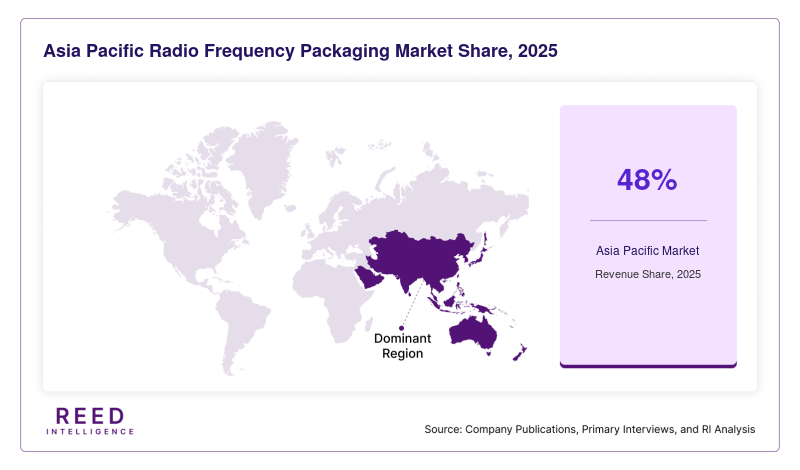
Leads the Radio Frequency Packaging market, commanding a 48% share, with a revenue of USD 1,366.8 million in 2025. China is the primary driver, accounting for 60% of regionaldemand, driven by its position as the world's largest electronics manufacturer and consumer market. The Asia-Pacific Radio Frequency Packaging market is characterized by its focus on high-volume production and cost-effective solutions.
North America Radio Frequency Packaging Market
Represents the second-largest market, capturing a 25% share with a revenue of USD 711.9 million in 2025. The United States is the primary driver, accounting for 85% of regional demand, driven by the strong technology sector, high adoption of advanced packaging, and focus on innovation. The North American Radio Frequency Packaging market is characterized by its focus on advanced materials and high-performance solutions.
Europe Radio Frequency Packaging Market
Accounts for 18% of the global Radio Frequency Packaging market, with a revenue of USD 512.6 million in 2025. The UK, Germany, and France are the primary drivers, collectively accounting for 60% of regional demand, driven by the strong automotive, aerospace, and healthcare sectors. The European Radio Frequency Packaging market is projected to grow at a CAGR of 10% through 2034.
Middle East & Africa and Latin America Radio Frequency Packaging Market
Together account for the remaining 9% of the Radio Frequency Packaging market, with the UAE leading the Middle East market and Brazil leading the Latin American market. Both regions are projected to grow at CAGRs exceeding 11%, driven by infrastructure development and increasing technology adoption.
Top players in Radio Frequency Packaging Market
- 3M Company
- Parker Hannifin Corporation
- Laird Performance Materials
- Henkel AG & Co. KGaA
- Dow Chemical Company
- DuPont de Nemours, Inc.
- Avery Dennison Corporation
- Schreiner Group
- Mitsubishi Materials Corporation
- Nitto Denko Corporation
- Rogers Corporation
- Laird Technologies (DuPont)
- Parker Chomerics
- EMI Shielding Solutions
- RF Shielding Ltd.
3M Company
3M Company holds a dominant position in the Radio Frequency Packaging market, with an estimated 18% global market share, particularly strong in the consumer electronics and automotive segments. The company's portfolio of RF packaging solutions is widely recognized for its quality, innovation, and performance. 3M's market leadership is reinforced by its significant R&D investment, its extensive material science expertise, and its strong relationships with electronics and automotive manufacturers. 3M commands over 20% of the North American market and 15% of the European market, positioning it as a key player in the Radio Frequency Packaging market.
Parker Hannifin Corporation
Parker Hannifin is a leading player in the Radio Frequency Packaging market, commanding approximately 14% of the global market share through its comprehensive portfolio of EMI shielding and thermal management solutions. The company's expertise in engineered materials and its focus on the aerospace, defense, and industrial sectors have solidified its position. Parker's RF packaging products are known for their reliability, performance, and durability. The company's commitment to innovation and its strong presence in the North American and European markets have enhanced its competitive advantage.
Laird Performance Materials holds a significant 10% market share, with particular strength in the wireless and telecom sectors. Henkel AG & Co. KGaA is a major player in the adhesives and materials market, holding an 8% share.
Recent Developments in Radio Frequency Packaging Market
- 2025: 3M launched a new line of ultra-thin RF shielding films for 5G and mmWave applications, offering improved performance and flexibility.
- 2025: Parker Hannifin introduced a new lightweight RF absorber material for aerospace and defense applications, targeting weight reduction.
Radio Frequency Packaging Market Segments
By Product Type
- RFID Tags
- RF Shielding Packaging
- RF Absorbers
- Others
By Application
- Consumer Electronics
- Automotive
- Healthcare
- Aerospace & Defense
- Others
By Material Type
- Metals
- Conductive Polymers
- Composites
- Others
By Region
- North America
- Europe
- APAC
- Middle East and Africa
- LATAM