Radiography Test Equipment Market Size, Share & Demand Report By Technology Type (Digital Radiography, Computed Radiography), By Portability (Fixed Radiography Systems, Portable Radiography Systems), By Application (Healthcare Diagnostics, Industrial Inspection, Oil & Gas Inspection), By End Use (Hospitals & Diagnostic Centers, Manufacturing Facilities, Aerospace & Defense Companies) By Region & Segment Forecasts, 2026–2034
USD 3950
Market Overview
The Radiography Test Equipment Market size was valued at USD 8.7 billion in 2026 and is projected to reach USD 15.9 billion by 2034, expanding at a CAGR of 7.8% during the forecast period from 2026 to 2034. The global Radiography Test Equipment Market growth has been supported by the increasing adoption of non-destructive testing technologies across aerospace, automotive, oil & gas, healthcare, and manufacturing industries. Rising investments in industrial safety standards and quality assurance programs have also accelerated the deployment of advanced radiography systems worldwide.
The expansion of digital transformation initiatives across industrial inspection facilities created strong demand for portable and automated radiography test systems. Industries increasingly adopted radiographic testing equipment to improve defect detection, reduce inspection downtime, and enhance operational reliability. The integration of artificial intelligence, cloud-based image analysis, and digital detector arrays further strengthened the market outlook.
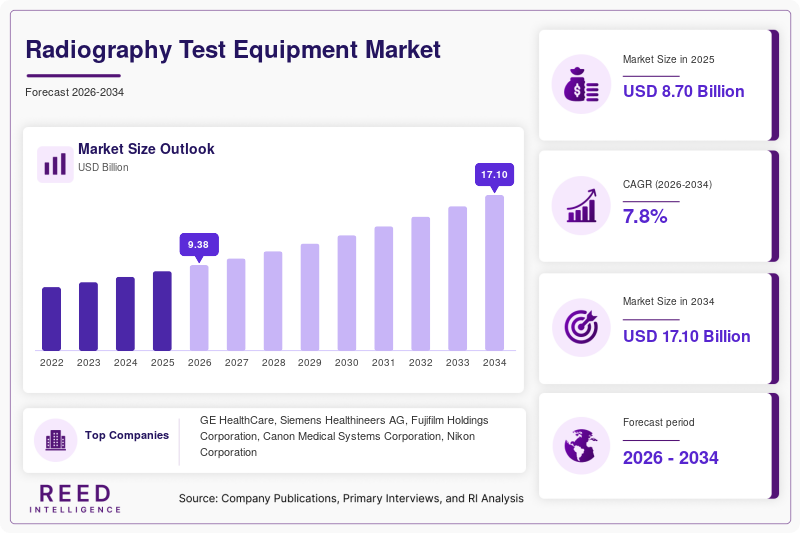
Key Highlights
- North America accounted for 36.4% of the global Radiography Test Equipment Market share in 2025, while Asia Pacific is projected to register the fastest CAGR of 9.1% during 2026–2034.
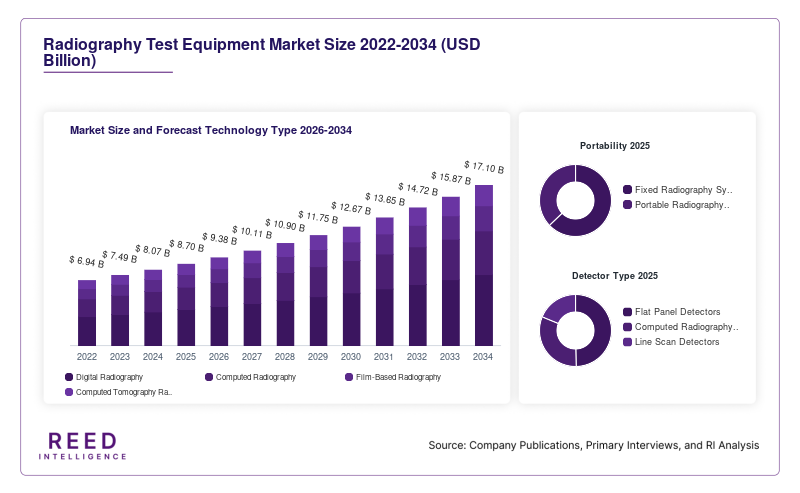
- By technology type, digital radiography dominated the market with a 48.7% share in 2025, while computed tomography radiography is projected to grow at a CAGR of 10.2%.
- By portability, fixed radiography systems held the largest market share of 58.3% in 2025, whereas portable radiography systems are anticipated to expand at a CAGR of 8.8%.
- By end use, industrial inspection applications accounted for 46.1% of the market share in 2025, while aerospace & defense applications are expected to witness a CAGR of 9.5%.
- The United States dominated the market and was valued at USD 2.4 billion in 2024 and USD 2.6 billion in 2025.
Market Trends
AI-Based Image Processing Integration
The integration of artificial intelligence into radiography testing equipment has become a notable trend in the Radiography Test Equipment Market. AI-powered software tools improved image interpretation speed and enhanced defect detection accuracy. Automated analytics reduced human inspection errors and supported predictive maintenance programs across industrial facilities. Companies increasingly invested in intelligent radiography systems capable of real-time analysis and cloud-based reporting.
Expansion of Portable Digital Radiography Systems
Portable digital radiography systems gained traction due to rising field inspection activities. Industries operating in remote locations adopted lightweight and battery-powered equipment to simplify inspection procedures. Portable systems reduced operational downtime and improved accessibility in confined environments such as offshore facilities, pipelines, and transportation infrastructure. This trend is expected to continue as industries focus on flexible inspection solutions.
Market Drivers
Rising Demand for Non-Destructive Testing Across Industries
The increasing use of non-destructive testing methods across industrial sectors is a major driver for the Radiography Test Equipment Market. Industries including aerospace, automotive, energy, and manufacturing adopted radiographic testing to identify structural defects without damaging components. The need to maintain product quality and operational reliability accelerated equipment adoption worldwide.
Increasing Healthcare Imaging Investments
Healthcare providers increased investments in advanced diagnostic imaging systems to improve patient care efficiency. Hospitals and diagnostic centers upgraded radiographic equipment with digital technologies that provide high-resolution imaging and faster workflows. The expansion of healthcare infrastructure across emerging economies also contributed to the market growth.
Market Restraint
High Equipment Installation and Maintenance Costs
The high initial investment associated with advanced radiography testing equipment remains a major restraint for market expansion. Digital radiography systems, automated inspection platforms, and computed tomography solutions require substantial capital expenditure and specialized maintenance services. Small-scale organizations often face budget limitations, which can slow technology adoption.
Market Opportunities
Growth in Smart Manufacturing Facilities
The increasing adoption of smart manufacturing practices is creating opportunities for the Radiography Test Equipment Market. Automated factories are implementing integrated inspection systems to improve production efficiency and reduce defect rates. Advanced radiography solutions connected with industrial IoT platforms are expected to gain wider adoption during the forecast period.
Expansion of Renewable Energy Infrastructure
The growing deployment of renewable energy infrastructure presents new opportunities for radiography testing equipment manufacturers. Wind turbines, solar power systems, and hydrogen facilities require regular structural inspections to maintain operational safety. Radiographic testing technologies are increasingly being used to inspect welded joints, pipelines, and structural assemblies in clean energy projects.
Segmental Analysis
By Technology Type
Digital Radiography
Digital radiography dominated the Radiography Test Equipment Market with a 48.7% share in 2025. The segment benefited from faster imaging, lower operational costs, and improved image quality. Industrial facilities and healthcare institutions increasingly replaced conventional film-based systems with digital alternatives to improve workflow efficiency.
Computed Tomography Radiography
Computed tomography radiography is expected to grow at a CAGR of 10.2% during the forecast period. The segment growth will be driven by rising demand for highly accurate three-dimensional inspection capabilities. Aerospace and semiconductor industries are anticipated to increase adoption due to the need for advanced defect analysis and precision inspection.
By Portability
Fixed Radiography Systems
Fixed radiography systems accounted for 58.3% of the market share in 2025. These systems remained widely used in industrial plants, manufacturing facilities, and hospitals where high-volume inspection activities require stable imaging infrastructure.
Portable Radiography Systems
Portable radiography systems are projected to expand at a CAGR of 8.8% during 2026–2034. The segment growth will be supported by increasing field inspection activities across oil & gas, transportation, and construction industries. Lightweight equipment and wireless connectivity features are expected to improve operational flexibility.
By End Use
Industrial Inspection
Industrial inspection applications held the largest market share of 46.1% in 2025. Manufacturing, aerospace, power generation, and automotive sectors increasingly implemented radiographic testing equipment to maintain product quality and operational reliability.
Aerospace & Defense
The aerospace & defense segment is projected to register a CAGR of 9.5% during the forecast period. Growing aircraft production and increasing defense modernization programs are expected to support demand for high-precision radiographic inspection systems. The need to detect microscopic structural defects in aircraft components will further accelerate growth.
By Detector Type
Flat Panel Detectors
Flat panel detectors dominated the market with a 52.4% share in 2025. These detectors gained popularity because of high-resolution imaging capabilities and rapid data acquisition features. Healthcare providers and industrial operators increasingly adopted flat panel detectors to improve inspection efficiency.
Computed Radiography Detectors
Computed radiography detectors are anticipated to witness a CAGR of 8.3% during the forecast period. The segment growth will be driven by cost-effective digital transition strategies among mid-sized organizations. Flexible deployment and compatibility with existing systems are expected to support adoption.
By Application
Healthcare Diagnostics
Healthcare diagnostics accounted for 41.8% of the market share in 2025. Hospitals and diagnostic imaging centers increasingly implemented digital radiography systems to improve patient throughput and imaging precision.
Oil & Gas Inspection
Oil & gas inspection applications are projected to grow at a CAGR of 8.9% during the forecast period. Rising pipeline monitoring activities and offshore infrastructure inspection requirements are expected to drive segment expansion. Energy companies are anticipated to adopt portable digital radiography systems for remote operational environments.
Regional Analysis
North America
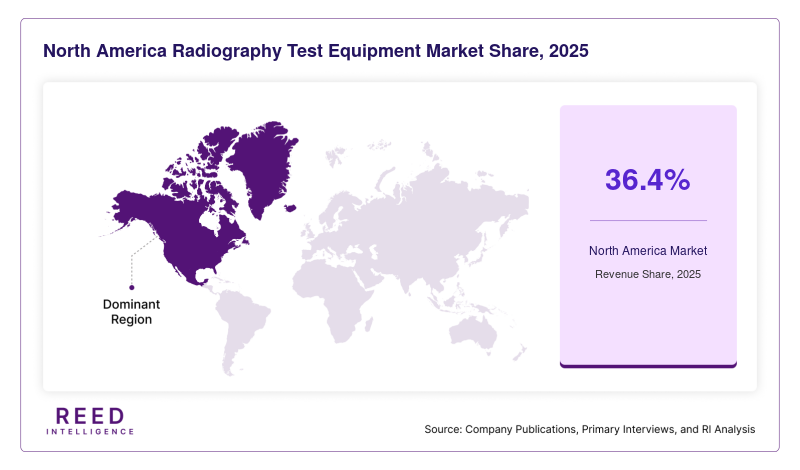
North America held 36.4% of the global Radiography Test Equipment Market share in 2025. The region benefited from extensive industrial automation and strong investment in aerospace inspection technologies. Companies across the United States and Canada increasingly implemented advanced radiographic systems to improve operational safety and regulatory compliance.
The United States dominated the regional market due to strong defense manufacturing activities and increasing modernization of healthcare imaging systems. Industrial operators across the country adopted digital radiography systems to improve inspection speed and reduce operational downtime. The market in North America is projected to expand at a CAGR of 7.2% during 2026–2034.
Europe
Europe accounted for 27.1% of the global Radiography Test Equipment Market share in 2025. The region experienced stable growth due to rising investments in industrial quality assurance and transportation infrastructure maintenance. European manufacturers increasingly implemented automated radiography systems to enhance production efficiency.
Germany led the regional market because of its strong automotive and industrial engineering sectors. Manufacturing companies in the country adopted advanced computed radiography systems to improve precision inspection procedures. The Europe market is expected to grow at a CAGR of 7.4% during the forecast period.
Asia Pacific
Asia Pacific represented 24.8% of the global Radiography Test Equipment Market share in 2025 and is anticipated to register the fastest CAGR of 9.1% during 2026–2034. Rapid industrialization and infrastructure development across China, India, Japan, and South Korea supported regional market expansion.
China dominated the regional market due to large-scale investments in manufacturing, transportation, and energy infrastructure. Industrial facilities increasingly adopted portable digital radiography systems to support maintenance and quality inspection activities. Growing healthcare modernization programs also contributed to regional growth.
Middle East & Africa
The Middle East & Africa accounted for 6.3% of the global market share in 2025. The region witnessed increasing demand for radiographic inspection systems in oil & gas and petrochemical operations. Infrastructure expansion and energy diversification initiatives further supported equipment adoption.
Saudi Arabia dominated the regional market because of increasing pipeline inspection activities and industrial expansion projects. Companies operating in the energy sector implemented radiographic testing technologies to improve asset reliability and operational safety. The market in the region is forecast to grow at a CAGR of 6.9% during 2026–2034.
Latin America
Latin America captured 5.4% of the global Radiography Test Equipment Market share in 2025. The market growth was supported by rising industrial maintenance activities and infrastructure renovation projects. Governments and private operators increased investments in transportation and energy inspection systems.
Brazil led the regional market due to growing industrial manufacturing and mining operations. Companies in the country increasingly adopted digital radiography systems for equipment inspection and maintenance procedures. The Latin America market is projected to expand at a CAGR of 6.7% during the forecast period.
Competitive Landscape
The Radiography Test Equipment Market remains moderately consolidated with the presence of established industrial imaging and diagnostic technology providers. Companies focus on digital innovation, product expansion, software integration, and strategic partnerships to strengthen their market positions.
GE HealthCare emerged as one of the leading players in the market due to its broad portfolio of digital imaging systems and industrial radiography technologies. In 2025, the company introduced an advanced AI-assisted digital radiography platform designed to improve imaging workflow efficiency and inspection accuracy.
Siemens Healthineers continued expanding its digital radiography product portfolio with upgraded imaging software and portable systems. Fujifilm Holdings Corporation focused on detector technology enhancements and cloud-connected radiography platforms. Canon Medical Systems Corporation invested in compact digital imaging systems for healthcare and industrial applications. Nikon Corporation strengthened its industrial inspection business through advanced computed tomography solutions for aerospace and automotive applications.
Key Players List
- GE HealthCare
- Siemens Healthineers AG
- Fujifilm Holdings Corporation
- Canon Medical Systems Corporation
- Nikon Corporation
- Carestream Health
- YXLON International GmbH
- Shimadzu Corporation
- Hitachi Ltd.
- Teledyne Technologies Incorporated
- Varex Imaging Corporation
- Rigaku Corporation
- Comet Group
- Waygate Technologies
- Zetec Inc.
Recent Developments
- In 2025, GE HealthCare launched an AI-integrated digital radiography system for industrial and medical imaging applications.
- In 2024, Siemens Healthineers introduced a portable wireless radiography detector designed for high-speed diagnostics.
- In 2025, Fujifilm Holdings Corporation expanded its cloud-enabled radiography imaging platform for remote image management.
- In 2024, Nikon Corporation upgraded its computed tomography inspection systems for aerospace component analysis.
- In 2025, Waygate Technologies introduced an automated industrial radiography platform for energy infrastructure inspection.
- In 2024, Canon Medical Systems Corporation launched a compact digital radiography solution for mobile healthcare environments.
- In 2025, Baker Hughes Company expanded its industrial inspection services using advanced portable radiographic equipment.
Radiography Test Equipment Market Segments
Technology Type
- Digital Radiography
- Computed Radiography
- Film-Based Radiography
- Computed Tomography Radiography
Portability
- Fixed Radiography Systems
- Portable Radiography Systems
Detector Type
- Flat Panel Detectors
- Computed Radiography Detectors
- Line Scan Detectors
Application
- Healthcare Diagnostics
- Industrial Inspection
- Oil & Gas Inspection
- Aerospace Testing
- Automotive Inspection
End Use
- Hospitals & Diagnostic Centers
- Manufacturing Facilities
- Aerospace & Defense Companies
- Energy & Utilities Companies
- Research Institutions
By Region
- North America
- Europe
- APAC
- Middle East and Africa
- LATAM