Radioimmunoassay Market Size, Share & Demand Report By Product (Kits & Reagents, Instruments), By Application (Clinical Diagnostics, Research Applications), By End-Use (Hospitals & Diagnostic Laboratories, Pharmaceutical & Biotechnology Companies, Academic & Research Institutes), By Technique (Traditional Radioimmunoassay, Immunoradiometric Assay), By Region & Segment Forecasts, 2025–2034
USD 3950
Market Overview
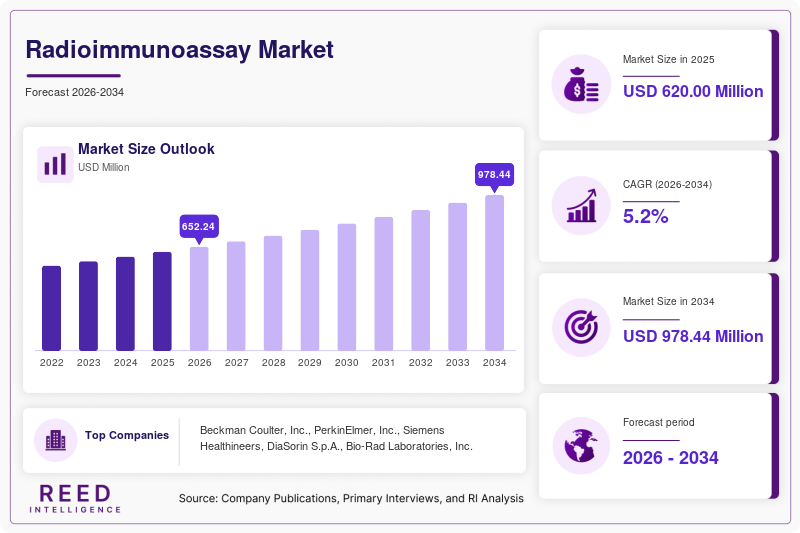
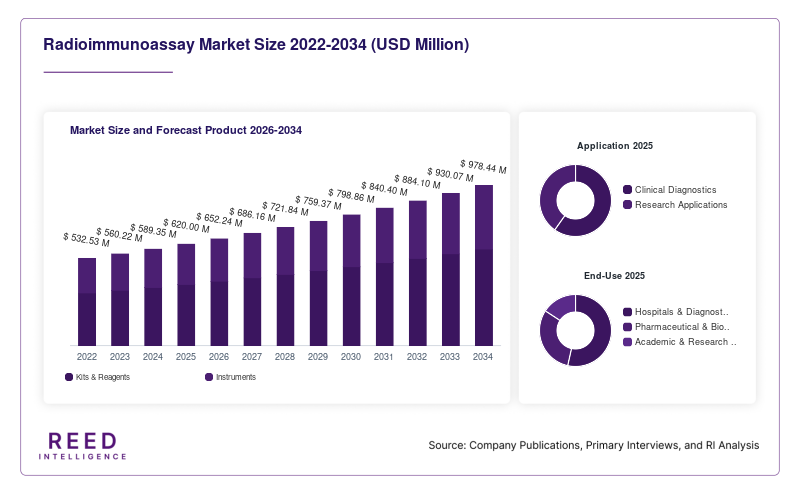
The global Radioimmunoassay Market size was valued at approximately USD 620 million in 2025 and is projected to reach around USD 980 million by 2034, expanding at a CAGR of 5.2% during the forecast period (2025–2034). The market growth has been supported by the sustained demand for highly sensitive diagnostic techniques capable of detecting low concentrations of hormones, drugs, and biomarkers. Radioimmunoassay (RIA) continues to play a critical role in clinical diagnostics and research applications where precision and sensitivity remain essential.
A key global factor supporting the growth of the Radioimmunoassay Market is the increasing prevalence of chronic diseases, particularly endocrine disorders and cancers, which require accurate biomarker quantification. The need for early diagnosis and disease monitoring has reinforced the adoption of RIA in specialized laboratories and healthcare institutions.
Key Highlights
- North America dominated the market with a share of 38% in 2025, while Asia Pacific is expected to grow at the fastest CAGR of 6.4%.
- The kits & reagents segment led the product category with a 54% share, while instruments are projected to register the fastest growth at a CAGR of 5.8%.
- Clinical diagnostics emerged as the dominant application segment with a 49% share, whereas research applications are anticipated to grow at a CAGR of 6.1%.
- The United States accounted for USD 210 million in 2025 and is expected to reach USD 222 million in 2026.
Market Trends
Integration of Automated Systems in Radioimmunoassay
Automation has been increasingly integrated into radioimmunoassay workflows, enhancing efficiency and reducing manual errors. Laboratories are adopting automated analyzers that streamline sample processing and improve throughput. This trend is particularly prominent in high-volume diagnostic centers where operational efficiency is essential. Automated RIA systems also support reproducibility and consistency, which are critical for clinical decision-making.
Shift Toward Hybrid Immunoassay Technologies
There is a growing shift toward combining radioimmunoassay with alternative immunoassay methods such as enzyme-linked immunosorbent assays (ELISA). Hybrid approaches enable laboratories to leverage the sensitivity of RIA alongside the safety and convenience of non-radioactive techniques. This trend is shaping product innovation, as manufacturers focus on developing versatile platforms that can accommodate multiple assay formats. The transition reflects evolving laboratory preferences and regulatory considerations related to radioactive materials handling.
Market Drivers
Rising Demand for High-Sensitivity Diagnostic Techniques
The increasing need for precise diagnostic tools capable of detecting trace-level biomarkers has driven the adoption of radioimmunoassay. RIA is widely recognized for its ability to measure minute concentrations of hormones, drugs, and proteins, making it indispensable in endocrinology and oncology diagnostics. The growing emphasis on early disease detection has further accelerated demand for high-sensitivity assays.
Expansion of Clinical Research Activities
The expansion of clinical and biomedical research has significantly contributed to the growth of the Radioimmunoassay Market. Research institutions and pharmaceutical companies rely on RIA for pharmacokinetic studies and biomarker validation. The increasing number of clinical trials and research initiatives has created a steady demand for reliable and accurate assay technologies, supporting market growth.
Market Restraint
Regulatory and Safety Concerns Related to Radioactive Materials
The use of radioactive isotopes in radioimmunoassay poses regulatory and safety challenges, which act as a significant restraint on market growth. Laboratories must comply with strict guidelines for handling, storage, and disposal of radioactive substances, leading to increased operational costs and complexity. Additionally, concerns regarding radiation exposure among laboratory personnel have prompted some institutions to adopt alternative immunoassay methods.
The need for specialized infrastructure and trained personnel further limits the widespread adoption of RIA, particularly in developing regions. Regulatory approvals for radioactive diagnostic products can also be time-consuming, delaying product launches and market entry. These factors collectively restrict the growth potential of the Radioimmunoassay Market.
Market Opportunities
Emerging Demand in Personalized Medicine
The growing focus on personalized medicine presents significant opportunities for the Radioimmunoassay Market. RIA enables precise measurement of biomarkers that are critical for tailoring treatment strategies to individual patients. As healthcare systems increasingly adopt personalized approaches, the demand for accurate diagnostic tools is expected to rise, creating new growth avenues for RIA technologies.
Expansion in Emerging Economies
Emerging economies in Asia Pacific, Latin America, and the Middle East & Africa offer substantial growth potential for the market. Improvements in healthcare infrastructure and increasing investments in diagnostic capabilities are driving the adoption of advanced technologies. The rising awareness of early disease detection and the expansion of laboratory networks are expected to support market growth in these regions.
Segmental Analysis
By Product
The kits & reagents segment dominated the Radioimmunoassay Market in 2025, accounting for 54% of the total share. The widespread use of kits in routine diagnostic procedures and their recurring demand contributed to their leading position. Laboratories rely heavily on reagents for accurate and consistent test results, supporting segment growth.
The instruments segment is expected to grow at the fastest CAGR of 5.8% during the forecast period. Advancements in automated analyzers and increasing adoption of integrated systems will drive segment growth. The need for improved efficiency and reduced manual intervention will support the demand for advanced instruments.
By Application
Clinical diagnostics emerged as the dominant application segment with a 49% share in 2025. The use of radioimmunoassay in detecting hormones, infectious diseases, and cancer biomarkers has supported its widespread adoption in clinical settings.
The research applications segment is projected to grow at a CAGR of 6.1%. The increasing focus on drug development and biomarker discovery will drive demand in this segment. Research institutions will continue to rely on RIA for high-sensitivity measurements.
By End-Use
Hospitals & diagnostic laboratories held the largest share of 58% in 2025. The high volume of diagnostic tests conducted in these settings contributed to segment dominance.
Pharmaceutical & biotechnology companies are expected to grow at a CAGR of 5.9%. The increasing number of clinical trials and research activities will drive demand for radioimmunoassay in this segment.
By Technique
Traditional radioimmunoassay techniques dominated the market with a 63% share in 2025 due to their established use and reliability in diagnostic applications.
Immunoradiometric assay (IRMA) is anticipated to grow at a CAGR of 6.2%. The higher sensitivity and specificity of IRMA compared to traditional methods will support its adoption.
Regional Analysis
North America
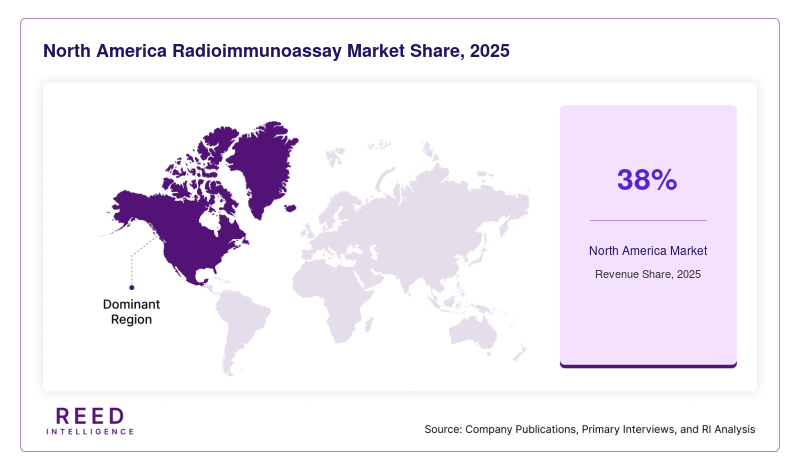
North America accounted for 38% of the Radioimmunoassay Market share in 2025 and will continue to grow at a CAGR of 4.8% during the forecast period. The region’s growth trajectory will be influenced by the strong presence of advanced healthcare infrastructure and well-established diagnostic laboratories.
The United States dominated the regional market due to its extensive clinical research activities and high adoption of advanced diagnostic technologies. The presence of leading research institutions and a strong focus on disease monitoring contributed to market expansion.
Europe
Europe held a 27% share of the market in 2025 and is projected to expand at a CAGR of 4.9% from 2025 to 2034. The region’s growth will be driven by increasing healthcare expenditure and a strong emphasis on early disease diagnosis.
Germany emerged as the dominant country in the region, supported by its advanced laboratory infrastructure and strong focus on research and development. The country’s emphasis on precision diagnostics has supported the adoption of radioimmunoassay technologies.
Asia Pacific
Asia Pacific accounted for 21% of the Radioimmunoassay Market in 2025 and is expected to grow at the fastest CAGR of 6.4% during the forecast period. Rapid improvements in healthcare infrastructure and increasing awareness of diagnostic testing will drive regional growth.
China dominated the market due to its expanding healthcare sector and rising investments in diagnostic technologies. The growing demand for accurate and cost-effective diagnostic solutions has supported the adoption of radioimmunoassay in the country.
Middle East & Africa
The Middle East & Africa region held a 7% market share in 2025 and will grow at a CAGR of 5.3% over the forecast period. The region’s growth will be supported by increasing healthcare investments and expanding diagnostic capabilities.
Saudi Arabia led the regional market due to its focus on healthcare modernization and increasing adoption of advanced diagnostic technologies. Government initiatives aimed at improving healthcare services have contributed to market growth.
Latin America
Latin America accounted for 7% of the market in 2025 and is projected to grow at a CAGR of 5.1% during the forecast period. The region’s growth will be driven by improving healthcare infrastructure and rising awareness of diagnostic testing.
Brazil dominated the market due to its expanding healthcare sector and increasing demand for advanced diagnostic solutions. The country’s focus on improving disease detection capabilities has supported the adoption of radioimmunoassay technologies.
Competitive Landscape
The Radioimmunoassay Market is moderately competitive, with key players focusing on product innovation and strategic collaborations. Companies are investing in advanced assay technologies to enhance sensitivity and efficiency.
The market leader, Beckman Coulter, has maintained its position through continuous product development and expansion of its diagnostic portfolio. The company recently introduced an advanced automated immunoassay system designed to improve laboratory efficiency.
Other major players are also focusing on expanding their global presence and strengthening their product offerings to gain a competitive edge.
Key Players List
- Beckman Coulter, Inc.
- PerkinElmer, Inc.
- Siemens Healthineers
- DiaSorin S.p.A.
- Bio-Rad Laboratories, Inc.
- DRG International, Inc.
- DIAsource ImmunoAssays SA
- MP Biomedicals
- Tecan Group Ltd.
- Euro Diagnostica AB
- Merck KGaA
- Thermo Fisher Scientific Inc.
- Abbott Laboratories
- Ortho Clinical Diagnostics
- Fujirebio
Recent Developments
- Beckman Coulter launched a new automated immunoassay platform to improve testing efficiency.
- Siemens Healthineers expanded its diagnostic portfolio with advanced assay solutions.
- PerkinElmer introduced upgraded RIA kits with enhanced sensitivity.
- Bio-Rad Laboratories focused on expanding its research assay offerings.
- DiaSorin strengthened its global distribution network for immunoassay products.
Radioimmunoassay Market Segments
Product
- Kits & Reagents
- Instruments
Application
- Clinical Diagnostics
- Research Applications
End-Use
- Hospitals & Diagnostic Laboratories
- Pharmaceutical & Biotechnology Companies
- Academic & Research Institutes
Technique
- Traditional Radioimmunoassay
- Immunoradiometric Assay (IRMA)
By Region
- North America
- Europe
- APAC
- Middle East and Africa
- LATAM