Rail Bellow Market Size, Share Demand Report By Type (Gangway Bellows, Articulation Bellows, Suspension Bellows), By Material (Rubber-Based Bellows, Composite Bellows), By Application (Passenger Coaches, Metro and Light Rail, Freight Rolling Stock, High-Speed Rail), By End Use (OEM, Aftermarket), By Train Type (Conventional Rail, High-Speed Rail, Urban Transit), By Region & Segment Forecasts, 2026–2034
USD 3950
Market Overview
The global Rail Bellow Market was valued at USD 1.42 billion in 2026 and is projected to reach USD 2.41 billion by 2034, expanding at a CAGR of 6.8% during 2026–2034. Rail bellows, used as flexible protective and connection systems in rolling stock, passenger gangways, suspension assemblies, HVAC systems, and articulation joints, continue to gain adoption as railway modernization programs expand across developed and emerging economies.
A major factor supporting growth in the Rail Bellow Market has been rising investments in rail infrastructure modernization and urban transit expansion. Governments and private rail operators have increased spending on metro systems, high-speed rail, and passenger coach upgrades, which has strengthened demand for durable bellows components capable of improving safety, vibration control, weather resistance, and passenger comfort.
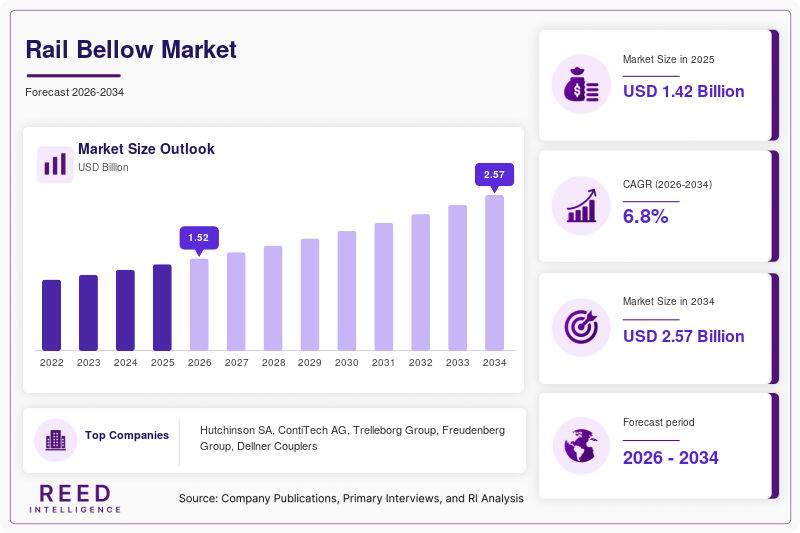
Key Highlights :
- Europe dominated the Rail Bellow Market with 34.6% share in 2025, supported by established rail networks and rolling stock refurbishment activity.
- Asia Pacific is anticipated to be the fastest-growing region, registering a CAGR of 8.2% through 2034.
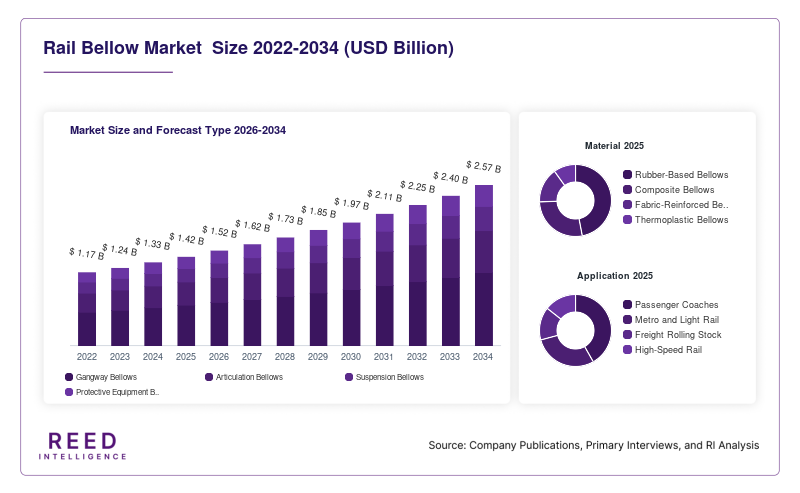
- By type, Gangway Bellows held the leading share of 38.9% in 2025, while Articulation Bellows will likely expand fastest at 7.9% CAGR.
- By material, Rubber-Based Bellows accounted for 44.3% share in 2025, while Composite Bellows are projected to grow at 8.4% CAGR.
- By application, Passenger Coaches represented 47.1% share in 2025, while Metro and Light Rail Systems are expected to grow at 8.7% CAGR.
- Germany, the dominant country, recorded an estimated market value of USD 176.2 million in 2024 and USD 184.8 million in 2025, supported by rolling stock replacement programs.
Market Trends
Smart Materials Integration in Rail Bellows
A significant trend shaping the Rail Bellow Market is the integration of smart and performance-engineered materials. Rail operators increasingly seek bellows systems with improved fire resistance, abrasion protection, acoustic insulation, and environmental durability. Manufacturers are responding by introducing multi-layer elastomer structures, sensor-compatible bellows, and reinforced materials that support condition monitoring. This trend is improving lifecycle performance while aligning with digital maintenance strategies.
Demand Shift Toward Lightweight Modular Designs
Another major trend is the shift toward lightweight and modular rail bellow systems. OEMs are prioritizing components that reduce train weight, improve energy efficiency, and simplify maintenance. Modular bellows designs allow faster replacement, lower downtime, and improved customization for new-generation trains. This trend is gaining traction across high-speed rail and metro projects where operational efficiency remains a procurement priority.
Market Drivers
Expansion of Passenger Rail and Metro Networks
The expansion of urban mobility infrastructure continues to drive the Rail Bellow Market. Growth in metro systems, commuter rail, and intercity transport has increased demand for gangway and protective bellows used in articulated coaches and passenger connections. Rising passenger volumes and urban congestion have encouraged transit investment, supporting long-term demand.
Increasing Focus on Rolling Stock Safety and Durability
Stricter safety standards for fire protection, weather sealing, and vibration management are contributing to market growth. Rail operators increasingly replace aging bellows with advanced systems that improve passenger safety and protect critical components. This emphasis on durability and compliance is expanding retrofit opportunities as well as new-build demand.
Market Restraint
High Replacement Costs and Long Procurement Cycles
One major restraint in the Rail Bellow Market is the relatively high replacement cost associated with specialized bellows systems and long procurement timelines in railway projects. Extended approval cycles and budget limitations can delay product adoption, particularly in cost-sensitive public rail programs.
Market Opportunities
Growth in High-Speed Rail Projects
High-speed rail expansion presents an emerging opportunity for the Rail Bellow Market. These systems require advanced bellows capable of withstanding higher pressure differentials, dynamic motion, and strict safety requirements. Suppliers developing specialized solutions for these projects are likely to benefit from long-term contracts.
Aftermarket Demand for Predictive Maintenance Solutions
The rise of predictive maintenance creates opportunities in the aftermarket segment. Rail operators are increasingly seeking bellows solutions compatible with monitoring technologies that help detect wear and reduce unscheduled maintenance. This trend may support recurring revenue opportunities for manufacturers.
Segmental Analysis
By Type
Gangway Bellows Dominated the Market: Gangway Bellows accounted for 38.9% of the Rail Bellow Market in 2025. Their demand was supported by extensive use in passenger coaches, metro systems, and articulated trains where flexible inter-car connections remain critical.
Articulation Bellows to Register Fastest Growth: Articulation Bellows are projected to grow at 7.9% CAGR through 2034. Growth will likely be driven by increasing adoption in multi-section trains and higher demand for advanced movement tolerance systems.
Other segments include Suspension Bellows and Protective Equipment Bellows.
By Material
Rubber-Based Bellows Led the Segment: Rubber-based bellows held 44.3% share in 2025 due to durability, cost efficiency, and established use across rolling stock applications.
Composite Bellows to Grow Fastest: Composite bellows are expected to expand at 8.4% CAGR. Growth will likely be supported by demand for lightweight solutions with enhanced resistance to temperature variation and mechanical stress.
Other segments include Fabric-Reinforced Bellows and Thermoplastic Bellows.
By Application
Passenger Coaches Held Largest Share: Passenger coaches accounted for 47.1% share in 2025, supported by replacement demand and new train manufacturing.
Metro and Light Rail Systems to Grow Fastest: Metro and light rail applications are expected to record 8.7% CAGR through 2034. Growth will likely stem from urban transit expansion and higher procurement of articulated train sets.
Other applications include Freight Rolling Stock and High-Speed Rail.
By End Use
OEM Segment Dominated: OEM installations represented 62.5% share in 2025, supported by strong integration of bellows in newly manufactured rolling stock.
Aftermarket Segment to Expand Fastest: The aftermarket segment is projected to grow at 7.5% CAGR, driven by predictive maintenance strategies and component replacement cycles.
By Train Type
Conventional Rail Dominated: Conventional rail accounted for 41.8% share in 2025 due to broad deployment across regional and intercity networks.
High-Speed Rail to Witness Fastest Growth: High-speed rail is projected to grow at 8.5% CAGR, supported by increasing deployment of advanced protective bellows in next-generation train systems.
Regional Analysis
North America
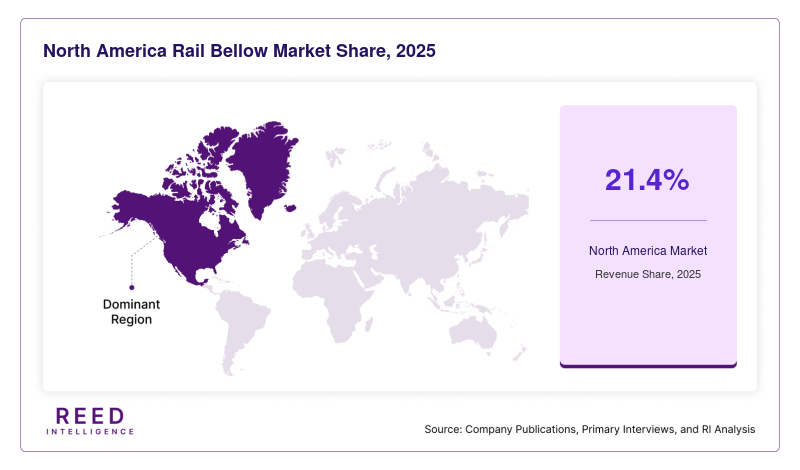
North America accounted for 21.4% of the Rail Bellow Market in 2025. The region will likely expand at a CAGR of 5.9% through 2034. Demand is expected to be supported by commuter rail modernization and refurbishment programs.
The United States remained the dominant country due to investment in urban transit fleet upgrades. Demand has been supported by replacement of aging rolling stock and adoption of advanced safety-focused bellows systems.
Europe
Europe held 34.6% share of the Rail Bellow Market in 2025. The region will likely grow at 6.3% CAGR over the forecast period.
Germany led the region due to strong rail manufacturing capabilities and refurbishment activity. Growth has been supported by modernization of regional trains and procurement of advanced articulated passenger systems.
Asia Pacific
Asia Pacific captured 28.8% share in 2025 and will likely register the fastest 8.2% CAGR through 2034.
China remained the dominant country due to large-scale high-speed rail development and metro expansion. Growth is expected to be supported by continued rolling stock production and domestic component demand.
Middle East & Africa
Middle East & Africa represented 8.2% market share in 2025 and is projected to expand at 6.7% CAGR.
Saudi Arabia led the region due to investment in urban transit and intercity rail projects. Growth is expected to be driven by infrastructure diversification initiatives and fleet development.
Latin America
Latin America accounted for 7.0% share in 2025 and will likely grow at 6.1% CAGR through 2034.
Brazil remained the dominant country, supported by rail maintenance activity and metro system upgrades. Demand is projected to increase as modernization projects advance.
Competitive Landscape
The Rail Bellow Market remains moderately consolidated, with competition centered on product durability, customization capabilities, and long-term supply contracts with rolling stock manufacturers and rail operators. Leading participants continue focusing on advanced materials, modular designs, and aftermarket service capabilities.
Hutchinson SA maintained a leading position through its diversified rail component portfolio and engineered bellow systems used across passenger and high-speed applications. A recent development involved expansion of its advanced elastomer rail component production capacity to support rising OEM demand.
ContiTech AG remained active in reinforced flexible systems and protective bellows innovation. Trelleborg Group continued emphasizing lightweight rail sealing and articulation products. Freudenberg Group focused on performance materials and long-life solutions for demanding rail environments. Dellner Couplers strengthened its market presence through integrated gangway and connection systems for modern rolling stock.
Market participants are also pursuing partnerships with train manufacturers, localized production expansion, and development of maintenance-oriented solutions to support long-term growth.
Key Players List
- Hutchinson SA
- ContiTech AG
- Trelleborg Group
- Freudenberg Group
- Dellner Couplers
- Hennig GmbH
- Wabtec Corporation
- Sumitomo Riko Co., Ltd.
- SKF Group
- Toyoda Gosei Co., Ltd.
- Bellow and Bushings Company
- Mageba Group
- Air Springs Supply Pty Ltd
- Dunlop Systems and Components
- BSB Bellow Systems
Recent Developments
- Multiple rail component manufacturers expanded production capacity for reinforced gangway bellows to address rising demand from metro and passenger coach programs.
- Several suppliers introduced lightweight composite bellows designed to improve durability while supporting train weight reduction initiatives.
- New product launches focused on fire-resistant and low-maintenance bellows systems aligned with stricter rail safety requirements.
- Strategic partnerships were formed between bellows suppliers and rolling stock OEMs for customized articulation system integration.
- Manufacturers increased investment in modular bellows designs intended to simplify installation and reduce maintenance downtime.
- Aftermarket suppliers introduced predictive maintenance-compatible bellows systems designed for condition monitoring applications.
- Regional production expansion in Asia supported localized supply for high-speed rail projects and reduced delivery lead times.
- Several companies expanded retrofit-focused offerings targeting aging passenger fleets requiring bellows replacement and modernization.
- Product development activity increased around multi-layer elastomer bellows capable of improved vibration absorption and environmental resistance.
- Suppliers strengthened engineering support services for rail operators seeking customized solutions for advanced transit platforms.
- Innovation efforts accelerated in thermoplastic and composite materials to improve wear performance and lifecycle economics in demanding operating environments.
Rail Bellow Market Segments
Type
- Gangway Bellows
- Articulation Bellows
- Suspension Bellows
- Protective Equipment Bellows
Material
- Rubber-Based Bellows
- Composite Bellows
- Fabric-Reinforced Bellows
- Thermoplastic Bellows
Application
- Passenger Coaches
- Metro and Light Rail
- Freight Rolling Stock
- High-Speed Rail
End Use
- OEM
- Aftermarket
Train Type
- Conventional Rail
- High-Speed Rail
- Urban Transit
By Region
- North America
- Europe
- APAC
- Middle East and Africa
- LATAM