Railcar Unloader Market Size, Share & Demand Report By Equipment Type (Bottom Dump Unloaders, Rotary Car Dumpers, Side Discharge Unloaders, Pneumatic Unloading Systems), By Application (Mining & Minerals, Agriculture, Chemicals, Construction Materials, Food Processing), By End-Use Industry (Industrial Manufacturing, Energy & Power, Logistics & Transportation, Ports & Terminals), By Region & Segment Forecasts, 2026–2034
USD 3950
Market Overview
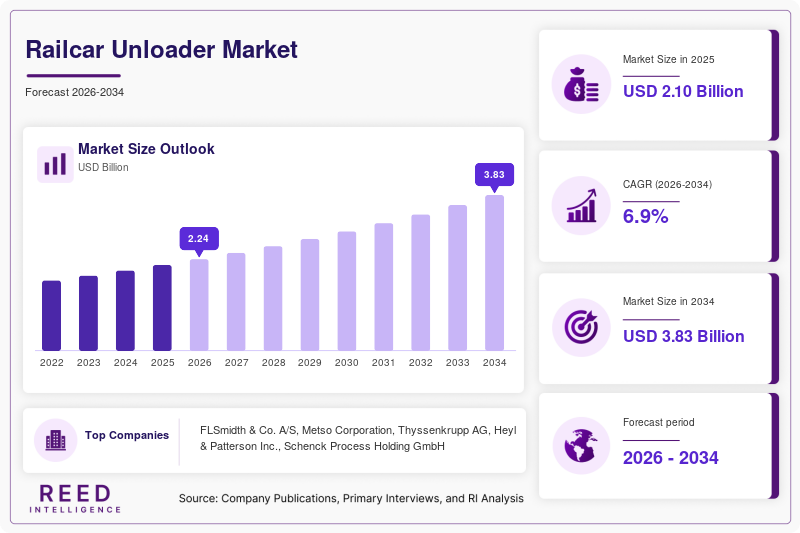
The Railcar Unloader Market size was valued at approximately USD 2.1 billion in 2026 and is projected to reach USD 3.6 billion by 2034, expanding at a CAGR of 6.9% during the forecast period (2026–2034). The market continues to evolve as bulk material handling becomes more critical across industries such as mining, agriculture, chemicals, and construction. Railcar unloaders play a key role in improving efficiency, reducing labor dependency, and enabling safer handling of dry and liquid bulk materials.
A key global factor supporting market growth is the steady expansion of rail freight transportation infrastructure. Governments and private stakeholders are investing in rail logistics as a cost-efficient and environmentally favorable alternative to road transport. This shift has increased the demand for automated unloading solutions that can handle high volumes with minimal operational delays. Additionally, the integration of advanced automation and monitoring technologies has enhanced operational precision, further supporting adoption across industrial facilities.
Key Highlights
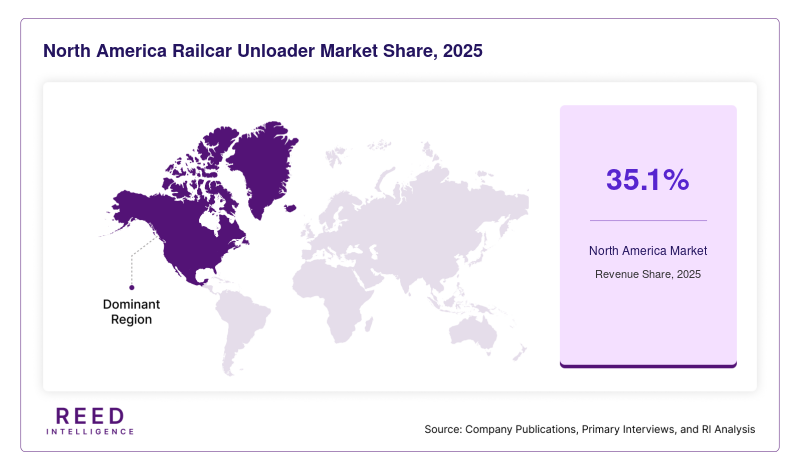
- North America dominated the market with a 35.1% share in 2025.
- Asia Pacific is expected to grow at the fastest CAGR of 8.7% during 2026–2034.
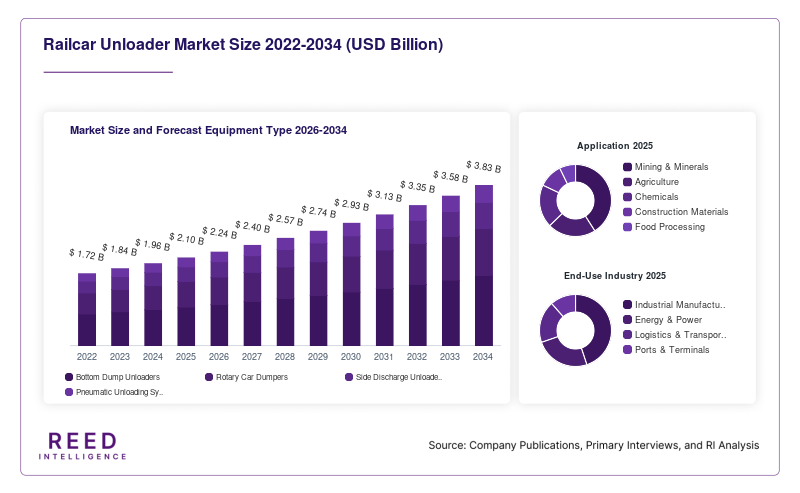
- By equipment type, bottom dump unloaders accounted for the largest share of 39.4%, while rotary car dumpers are projected to grow at a CAGR of 8.9%.
- By application, mining and minerals led with a 42.3% share, whereas agriculture is expected to expand at a CAGR of 7.8%.
- The United States remained the dominant country, with market values of USD 480 million in 2024 and USD 515 million in 2025.
Market Trends
Increasing adoption of automated unloading systems
The market is witnessing a gradual transition toward automated and semi-automated railcar unloading systems. Industries are focusing on reducing manual intervention to enhance operational safety and efficiency. Automated unloaders equipped with sensors, programmable logic controllers, and real-time monitoring systems help streamline material flow and minimize downtime. This trend is particularly evident in large-scale facilities such as ports, mining operations, and grain terminals, where high throughput is essential. The integration of digital control systems also allows operators to optimize unloading cycles and improve asset utilization. As labor costs continue to rise globally, the demand for automation is expected to remain strong, contributing to sustained market growth over the forecast period.
Rising demand for high-capacity bulk handling solutions
Another noticeable trend in the Railcar Unloader Market is the growing need for high-capacity unloading systems capable of handling large volumes of bulk materials. Industries such as mining and construction require efficient equipment to manage increasing production levels and supply chain demands. This has led to the development of advanced unloaders with higher load capacities, improved durability, and enhanced operational flexibility. Manufacturers are focusing on designing systems that can accommodate various railcar types and materials, including coal, cement, and agricultural products. The emphasis on scalability and adaptability is expected to shape product innovation, enabling end-users to manage fluctuating demand while maintaining cost efficiency.
Market Drivers
Expansion of rail freight infrastructure
The expansion of rail freight infrastructure across developed and developing economies is a significant driver for the Railcar Unloader Market. Governments are investing in railway modernization projects to improve connectivity, reduce transportation costs, and lower carbon emissions. These initiatives have increased the volume of goods transported via rail, thereby driving the need for efficient unloading systems. Railcar unloaders are essential for ensuring quick turnaround times and minimizing congestion at terminals. Additionally, the growth of intermodal transportation has further emphasized the importance of seamless loading and unloading operations. As rail networks continue to expand, the demand for advanced unloading equipment is expected to rise steadily.
Growth in bulk material handling industries
The increasing demand for bulk materials such as coal, minerals, cement, and grains is another major driver of the market. Industries involved in these sectors require reliable and efficient unloading solutions to maintain smooth operations. Railcar unloaders enable faster material transfer, reduce spillage, and improve overall productivity. The growth of infrastructure development projects, particularly in emerging economies, has further boosted the demand for bulk materials, thereby supporting market expansion. Moreover, advancements in equipment design have improved operational efficiency and reduced maintenance requirements, making railcar unloaders a preferred choice for industrial applications.
Market Restraint
High initial investment and maintenance costs
The Railcar Unloader Market faces challenges due to the high initial investment required for installing advanced unloading systems. These systems often involve complex machinery, automation technologies, and infrastructure modifications, which can be costly for small and medium-sized enterprises. In addition to the initial capital expenditure, ongoing maintenance and operational costs can also be significant. Regular servicing, component replacement, and system upgrades are necessary to ensure optimal performance and safety. This financial burden may limit adoption, particularly in regions with budget constraints or limited access to financing. For example, smaller agricultural facilities may prefer manual or semi-mechanized solutions due to lower upfront costs, even if they are less efficient.
Market Opportunities
Integration of smart technologies and IoT
The integration of smart technologies and the Internet of Things (IoT) presents significant opportunities for the Railcar Unloader Market. Modern unloading systems are increasingly being equipped with sensors and connectivity features that enable real-time monitoring and predictive maintenance. These capabilities help operators identify potential issues before they lead to equipment failure, reducing downtime and maintenance costs. Additionally, data analytics can be used to optimize unloading processes and improve operational efficiency. The adoption of digital solutions is expected to enhance the value proposition of railcar unloaders, making them more attractive to end-users seeking advanced and reliable systems.
Emerging markets and industrial expansion
Emerging economies offer substantial growth opportunities for the Railcar Unloader Market due to rapid industrialization and infrastructure development. Countries in Asia Pacific, Latin America, and the Middle East are investing in sectors such as mining, agriculture, and construction, which require efficient bulk material handling solutions. The expansion of rail networks in these regions further supports market growth by increasing the demand for unloading equipment. Additionally, favorable government policies and investments in logistics infrastructure are expected to create a conducive environment for market expansion. Companies that focus on providing cost-effective and scalable solutions are likely to benefit from these opportunities.
Segmental Analysis
By Equipment Type
Bottom dump unloaders dominated the Railcar Unloader Market, accounting for approximately 39.4% of the market share in 2024. These systems are widely used due to their efficiency in handling bulk materials such as coal, grains, and aggregates. Bottom dump unloaders allow for quick and continuous unloading, reducing operational downtime and improving productivity. Their relatively simple design and lower maintenance requirements make them a preferred choice for many industries. Additionally, these systems are compatible with various railcar designs, enhancing their versatility and applicability across different sectors.
Rotary car dumpers are expected to be the fastest-growing subsegment, with a projected CAGR of 8.9% during the forecast period. These systems are designed to handle high-capacity operations, making them ideal for large-scale industrial applications such as mining and power generation. The ability to unload entire railcars quickly and efficiently is a key factor driving their adoption. Furthermore, advancements in automation and control systems have improved the performance and reliability of rotary car dumpers, making them an attractive option for end-users seeking high-capacity solutions.
By Application
Mining and minerals represented the largest application segment, holding a market share of 42.3% in 2024. The demand for railcar unloaders in this segment is driven by the need to handle large volumes of bulk materials efficiently. Mining operations require reliable equipment to ensure smooth material flow and minimize operational disruptions. Railcar unloaders play a critical role in improving productivity and reducing transportation costs, making them an essential component of mining operations.
Agriculture is expected to be the fastest-growing application segment, with a CAGR of 7.8% during the forecast period. The increasing demand for efficient handling of grains and other agricultural products is driving the adoption of railcar unloaders in this sector. These systems help reduce spillage, improve unloading speed, and enhance overall efficiency. Additionally, the expansion of global trade in agricultural commodities is expected to further boost demand for railcar unloaders in this segment.
By End-Use Industry
The industrial sector dominated the Railcar Unloader Market, accounting for a significant share in 2024. Industries such as chemicals, cement, and construction rely heavily on efficient material handling solutions to maintain smooth operations. Railcar unloaders enable faster unloading, reduce labor costs, and improve overall productivity. The growing demand for bulk materials in these industries has further supported the adoption of railcar unloaders.
The energy sector is expected to be the fastest-growing end-use segment, with a strong CAGR during the forecast period. The increasing demand for coal and other energy resources has driven the need for efficient unloading systems. Railcar unloaders are widely used in power plants and energy facilities to handle large volumes of materials. The focus on improving operational efficiency and reducing costs is expected to drive the adoption of advanced unloading systems in this sector.
Regional Analysis
North America
North America accounted for a significant share of the Railcar Unloader Market, holding approximately 35.1% in 2025. The region is expected to maintain steady growth, with a projected CAGR of 5.8% during the forecast period. The presence of well-established rail infrastructure and high adoption of advanced technologies contribute to the region’s dominant position. Industries such as mining, chemicals, and agriculture rely heavily on efficient unloading systems to handle large volumes of materials. The focus on automation and operational efficiency further supports market growth in North America.
The United States remains the dominant country in this region, driven by extensive rail networks and strong industrial activity. A unique growth factor is the increasing investment in upgrading aging rail infrastructure to improve efficiency and sustainability. These upgrades often include the adoption of modern unloading systems, which enhance productivity and reduce operational costs. Additionally, the emphasis on reducing carbon emissions has encouraged the use of rail transport, further boosting demand for railcar unloaders.
Europe
Europe held a notable share of the Railcar Unloader Market in 2025, accounting for around 24.3%, and is expected to grow at a CAGR of 5.6% during the forecast period. The region’s focus on sustainable transportation and strict environmental regulations has encouraged the use of rail freight. This shift has increased the demand for efficient unloading solutions that can support high-volume operations while minimizing environmental impact. Technological advancements and innovation in material handling equipment also contribute to market growth in Europe.
Germany is the leading country in the European market, supported by its strong industrial base and advanced logistics infrastructure. A unique growth factor is the country’s emphasis on automation and Industry 4.0 initiatives, which promote the adoption of smart and connected systems. These initiatives have led to increased demand for automated railcar unloaders that can integrate seamlessly with digital platforms, improving operational efficiency and data-driven decision-making.
Asia Pacific
Asia Pacific is the fastest-growing region in the Railcar Unloader Market, with a CAGR of 8.7% during the forecast period and a market share of approximately 22.8% in 2025. Rapid industrialization, urbanization, and infrastructure development are key factors driving market growth in this region. The increasing demand for bulk materials such as coal, cement, and agricultural products has further boosted the need for efficient unloading systems. Governments are also investing heavily in rail infrastructure to support economic growth.
China dominates the Asia Pacific market, driven by its extensive rail network and large-scale industrial activities. A unique growth factor is the country’s focus on expanding its logistics and supply chain capabilities to support domestic and international trade. This includes the development of high-capacity rail terminals equipped with advanced unloading systems. The growing emphasis on automation and efficiency is expected to further drive market growth in China and the broader region.
Middle East & Africa
The Middle East & Africa region accounted for approximately 9.6% of the Railcar Unloader Market in 2025 and is expected to grow at a CAGR of 6.2% during the forecast period. The region’s growth is driven by investments in mining, oil and gas, and infrastructure development. Rail transport is increasingly being adopted to improve logistics efficiency and reduce transportation costs. This has created a demand for reliable and efficient unloading systems.
Saudi Arabia is a key country in this region, supported by its ongoing infrastructure projects and economic diversification initiatives. A unique growth factor is the development of large-scale industrial and logistics hubs, which require advanced material handling solutions. These projects are expected to drive the adoption of railcar unloaders, particularly in sectors such as mining and construction, where bulk material handling is essential.
Latin America
Latin America held a market share of around 8.2% in 2025 and is projected to grow at a CAGR of 6.5% during the forecast period. The region’s growth is supported by the expansion of mining and agricultural activities, which require efficient transportation and unloading of bulk materials. Investments in rail infrastructure are also contributing to market growth, as governments seek to improve logistics efficiency and reduce transportation costs.
Brazil is the dominant country in the Latin American market, driven by its large mining and agricultural sectors. A unique growth factor is the increasing focus on export-oriented industries, which require efficient supply chain solutions. The development of rail networks and logistics infrastructure has created a favorable environment for the adoption of railcar unloaders, supporting market growth in the region.
Competitive Landscape
The Railcar Unloader Market is moderately consolidated, with several key players focusing on innovation, product development, and strategic partnerships to strengthen their market position. Companies are investing in advanced technologies such as automation and digital monitoring systems to enhance the efficiency and reliability of their products. The competitive environment is characterized by the presence of both global and regional players catering to diverse industry needs.
A leading company in the market is FLSmidth & Co. A/S, known for its comprehensive range of material handling solutions. The company has recently focused on expanding its product portfolio by integrating smart technologies into its railcar unloading systems. Other major players are also emphasizing research and development to introduce innovative solutions that meet evolving customer requirements. Strategic collaborations and mergers are common strategies adopted by companies to expand their market presence and enhance their technological capabilities.
Key Players
- FLSmidth & Co. A/S
- Metso Corporation
- Thyssenkrupp AG
- Heyl & Patterson Inc.
- Schenck Process Holding GmbH
- AUMUND Group
- CDG Engineers Inc.
- BEUMER Group
- TAKRAF GmbH
- WAMGROUP S.p.A.
- Martin Engineering
- Flexicon Corporation
- Kase Conveyors
- Vortex Global
- Railcar Unloading Systems LLC
Recent Developments
- A major equipment manufacturer introduced an automated railcar unloader with integrated IoT capabilities to enhance real-time monitoring and predictive maintenance.
- A leading player expanded its production facility to meet the growing demand for high-capacity unloading systems in emerging markets.
- A strategic partnership between two industry participants focused on developing advanced unloading solutions for the mining sector, aiming to improve efficiency and reduce operational costs.
Railcar Unloader Market Segments
Equipment Type
- Bottom Dump Unloaders
- Rotary Car Dumpers
- Side Discharge Unloaders
- Pneumatic Unloading Systems
Application
- Mining & Minerals
- Agriculture
- Chemicals
- Construction Materials
- Food Processing
End-Use Industry
- Industrial Manufacturing
- Energy & Power
- Logistics & Transportation
- Ports & Terminals
By Region
- North America
- Europe
- APAC
- Middle East and Africa
- LATAM