Rapid Plasma Reagin Test Market Size, Share & Demand Report By Product Type (RPR Test Kits, Automated RPR Systems), By Application (Syphilis Testing, Blood Screening, Research Applications), By End-Use (Hospitals, Diagnostic Laboratories, Clinics, Blood Banks), By Distribution Channel (Direct Sales, Distributors, Online Sales), By Region & Segment Forecasts, 2025–2034
USD 3950
Market Overview
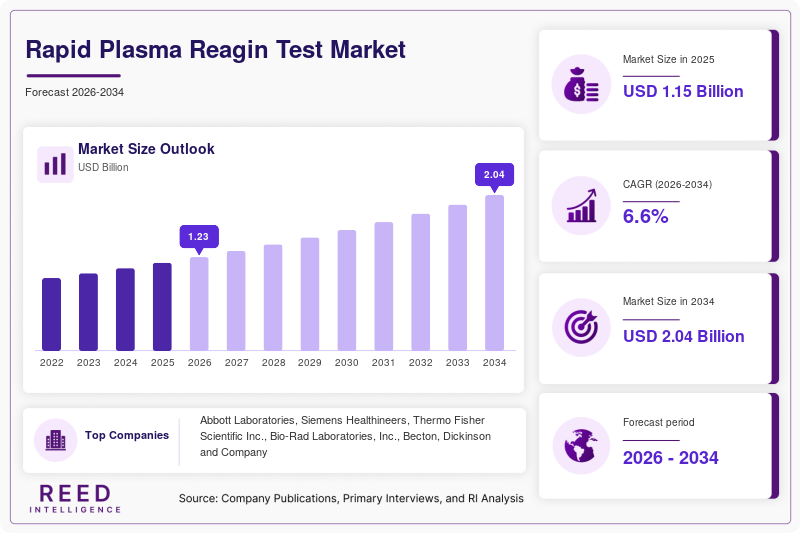
The Rapid Plasma Reagin Test Market size was valued at approximately USD 1.15 billion in 2025 and is projected to reach USD 2.05 billion by 2034, expanding at a CAGR of 6.6% from 2025 to 2034. The market growth is primarily supported by the increasing global burden of sexually transmitted infections (STIs), particularly syphilis, which continues to require cost-effective and rapid screening solutions in both developed and developing healthcare systems.
A key global factor supporting the expansion of the Rapid Plasma Reagin Test Market is the rising adoption of point-of-care diagnostic solutions. Healthcare providers are prioritizing rapid and accessible testing methods to enable early disease detection and timely treatment, especially in resource-limited settings. The affordability, simplicity, and quick turnaround time of rapid plasma reagin (RPR) tests have contributed significantly to their widespread use in public health programs.
Key Highlights
- North America dominated the market with a share of 36.8% in 2025, while Asia Pacific is projected to be the fastest-growing region with a CAGR of 8.1%.
- By product type, RPR test kits led with a 54.2% share, while automated RPR systems are expected to grow at a CAGR of 7.4%.
- By end-use, hospitals dominated with a 41.5% share, while diagnostic laboratories are projected to grow at a CAGR of 7.0%.
- The United States recorded market values of USD 345 million in 2025 and is estimated to reach USD 365 million in 2026.
Market Trends
Shift Toward Point-of-Care Testing
The Rapid Plasma Reagin Test Market is experiencing a strong shift toward decentralized testing environments. Healthcare systems are increasingly adopting point-of-care diagnostics to reduce diagnostic delays and improve patient outcomes. RPR tests are widely used in clinics, mobile health units, and rural healthcare settings due to their simplicity and minimal infrastructure requirements. This trend is particularly evident in emerging economies, where accessibility remains a challenge. The portability and ease of use of these tests are encouraging their integration into national screening programs.
Integration of Digital Diagnostic Platforms
Another notable trend shaping the Rapid Plasma Reagin Test Market is the integration of digital technologies with traditional testing methods. Manufacturers are developing systems that enable automated result interpretation and digital record-keeping. These advancements improve accuracy, reduce human error, and enhance data management in clinical workflows. Digital integration also supports telemedicine and remote diagnostics, allowing healthcare professionals to monitor and track disease prevalence more effectively. This trend is expected to support long-term market growth by enhancing efficiency and scalability.
Market Drivers
Increasing Prevalence of Syphilis and STIs
The rising global incidence of syphilis and other sexually transmitted infections is a primary driver of the Rapid Plasma Reagin Test Market. Public health agencies are intensifying screening efforts to control disease transmission, leading to higher demand for reliable and rapid diagnostic tools. RPR tests are widely used as initial screening methods, making them essential in large-scale testing initiatives.
Expansion of Public Health Screening Programs
Governments and healthcare organizations are increasingly investing in screening programs targeting high-risk populations, including pregnant women and blood donors. These programs emphasize early detection to prevent complications and transmission. The affordability and efficiency of RPR tests make them a preferred choice for such initiatives. Continuous funding and policy support for disease surveillance are expected to sustain market growth over the forecast period.
Market Restraint
Limited Specificity and Need for Confirmatory Testing
A significant restraint in the Rapid Plasma Reagin Test Market is the limited specificity of RPR tests. While these tests are effective for initial screening, they often produce false-positive results due to cross-reactivity with other medical conditions. As a result, confirmatory tests such as treponemal assays are required to validate results.
This limitation increases the overall cost and complexity of diagnosis, particularly in resource-constrained settings. Healthcare providers may face challenges in ensuring follow-up testing, leading to potential gaps in diagnosis and treatment. Additionally, concerns regarding diagnostic accuracy may limit the adoption of RPR tests in advanced healthcare systems where more precise alternatives are available. These factors collectively act as a constraint on market expansion.
Market Opportunities
Growth in Emerging Healthcare Markets
Emerging economies present significant growth opportunities for the Rapid Plasma Reagin Test Market. Increasing healthcare investments, expanding diagnostic infrastructure, and rising awareness about infectious diseases are driving demand for cost-effective testing solutions. Governments in these regions are focusing on improving access to primary healthcare services, which includes routine STI screening.
Development of Advanced Test Kits
Technological advancements in diagnostic kits offer another promising opportunity. Manufacturers are investing in the development of improved RPR tests with enhanced sensitivity and specificity. Innovations such as combination test kits and automated systems are expected to reduce diagnostic errors and improve efficiency. These advancements will likely increase adoption across both developed and developing regions, supporting long-term market growth.
Segmental Analysis
By Product Type
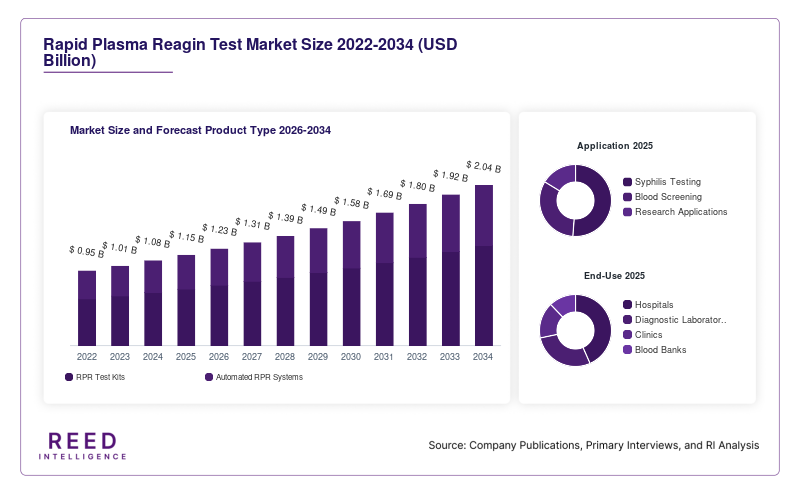
RPR test kits dominated the Rapid Plasma Reagin Test Market with a 54.2% share in 2025. Their widespread use in clinical and field settings was attributed to their affordability, ease of use, and rapid results. These kits are commonly used in screening programs and primary healthcare facilities.
Automated RPR systems are expected to grow at a CAGR of 7.4% during the forecast period. Their growth will be driven by increasing demand for high-throughput testing and improved diagnostic accuracy. Automation reduces manual errors and enhances efficiency in laboratory workflows.
By Application
Syphilis testing accounted for the largest share of 61.8% in 2025, reflecting the primary use of RPR tests in detecting this infection. The high prevalence of syphilis globally contributed to the dominance of this segment.
Blood screening applications are projected to grow at a CAGR of 6.9%. Increasing emphasis on ensuring blood safety and preventing transfusion-transmitted infections will drive demand in this segment.
By End-Use
Hospitals held the largest share of 41.5% in 2025, supported by their role as primary healthcare providers. Hospitals conduct a high volume of diagnostic tests, making them a key end-user segment.
Diagnostic laboratories are expected to grow at a CAGR of 7.0%. The expansion of laboratory networks and increasing outsourcing of diagnostic services will contribute to this growth.
By Distribution Channel
Direct sales dominated with a 48.7% share in 2025, driven by bulk procurement by hospitals and healthcare institutions. Manufacturers often prefer direct sales channels to maintain pricing control and customer relationships.
Online distribution channels are projected to grow at a CAGR of 7.2%. The increasing adoption of e-commerce platforms for medical supplies is expected to support this segment’s growth.
Regional Analysis
North America
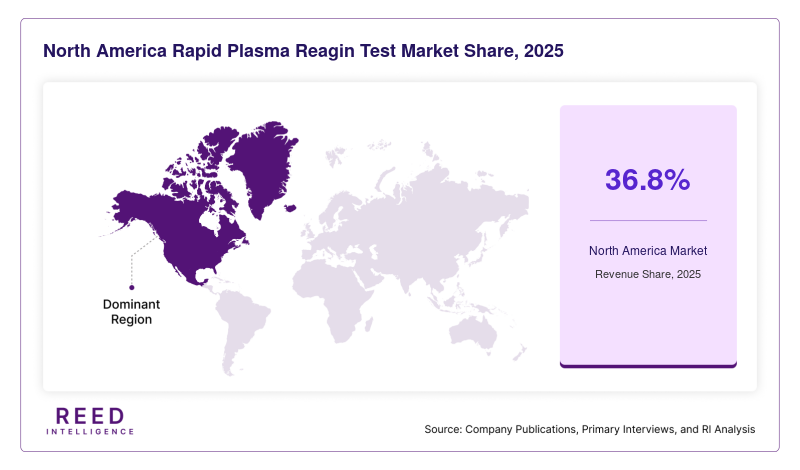
North America accounted for 36.8% of the Rapid Plasma Reagin Test Market in 2025 and is expected to grow at a CAGR of 5.8% during 2025–2034. The region benefited from well-established healthcare infrastructure and high awareness regarding STI screening. The presence of advanced diagnostic facilities and widespread adoption of routine screening programs supported market growth.
The United States dominated the regional market due to strong public health initiatives and extensive insurance coverage for diagnostic testing. The increasing integration of STI screening into preventive healthcare programs contributed to sustained demand for RPR tests.
Europe
Europe held a 27.5% share in 2025 and is projected to grow at a CAGR of 5.9% over the forecast period. The region experienced steady growth due to increasing focus on infectious disease control and preventive healthcare measures.
Germany emerged as the leading country in Europe, driven by strong healthcare policies and advanced laboratory infrastructure. The country’s emphasis on early disease detection and routine testing supported the adoption of RPR tests.
Asia Pacific
Asia Pacific represented 21.3% of the market in 2025 and is anticipated to grow at the fastest CAGR of 8.1%. The region’s growth was driven by rising population, increasing prevalence of STIs, and improving healthcare access.
China led the regional market due to large-scale public health programs and increasing investments in healthcare infrastructure. Government initiatives aimed at expanding diagnostic services in rural areas played a key role in market growth.
Middle East & Africa
The Middle East & Africa accounted for 8.2% of the market in 2025 and is expected to grow at a CAGR of 6.7%. The region showed growth potential due to increasing awareness and improving healthcare facilities.
South Africa dominated the region, supported by government-led STI control programs and increasing access to diagnostic services. Efforts to expand healthcare coverage contributed to market expansion.
Latin America
Latin America held a 6.2% share in 2025 and is projected to grow at a CAGR of 6.3%. The region experienced growth due to rising healthcare investments and increasing focus on disease prevention.
Brazil led the regional market, driven by public health campaigns and improved diagnostic infrastructure. The country’s focus on expanding access to healthcare services supported the adoption of RPR tests.
Competitive Landscape
The Rapid Plasma Reagin Test Market is moderately competitive, with several global and regional players focusing on product development and strategic partnerships. Key companies are investing in research to improve test accuracy and expand their product portfolios.
A leading player in the market is Abbott Laboratories, which has strengthened its position through continuous innovation in diagnostic solutions. The company recently introduced enhanced RPR testing kits designed to improve sensitivity and reduce false-positive results.
Other prominent players are focusing on expanding their geographic presence and collaborating with healthcare organizations to increase market penetration. Competitive strategies include mergers, acquisitions, and product launches aimed at meeting evolving diagnostic needs.
Key Players List
- Abbott Laboratories
- Siemens Healthineers
- Thermo Fisher Scientific Inc.
- Bio-Rad Laboratories, Inc.
- Becton, Dickinson and Company
- Danaher Corporation
- F. Hoffmann-La Roche Ltd.
- Meridian Bioscience, Inc.
- Trinity Biotech plc
- Cardinal Health, Inc.
- Sekisui Diagnostics
- Grifols, S.A.
- QuidelOrtho Corporation
- Creative Diagnostics
- Atlas Medical GmbH
Recent Developments
- In 2024, Abbott Laboratories launched an improved RPR test kit with enhanced diagnostic accuracy.
- In 2023, Siemens Healthineers expanded its diagnostic portfolio with automated testing solutions.
- In 2024, Bio-Rad Laboratories introduced new reagents for syphilis screening.
- In 2023, Trinity Biotech partnered with healthcare providers to expand testing access in emerging markets.
- In 2024, Thermo Fisher Scientific invested in R&D to develop advanced diagnostic kits.
Rapid Plasma Reagin Test Market Segments
Product Type
- RPR Test Kits
- Automated RPR Systems
Application
- Syphilis Testing
- Blood Screening
- Research Applications
End-Use
- Hospitals
- Diagnostic Laboratories
- Clinics
- Blood Banks
Distribution Channel
- Direct Sales
- Distributors
- Online Sales
By Region
- North America
- Europe
- APAC
- Middle East and Africa
- LATAM