Rare Neurodegenerative Disease Treatment Market Size, Share & Demand Report By Drug Type (Small Molecule Drugs, Biologics, Gene Therapy), By Disease Type (Huntington’s Disease, Spinocerebellar Ataxia, Multiple System Atrophy, Progressive Supranuclear Palsy), By Distribution Channel (Hospital Pharmacies, Retail Pharmacies, Specialty Pharmacies), By Region & Segment Forecasts, 2025–2034
USD 3950
Market Overview
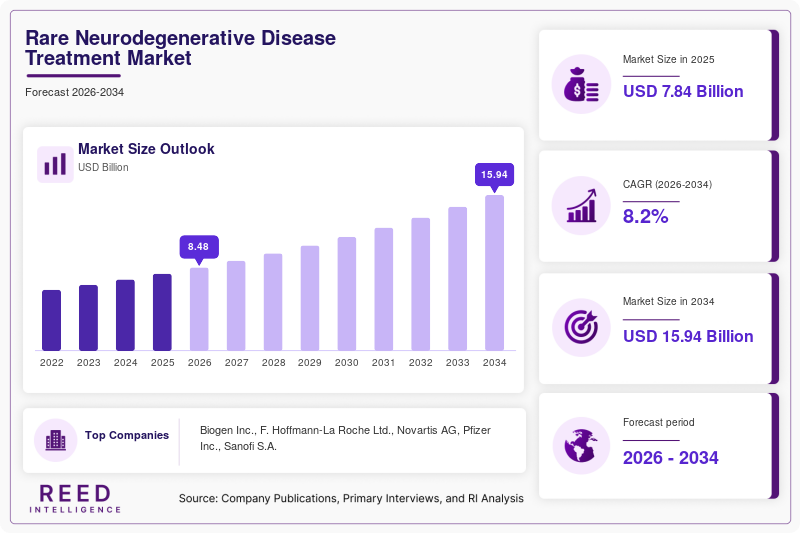
The Rare Neurodegenerative Disease Treatment Market size was valued at USD 7.84 billion in 2025 and is projected to reach USD 15.92 billion by 2034, expanding at a CAGR of 8.2% during 2025–2034. Rare neurodegenerative diseases include conditions such as Huntington’s disease, spinocerebellar ataxia, progressive supranuclear palsy, and multiple system atrophy. These disorders often lead to progressive neurological deterioration and require specialized treatment approaches involving disease-modifying therapies, symptomatic medications, and supportive care.
One global factor supporting the growth of the Rare Neurodegenerative Disease Treatment Market is the increasing focus on orphan drug development programs worldwide. Governments and regulatory agencies have introduced incentives for pharmaceutical companies to develop therapies targeting rare diseases. These incentives include market exclusivity benefits, tax credits for clinical trials, and accelerated regulatory review pathways. As a result, pharmaceutical companies and biotechnology firms have intensified research into rare neurological conditions.
Key Highlights
- North America accounted for 39.4% of the Rare Neurodegenerative Disease Treatment Market share in 2025, while Asia Pacific is projected to grow at a CAGR of 9.1% through 2034.
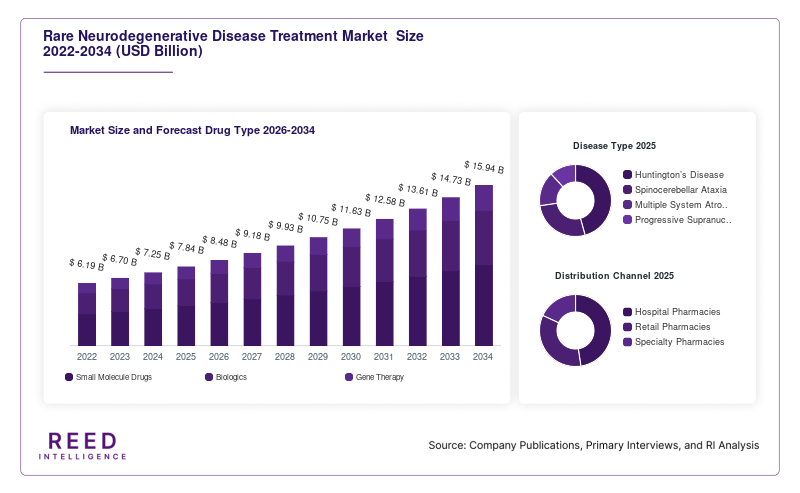
- Small molecule drugs dominated the drug type segment with 46.8% share, while gene therapies are expected to grow at 10.5% CAGR.
- Huntington’s disease treatments led the disease type segment with 34.7% share, while spinocerebellar ataxia therapies are projected to grow at 9.3% CAGR.
- The United States remained the dominant national market with USD 2.16 billion in 2025, expected to reach USD 2.32 billion in 2026
Market Trends
Expansion of Gene Therapy Research
A major trend influencing the Rare Neurodegenerative Disease Treatment Market is the expansion of gene therapy research targeting inherited neurological disorders. Many rare neurodegenerative diseases are linked to specific genetic mutations. Advances in gene editing and viral vector technologies have enabled researchers to explore therapies that modify or replace defective genes.
Biotechnology companies and academic research institutions are increasingly conducting clinical trials focused on gene-based therapies for rare neurological disorders. These therapies aim to slow disease progression or correct underlying genetic abnormalities. As gene therapy platforms continue to evolve, they are expected to influence future treatment strategies within the Rare Neurodegenerative Disease Treatment Market.
Development of Precision Medicine Approaches
Another significant trend shaping the Rare Neurodegenerative Disease Treatment Market is the growing adoption of precision medicine. Precision medicine involves tailoring treatments to the genetic and molecular characteristics of individual patients.
Advances in genomic sequencing technologies have allowed researchers to better understand the genetic mechanisms associated with rare neurological diseases. This has encouraged the development of targeted therapies designed for specific patient populations. The expansion of precision medicine initiatives is expected to contribute to innovation in rare neurodegenerative disease treatment strategies.
Market Drivers
Increasing Orphan Drug Approvals
The growing number of orphan drug approvals has been a major factor driving the Rare Neurodegenerative Disease Treatment Market. Regulatory authorities in multiple countries have introduced policies to encourage the development of treatments for rare diseases.
Pharmaceutical companies developing therapies for rare neurological conditions can benefit from regulatory incentives such as market exclusivity and expedited approval pathways. These incentives have increased investment in research programs focused on rare neurodegenerative disorders. As more therapies progress through clinical trials and regulatory approval processes, the treatment landscape for rare neurological diseases is expected to expand.
Rising Awareness of Rare Neurological Disorders
Increasing awareness of rare neurodegenerative diseases among healthcare professionals and patient communities has supported the growth of the Rare Neurodegenerative Disease Treatment Market. Advocacy organizations and medical associations have been promoting education programs focused on early diagnosis and treatment.
Improved awareness has encouraged healthcare providers to implement advanced diagnostic tools and refer patients to specialized neurological treatment centers. This has increased demand for targeted treatment options designed for rare neurological disorders.
Market Restraints
High Treatment Costs and Limited Accessibility
One of the major restraints affecting the Rare Neurodegenerative Disease Treatment Market is the high cost associated with developing and administering specialized therapies. Many treatments for rare neurodegenerative diseases involve complex biologics or advanced gene therapy technologies.
These therapies require extensive clinical research, specialized manufacturing processes, and strict regulatory compliance, which can significantly increase treatment costs. As a result, access to certain therapies may be limited for patients in regions with constrained healthcare funding.
Additionally, rare neurodegenerative diseases often require long-term treatment and continuous clinical monitoring. Healthcare providers must allocate specialized resources for managing these conditions, which can create additional cost burdens for healthcare systems.
Limited reimbursement coverage in certain healthcare markets may also restrict patient access to innovative therapies, affecting the broader expansion of the Rare Neurodegenerative Disease Treatment Market.
Market Opportunities
Expansion of Neurogenetic Research Programs
One emerging opportunity in the Rare Neurodegenerative Disease Treatment Market is the expansion of neurogenetic research programs. Advances in genetic sequencing and molecular biology are enabling researchers to identify specific gene mutations responsible for rare neurological disorders.
Research institutions and biotechnology companies are increasingly collaborating on large-scale genomic studies to uncover new therapeutic targets. These initiatives could lead to the development of novel treatment strategies that address the underlying causes of rare neurodegenerative diseases.
Growth of Specialized Neurological Treatment Centers
Another opportunity within the Rare Neurodegenerative Disease Treatment Market is the growing number of specialized neurological treatment centers. These centers provide advanced diagnostic and therapeutic services for patients with rare neurological conditions.
The establishment of dedicated treatment facilities allows healthcare providers to deliver specialized care and conduct clinical research programs focused on rare diseases. As healthcare systems continue to expand neurological care infrastructure, demand for innovative treatment options is expected to increase.
Segmental Analysis
By Drug Type
The Small Molecule Drugs segment dominated the Rare Neurodegenerative Disease Treatment Market, accounting for 46.8% of the market share in 2025. These drugs are widely used in neurological treatment due to their ability to cross the blood–brain barrier and influence biochemical pathways associated with disease progression.
The Gene Therapy segment is projected to grow at the fastest CAGR of 10.5% during the forecast period. Gene therapies aim to address genetic mutations responsible for certain rare neurodegenerative disorders. Increasing clinical research efforts are expected to drive growth in this segment.
By Disease Type
The Huntington’s Disease segment accounted for 34.7% of the Rare Neurodegenerative Disease Treatment Market share in 2025. The disease has been widely studied in neurological research, leading to the development of multiple therapeutic approaches designed to manage symptoms and slow disease progression.
The Spinocerebellar Ataxia segment is projected to grow at a CAGR of 9.3% during the forecast period. Advances in genetic testing and biomarker research are expected to improve diagnosis and support the development of targeted therapies.
By Distribution Channel
The Hospital Pharmacies segment held the largest share of 43.5% in 2025. Patients receiving treatment for rare neurodegenerative diseases often require specialized medications administered under medical supervision.
The Specialty Pharmacies segment is expected to grow at a CAGR of 8.7% through 2034. These pharmacies focus on distributing specialized medications used for complex and rare medical conditions, supporting improved patient access to advanced therapies.
Regional Analysis
North America
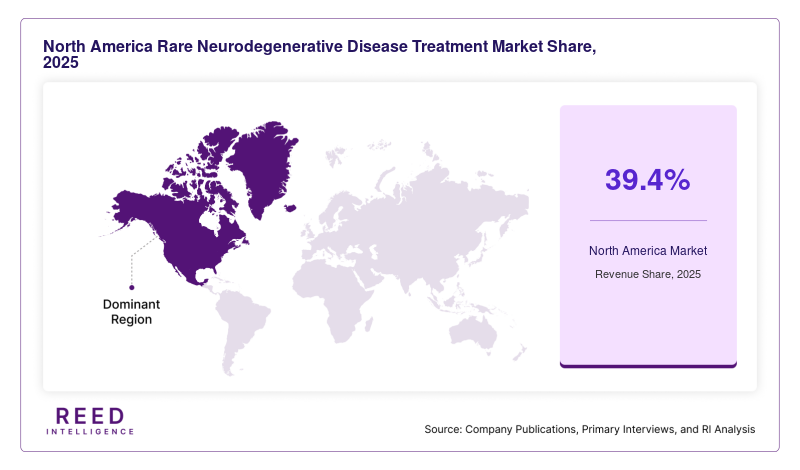
North America accounted for 39.4% of the Rare Neurodegenerative Disease Treatment Market share in 2025. The regional market is projected to grow at a CAGR of 7.9% during 2025–2034. The region has maintained a strong presence in pharmaceutical innovation and neurological research.
The United States dominated the regional market due to its advanced biotechnology sector and extensive clinical research infrastructure. Numerous pharmaceutical companies and research institutions conduct clinical trials focused on rare neurological disorders in the country.
Europe
Europe represented 28.2% of the Rare Neurodegenerative Disease Treatment Market share in 2025 and is expected to grow at a CAGR of 7.6% through 2034. Several European countries have implemented national strategies for rare disease research and treatment development.
Germany emerged as the dominant national market in Europe due to its strong pharmaceutical industry and established neurological research institutions. The country also supports multiple clinical trial programs targeting rare neurological diseases.
Asia Pacific
Asia Pacific held 20.1% of the Rare Neurodegenerative Disease Treatment Market share in 2025 and is projected to grow at the fastest CAGR of 9.1% during the forecast period. Expanding healthcare infrastructure and growing pharmaceutical research capabilities have supported regional market growth.
Japan dominated the regional market due to its strong biotechnology research ecosystem and government initiatives supporting rare disease treatment development.
Middle East & Africa
The Middle East & Africa accounted for 6.7% of the Rare Neurodegenerative Disease Treatment Market share in 2025 and is projected to grow at a CAGR of 6.8% through 2034. Healthcare systems in several countries within the region have been expanding neurological diagnostic capabilities.
Saudi Arabia emerged as the dominant national market due to ongoing healthcare modernization programs and investments in specialized medical facilities.
Latin America
Latin America held 5.6% of the Rare Neurodegenerative Disease Treatment Market share in 2025 and is forecast to grow at a CAGR of 6.4% during 2025–2034. Regional healthcare systems have been expanding neurological treatment services and clinical research programs.
Brazil dominated the regional market due to its growing pharmaceutical industry and increasing focus on rare disease treatment initiatives.
Competitive Landscape
The Rare Neurodegenerative Disease Treatment Market includes several pharmaceutical and biotechnology companies focused on developing therapies for rare neurological disorders. Companies compete through research innovation, clinical trial development, and strategic collaborations with research institutions.
Biogen Inc. is recognized as a leading company in the market due to its extensive experience in neurological drug development and rare disease research. The company recently advanced a new investigational therapy targeting genetic mechanisms associated with rare neurodegenerative disorders.
Other pharmaceutical companies are focusing on expanding their rare disease pipelines and investing in gene therapy technologies to address unmet medical needs in neurological treatment.
Key Players
- Biogen Inc.
- F. Hoffmann-La Roche Ltd.
- Novartis AG
- Pfizer Inc.
- Sanofi S.A.
- Takeda Pharmaceutical Company Limited
- Amgen Inc.
- Ionis Pharmaceuticals Inc.
- Sarepta Therapeutics Inc.
- BioMarin Pharmaceutical Inc.
- Ultragenyx Pharmaceutical Inc.
- Vertex Pharmaceuticals Incorporated
- Alexion Pharmaceuticals Inc.
- Eisai Co., Ltd.
- Astellas Pharma Inc.
Recent Developments
- 2024: Biogen advanced clinical trials for a gene therapy candidate targeting rare neurodegenerative diseases.
- 2023: Novartis expanded research programs focused on neurological genetic disorders.
- 2023: Roche strengthened its rare disease treatment portfolio through new research collaborations.
- 2022: Takeda Pharmaceutical increased investment in neurological rare disease therapy development.
Rare Neurodegenerative Disease Treatment Market Segments
Drug Type
- Small Molecule Drugs
- Biologics
- Gene Therapy
Disease Type
- Huntington’s Disease
- Spinocerebellar Ataxia
- Multiple System Atrophy
- Progressive Supranuclear Palsy
Distribution Channel
- Hospital Pharmacies
- Retail Pharmacies
- Specialty Pharmacies
By Region
- North America
- Europe
- APAC
- Middle East and Africa
- LATAM