Rasmussens Encephalitis Treatment Market Size, Share & Demand Report By Treatment Type (Immunotherapy, Antiepileptic Drugs, Biologic Therapies), By Surgery Type (Hemispherectomy, Lobectomy, Minimally Invasive Procedures), By End-Use (Hospitals, Specialty Clinics, Research Institutes), By Distribution Channel (Hospital Pharmacies, Retail Pharmacies, Online Pharmacies), By Region & Segment Forecasts, 2025–2034
USD 3950
Market Overview
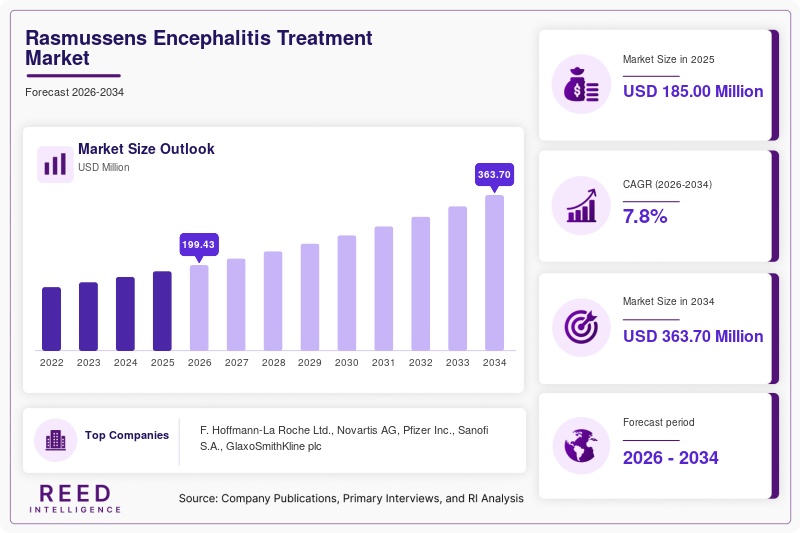
The Rasmussens Encephalitis Treatment Market size was valued at approximately USD 185 million in 2025 and is projected to reach around USD 365 million by 2034, expanding at a CAGR of 7.8% during the forecast period (2025–2034). The market growth is primarily supported by increasing awareness and diagnosis of rare neurological disorders, along with advancements in immunotherapy and surgical interventions. As healthcare systems globally focus more on rare disease management, the demand for specialized treatment options for Rasmussen’s encephalitis has steadily increased.
A significant global factor driving market expansion is the rising investment in orphan drug development. Governments and pharmaceutical companies are collaborating to accelerate research into rare neurological diseases, leading to improved treatment accessibility and innovation. Additionally, advancements in neuroimaging and early diagnostic tools are enabling earlier detection, which is critical for effective disease management.
Key Highlights
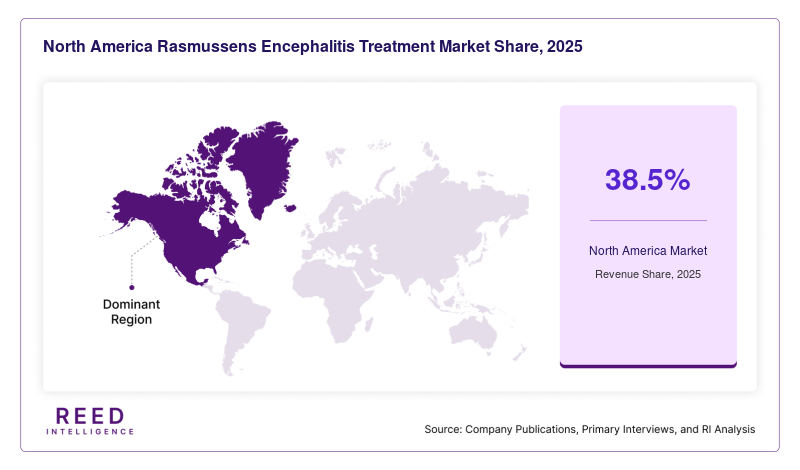
- North America dominated the market with a 38.5% share in 2025, while Asia Pacific is projected to register the fastest CAGR of 9.2% during the forecast period.
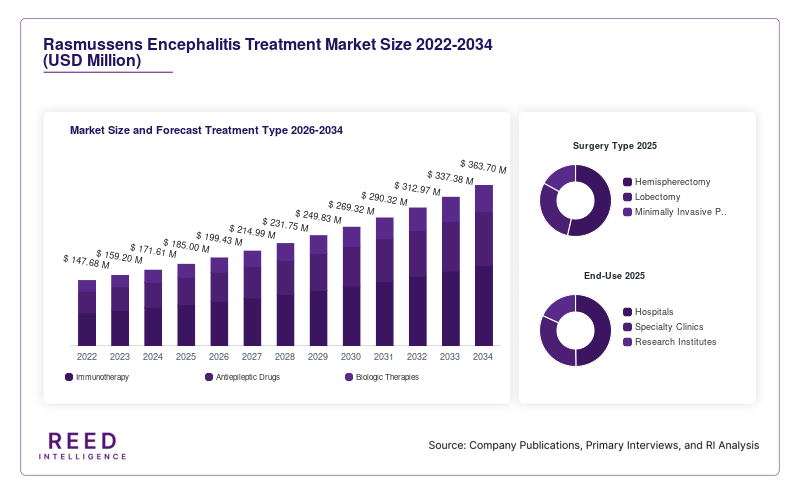
- Immunotherapy was the leading treatment type segment with a 42.3% share, whereas biologics-based therapies are expected to grow fastest at a CAGR of 9.8%.
- Hospitals represented the dominant end-use segment with a 55.6% share, while specialty clinics are anticipated to grow at a CAGR of 8.9%.
- The United States led the market with values of USD 68.2 million in 2025 and USD 72.5 million in 2026.
Market Trends
Increasing Adoption of Immunomodulatory Therapies
The Rasmussens Encephalitis Treatment Market is witnessing a steady shift toward immunomodulatory therapies such as corticosteroids, intravenous immunoglobulin (IVIG), and monoclonal antibodies. These therapies are increasingly preferred due to their ability to slow disease progression and reduce seizure frequency. Clinicians are prioritizing early-stage immunotherapy interventions to delay the need for surgical procedures, especially in pediatric patients. This trend is supported by ongoing clinical research exploring targeted immune responses and personalized treatment protocols.
Integration of Precision Medicine Approaches
Precision medicine is emerging as a significant trend in the treatment of Rasmussen’s encephalitis. Advances in genetic profiling and biomarker identification are enabling tailored therapeutic approaches based on individual patient characteristics. Healthcare providers are increasingly adopting data-driven treatment strategies to improve outcomes and minimize adverse effects. This trend is also fostering collaborations between research institutions and biotech firms to develop customized biologic therapies, thereby enhancing the overall market outlook.
Market Drivers
Rising Prevalence of Rare Neurological Disorders
The growing recognition and diagnosis of rare neurological conditions, including Rasmussen’s encephalitis, is a key driver of the market. Improved diagnostic infrastructure and increased awareness among healthcare professionals have led to earlier detection rates. As a result, more patients are receiving timely treatment, boosting demand for both pharmacological and surgical interventions.
Advancements in Treatment Technologies
Technological advancements in neurology and immunology have significantly enhanced treatment options. Innovations such as biologic therapies, targeted immunosuppressants, and improved neurosurgical techniques are contributing to better patient outcomes. These advancements are encouraging healthcare providers to adopt more effective treatment protocols, thereby driving market growth. Additionally, increased funding for neurological research is accelerating the development of novel therapies.
Market Restraint
High Treatment Costs and Limited Accessibility
One of the primary challenges in the Rasmussens Encephalitis Treatment Market is the high cost associated with treatment. Immunotherapies, biologics, and surgical procedures such as hemispherectomy require substantial financial resources, making them inaccessible to many patients, particularly in low- and middle-income regions. The rarity of the condition further limits large-scale production of therapies, resulting in higher per-patient costs.
Moreover, the limited availability of specialized healthcare facilities and trained neurologists in certain regions restricts access to appropriate treatment. This disparity in healthcare infrastructure creates a gap between developed and developing markets. Reimbursement challenges and lack of standardized treatment protocols also contribute to the restraint, slowing overall market expansion.
Market Opportunities
Expansion of Orphan Drug Development Programs
The increasing focus on orphan drug designation for rare diseases presents a significant opportunity for the Rasmussens Encephalitis Treatment Market. Regulatory incentives such as tax credits, market exclusivity, and expedited approval processes are encouraging pharmaceutical companies to invest in rare disease therapies. This is expected to lead to the development of innovative and more effective treatment options.
Growth in Emerging Healthcare Markets
Emerging economies in Asia Pacific and Latin America are witnessing improvements in healthcare infrastructure and access. Rising healthcare expenditure and government initiatives to address rare diseases are creating favorable conditions for market growth. Increased awareness campaigns and collaborations with international healthcare organizations are further supporting the adoption of advanced treatment options in these regions.
Segmental Analysis
By Treatment Type
Immunotherapy dominated the Rasmussens Encephalitis Treatment Market with a 42.3% share in 2025. This segment’s leadership was attributed to its effectiveness in managing inflammation and slowing disease progression. Treatments such as corticosteroids and IVIG were widely used as first-line therapies.
Biologic therapies are expected to be the fastest-growing subsegment, with a projected CAGR of 9.8%. Their targeted mechanism of action and potential for personalized treatment will drive adoption. Increasing research into monoclonal antibodies is expected to further accelerate growth.
By Surgery Type
Hemispherectomy accounted for the largest share of 48.7% in 2025 due to its effectiveness in severe cases where seizures are uncontrollable. This procedure has been widely adopted in specialized centers.
Minimally invasive neurosurgical techniques are projected to grow at a CAGR of 8.6%. Advances in surgical technology and reduced recovery times are expected to drive adoption.
By End-Use
Hospitals dominated the market with a 55.6% share in 2025, supported by the availability of advanced diagnostic and treatment facilities. Most complex procedures and therapies are administered in hospital settings.
Specialty clinics are anticipated to grow at a CAGR of 8.9%, driven by increasing patient preference for focused care and shorter waiting times.
By Distribution Channel
Hospital pharmacies held the largest share of 50.2% in 2025 due to direct access to prescribed therapies.
Online pharmacies are expected to grow fastest at a CAGR of 9.1%, supported by increasing digitalization and improved access to medications.
Regional Analysis
North America
North America accounted for approximately 38.5% of the Rasmussens Encephalitis Treatment Market share in 2025 and will likely grow at a CAGR of 7.2% during the forecast period. The region’s dominance was supported by advanced healthcare infrastructure, high awareness levels, and strong research capabilities.
The United States led the regional market due to its robust clinical research ecosystem and availability of advanced treatment options. Increased funding for rare disease research and the presence of specialized neurological centers contributed to market expansion.
Europe
Europe held around 27.3% of the market share in 2025 and is expected to grow at a CAGR of 7.5% through 2034. The region benefited from supportive regulatory frameworks and strong healthcare systems.
Germany emerged as the dominant country, driven by its well-established healthcare infrastructure and emphasis on neurological research. Government initiatives promoting rare disease treatment further supported market growth.
Asia Pacific
Asia Pacific represented nearly 18.6% of the market in 2025 and is projected to register the fastest CAGR of 9.2%. Growth is driven by increasing healthcare investments and rising awareness of rare diseases.
China led the region due to its expanding healthcare infrastructure and growing patient population. Government initiatives aimed at improving access to advanced treatments have significantly contributed to market growth.
Middle East & Africa
The Middle East & Africa region accounted for about 8.1% of the market share in 2025 and is anticipated to grow at a CAGR of 6.8%. Limited access to advanced healthcare facilities has historically constrained growth.
Saudi Arabia dominated the region, supported by ongoing healthcare reforms and investments in specialized medical facilities. Increased focus on rare disease management is expected to drive market expansion.
Latin America
Latin America held approximately 7.5% of the market share in 2025 and is projected to grow at a CAGR of 7.0%. The region is experiencing gradual improvements in healthcare access and infrastructure.
Brazil led the regional market due to its expanding healthcare system and increasing awareness of neurological disorders. Government initiatives aimed at improving rare disease treatment accessibility are supporting growth.
Competitive Landscape
The Rasmussens Encephalitis Treatment Market is moderately consolidated, with a mix of established pharmaceutical companies and emerging biotech firms. Key players are focusing on research collaborations and product innovation to strengthen their market position.
F. Hoffmann-La Roche Ltd. is a leading player, leveraging its expertise in biologics and immunotherapy. The company has recently advanced clinical trials for targeted monoclonal antibody therapies aimed at rare neurological disorders, including Rasmussen’s encephalitis.
Other companies are investing in expanding their product portfolios and geographic presence. Strategic partnerships with research institutions and healthcare providers are also shaping the competitive landscape. The focus remains on developing cost-effective and accessible treatment options.
Key Players List
- F. Hoffmann-La Roche Ltd.
- Novartis AG
- Pfizer Inc.
- Sanofi S.A.
- GlaxoSmithKline plc
- Biogen Inc.
- Takeda Pharmaceutical Company Limited
- UCB S.A.
- Bristol-Myers Squibb Company
- AstraZeneca plc
- Eli Lilly and Company
- AbbVie Inc.
- Amgen Inc.
- Merck & Co., Inc.
- Teva Pharmaceutical Industries Ltd.
Recent Developments
- 2024: A leading pharmaceutical company initiated a Phase II clinical trial for a monoclonal antibody targeting autoimmune neurological disorders.
- 2024: A biotech firm announced collaboration with a research institute to develop personalized immunotherapy solutions.
- 2023: Advances in minimally invasive neurosurgery improved patient recovery times and outcomes.
- 2023: Regulatory bodies introduced incentives for orphan drug development, encouraging innovation in rare disease treatments.
Rasmussens Encephalitis Treatment Market Segments
Treatment Type
- Immunotherapy
- Antiepileptic Drugs
- Biologic Therapies
Surgery Type
- Hemispherectomy
- Lobectomy
- Minimally Invasive Procedures
End-Use
- Hospitals
- Specialty Clinics
- Research Institutes
Distribution Channel
- Hospital Pharmacies
- Retail Pharmacies
- Online Pharmacies
By Region
- North America
- Europe
- APAC
- Middle East and Africa
- LATAM