Real Estate Consulting Service Market Size, Share & Trends Analysis Report By Service Type (Transaction Advisory, Valuation & Advisory, Strategic Consulting, Project & Development Consulting, Property & Asset Consulting), By Property Type (Commercial Real Estate, Residential Real Estate, Industrial & Logistics), By End User (Investors & Funds, Developers, Corporates & Occupiers), By Deployment Model (On-Site, Remote & Digital, Hybrid) and By Region (North America, Europe, APAC, Middle East and A
USD 3950
Real Estate Consulting Service Market Size
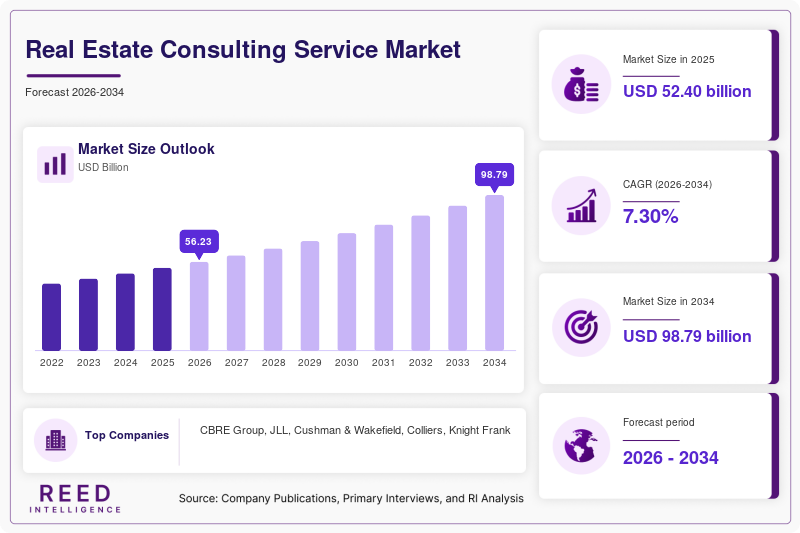
The global Real Estate Consulting Service Market size was valued at USD 52.40 billion in 2025 and is projected to grow from USD 56.23 billion in 2026 to USD 98.79 billion by 2034, registering a CAGR of 7.30% during the forecast period from 2026 to 2034.
The Real Estate Consulting Service Market is becoming more data-intensive and strategically integrated as investors, developers and occupiers face changing interest rates, asset repricing, sustainability requirements, AI-driven infrastructure demand and increasingly complex development decisions. Real estate consultants are moving beyond traditional brokerage and valuation toward integrated advisory covering capital markets, portfolio strategy, development feasibility, workplace planning, ESG, digital infrastructure and risk.
The current market environment is showing stronger transaction activity. JLL reported that its first-quarter 2026 Capital Markets Services revenue increased 21% in local currency, while Leasing Advisory increased 16%, indicating improved activity across investment and occupier markets. CBRE also reported 19% overall revenue growth in Q1 2026, with its three services segments Advisory, Building Operations & Experience and Project Management growing revenue 20%.
Investment decisions are increasingly concentrated in sectors where demand is supported by structural trends. JLL identifies data centers, living, industrial/logistics and selected high-quality offices as important areas of capital activity in 2026. Colliers likewise reports renewed institutional capital deployment, with investors becoming more selective and favoring active strategies, redevelopment and sectors such as residential and data centers.
Real Estate Consulting Service Market Drivers
Recovery in Real Estate Investment and Capital Markets
Real estate consulting demand is closely linked to transaction volume because investors require market studies, valuations, due diligence, financing advice, feasibility analysis and transaction execution. After several years of elevated interest rates and valuation uncertainty, capital-market activity has started to recover.
CBRE expects U.S. commercial real estate investment volume to increase 16% in 2026, with sellers becoming more realistic on pricing and buyer activity increasing. JLL's global market data similarly shows stronger transaction activity, supported by improving debt markets and available capital.
The commercial mechanism is direct: more acquisitions, dispositions, refinancing transactions and development decisions create additional demand for valuation, investment advisory, market intelligence and due-diligence services. Consultants with transaction data, local teams and cross-border capital relationships can capture a larger share of this spending.
The counterbalance is that capital remains selective. Colliers reports that investors are increasingly favoring active strategies and diversification rather than returning indiscriminately to all property sectors.
Data Centers, AI Infrastructure and Specialized Assets Require More Complex Advisory
AI and cloud computing are changing real estate investment decisions because data centers require large amounts of power, land, cooling infrastructure, connectivity and regulatory approvals. PwC and ULI identify AI infrastructure as one of the major real estate opportunities in 2026, while also noting power shortages and supply bottlenecks.
This creates consulting requirements that extend well beyond conventional property brokerage. Developers need site selection, power-access analysis, infrastructure planning, financial modeling, market studies, permitting support and development management.
Cushman & Wakefield's consulting platform illustrates this expansion, with dedicated data-center advisory covering market strategy, site selection, development, sustainability and regulatory requirements. Colliers similarly provides data-center consulting and project-management services in Indian markets, including Hyderabad, Mumbai, Chennai and Pune.
As specialized assets become more important, consulting firms can increase revenue per assignment because projects require multidisciplinary expertise.
ESG, Climate Risk and Regulatory Requirements Are Expanding Advisory Scope
Sustainability is increasingly becoming part of valuation, investment underwriting and asset strategy rather than a separate reporting exercise. RICS' fourth edition of its global professional standard on ESG and sustainability in commercial property valuation became effective on 30 April 2026 and provides guidance on how material ESG factors should be incorporated into valuation advice.
The market mechanism is important: energy performance, retrofit expenditure, regulatory compliance, climate exposure and building obsolescence can affect operating costs, financing and asset value. This creates demand for ESG due diligence, decarbonization planning, energy analysis, sustainability certification and climate-risk assessment.
Cushman & Wakefield's consulting practice includes ESG and sustainability solutions, renewable-energy advisory, developers-and-funds advisory and infrastructure consulting.
The opportunity is strongest for firms able to connect ESG analysis with financial outcomes rather than treating sustainability as a standalone reporting service.
Real Estate Consulting Service Market Restraints
Real Estate Cyclicality Can Reduce Transaction-Linked Consulting Revenue
Consulting firms with significant exposure to capital markets and leasing remain sensitive to property transaction cycles. CBRE notes that transactional revenue is less predictable than resilient businesses such as facilities management and project management.
Higher interest rates, financing constraints, geopolitical uncertainty or falling property values can delay acquisitions and development projects. This directly reduces demand for transaction advisory, brokerage and some valuation assignments.
The market is responding through diversification. CBRE's business mix has increasingly shifted toward resilient revenue sources such as occupier outsourcing and project management. This creates a structural incentive for consultants to broaden service portfolios.
Shortage of Specialized Talent and Data Quality Challenges
Modern real estate consulting increasingly requires professionals who understand property markets, finance, engineering, ESG, technology, data science and regulatory requirements. The need for multidisciplinary teams increases operating costs and makes experienced talent strategically important.
AI also creates a data-governance challenge. RICS' emerging guidance on AI in valuation emphasizes responsible use, professional judgment, transparency and verification of information generated or processed through AI systems.
Consultants therefore cannot simply replace professional judgment with automated models. They must combine technology with verified market data and qualified professionals, particularly in valuations, lending decisions and complex development assignments.
Real Estate Consulting Service Market Opportunities
AI-Enabled Valuation and Real Estate Analytics
AI is creating a new layer of demand for automated valuation models, market forecasting, portfolio analytics, document processing and scenario analysis. RICS is developing global guidance specifically addressing AI applications in real estate valuation, including data reliability, professional judgment and accountability.
JLL is already integrating AI-powered analytics into enterprise real estate services. Its 2026 global engagement with Nestlé combines strategic advisory and leasing transaction management across 130 countries with AI-enabled tools including JLL Azara and Horizon.
The commercial opportunity is to reduce analytical turnaround time while allowing consultants to handle larger portfolios. The value proposition remains strongest where AI improves decision support rather than replacing regulated professional conclusions.
Data Center and Digital Infrastructure Consulting
Data centers represent a specialized advisory opportunity because land, electricity, water, fiber connectivity, permitting and cooling capacity must be assessed together. PwC identifies power availability as a major constraint on AI infrastructure expansion, while JLL reports record data-center capital activity.
Consultants can therefore sell integrated site-selection, feasibility, valuation, capital-markets, project-management and sustainability services. This increases the addressable consulting spend associated with each development.
Portfolio Optimization and Corporate Real Estate Strategy
Large occupiers are increasingly reconsidering fixed real estate footprints because hybrid work, changing labor markets and business restructuring affect office, industrial and retail requirements.
JLL's Nestlé mandate illustrates this shift toward an "elastic portfolio" approach, integrating leasing transactions and strategic advisory across office, industrial and retail assets in 130 countries.
This creates recurring consulting opportunities around lease restructuring, location strategy, workplace planning, portfolio consolidation, site selection and transaction management.
Segmental Analysis
By Service Type
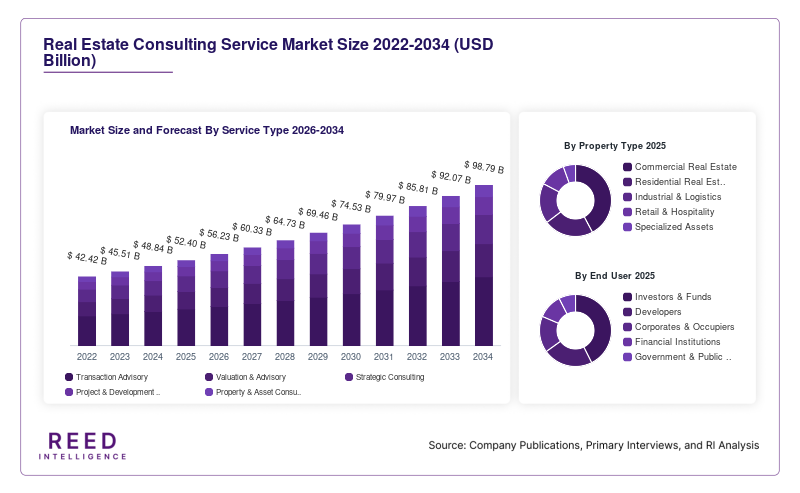
Transaction Advisory represents approximately 29% of the global market in 2025, supported by acquisitions, dispositions, leasing decisions, financing transactions and portfolio restructuring.
Valuation & Advisory accounts for approximately 21%, while Strategic Consulting represents approximately 19%. Project & Development Consulting contributes approximately 17%, and Property & Asset Consulting accounts for approximately 14%.
Strategic Consulting is the fastest-growing service category, with an estimated 8.5% CAGR through 2034. Demand is shifting toward integrated decisions involving portfolio strategy, workplace transformation, development feasibility, sustainability, data centers and operational efficiency. Cushman & Wakefield's consulting platform includes strategic consulting, ESG, renewable energy, infrastructure, developers-and-funds advisory and data-center research and advisory, illustrating the broadening scope of this category.
By Property Type
Commercial Real Estate represents approximately 32% of the market in 2025, reflecting the breadth of office, mixed-use and other business-property advisory requirements.
Industrial & Logistics represents approximately 24%, supported by supply-chain restructuring, e-commerce and logistics demand. Residential Real Estate accounts for 21%, while Retail & Hospitality represents 14%.
Specialized Assets account for approximately 9% but are the fastest-growing category, with a CAGR of approximately 10.2%. Data centers, life sciences, healthcare, senior housing, renewable-energy infrastructure and other specialized properties require more technical and financial analysis than conventional real estate.
JLL identifies data centers as a leading capital-flow segment, while PwC highlights AI infrastructure and senior housing among the major 2026 real estate themes.
By End User
Investors & Funds represent approximately 34% of the market in 2025. These customers require investment underwriting, market studies, valuations, portfolio strategy, capital-markets execution and asset-level analysis.
Developers account for approximately 26%, followed by Corporates & Occupiers at 22%, Financial Institutions at 12% and Government & Public Sector at 6%.
Corporates & Occupiers are the fastest-growing end-user segment, with approximately 8.4% CAGR, driven by portfolio optimization, workplace strategy, lease restructuring and integrated transaction management.
JLL's Nestlé mandate demonstrates this shift toward enterprise-wide real estate strategy, with leasing transaction management and strategic advisory integrated across 130 countries.
By Deployment Model
On-Site Consulting accounts for approximately 46% of the market in 2025, particularly for valuation inspections, development projects, due diligence, construction monitoring and complex property assignments.
Hybrid Consulting represents approximately 34%, combining physical market knowledge with digital analytics and remote advisory.
Remote & Digital Consulting represents approximately 20% and is the fastest-growing deployment model, with approximately 11.3% CAGR. Digital valuation, portfolio analytics, virtual due diligence, AI-supported market research and centralized enterprise platforms are increasing the proportion of work that can be delivered remotely.
RICS' work on AI and automated valuation models reflects this transition while emphasizing that technology must remain subject to professional oversight.
Regional Analysis
North America Real Estate Consulting Service Market
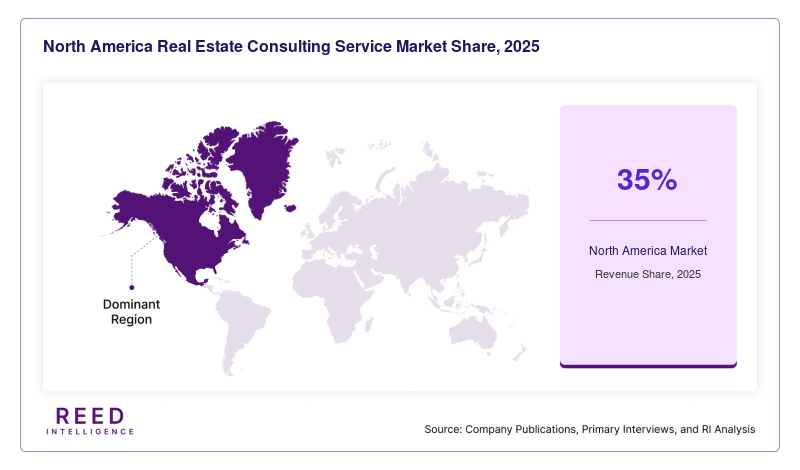
North America represents approximately 35% of the global Real Estate Consulting Service Market in 2025. The region benefits from deep capital markets, large institutional investor bases, extensive commercial real estate stock and strong demand for specialized advisory.
The U.S. market entered 2026 with improving transaction conditions. CBRE expects investment volume to increase 16% in 2026, while JLL reported strong first-quarter growth in capital markets and leasing advisory.
Consulting demand is particularly strong around data centers, multifamily, industrial/logistics and high-quality office assets. Colliers reports that U.S. multifamily and industrial remain important capital-allocation targets, while data centers are attracting substantial investment because of AI infrastructure demand.
North America is projected to grow at approximately 6.8% CAGR through 2034. The region's mature consulting ecosystem creates strong demand for integrated advisory, although market cyclicality and office-sector bifurcation remain constraints.
Europe Real Estate Consulting Service Market
Europe accounts for approximately 27% of the global market in 2025. The region combines mature institutional real estate markets with increasingly complex ESG, energy, regulatory and redevelopment requirements.
RICS' updated ESG valuation standard, effective from April 2026, provides a global framework with jurisdiction-specific provisions for the UK, EU and Australia. This increases the importance of sustainability expertise in valuation and investment decisions.
Investment activity is also improving. Colliers reported renewed capital-market momentum across Europe and identified residential, data centers and senior living as important destinations for capital.
Strategic Consulting and Valuation & Advisory benefit from the region's need to assess retrofit costs, energy performance, regulatory exposure and asset obsolescence. Europe is projected to grow at approximately 6.5% CAGR.
APAC Real Estate Consulting Service Market
APAC represents approximately 22% of the global market in 2025 and is the fastest-growing region, with approximately 9.4% CAGR.
Capital flows are recovering strongly. Colliers reported that Asia Pacific recorded its strongest first half for real estate investment since 2022 in H1 2026, with increasing cross-border capital and renewed investor appetite for traditional real estate sectors.
India is particularly important because of expanding office, residential, logistics, data-center and infrastructure development. JLL ranked first in India's 2025 real estate capital-markets advisory by transaction value, reporting USD 4.3 billion of advised transactions and 48% market share according to MSCI Real Capital Analytics.
Colliers also moved to full ownership of its India business in December 2025, citing investment in talent, technology, sustainability and capabilities across service lines.
Data-center consulting is another major growth mechanism because rapid digital adoption requires site selection, power analysis, regulatory approvals and sustainability planning.
Middle East and Africa Real Estate Consulting Service Market
Middle East and Africa represents approximately 8% of the global market in 2025 and is expected to grow at approximately 8.6% CAGR.
The region's consulting demand is increasingly connected to large-scale urban development, tourism, logistics, infrastructure, mixed-use projects and sovereign investment. Consultants support feasibility analysis, development strategy, capital structuring, project management and asset operations.
Data centers are also becoming more important. Cushman & Wakefield's regional data-center advisory work identifies power availability, grid access and regulation as increasingly important development variables.
Large development programs create demand for multidisciplinary consulting because land, infrastructure, financing, sustainability and development phasing must be analyzed simultaneously.
The main constraints are differences in market maturity, regulatory frameworks, financing conditions and geopolitical exposure across individual countries.
LATAM Real Estate Consulting Service Market
LATAM accounts for approximately 8% of the global market in 2025 and is projected to grow at approximately 7.7% CAGR.
Brazil and Mexico provide the region's largest consulting ecosystems, supported by commercial real estate, logistics, industrial, residential and infrastructure activity.
JLL appointed a new CEO for Brazil in May 2026 as part of a regional integration and growth strategy, while maintaining its broader Work Dynamics and real estate services platform across Latin America.
Consulting demand is increasingly linked to industrial and logistics development, corporate portfolio strategy, investment advisory and infrastructure. The region also provides opportunities for international investors seeking diversification and local market expertise.
Currency volatility, financing costs and uneven data availability remain important constraints, increasing the value of local market knowledge and risk analysis.
Competitive Landscape
The Real Estate Consulting Service Market is highly competitive and relatively concentrated among global professional-services firms with large research databases, multidisciplinary teams and international transaction networks. CBRE, JLL, Cushman & Wakefield, Colliers and Knight Frank compete across combinations of capital markets, leasing, valuation, strategic consulting, project management, ESG and property services.
CBRE generated USD 8.84 billion of 2025 Advisory Services revenue, covering leasing, capital markets, loan servicing and valuation, while its broader platform also includes building operations, project management and real estate investment services.
JLL generated USD 20.0 billion of 2025 Real Estate Management Services revenue, USD 3.0 billion from Leasing Advisory and USD 2.4 billion from Capital Markets Services, demonstrating the scale of its integrated model.
Key Market Players
Recent Market Developments
- September 2026 – JLL selected by Nestlé for global real estate portfolio services. The agreement covers leasing transaction management and strategic advisory across 130 countries and incorporates AI-powered analytics through JLL Azara and Horizon. This strengthens the integrated enterprise-consulting model.
- June 2026 – Cushman & Wakefield appointed a Global Head of Sustainability Services. The appointment expanded the firm's focus on sustainability consulting as ESG requirements increasingly affect asset strategy and operating performance.
Real Estate Consulting Service Market Segments
By Service Type
- Transaction Advisory
- Valuation & Advisory
- Strategic Consulting
- Project & Development Consulting
- Property & Asset Consulting
By Property Type
- Commercial Real Estate
- Residential Real Estate
- Industrial & Logistics
- Retail & Hospitality
- Specialized Assets
By End User
- Investors & Funds
- Developers
- Corporates & Occupiers
- Financial Institutions
- Government & Public Sector
By Deployment Model
- On-Site
- Remote & Digital
- Hybrid
By Region
- North America
- Europe
- APAC
- Middle East and Africa
- LATAM