Real Estate Development Market Size, Share, Growth Analysis Report By Property Type (Residential Development, Commercial Development, Industrial Development, Mixed-Use Development), By Project Scale (Small-Scale Developments, Medium-Scale Developments, Large-Scale Developments, Mega-Development Projects), By End User (Private Investors, Institutional Investors, Corporate Occupiers, Government Sector), Regional Outlook & Forecast 2026–2034
USD 3950
Market Overview
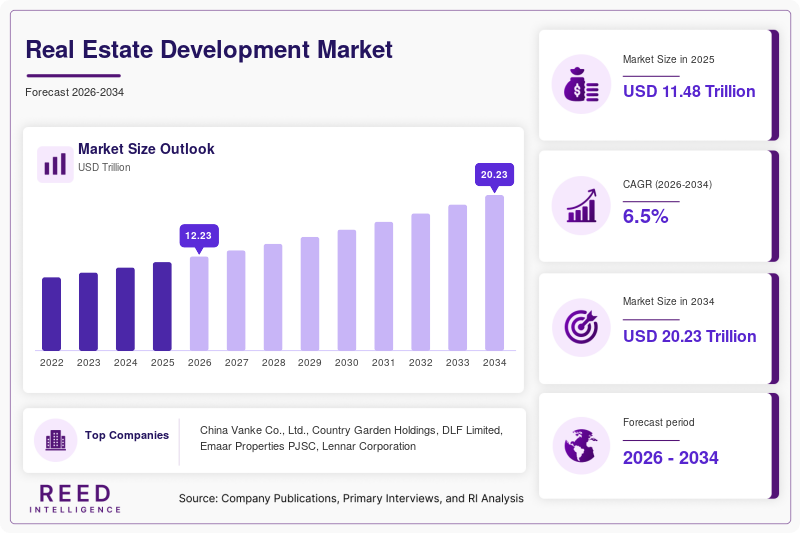
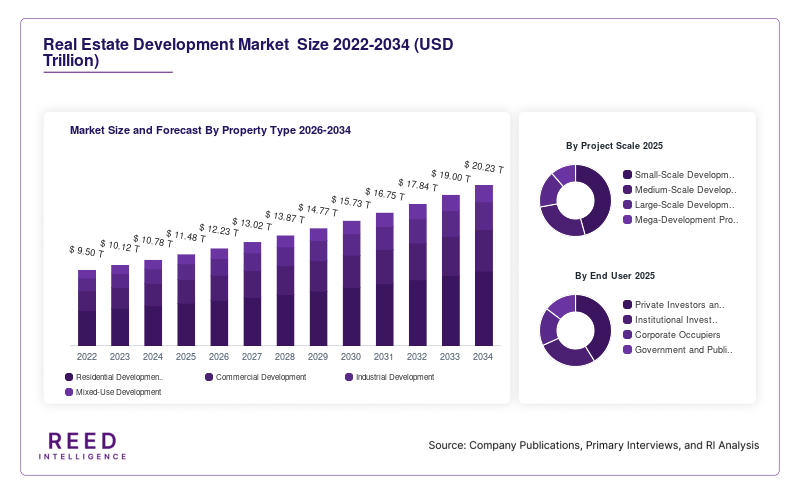
The global Real Estate Development Market size was valued at USD 11.48 trillion in 2026 and is projected to reach USD 18.96 trillion by 2034, expanding at a CAGR of 6.5% during 2026–2034. The market continues to evolve as urbanization, infrastructure modernization, and population growth increase demand for residential, commercial, industrial, and mixed-use properties across developed and emerging economies. Real estate development remains a fundamental component of economic activity, supporting employment generation, capital investment, and urban transformation.
One of the primary global factors supporting market growth is the continued migration of populations toward urban centers. Governments and private investors are responding by funding large-scale residential communities, commercial complexes, logistics hubs, and smart city projects. Increasing household formation, rising disposable income levels, and improvements in transportation networks are further encouraging real estate investments. In addition, the adoption of digital construction technologies, sustainability-focused building practices, and green financing initiatives has improved project feasibility and investor confidence.
Key Highlights
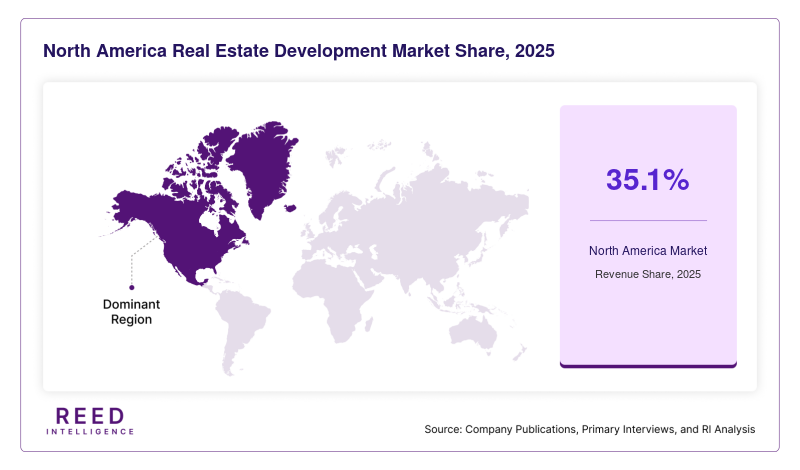
- North America dominated the market with a 35.1% share in 2025, while Asia Pacific is expected to grow at the fastest CAGR of 8.1% during 2026–2034.
- By property type, residential development accounted for the largest share of 44.8%, while mixed-use development is projected to grow at a CAGR of 8.7%.
- By project scale, large-scale developments led with a 57.4% share, whereas mega-development projects are expected to expand at a CAGR of 8.5%.
- By end user, private investors and homeowners held a 48.2% share, while institutional investors are projected to grow at a CAGR of 8.3%.
- The United States remained the dominant country, with market values of USD 3.52 trillion in 2024 and USD 3.73 trillion in 2025.
Market Trends
Growth of Smart and Sustainable Developments
Sustainability has become a central theme across the Real Estate Development Market. Developers are increasingly incorporating energy-efficient materials, renewable energy systems, water conservation technologies, and intelligent building management solutions into projects. Demand for environmentally responsible properties is growing among tenants, investors, and governments, encouraging developers to align projects with green building standards. Smart buildings equipped with digital monitoring systems improve operational efficiency while reducing long-term maintenance costs. As sustainability regulations become more stringent worldwide, developers are integrating environmental considerations during planning and construction stages. This trend is contributing to higher asset values, stronger occupancy rates, and improved investor confidence across residential, commercial, and industrial developments.
Expansion of Mixed-Use Urban Communities
Mixed-use developments are gaining popularity as cities seek to optimize land utilization and create integrated urban environments. These projects combine residential units, office spaces, retail facilities, entertainment venues, and public amenities within a single location. The approach reduces commuting requirements while enhancing convenience for residents and businesses. Growing demand for live-work-play environments has encouraged developers to pursue large-scale mixed-use projects in metropolitan regions. Local governments also support these developments because they contribute to economic activity and urban regeneration. The increasing adoption of transit-oriented development models and smart city initiatives is expected to further accelerate investment in mixed-use communities across major global markets.
Market Drivers
Rapid Urbanization and Population Expansion
Urbanization remains one of the strongest growth drivers for the Real Estate Development Market. Expanding urban populations require new housing units, transportation infrastructure, commercial facilities, healthcare institutions, and educational establishments. Developing economies are witnessing significant migration from rural regions to urban centers, creating sustained demand for real estate projects. Governments are investing heavily in urban expansion programs to accommodate growing populations and improve living standards. Developers benefit from increased demand across multiple property categories, including residential communities, retail centers, and industrial parks. The long-term nature of demographic growth provides a stable foundation for continued development activity, supporting market expansion throughout the forecast period.
Increasing Infrastructure Investments and Capital Availability
Large-scale infrastructure investments are creating favorable conditions for real estate development worldwide. New highways, rail networks, airports, ports, and public transit systems increase land accessibility and enhance property values in surrounding areas. At the same time, institutional investors, real estate investment funds, and private equity firms continue allocating capital toward development projects. Improved financing options enable developers to undertake larger and more complex projects. Low vacancy rates in several urban markets have also encouraged investment in new developments. As governments prioritize economic development and modernization initiatives, infrastructure improvements are expected to remain a significant catalyst for real estate construction and investment activity.
Market Restraint
Rising Construction Costs and Regulatory Complexity
The Real Estate Development Market faces challenges associated with increasing construction expenses and complex regulatory requirements. Rising prices of building materials, labor shortages, land acquisition costs, and financing expenses can significantly impact project profitability. Developers often encounter delays due to zoning approvals, environmental assessments, permitting procedures, and compliance requirements. These challenges are particularly pronounced in densely populated urban regions where land availability is limited and regulations are extensive. Cost inflation can force developers to revise project budgets or postpone investments, affecting overall market growth. For example, large mixed-use developments frequently require multiple regulatory approvals across various government agencies, extending project timelines and increasing administrative expenses. Such constraints can reduce investment attractiveness and create uncertainty for stakeholders, particularly during periods of economic volatility or rising interest rates.
Market Opportunities
Emerging Demand for Logistics and Industrial Real Estate
The rapid growth of e-commerce and supply chain modernization has created substantial opportunities within industrial and logistics real estate development. Businesses increasingly require distribution centers, fulfillment facilities, cold storage warehouses, and last-mile delivery hubs located near major urban areas. Developers are responding by expanding industrial property portfolios and investing in technologically advanced logistics facilities. Rising consumer expectations for faster delivery services continue to support demand for strategically located industrial developments. This trend is particularly evident in Asia Pacific, North America, and parts of Europe, where logistics infrastructure investment remains strong. The segment is expected to attract significant capital due to stable occupancy levels and growing tenant demand.
Development Potential in Secondary and Emerging Cities
Secondary cities and emerging urban centers offer significant growth opportunities for developers seeking new investment destinations. Rapid economic development, improving infrastructure, and population growth are driving property demand beyond traditional metropolitan hubs. Land prices in secondary cities are generally lower, allowing developers to achieve favorable project economics. Governments are also encouraging regional development through tax incentives, infrastructure investments, and industrial corridor projects. Residential communities, business parks, and mixed-use developments are increasingly being launched in these markets. As congestion and affordability concerns rise in major cities, secondary urban centers are expected to attract greater investment and become important contributors to future market growth.
Segmental Analysis
By Property Type
Residential development dominated the Real Estate Development Market, accounting for approximately 44.8% of total market share in 2024. The segment benefits from population growth, urban migration, and increasing demand for housing across developed and developing economies. Governments worldwide continue to support residential construction through housing initiatives, financing programs, and infrastructure investments. Developers are focusing on multifamily housing, affordable housing projects, and master-planned communities to address changing consumer needs. Demand remains particularly strong in rapidly urbanizing regions where housing shortages persist. The segment also benefits from rising household formation rates and increased interest in community-oriented residential developments that offer integrated amenities and improved quality of life.
Mixed-use development is projected to register the fastest CAGR of 8.7% during the forecast period. Growth is driven by increasing demand for integrated environments that combine residential, commercial, retail, and recreational facilities. These projects maximize land utilization while creating vibrant urban destinations. Developers are increasingly partnering with municipalities to deliver large-scale mixed-use communities aligned with smart city objectives. Improved transportation connectivity and transit-oriented development strategies further support market expansion. The ability of mixed-use projects to diversify revenue streams and enhance property values makes them attractive to investors. As urban populations continue to expand, mixed-use developments are expected to become a preferred model for future city planning.
By Project Scale
Large-scale developments accounted for approximately 57.4% of market share in 2024, making them the dominant project scale category. These developments include residential townships, commercial districts, industrial parks, and integrated urban communities. Large-scale projects benefit from economies of scale, allowing developers to optimize construction costs and infrastructure investments. Governments often support such developments because they contribute to economic growth, employment generation, and urban modernization. Developers also gain greater flexibility in incorporating amenities, transportation links, and sustainability features. Strong investor interest and the ability to meet diverse market demands continue to support the dominance of large-scale development projects across global markets.
Mega-development projects are expected to witness the fastest CAGR of 8.5% through 2034. Growth is being driven by ambitious smart city programs, economic diversification strategies, and major infrastructure initiatives. These projects often involve mixed-use districts, transportation hubs, tourism facilities, and large commercial centers. Governments and private investors are increasingly collaborating to finance transformative developments capable of reshaping regional economies. Technological advancements in planning, construction, and project management have improved the feasibility of executing complex mega-projects. Rising demand for integrated urban ecosystems and sustainable city solutions is expected to further accelerate investment in this rapidly growing segment.
By End User
Private investors and homeowners held the largest share of the market in 2024, accounting for approximately 48.2% of total revenue. Demand from this segment is driven by residential property purchases, investment opportunities, and long-term wealth creation objectives. Favorable mortgage availability, urban population growth, and rising disposable incomes continue to encourage property ownership. Developers frequently prioritize residential projects targeted at private buyers due to strong demand consistency. In many countries, government housing incentives further support purchasing activity. The segment also benefits from growing interest in rental income generation and portfolio diversification through real estate investments.
Institutional investors are anticipated to register the fastest CAGR of 8.3% during the forecast period. Pension funds, insurance companies, sovereign wealth funds, and real estate investment trusts are increasingly allocating capital to development projects. These investors seek stable returns, portfolio diversification, and exposure to long-term urban growth trends. Institutional participation is expanding across residential, commercial, industrial, and mixed-use developments. The growing sophistication of real estate investment vehicles and improved transparency in property markets support continued investment activity. As global capital flows into large-scale developments increase, institutional investors are expected to play an increasingly significant role in shaping future market dynamics.
Regional Analysis
North America
North America accounted for approximately 35.1% of the Real Estate Development Market share in 2025, making it the largest regional market. The region is expected to expand at a CAGR of 5.8% through 2034. Strong institutional investment activity, established financing systems, and continuous demand for residential and commercial properties support market growth. The region also benefits from advanced construction technologies and widespread adoption of sustainable building practices.
The United States remains the dominant country within the region. A key growth factor is the expansion of logistics and industrial developments linked to e-commerce growth. Demand for distribution centers, data centers, and mixed-use urban projects continues to attract investment. Strong population mobility across states and ongoing infrastructure modernization programs further support long-term development opportunities.
Europe
Europe represented approximately 25.4% of global market share in 2025 and is forecast to grow at a CAGR of 5.5% during the forecast period. The region's market is supported by urban regeneration projects, sustainable development initiatives, and modernization of aging infrastructure. Developers are increasingly focusing on energy-efficient buildings and adaptive reuse projects that align with environmental goals.
Germany remains the leading national market in Europe. A unique growth factor is the country's emphasis on sustainable urban planning and green construction standards. Government support for climate-friendly buildings and energy-efficient residential projects continues to encourage investment. Demand for logistics facilities and modern office developments also contributes to market expansion across major German cities.
Asia Pacific
Asia Pacific held nearly 22.8% of market share in 2025 and is expected to register the fastest CAGR of 8.1% through 2034. Rapid urbanization, industrialization, and infrastructure development are driving substantial real estate activity across the region. Rising income levels and population growth continue to create demand for residential housing, commercial facilities, and industrial properties.
China remains the dominant country in the regional market. A major growth factor is the ongoing development of smart cities and integrated urban infrastructure projects. Government-backed investments in transportation networks and urban modernization programs continue to create opportunities for developers. Large-scale mixed-use developments and industrial parks remain important growth contributors.
Middle East & Africa
The Middle East & Africa accounted for approximately 8.6% of global market share in 2025 and is projected to grow at a CAGR of 6.7% during the forecast period. Economic diversification efforts and infrastructure investments are supporting real estate development across several countries. Large urban development projects and tourism-related investments continue to generate market opportunities.
The United Arab Emirates remains the dominant country in the region. A distinctive growth factor is the government's focus on attracting international business and tourism investments. High-profile mixed-use projects, hospitality developments, and smart city initiatives continue to enhance market attractiveness. Strategic location advantages also support commercial and logistics real estate growth.
Latin America
Latin America captured approximately 8.1% of market share in 2025 and is expected to grow at a CAGR of 6.2% through 2034. Urban expansion, rising housing demand, and infrastructure improvements are contributing to market development. Increasing foreign direct investment and government-backed housing initiatives continue to support construction activity throughout the region.
Brazil remains the dominant market within Latin America. A key growth factor is the expansion of affordable housing programs and urban infrastructure investments. Growing demand for residential properties in metropolitan areas has encouraged developers to launch large-scale projects. Industrial and logistics developments are also gaining momentum as regional trade activity expands.
Competitive Landscape
The Real Estate Development Market is characterized by the presence of multinational developers, regional construction groups, and diversified property investment firms. Competition is based on project scale, land acquisition capabilities, financing strength, geographic reach, and sustainability initiatives. Developers are increasingly investing in digital planning tools, green construction practices, and mixed-use development strategies to strengthen market positioning.
Among leading participants, China Vanke Co., Ltd. maintains a strong position due to its extensive residential and mixed-use development portfolio. In 2025, the company expanded its focus on sustainable urban communities and smart building technologies. Other major companies continue pursuing partnerships, acquisitions, and joint ventures to expand their project pipelines and geographic footprints.
Key industry participants are also increasing investments in logistics parks, affordable housing projects, and smart city developments. The integration of environmental standards and digital construction technologies has become a major competitive differentiator. As investor expectations evolve, companies are focusing on operational efficiency, project quality, and long-term asset value creation to maintain market competitiveness.
Key Players
- China Vanke Co., Ltd.
- Country Garden Holdings
- DLF Limited
- Emaar Properties PJSC
- Lennar Corporation
- Toll Brothers, Inc.
- Brookfield Properties
- Sun Hung Kai Properties
- Mitsubishi Estate Co., Ltd.
- Henderson Land Development
- Shimao Group Holdings
- CapitaLand Investment
- Nakheel Properties
- Related Companies
- Hines
Recent Developments
- In 2025, a leading global developer launched a large-scale smart city project integrating residential, commercial, and renewable energy infrastructure.
- In 2025, a major real estate company expanded its logistics property portfolio through the acquisition of strategically located industrial development sites.
- In 2024, a multinational property developer introduced advanced digital twin technology to improve planning efficiency and project lifecycle management.
- In 2024, several urban development firms increased investments in mixed-use communities focused on sustainable mobility and green building standards.
Real Estate Development Market Segments
By Property Type
- Residential Development
- Commercial Development
- Industrial Development
- Mixed-Use Development
By Project Scale
- Small-Scale Developments
- Medium-Scale Developments
- Large-Scale Developments
- Mega-Development Projects
By End User
- Private Investors and Homeowners
- Institutional Investors
- Corporate Occupiers
- Government and Public Sector Organizations
By Region
- North America
- Europe
- APAC
- Middle East and Africa
- LATAM