Recreation Management Software Market Size, Share & Trends Analysis Report By Deployment Type (Cloud-Based, On-Premise), By Application (Venue Management, Registration Management, Ticketing Solutions, Event Solutions), By Organization Size (SMEs, Large Enterprises) and By Region (North America, Europe, Asia-Pacific, Middle East and Africa, Latin America) Forecasts, 2026–2034
USD 3950
Recreation Management Software Market Size
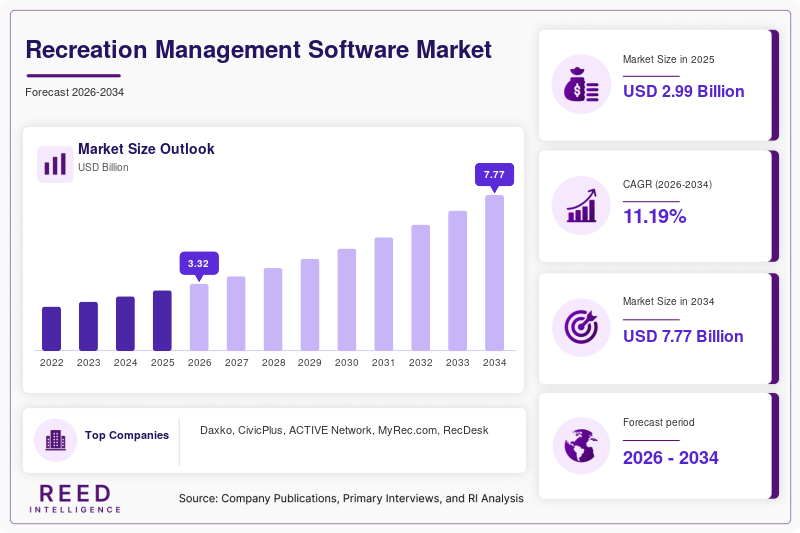
The recreation management software market was valued at USD 2.99 billion in 2025 and is estimated to reach USD 3.32 billion in 2026. The market is projected to reach USD 7.76 billion by 2034, registering a CAGR of 11.19% during 2026–2034.
Recreation management software is evolving from basic registration applications into integrated operating platforms covering program enrollment, facility reservations, memberships, payments, scheduling, reporting and customer communication. This change is linked to the increasing administrative complexity of parks, recreation departments, community centers, sports facilities and other organizations managing multiple activities and physical assets.
The underlying demand base is supported by high participation in organized recreation. In the U.S., more than 276 million people visited a local park or recreation facility in 2024, according to the National Recreation and Park Association. The association also reported that the parks and recreation field generated USD 201 billion in economic activity in 2024, illustrating the scale of the operating environment that supports demand for administrative technology.
Recreation Management Software Market Drivers
Integrated Recreation Platforms Reduce Administrative Friction Across Multiple Workflows
Recreation organizations increasingly require software that connects registration, scheduling, facility reservations, payments and reporting. CivicPlus describes its platform as consolidating these functions to reduce fragmented workflows and manual data entry, while its program-management tools support scheduling, rosters, attendance and participant tracking.
The market mechanism is operational consolidation. When registration, payment and facility information are maintained within a connected environment, staff can reduce repetitive data entry and manage customer records across multiple programs. The same integration also provides a foundation for reporting on participation, revenue and facility utilization.
This mechanism is particularly relevant to municipalities and multi-facility operators. The counterbalance is implementation complexity when historical customer data and existing systems must be migrated into a new platform.
High Participation in Parks and Recreation Creates Recurring Digital Transactions
The U.S. recreation ecosystem generated more than 276 million park and recreation visitors in 2024, according to NRPA. Its 2024 annual report also recorded approximately 171,000 full-time park and recreation employees nationwide.
Large participation volumes translate into recurring administrative activity, including registrations, payments, memberships, facility bookings, waitlists and customer communications. Software therefore addresses an ongoing operational requirement rather than a single transaction.
The effect is strongest for organizations managing numerous seasonal programs and facilities. However, participation alone does not guarantee technology spending because local government budgets and procurement cycles determine whether organizations replace existing systems.
Digital Self-Service Increases the Value of Online Registration and Facility Management
Recreation customers increasingly interact with providers through online registration, facility calendars, digital payments and self-service accounts. CivicPlus supports mobile-friendly registration, online payments, facility reservations and automated scheduling, while MyRec provides online registration, facility management and related administrative tools.
The commercial mechanism is reduced transaction friction. Customers can search for activities, register and pay without requiring staff to manually process each transaction. For operators, digital workflows can shift staff time toward program delivery and customer service.
The constraint is uneven digital adoption among users and organizations, particularly where customers still rely on in-person or telephone registration.
Recreation Management Software Market Restraints
Municipal Budget Constraints Can Extend Software Replacement Cycles
A significant proportion of recreation software demand comes from municipal departments and community organizations that must balance technology spending with staffing, facility maintenance and programming budgets. CivicPlus itself identifies tighter budgets and staffing constraints as operating challenges for parks and recreation departments.
The economic mechanism is delayed purchasing. Organizations may continue using existing systems when the immediate cost of implementation, migration and training outweighs the perceived short-term benefit of replacement.
Subscription-based cloud deployment can reduce infrastructure requirements, while modular pricing and implementation assistance can lower adoption barriers. Nevertheless, public procurement procedures and annual budgeting can extend purchasing timelines.
Legacy Data and Fragmented Systems Increase Implementation Complexity
Recreation departments may have accumulated customer, membership, program, facility and payment records across different platforms. A recent public-sector recreation software procurement from Danville, Virginia, for example, specified requirements covering data migration, configuration, staff training and post-launch support, alongside registration, facility reservations and reporting.
The market mechanism is implementation risk. Larger organizations may require extensive migration and integration before realizing the benefits of a unified platform.
Vendors can address this constraint through APIs, migration services, training and configurable workflows. However, complex legacy environments can still increase project duration and switching costs.
Recreation Management Software Market Opportunities
Data Analytics Can Convert Recreation Software From Administrative Infrastructure Into a Planning Tool
Recreation platforms collect information from registrations, reservations, memberships, payments and facility usage. CivicPlus highlights the connection between this operational data and financial reporting, pricing and program-performance decisions.
This creates an opportunity to expand software beyond transaction processing into demand forecasting, facility-utilization analysis, program profitability and resource planning. Operators could use historical attendance and reservation information to identify underutilized facilities or programs with persistent capacity constraints.
The opportunity is strongest among organizations with multiple facilities and substantial transaction histories. Adoption will depend on data quality, integration capabilities and the ability of vendors to convert raw operational information into usable recommendations.
AI-Based Automation Can Reduce Repetitive Administrative Work
Daxko announced an AI-first strategy in December 2025, describing planned investment in platform architecture, data and security and positioning AI around member management and operational workflows.
For recreation-oriented software, similar capabilities could automate communication, customer segmentation, scheduling assistance, reporting and administrative queries. The commercial opportunity is particularly relevant where staff resources are limited and organizations need to manage growing program complexity without proportional increases in administrative headcount.
Data privacy, security, implementation costs and the reliability of automated recommendations remain constraints on adoption.
Specialized Platforms Create Expansion Opportunities Across Community and Fitness Organizations
Recent acquisitions demonstrate that vendors are expanding beyond traditional municipal recreation workflows. Daxko acquired Vision in 2025 to strengthen its offering for Boys & Girls Clubs and later acquired Exercise.com to broaden coverage across boutique, hybrid and online fitness businesses.
The opportunity is to adapt shared capabilities such as membership management, payments, registration, scheduling and engagement to adjacent organizations with similar administrative requirements.
This broadens the addressable customer base but also increases competition between general-purpose recreation platforms and specialized software built for particular facility or organization types.
Recreation Management Software Market Deployment Type Analysis
By Deployment Type
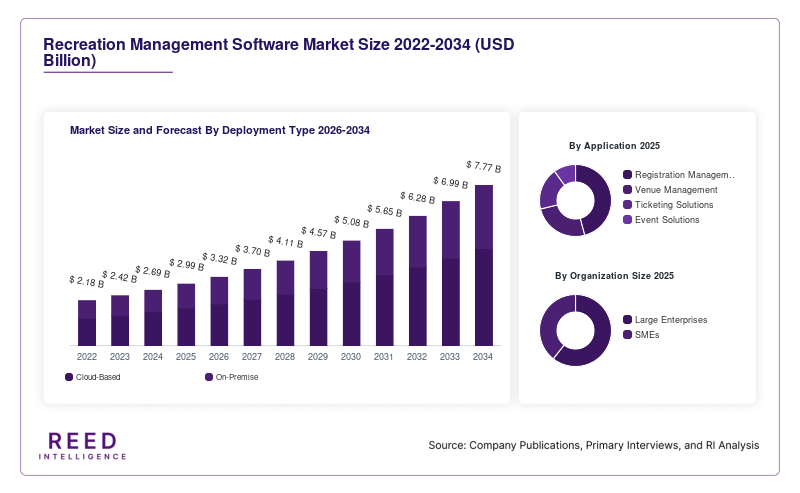
Cloud-Based software accounts for approximately 72% of the market in 2025. Cloud deployment supports remote administration, online registration, facility scheduling, digital payments and customer self-service without requiring organizations to maintain the full software infrastructure locally.
CivicPlus provides cloud-based recreation functionality spanning registrations, facility reservations, payments and reporting, while MyRec supports more than 550 departments with registration, facilities, financial and related software functions.
The segment's commercial advantage is therefore tied to accessibility and functional consolidation. It is particularly relevant for organizations with limited internal IT resources.
Cloud-Based software is projected to register approximately 12.40% CAGR during 2026–2034. Its expansion is supported by mobile customer access, centralized updates, online payments and the ability to connect multiple administrative functions within one platform.
On-Premise solutions are projected to grow at approximately 8.10% CAGR during the same period. These systems remain relevant where organizations have established infrastructure, legacy integrations or internal requirements favoring local deployment.
Recreation Management Software Market Application Analysis
By Application
Registration Management accounts for approximately 34% of the market in 2025. Registration is required across classes, sports programs, camps, leagues, memberships and other activities, creating a recurring need for participant records, payments, waitlists and communications.
CivicPlus supports online registration, waitlists, self-service accounts, participant tracking and integrated payments within its recreation platform.
The segment therefore benefits from the frequency of registration transactions and its direct connection to revenue collection.
Venue Management is projected to register approximately 12.10% CAGR during 2026–2034. Recreation operators increasingly need to coordinate fields, courts, rooms, pools and other facilities while preventing scheduling conflicts.
CivicPlus provides automated scheduling, facility reservations and resource-management functionality, while public-sector procurement requirements increasingly include real-time availability, conflict detection and usage reporting.
Venue Management accounts for approximately 28% of the market in 2025, placing it behind registration management while giving it a substantial addressable base.
Ticketing Solutions are projected to grow at approximately 10.50% CAGR, supported by event and facility transactions, while Event Solutions are projected to grow at approximately 11.20% CAGR as organizations digitize event registration, scheduling and customer communications.
Recreation Management Software Market Organization Size Analysis
By Organization Size
Large Enterprises account for approximately 61% of the market in 2025. Larger recreation operators typically manage multiple facilities, programs, memberships, staff groups and payment workflows, increasing the value of centralized software.
CivicPlus provides program, facility, event, payment and reporting functionality within one environment, while MyRec supports organizations across registration, facility and financial management.
The larger addressable transaction volume also makes integration and reporting more economically relevant.
SMEs are projected to register approximately 12.60% CAGR during 2026–2034. Smaller recreation and fitness operators can use cloud-based platforms without maintaining extensive internal technology infrastructure.
The commercial mechanism is lower deployment complexity combined with access to registration, payment, scheduling and customer-management capabilities that previously required multiple systems.
Large Enterprises are projected to grow at approximately 10.20% CAGR during the forecast period, supported by modernization of existing systems and expansion across multi-location facilities.
Recreation Management Software Market Regional Analysis
North America Holds the Largest Regional Share Through an Established Recreation Infrastructure and Mature Software Base
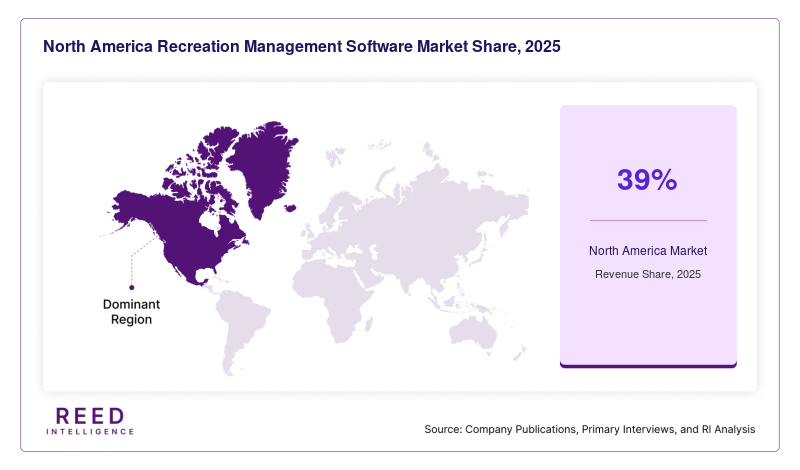
North America accounts for approximately 39% of the market in 2025. The region benefits from a large organized recreation ecosystem and established demand for digital registration, facility management and payments.
NRPA reported more than 276 million U.S. people visited a local park or recreation facility in 2024, providing a substantial recurring user base for municipal recreation services.
The regional software environment is also relatively mature. CivicPlus reports serving more than 1,200 local-government parks and recreation departments and special districts, while MyRec reports supporting more than 550 departments.
North America is projected to grow at approximately 10.20% CAGR during 2026–2034. Growth will be linked to replacement of fragmented systems, digital self-service, facility utilization and integrated payment management.
Budget constraints and lengthy public-sector procurement cycles remain important limitations.
Europe Maintains a Significant Market Through Digitalization of Public and Private Recreation Services
Europe accounts for approximately 25% of the market in 2025. Demand is supported by municipal recreation facilities, sports organizations, leisure centers and private operators requiring registration, membership and facility-management systems.
Europe is projected to grow at approximately 10.00% CAGR during 2026–2034. The growth mechanism is primarily the replacement of manual processes with cloud-based registration, scheduling and payment workflows.
The region's requirements for data protection, accessibility, localization and interoperability can increase implementation complexity, while established legacy systems can lengthen replacement cycles.
Asia-Pacific Is the Fastest-Growing Region as Digital Recreation Services Expand Across a Wider Operator Base
Asia-Pacific is projected to register approximately 13.10% CAGR during 2026–2034. Expansion is supported by increasing digitalization of fitness centers, sports facilities, community organizations and private recreation operators.
Asia-Pacific accounts for approximately 23% of the market in 2025. The region's growth mechanism is the transition from manual registration and facility administration toward cloud-based customer management, electronic payments and online booking.
The opportunity is particularly relevant to software vendors that can provide localized interfaces, payment methods and workflows. Fragmented markets, different procurement structures and varying levels of digital infrastructure can constrain adoption.
Latin America Represents an Emerging Market for Cloud-Based Recreation Administration
Latin America accounts for approximately 7% of the market in 2025. The customer base includes sports organizations, recreation centers, educational facilities, fitness operators and municipal recreation providers.
Latin America is projected to grow at approximately 10.40% CAGR during 2026–2034. Cloud delivery provides a mechanism for organizations to access registration, payment and scheduling capabilities without extensive local infrastructure.
Price sensitivity and differences in digital-payment adoption can affect purchasing decisions, especially among smaller organizations.
Middle East and Africa Remain Developing Markets With Opportunities Around New Recreation Infrastructure
Middle East and Africa account for approximately 6% of the market in 2025. Demand is concentrated around organized sports, fitness, leisure, community and hospitality-linked recreation facilities.
Middle East and Africa are projected to grow at approximately 10.10% CAGR during 2026–2034. The opportunity is linked to the professionalization and digitalization of facility operations, particularly where operators need centralized booking, membership and payment capabilities.
Market development varies substantially across countries, with connectivity, localization, procurement structures and technology budgets affecting adoption.
Recreation Management Software Market Competitive Landscape
Competition is increasingly shifting from standalone registration software toward broader operating platforms combining registration, facility management, payments, memberships, reporting, communications and customer engagement.
CivicPlus competes through an integrated local-government recreation platform. Its current offering covers program registration, facility and event reservations, payment processing and cost recovery, and the company states that its Recreation Management solution serves more than 1,200 local-government parks and recreation departments and special districts.
Daxko is pursuing a portfolio strategy across community, fitness and wellness organizations. Its 2025 acquisition of Vision expanded its Boys & Girls Club presence, while its Exercise.com acquisition expanded its coverage of boutique, hybrid and online fitness operators.
Key Market Players
- Daxko
- CivicPlus
- ACTIVE Network
- MyRec.com
- RecDesk
- PerfectMind
- Vermont Systems
Recreation Management Software Market Recent Developments
- September 2026 – Daxko acquired Alaris to strengthen childcare safety, compliance and wellbeing capabilities for fitness and wellness operators. The transaction expands Daxko's platform beyond core membership and facility management into adjacent operational requirements, potentially increasing the breadth of functions available through its ecosystem.
- June 2026 – Daxko acquired FitnessForce, an API-first membership-management platform serving multi-location, franchise and international fitness operators. The transaction expands Daxko's geographic and organizational coverage and adds capabilities relevant to operators managing multiple brands and locations.
Recreation Management Software Market Segments
By Deployment Type
- Cloud-Based
- On-Premise
By Application
- Registration Management
- Venue Management
- Ticketing Solutions
- Event Solutions
By Organization Size
- Large Enterprises
- SMEs
By Region
- North America
- Europe
- APAC
- Middle East and Africa
- LATAM