Reed Sensors Switches Market Size, Share & Demand Report By Type (Form A (Normally Open), Form B (Normally Closed), Form C (Changeover)), By Mounting Type (Surface Mount, Through Hole), By Application (Automotive, Industrial Automation, Consumer Electronics, Healthcare, Aerospace & Defense), By End-Use Industry (Manufacturing, Electronics, Healthcare, Energy & Utilities), By Region & Segment Forecasts, 2026–2034
USD 3950
Market Overview
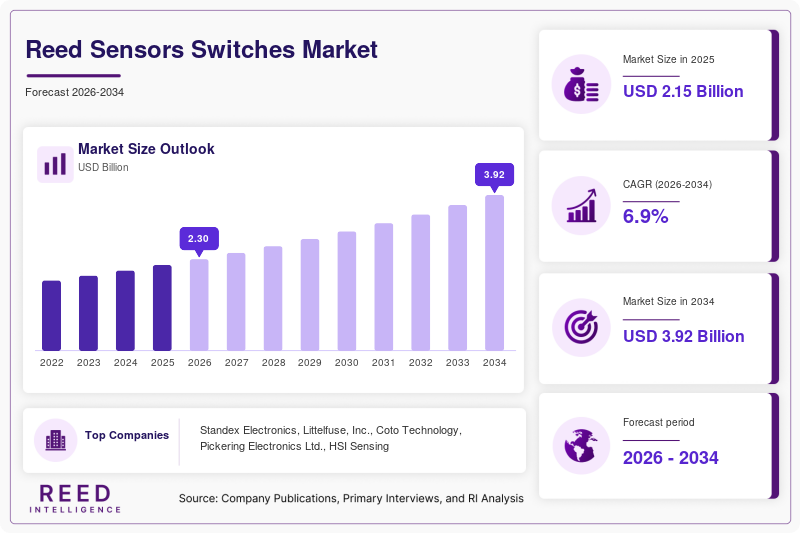
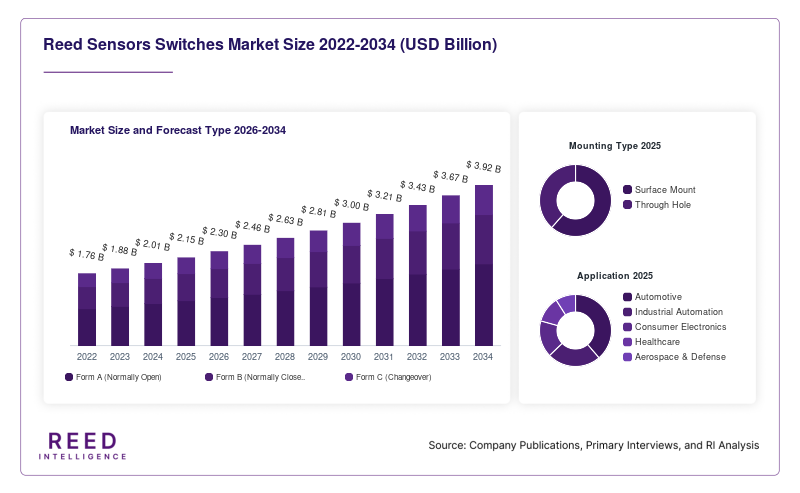
The Reed Sensors Switches Market was valued at approximately USD 2.15 billion in 2026 and is projected to reach USD 3.68 billion by 2034, expanding at a CAGR of 6.9% during the forecast period (2026–2034). The steady growth trajectory of the market reflects the increasing integration of contactless sensing technologies across industrial automation, automotive electronics, and consumer devices. Reed sensors and switches, known for their reliability, low power consumption, and compact design, continue to find extensive applications in environments requiring precise magnetic field detection.
A key global factor supporting market growth has been the accelerating adoption of automation and smart sensing systems across manufacturing and infrastructure sectors. As industries shift toward digitized operations and predictive maintenance frameworks, the demand for robust, low-maintenance sensing components has increased significantly. Reed sensors switches, due to their durability and ability to operate in harsh environments, are becoming essential components in such applications.
Key Highlights
- North America dominated the market with a share of 34.8% in 2025, while Asia Pacific is expected to grow at the fastest CAGR of 8.1% during the forecast period.
- By type, Form A (Normally Open) switches held the largest share of 46.2% in 2025, whereas Form C (Changeover) switches are anticipated to grow at the fastest CAGR of 7.6%.
- By application, automotive applications accounted for the dominant share of 29.5% in 2025, while industrial automation is projected to expand at the fastest CAGR of 7.9%.
- The United States remained the dominant country, with market values of USD 615 million in 2024 and USD 642 million in 2025.
Market Trends
Miniaturization and Integration of Sensors
The trend toward miniaturization has significantly influenced the Reed Sensors Switches Market. Manufacturers are increasingly focusing on producing compact reed switches that can be easily integrated into space-constrained devices such as wearable electronics, medical equipment, and compact automotive modules. This trend is aligned with broader developments in electronics design, where reduced size and enhanced functionality are critical. The integration of reed sensors into multifunctional modules is enabling improved system efficiency and performance.
Expansion in Electric Vehicle Applications
The rapid expansion of electric vehicles (EVs) has emerged as another key trend shaping the market. Reed sensors switches are being widely adopted in battery management systems, charging interfaces, and safety mechanisms within EVs. Their ability to operate reliably under varying environmental conditions makes them suitable for automotive applications. As global EV production continues to rise, the demand for reed-based sensing components is expected to grow steadily.
Market Drivers
Rising Adoption of Industrial Automation
The increasing implementation of industrial automation across manufacturing sectors is a major driver of the Reed Sensors Switches Market. Automated systems rely heavily on precise sensing technologies to monitor processes and ensure operational efficiency. Reed sensors switches offer advantages such as high durability, low maintenance, and consistent performance, making them ideal for industrial applications. As industries continue to invest in smart factories and automation technologies, the demand for reed sensors is expected to increase.
Growth in Consumer Electronics Sector
The expansion of the consumer electronics industry has also contributed to market growth. Reed sensors switches are widely used in devices such as smartphones, laptops, home appliances, and gaming systems for position sensing and safety functions. The growing demand for advanced electronic devices with enhanced functionality is driving the adoption of reed sensors. Continuous innovation in consumer electronics is expected to further support market expansion.
Market Restraint
Competition from Alternative Sensor Technologies
One of the primary restraints in the Reed Sensors Switches Market is the increasing competition from alternative sensor technologies such as Hall effect sensors and solid-state sensors. These alternatives offer advantages such as higher sensitivity and integration capabilities, which may limit the adoption of reed sensors in certain applications. As technology continues to evolve, manufacturers of reed sensors must focus on innovation to maintain their competitive position.
Market Opportunities
Emerging Applications in Medical Devices
The growing use of reed sensors switches in medical devices presents a significant opportunity for market growth. These sensors are used in applications such as infusion pumps, diagnostic equipment, and patient monitoring systems due to their reliability and safety. As the healthcare industry continues to adopt advanced technologies, the demand for reed sensors in medical applications is expected to increase.
Expansion in Renewable Energy Systems
The increasing focus on renewable energy systems is creating new opportunities for the Reed Sensors Switches Market. Reed sensors are used in wind turbines, solar tracking systems, and energy storage solutions for position and safety monitoring. The global shift toward sustainable energy sources is expected to drive the adoption of reed sensors in these applications.
Segmental Analysis
By Type
Form A (Normally Open) switches dominated the market with a share of 46.2% in 2025, owing to their widespread use in basic switching applications. These switches are preferred for their simplicity and cost-effectiveness.
Form C (Changeover) switches are expected to grow at the fastest CAGR of 7.6% during the forecast period, driven by their versatility in complex switching applications and ability to provide multiple switching states.
By Mounting Type
Surface mount reed switches accounted for the largest share of 52.4% in 2025, supported by their compatibility with modern electronic manufacturing processes.
Through-hole reed switches are projected to grow at a CAGR of 7.1%, driven by their use in applications requiring robust mechanical stability and durability.
By Application
Automotive applications held the dominant share of 29.5% in 2025, reflecting the extensive use of reed sensors in safety systems and position sensing.
Industrial automation is expected to grow at the fastest CAGR of 7.9%, supported by increasing adoption of smart manufacturing technologies and process automation.
By End-Use Industry
The consumer electronics segment dominated the market with a share of 31.8% in 2025, driven by the widespread use of reed sensors in electronic devices.
The healthcare segment is anticipated to grow at a CAGR of 7.4%, fueled by increasing adoption of advanced medical devices and diagnostic equipment.
Regional Analysis
North America
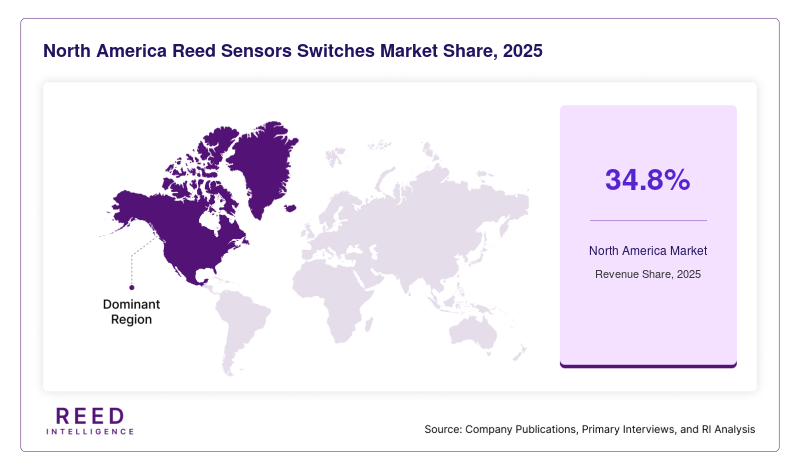
North America accounted for a market share of 34.8% in 2025 and is expected to grow at a CAGR of 6.2% during the forecast period. The region’s growth was driven by strong demand from industrial automation and automotive sectors. The United States remained the dominant country due to its advanced manufacturing infrastructure and high adoption of automation technologies.
Europe
Europe held a market share of 26.7% in 2025 and is projected to expand at a CAGR of 6.5% from 2026 to 2034. The region’s growth was supported by the increasing adoption of electric vehicles and stringent safety regulations. Germany emerged as the dominant country, driven by its strong automotive industry and focus on technological innovation.
Asia Pacific
Asia Pacific captured a market share of 24.3% in 2025 and is expected to grow at the fastest CAGR of 8.1% during the forecast period. The region’s rapid growth is attributed to expanding industrialization and rising consumer electronics production. China dominated the region due to its large manufacturing base and increasing investments in automation.
Middle East & Africa
The Middle East & Africa region accounted for a market share of 7.2% in 2025 and is anticipated to grow at a CAGR of 6.8% during the forecast period. The growth in this region is supported by increasing investments in infrastructure and energy projects. The United Arab Emirates emerged as a key country, driven by its focus on smart city initiatives.
Latin America
Latin America held a market share of 7.0% in 2025 and is expected to grow at a CAGR of 6.4% from 2026 to 2034. The region’s growth is driven by expanding industrial activities and increasing adoption of automation technologies. Brazil dominated the market due to its growing manufacturing sector.
Competitive Landscape
The Reed Sensors Switches Market is characterized by moderate competition, with several established players focusing on product innovation and strategic partnerships. Key companies are investing in research and development to enhance product performance and expand their application scope.
Among the leading players, Standex Electronics has maintained a strong market position due to its extensive product portfolio and global presence. The company recently introduced advanced reed switch solutions designed for high-reliability applications, strengthening its competitive edge.
Other prominent players such as Littelfuse, Coto Technology, Pickering Electronics, and HSI Sensing are also actively contributing to market growth through technological advancements and expansion strategies. These companies are focusing on developing compact and energy-efficient reed sensors to meet evolving industry requirements. The competitive landscape is expected to remain dynamic, with continuous innovation shaping market trends.
Key Players List
- Standex Electronics
- Littelfuse, Inc.
- Coto Technology
- Pickering Electronics Ltd.
- HSI Sensing
- PIC GmbH
- Aleph America
- Comus International
- Nippon Aleph Corporation
- OKI Sensor Device Corporation
- Yaskawa Electric Corporation
- Sensata Technologies
- Honeywell International Inc.
- Schneider Electric SE
- TE Connectivity Ltd.
Recent Developments
- In 2025, Standex Electronics launched a new series of high-sensitivity reed switches designed for automotive safety applications.
- In 2025, Littelfuse expanded its product portfolio with compact reed sensors for consumer electronics.
- In 2024, Pickering Electronics introduced miniaturized reed relays aimed at medical device applications.
- In 2024, Coto Technology developed advanced reed switches with enhanced durability for industrial automation.
- In 2025, HSI Sensing expanded its manufacturing capacity to meet growing global demand.
Reed Sensors Switches Market Segments
Type
- Form A (Normally Open)
- Form B (Normally Closed)
- Form C (Changeover)
Mounting Type
- Surface Mount
- Through Hole
Application
- Automotive
- Industrial Automation
- Consumer Electronics
- Healthcare
- Aerospace & Defense
End-Use Industry
- Manufacturing
- Electronics
- Healthcare
- Energy & Utilities
By Region
- North America
- Europe
- APAC
- Middle East and Africa
- LATAM