Reflective Polarizing Films Market Size, Share & Demand Report By Product Type (Multilayer Reflective Polarizing Films), By Material Type (Polymer-Based Films, PET-Based Films, Polycarbonate Films), By Application (LCD Displays, Automotive Displays, Smartphones and Tablets), By End-Use Industry (Consumer Electronics, Automotive Electronics, Healthcare, Industrial Equipment), By Distribution Channel (Direct Sales, Distributors, Online Procurement Platforms) By Region & Segment Forecasts, 2026–203
USD 3950
Market Overview
The Reflective Polarizing Films Market size was valued at USD 2.84 billion in 2026 and is projected to reach USD 5.97 billion by 2034, expanding at a CAGR of 9.7% during 2026–2034. The global Reflective Polarizing Films Market growth has been supported by increasing demand for energy-efficient display technologies across consumer electronics, automotive displays, industrial monitors, and advanced communication devices. Reflective polarizing films are widely used in LCD panels to improve brightness, reduce power consumption, and enhance visual clarity, making them essential components in next-generation display manufacturing.
The rapid adoption of high-resolution smartphones, tablets, smart televisions, wearable electronics, and infotainment systems has accelerated the demand for advanced optical films. Manufacturers are increasingly integrating reflective polarizing films into display architectures to optimize luminance efficiency while minimizing energy usage. Growing investment in OLED-compatible optical technologies and mini-LED display systems has further strengthened market expansion globally.
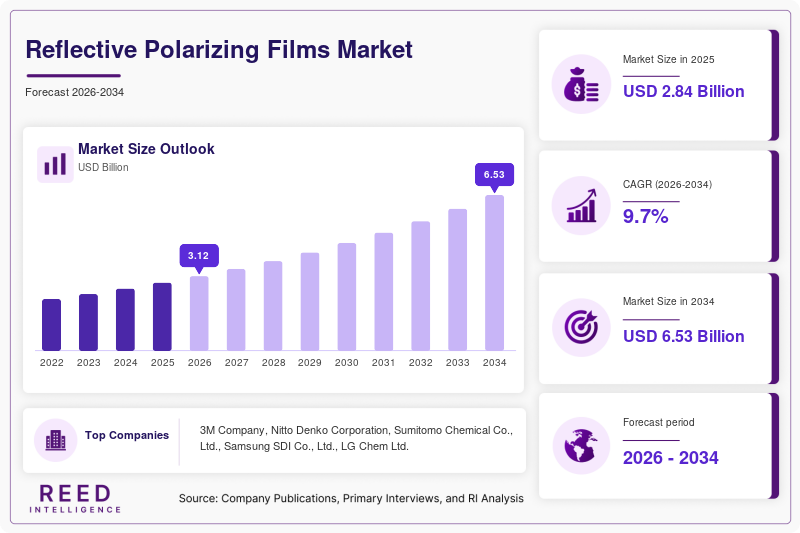
Key Highlights
- Asia Pacific accounted for 47.8% of the Reflective Polarizing Films Market share in 2025 and remained the dominant regional market, while Latin America is projected to register the fastest CAGR of 10.9% during 2026–2034.
- By product type, multilayer reflective polarizing films held the leading share of 58.6% in 2025, while ultra-thin reflective films are anticipated to witness the fastest CAGR of 11.4% during the forecast period.
- By application, LCD displays dominated the market with a 61.3% share in 2025, whereas automotive displays are projected to expand at a CAGR of 12.1% during 2026–2034.
- By end-use industry, consumer electronics accounted for the largest market share of 54.9% in 2025, while automotive electronics are forecast to grow at a CAGR of 11.7%.
- China remained the dominant country market, valued at USD 0.79 billion in 2024 and USD 0.86 billion in 2025 due to strong electronics manufacturing capabilities and display panel production investments.
Market Trends
Integration of Reflective Films in Mini-LED and OLED Hybrid Displays
Display manufacturers are increasingly integrating reflective polarizing films into mini-LED backlighting systems and OLED hybrid display architectures. These films improve brightness uniformity, reduce internal light loss, and enhance power efficiency. The growing popularity of premium televisions, gaming monitors, and professional displays is supporting the adoption of high-performance reflective polarizing films with advanced optical characteristics.
The trend toward ultra-high-definition displays has encouraged manufacturers to invest in films capable of improving contrast ratios and reducing glare. This has increased the demand for multilayer polymer reflective films with enhanced durability and optical precision.
Rising Demand for Flexible and Foldable Display Components
Flexible electronics and foldable smartphones are creating strong demand for lightweight reflective polarizing films with improved flexibility and mechanical stability. Electronics manufacturers are focusing on thin-film technologies that maintain optical efficiency even under repeated folding and bending conditions.
This trend is encouraging material science companies to develop next-generation reflective films with improved thermal stability, scratch resistance, and compatibility with flexible substrates. The expansion of wearable electronics and compact medical displays is further supporting innovation in flexible reflective polarizing film technologies.
Market Drivers
Growing Demand for Energy-Efficient Display Technologies
Increasing consumer preference for energy-efficient electronic devices has become a major driver for the Reflective Polarizing Films Market. Reflective polarizing films help recycle unused light within LCD panels, significantly reducing backlight power requirements. Electronics manufacturers are increasingly using these films to improve battery life in smartphones, tablets, and laptops.
The rising adoption of sustainability targets in electronics manufacturing has accelerated investment in low-power display solutions. This factor has strengthened demand for reflective films across commercial and industrial display applications.
Expansion of Automotive Display Systems
The increasing use of digital instrument clusters, infotainment systems, navigation displays, and heads-up displays in modern vehicles is driving the adoption of reflective polarizing films. Automotive manufacturers are emphasizing high-visibility display systems that remain effective under bright sunlight conditions.
Reflective polarizing films improve display readability and reduce glare, making them suitable for automotive applications. The growth of electric vehicles and connected vehicles is expected to increase demand for advanced optical film technologies during the forecast period.
Market Restraint
High Production Costs of Advanced Optical Films
The manufacturing of reflective polarizing films requires advanced multilayer processing technologies, precision coating systems, and specialized raw materials. These factors increase production costs and limit adoption among cost-sensitive electronics manufacturers. Price volatility in optical-grade polymers and limited availability of high-performance materials may also challenge market growth.
Market Opportunities
Expansion of Smart Wearable Electronics
The increasing penetration of smartwatches, fitness trackers, augmented reality devices, and compact healthcare wearables is creating opportunities for reflective polarizing film manufacturers. These devices require low-power displays with improved brightness and lightweight construction, encouraging the adoption of advanced optical films.
Manufacturers are expected to develop miniaturized reflective film solutions tailored for compact electronic devices with high energy efficiency requirements.
Growth in Medical and Industrial Display Applications
Medical imaging systems, surgical displays, and industrial automation equipment increasingly rely on high-clarity displays with reduced glare and improved luminance performance. Reflective polarizing films are gaining importance in these sectors due to their ability to improve image visibility under varying lighting conditions.
The increasing adoption of advanced diagnostic equipment and industrial monitoring systems is anticipated to support long-term market expansion.
Segmental Analysis
By Product Type
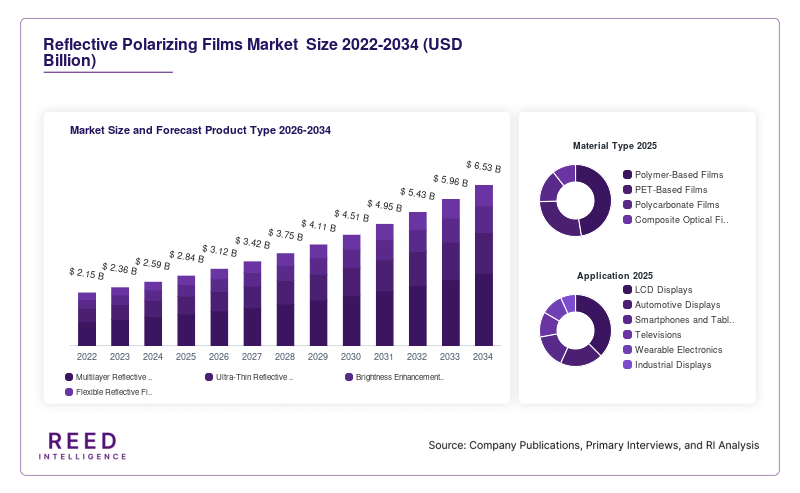
The Reflective Polarizing Films Market is segmented into multilayer reflective polarizing films, ultra-thin reflective films, brightness enhancement reflective films, and flexible reflective films.
Multilayer reflective polarizing films dominated the market with a 58.6% share in 2025 due to their superior light recycling efficiency and broad use in LCD panel manufacturing. These films were widely adopted across televisions, monitors, and mobile devices because of their high optical performance.
Ultra-thin reflective films are projected to register the fastest CAGR of 11.4% during 2026–2034. Their growth will be driven by increasing demand for compact electronic devices and foldable displays requiring lightweight optical components.
By Material Type
Based on material type, the market is divided into polymer-based films, PET-based films, polycarbonate films, and composite optical films.
Polymer-based films accounted for the largest share of 49.3% in 2025 owing to their high durability, optical clarity, and compatibility with advanced display systems. These materials were extensively used in high-resolution LCD applications.
Composite optical films are anticipated to grow at the fastest CAGR of 11.2% during the forecast period due to increasing demand for multifunctional optical layers with improved thermal and mechanical properties.
By Application
The market is segmented into LCD displays, automotive displays, smartphones and tablets, televisions, wearable electronics, and industrial displays.
LCD displays dominated the Reflective Polarizing Films Market with a 61.3% share in 2025 because of the widespread use of reflective films in backlight optimization systems. Increasing production of large-format displays further supported this segment.
Automotive displays are expected to witness the fastest CAGR of 12.1% during the forecast period. The growth will be supported by rising adoption of digital instrument clusters, infotainment systems, and heads-up displays in connected vehicles.
By End-Use Industry
Based on end-use industry, the market is categorized into consumer electronics, automotive electronics, healthcare, industrial equipment, and aerospace & defense.
Consumer electronics held the dominant market share of 54.9% in 2025 due to strong demand for smartphones, tablets, televisions, and gaming displays. Increasing consumer preference for energy-efficient electronics strengthened the segment.
Automotive electronics are forecast to grow at a CAGR of 11.7% during 2026–2034. Rising production of electric vehicles and advanced driver-assistance systems will continue to drive demand for high-performance display components.
By Distribution Channel
The market is segmented into direct sales, distributors, and online procurement platforms.
Direct sales accounted for the largest market share in 2025 as major display manufacturers preferred long-term procurement agreements with optical film suppliers to ensure quality consistency and supply reliability.
Online procurement platforms are expected to register the fastest growth during the forecast period due to increasing digitization of industrial sourcing operations and growing accessibility of specialized optical materials.
Regional Analysis
North America
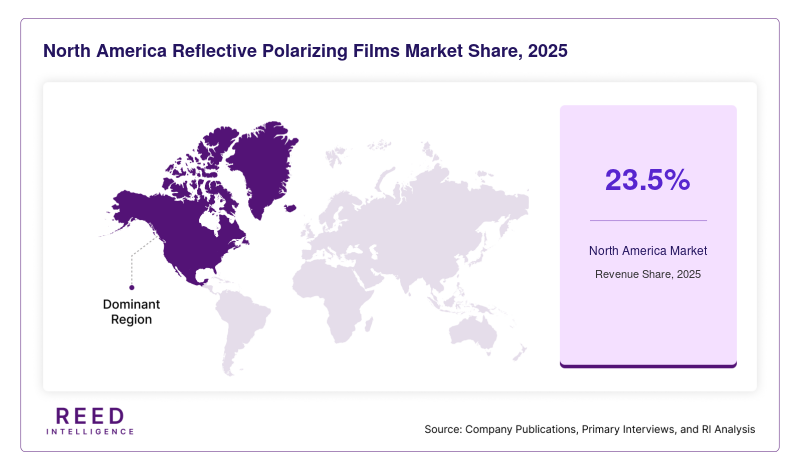
North America accounted for 23.5% of the Reflective Polarizing Films Market share in 2025. The region benefited from strong demand for premium consumer electronics, advanced automotive systems, and high-performance industrial displays. The market is projected to expand at a CAGR of 8.8% during 2026–2034.
The United States dominated the regional market due to increasing adoption of advanced automotive infotainment systems and rising investment in next-generation display technologies. The presence of leading technology companies and display component developers further supported regional growth.
Europe
Europe held 19.6% of the global Reflective Polarizing Films Market share in 2025 and is expected to grow at a CAGR of 8.9% during the forecast period. Increasing deployment of advanced automotive displays and industrial automation systems supported market expansion across the region.
Germany remained the leading country market due to the strong automotive manufacturing sector and increasing integration of digital cockpit displays in passenger vehicles. Demand for energy-efficient industrial displays also contributed to regional growth.
Asia Pacific
Asia Pacific dominated the Reflective Polarizing Films Market with a 47.8% share in 2025 and is projected to grow at a CAGR of 10.4% during 2026–2034. The region benefited from large-scale electronics manufacturing operations, strong LCD panel production capacity, and rising demand for consumer electronics.
China emerged as the leading country market owing to major investments in display manufacturing facilities and increasing domestic consumption of smartphones and televisions. South Korea, Japan, and Taiwan also contributed significantly to regional market expansion through technological advancements in display materials.
Middle East & Africa
The Middle East & Africa accounted for 4.1% of the global Reflective Polarizing Films Market share in 2025. The market is expected to expand at a CAGR of 8.2% during the forecast period due to rising adoption of digital signage systems and smart consumer electronics.
The United Arab Emirates dominated the regional market because of increasing investments in smart retail infrastructure and advanced commercial display technologies. Growth in hospitality and transportation display applications also supported demand.
Latin America
Latin America represented 5.0% of the global Reflective Polarizing Films Market share in 2025 and is forecast to register the fastest CAGR of 10.9% during 2026–2034. Rising electronics imports and increasing demand for affordable smart devices supported regional growth.
Brazil remained the dominant country market due to expanding consumer electronics consumption and increasing investment in automotive electronics manufacturing. Growth in local assembly operations further strengthened regional market demand.
Competitive Landscape
The Reflective Polarizing Films Market remains moderately consolidated with competition centered on optical performance, material innovation, manufacturing efficiency, and strategic partnerships with display manufacturers. Leading companies are investing in multilayer optical engineering technologies and expanding production capacity to strengthen their market presence.
3M Company remained one of the leading players in the market due to its extensive portfolio of reflective display enhancement films and advanced optical solutions. The company recently expanded its optical film manufacturing capabilities to support rising demand from premium display manufacturers.
Nitto Denko Corporation focused on developing ultra-thin reflective films for foldable electronic devices and high-resolution displays. Sumitomo Chemical Co., Ltd. emphasized research in multilayer polymer engineering to improve luminance efficiency and film durability.
Samsung SDI strengthened its position through integration of advanced display materials into consumer electronics and automotive display systems. Shinwha Intertek Corporation continued expanding its optical film portfolio for next-generation LCD applications.
Strategic collaborations between display panel manufacturers and optical film suppliers are expected to increase as companies seek improved performance and supply chain stability.
Key Players List
- 3M Company
- Nitto Denko Corporation
- Sumitomo Chemical Co., Ltd.
- Samsung SDI Co., Ltd.
- Shinwha Intertek Corporation
- LG Chem Ltd.
- Toray Industries, Inc.
- BenQ Materials Corporation
- MNTech Co., Ltd.
- Sanritz Corporation
- Kolon Industries, Inc.
- Chi Mei Corporation
- Teijin Limited
- Mitsubishi Chemical Group Corporation
- Hyosung Chemical Corporation
Recent Developments
- 3M Company introduced advanced brightness enhancement reflective films for energy-efficient premium television displays in 2025.
- Nitto Denko Corporation expanded production of ultra-thin reflective films for foldable smartphone applications.
- Samsung SDI announced investments in automotive display optical materials for next-generation electric vehicles.
- Sumitomo Chemical Co., Ltd. developed multilayer optical films with improved thermal resistance for industrial displays.
- LG Chem Ltd. enhanced its optical film portfolio for mini-LED television applications.
- Toray Industries, Inc. focused on flexible reflective film development for wearable electronics and foldable displays.
Reflective Polarizing Films Market Segments
Product Type
- Multilayer Reflective Polarizing Films
- Ultra-Thin Reflective Films
- Brightness Enhancement Reflective Films
- Flexible Reflective Films
Material Type
- Polymer-Based Films
- PET-Based Films
- Polycarbonate Films
- Composite Optical Films
Application
- LCD Displays
- Automotive Displays
- Smartphones and Tablets
- Televisions
- Wearable Electronics
- Industrial Displays
End-Use Industry
- Consumer Electronics
- Automotive Electronics
- Healthcare
- Industrial Equipment
- Aerospace & Defense
Distribution Channel
- Direct Sales
- Distributors
- Online Procurement Platforms
By Region
- North America
- Europe
- APAC
- Middle East and Africa
- LATAM