Refrigerant Compressors Market Size, Share Demand Report By Type (Reciprocating Compressors, Scroll Compressors, Screw Compressors, Centrifugal Compressors, Rotary Compressors), By Refrigerant Type (HFC-Compatible Compressors, HFO-Compatible Compressors, Natural Refrigerant Compressors), By Application (Air Conditioning Systems, Refrigeration Systems, Heat Pump Systems, Industrial Cooling Systems), By End User (Residential, Commercial, Industrial, Cold Chain & Logistics, Transportation) By Regio
USD 3950
Market Overview
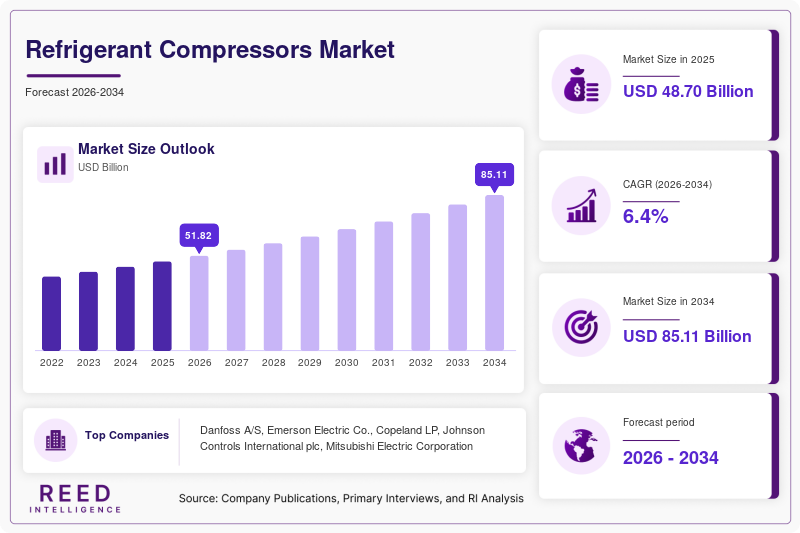
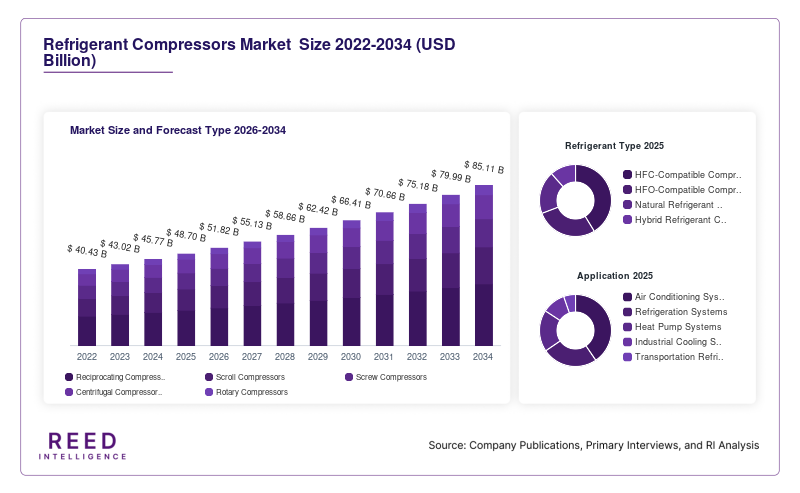
The Refrigerant Compressors Market size was valued at USD 48.7 billion in 2026 and is projected to reach USD 79.8 billion by 2034, registering a CAGR of 6.4% during the forecast period (2026–2034). One of the primary global factors supporting market growth has been the increasing deployment of cooling infrastructure worldwide. Rapid urbanization, rising temperatures, expansion of cold-chain logistics, and growing demand for food preservation have accelerated investments in refrigeration systems. Refrigerant compressors remain the core component of cooling equipment, enabling efficient refrigerant circulation and temperature control across diverse applications.
Manufacturers are increasingly focusing on compressor technologies that improve energy efficiency, reduce operational costs, and comply with evolving environmental regulations regarding refrigerants. Innovations in variable-speed compressors, inverter technologies, and low-global-warming-potential refrigerant compatibility have improved system performance and expanded application areas. The transition toward sustainable cooling solutions is creating favorable conditions for long-term market expansion.
Key Highlights
- Asia Pacific accounted for the largest market share of 39.6% in 2025, while Middle East & Africa is projected to register the fastest CAGR of 7.8% during 2026–2034.
- By Type, Reciprocating Compressors held the dominant market share of 34.8% in 2025, whereas Scroll Compressors are expected to expand at a CAGR of 7.6% through 2034.
- By Refrigerant Type, HFC-Compatible Compressors represented 43.2% share in 2025, while Natural Refrigerant Compressors are forecast to grow at a CAGR of 8.4%.
- By Application, Air Conditioning Systems captured 38.4% market share in 2025, whereas Heat Pump Systems are anticipated to record a CAGR of 8.1%.
- By End User, Commercial Sector remained the leading segment with 36.9% share in 2025, while the Cold Chain & Logistics Sector is forecast to grow at 7.9% CAGR.
- The United States remained the dominant country, with market values of USD 7.84 billion in 2024 and USD 8.22 billion in 2025.
Market Trends
Integration of Variable-Speed Compressor Technology
Variable-speed compressor technology is becoming increasingly common across refrigeration and HVAC systems. Unlike conventional fixed-speed systems, variable-speed compressors adjust operating capacity according to cooling demand, reducing energy consumption and improving temperature consistency. This trend is gaining traction in residential air conditioners, commercial refrigeration units, and industrial cooling systems where operational efficiency remains a key purchasing criterion. Manufacturers continue introducing inverter-driven compressors capable of delivering enhanced performance under varying load conditions.
Adoption of Compressors Compatible with Low-GWP Refrigerants
Environmental regulations targeting greenhouse gas emissions are encouraging the transition toward low-global-warming-potential refrigerants. As a result, compressor manufacturers are developing equipment compatible with refrigerants such as CO₂, propane, ammonia, and hydrofluoroolefin blends. The growing focus on sustainability and regulatory compliance is influencing product development strategies. New compressor platforms designed for environmentally responsible refrigerants are becoming increasingly important across commercial refrigeration and industrial cooling applications.
Market Drivers
Expansion of Global Cold Chain Infrastructure
The rapid growth of temperature-controlled logistics networks is significantly increasing demand for refrigeration equipment. Expansion of food processing facilities, pharmaceutical distribution centers, and cold storage warehouses has accelerated the deployment of advanced refrigeration systems. Refrigerant compressors play a critical role in maintaining product quality throughout storage and transportation operations. Increasing investments in cold chain infrastructure continue to support market growth across developed and emerging economies.
Rising Demand for HVAC Equipment in Urban Areas
Urban development and rising construction activities are driving installation of air-conditioning systems in residential, commercial, and institutional buildings. Growing demand for indoor comfort and climate control solutions has increased production of HVAC equipment worldwide. Refrigerant compressors serve as essential components within these systems, supporting efficient cooling and temperature regulation. Continued expansion of urban infrastructure is expected to sustain market demand over the forecast period.
Market Restraint
Volatility in Raw Material and Component Costs
The manufacturing of refrigerant compressors relies on metals, electronic controls, precision components, and specialized materials. Fluctuations in raw material prices and supply chain disruptions can increase production costs and affect profitability. Such uncertainties may create pricing challenges for manufacturers and limit adoption among cost-sensitive end users.
Market Opportunities
Increasing Deployment of Heat Pump Technologies
The growing adoption of heat pumps for residential and commercial heating applications presents a substantial opportunity for compressor manufacturers. Heat pump systems rely heavily on advanced compressor technologies to achieve efficient thermal transfer. Expanding investments in energy-efficient heating infrastructure are expected to create additional demand throughout the forecast period.
Growth of Data Center Cooling Applications
The expansion of cloud computing facilities and digital infrastructure is generating demand for advanced cooling solutions. Modern data centers require precise thermal management systems to maintain equipment reliability and operational efficiency. Refrigerant compressors designed for specialized cooling applications are increasingly being incorporated into data center environments, creating attractive growth prospects for market participants.
Segmental Analysis
By Type
The Refrigerant Compressors Market is segmented into:
- Reciprocating Compressors
- Scroll Compressors
- Screw Compressors
- Centrifugal Compressors
- Rotary Compressors
Reciprocating Compressors dominated the market with 34.8% share in 2025. Their extensive use across refrigeration systems, commercial cooling equipment, and industrial applications contributed to strong market penetration. These compressors offer reliable performance across varying operating conditions and remain widely utilized in multiple end-use sectors.
Scroll Compressors are projected to register the fastest CAGR of 7.6% through 2034. Their compact design, low noise levels, and improved energy efficiency make them increasingly attractive for modern HVAC and refrigeration systems. Growing demand for high-performance climate-control solutions will support segment growth.
By Refrigerant Type
The market is categorized into:
- HFC-Compatible Compressors
- HFO-Compatible Compressors
- Natural Refrigerant Compressors
- Hybrid Refrigerant Compressors
HFC-Compatible Compressors accounted for 43.2% market share in 2025 owing to their widespread deployment across existing refrigeration and air-conditioning infrastructure. Established service networks and extensive installed equipment bases contributed to segment dominance.
Natural Refrigerant Compressors are expected to record the highest CAGR of 8.4% during the forecast period. Growing interest in environmentally responsible refrigeration technologies and increasing adoption of ammonia, CO₂, and hydrocarbon refrigerants will accelerate demand.
By Application
The market includes:
- Air Conditioning Systems
- Refrigeration Systems
- Heat Pump Systems
- Industrial Cooling Systems
- Transportation Refrigeration
Air Conditioning Systems held the largest share of 38.4% in 2025. Rising installation of residential and commercial cooling equipment contributed significantly to segment revenue generation. Consistent demand for indoor climate management supported widespread adoption.
Heat Pump Systems are forecast to expand at a CAGR of 8.1% through 2034. Increasing utilization of heat pumps for energy-efficient heating and cooling applications will create substantial growth opportunities. Regulatory support for efficient building technologies is expected to encourage wider adoption.
By End User
The market is segmented into:
- Residential
- Commercial
- Industrial
- Cold Chain & Logistics
- Transportation
Commercial accounted for 36.9% market share in 2025 due to extensive installation of refrigeration and air-conditioning equipment across retail facilities, office complexes, hospitality establishments, and healthcare institutions.
Cold Chain & Logistics is anticipated to register the fastest CAGR of 7.9% during the forecast period. Expansion of temperature-controlled storage networks and pharmaceutical logistics infrastructure will continue supporting demand for advanced compressor technologies.
Regional Analysis
North America
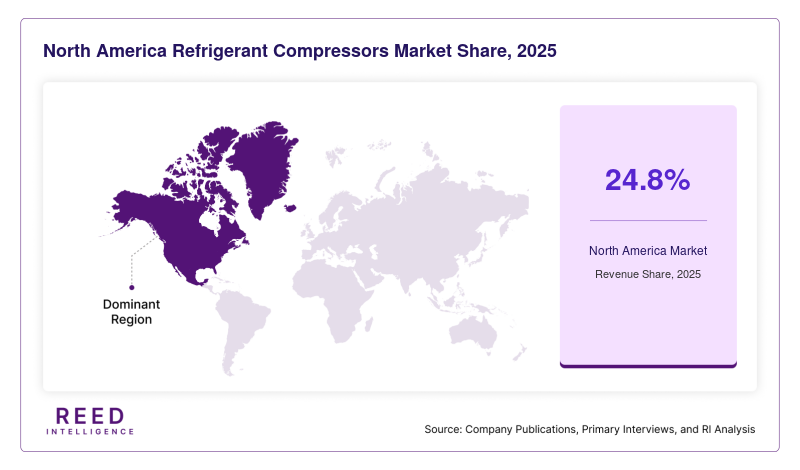
North America accounted for 24.8% of the Refrigerant Compressors Market share in 2025 and is projected to grow at a CAGR of 5.8% between 2026 and 2034. The region benefits from strong replacement demand for aging HVAC infrastructure and widespread adoption of advanced cooling technologies. Building modernization programs and energy-efficiency initiatives continue to support market development.
The United States dominated the regional market due to increasing deployment of high-efficiency HVAC systems in residential and commercial properties. Growing investment in sustainable building technologies has encouraged the adoption of advanced compressor solutions.
Europe
Europe represented 22.5% market share in 2025 and will likely expand at a CAGR of 5.9% through 2034. Market growth is supported by stringent environmental regulations promoting efficient refrigeration technologies and environmentally compatible cooling systems. The transition toward sustainable climate-control solutions remains an important industry trend.
Germany maintained regional leadership owing to its extensive manufacturing ecosystem and strong adoption of industrial refrigeration equipment. Continuous modernization of production facilities has strengthened demand for advanced compressor systems.
Asia Pacific
Asia Pacific held the largest 39.6% market share in 2025 and is anticipated to register a CAGR of 7.3% during the forecast period. Rapid industrialization, expanding residential construction, and rising demand for consumer cooling products continue to stimulate market growth throughout the region.
China emerged as the dominant country due to its extensive HVAC manufacturing capacity and expanding cold-storage infrastructure. Strong domestic demand for refrigeration equipment has supported continued market expansion.
Middle East & Africa
The Middle East & Africa accounted for 7.1% market share in 2025 and is forecast to expand at a CAGR of 7.8% between 2026 and 2034. Increasing investments in commercial developments and climate-control infrastructure are creating favorable conditions for market growth. Demand remains particularly strong in regions experiencing elevated cooling requirements.
Saudi Arabia led the regional market due to extensive deployment of air-conditioning systems across residential, hospitality, and commercial developments. Large-scale infrastructure projects continue to support equipment demand.
Latin America
Latin America captured 6.0% market share in 2025 and is expected to grow at a CAGR of 6.1% through 2034. Market expansion is supported by increasing refrigeration requirements across food processing industries and retail distribution networks. Growing cold-storage investments continue to contribute to regional demand.
Brazil remained the leading market due to ongoing expansion of food preservation infrastructure and modernization of commercial refrigeration systems. Increasing industrial refrigeration deployment has further strengthened market prospects.
Competitive Landscape
The Refrigerant Compressors Market remains moderately consolidated, with manufacturers focusing on energy-efficient technologies, environmentally compatible refrigerant solutions, and advanced digital controls. Product innovation, strategic partnerships, and manufacturing capacity expansion remain key competitive strategies.
Danfoss A/S maintained a leading position within the market due to its extensive portfolio of refrigeration and HVAC compressor technologies. The company recently introduced an advanced compressor platform optimized for low-GWP refrigerants and smart monitoring integration, enhancing operational efficiency and environmental performance.
Emerson Electric Co. continues strengthening its position through development of intelligent compressor systems designed for commercial refrigeration applications.
Johnson Controls International plc focuses on integrated cooling solutions that combine advanced compressors with digital building management technologies.
Mitsubishi Electric Corporation remains active in the development of inverter-driven compressors for residential and commercial climate-control systems.
Copeland LP continues expanding its refrigeration portfolio through innovations targeting sustainable cooling infrastructure and cold-chain applications.
Key Players List
- Danfoss A/S
- Emerson Electric Co.
- Copeland LP
- Johnson Controls International plc
- Mitsubishi Electric Corporation
- Daikin Industries Ltd.
- Panasonic Corporation
- LG Electronics Inc.
- Carrier Global Corporation
- Bitzer SE
- GEA Group AG
- Mayekawa Mfg. Co., Ltd.
- Frascold S.p.A.
- Tecumseh Products Company LLC
- Samsung Electronics Co., Ltd.
Refrigerant Compressors Market Segments
Type
- Reciprocating Compressors
- Scroll Compressors
- Screw Compressors
- Centrifugal Compressors
- Rotary Compressors
Refrigerant Type
- HFC-Compatible Compressors
- HFO-Compatible Compressors
- Natural Refrigerant Compressors
- Hybrid Refrigerant Compressors
Application
- Air Conditioning Systems
- Refrigeration Systems
- Heat Pump Systems
- Industrial Cooling Systems
- Transportation Refrigeration
End User
- Residential
- Commercial
- Industrial
- Cold Chain & Logistics
- Transportation
By Region
- North America
- Europe
- APAC
- Middle East and Africa
- LATAM