Refrigerated Incubator Market Size, Share Demand Report By Product Type (Benchtop Refrigerated Incubators, Floor-Standing Refrigerated Incubators, CO₂ Refrigerated Incubators), By Application (Microbiological Testing, Cell Culture Research, Stability Testing, Environmental Studies), By End Use (Pharmaceutical & Biotechnology Companies, Academic & Research Institutes, Food Testing Laboratories, Clinical Laboratories) By Region & Segment Forecasts, 2025–2034
USD 3950
Market Overview
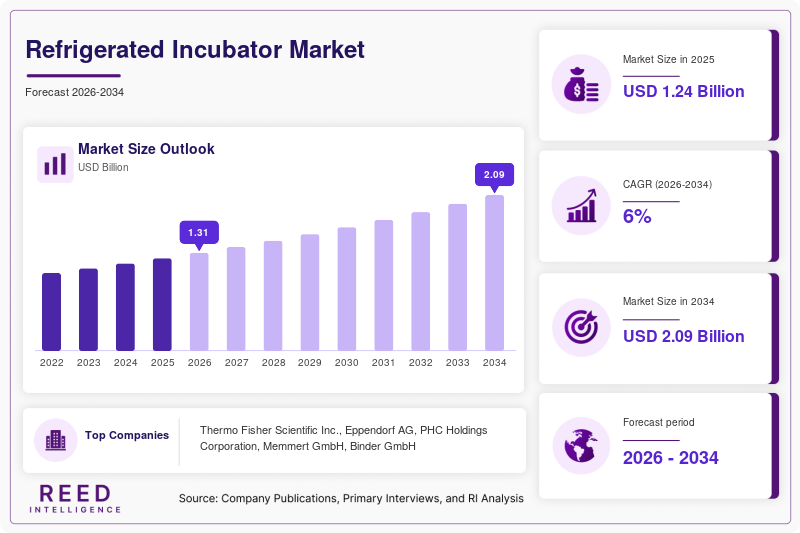
The Refrigerated Incubator Market size was valued at USD 1.24 billion in 2025 and is projected to reach USD 2.09 billion by 2034, expanding at a CAGR of 6.0% from 2025 to 2034. Refrigerated incubators are widely used in microbiology, biotechnology, pharmaceuticals, and food testing laboratories where precise temperature control and stable environmental conditions are required for microbial culture growth and sample storage. Increasing laboratory automation and the global expansion of life sciences research infrastructure are supporting steady demand for refrigerated incubation systems.
One of the major global factors contributing to the growth of the Refrigerated Incubator Market is the expansion of microbiological testing across healthcare, pharmaceutical manufacturing, and food safety monitoring. Governments and regulatory agencies worldwide have strengthened testing protocols for microbial contamination in food products, vaccines, and biologics. This has encouraged research laboratories, diagnostic centers, and industrial testing facilities to adopt advanced refrigerated incubators capable of maintaining uniform temperature ranges for reliable testing outcomes.
Key Highlights
- North America dominated the market with 36% share in 2025, while Asia Pacific will register the fastest growth at 7.4% CAGR through 2034.
- Benchtop refrigerated incubators led the type segment with 41% market share, while CO₂ refrigerated incubators are projected to grow fastest at 7.1% CAGR.
- Pharmaceutical & biotechnology companies were the dominant end-use segment with 38% share, whereas food testing laboratories are expected to grow at 7.6% CAGR.
- The United States remained the leading country with USD 390 million market size in 2025, expected to reach USD 412 million in 2026.
Market Trends
Integration of Smart Monitoring and IoT-Based Control Systems
Digitalization is influencing the Refrigerated Incubator Market as laboratories increasingly adopt smart monitoring and IoT-enabled equipment. Modern refrigerated incubators are equipped with remote monitoring capabilities that allow users to track temperature, humidity, and system performance in real time through connected software platforms. These features help laboratories maintain compliance with regulatory standards and ensure sample integrity. Data logging functions and cloud connectivity are also becoming common in advanced incubator models, allowing laboratories to automate environmental monitoring and reduce manual documentation tasks.
Rising Preference for Energy-Efficient Laboratory Equipment
Energy efficiency has become an important purchasing factor in laboratory infrastructure upgrades. Refrigerated incubators traditionally consume significant electricity due to continuous cooling operations. Manufacturers are responding by developing eco-friendly cooling technologies, low-energy compressors, and advanced insulation materials that reduce operational costs. Laboratories and research institutes are increasingly prioritizing equipment with lower energy consumption and reduced environmental impact. This trend is expected to support the adoption of next-generation refrigerated incubators that balance performance with sustainability requirements across pharmaceutical, academic, and industrial laboratories.
Market Drivers
Expansion of Biotechnology and Pharmaceutical Research
The growing scale of biotechnology and pharmaceutical research is driving demand in the Refrigerated Incubator Market. Biopharmaceutical companies conduct extensive microbial culture experiments, stability testing, and vaccine development processes that require controlled incubation environments. Refrigerated incubators provide precise temperature control necessary for culturing microorganisms, storing reagents, and conducting quality testing. As global pharmaceutical companies increase investments in biologics and cell-based therapies, laboratories are expanding their research infrastructure. This expansion continues to support demand for advanced incubation systems across drug discovery, vaccine development, and clinical research laboratories.
Increasing Importance of Food Safety and Microbial Testing
Food safety regulations are becoming more stringent worldwide, encouraging testing laboratories to adopt reliable microbiological testing equipment. Refrigerated incubators are essential for monitoring microbial growth during food contamination testing and quality assurance procedures. Food processing companies and independent testing laboratories are investing in advanced incubation systems to comply with regulatory standards and ensure product safety. The expansion of packaged food consumption and international food trade has increased the volume of microbial testing performed globally, which is expected to support sustained growth in the Refrigerated Incubator Market.
Market Restraint
High Equipment Cost and Maintenance Requirements
The high initial investment required for refrigerated incubators remains a key restraint affecting market growth. Advanced incubators with programmable temperature control, data monitoring capabilities, and energy-efficient cooling systems are relatively expensive compared to conventional laboratory incubation equipment. Small research laboratories and academic institutions with limited budgets may delay equipment upgrades due to financial constraints.
In addition to the purchase cost, refrigerated incubators require regular maintenance, calibration, and servicing to maintain temperature accuracy and system reliability. Cooling components such as compressors and refrigerant systems must be periodically inspected to prevent operational failures. Maintenance requirements increase operational expenses for laboratories, particularly in regions where technical service support is limited.
These cost-related challenges may slow adoption among small laboratories and emerging research facilities. However, manufacturers are addressing this restraint by introducing modular designs and cost-effective models that provide reliable incubation performance while reducing operational costs.
Market Opportunities
Growth of Contract Research and Testing Laboratories
Contract research organizations (CROs) and contract testing laboratories are expanding rapidly as pharmaceutical companies outsource laboratory testing and research services. These organizations require a wide range of laboratory equipment, including refrigerated incubators, to support microbiological analysis and stability studies. As outsourcing becomes more common in pharmaceutical development and food safety testing, CROs are expected to invest in advanced incubation systems to support high-volume laboratory operations.
Increasing Demand from Emerging Biotechnology Startups
The global biotechnology startup ecosystem is expanding as venture capital funding supports innovation in genomics, synthetic biology, and cell-based research. Many early-stage biotechnology companies are establishing research laboratories that require specialized equipment such as refrigerated incubators. This growth in startup-driven research infrastructure presents a long-term opportunity for equipment manufacturers. Companies offering compact, cost-efficient incubators designed for small laboratories may benefit significantly from this emerging demand.
Segmental Analysis
By Product Type
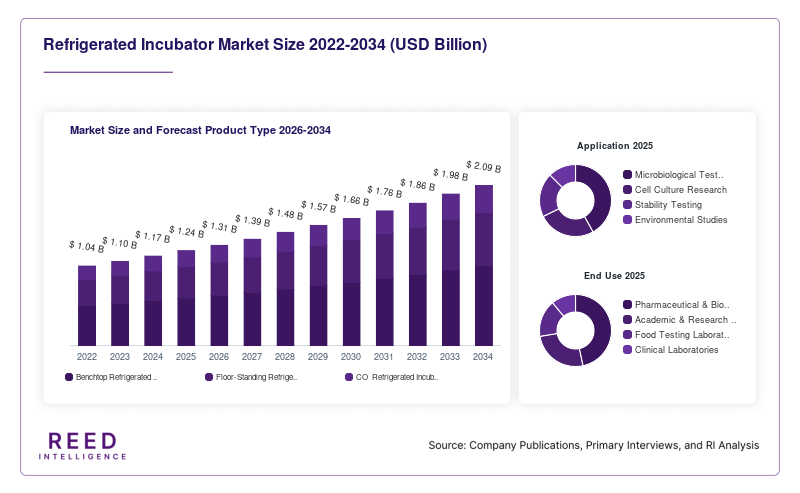
Benchtop refrigerated incubators dominated the Refrigerated Incubator Market in 2025 with a 41% market share. These incubators are widely used in academic laboratories, small research facilities, and diagnostic centers where space efficiency is important. Benchtop units provide precise temperature control while occupying minimal laboratory space. Their compact design and relatively lower cost compared to large floor-standing models contributed to their widespread adoption across research and testing laboratories.
CO₂ refrigerated incubators will represent the fastest-growing subsegment with a CAGR of 7.1% during the forecast period. These incubators maintain controlled carbon dioxide environments required for specialized microbiological research and cell culture applications. Increasing demand for cell-based research and advanced biological experiments will encourage laboratories to adopt CO₂-enabled refrigerated incubators that provide stable environmental conditions for complex biological studies.
By Application
The microbiological testing segment accounted for the largest share of the Refrigerated Incubator Market at 44% in 2025. Refrigerated incubators play a key role in culturing microorganisms and maintaining controlled conditions for microbial growth analysis. Laboratories conducting environmental monitoring, pharmaceutical quality testing, and clinical diagnostics frequently rely on these incubators to maintain consistent incubation environments for microbial samples.
The cell culture research segment will grow at the fastest CAGR of 7.5% through 2034. Advances in biotechnology research and cell-based experiments are increasing the need for controlled incubation environments for cell growth and tissue culture. Research laboratories are expected to expand their adoption of advanced incubators with improved temperature stability and environmental control to support these applications.
By End Use
Pharmaceutical and biotechnology companies held the dominant position in the Refrigerated Incubator Market with a 38% share in 2025. These organizations conduct large volumes of laboratory testing and microbiological research during drug development and manufacturing processes. Refrigerated incubators support stability testing, microbial culture growth, and quality control testing within pharmaceutical laboratories.
The food testing laboratories segment will grow at the fastest CAGR of 7.6% during the forecast period. Food safety regulations require strict microbial contamination testing across food production and distribution chains. Testing laboratories are expected to expand their equipment capacity to handle increasing testing volumes. This will drive demand for refrigerated incubators designed for food safety applications.
Regional Analysis
North America
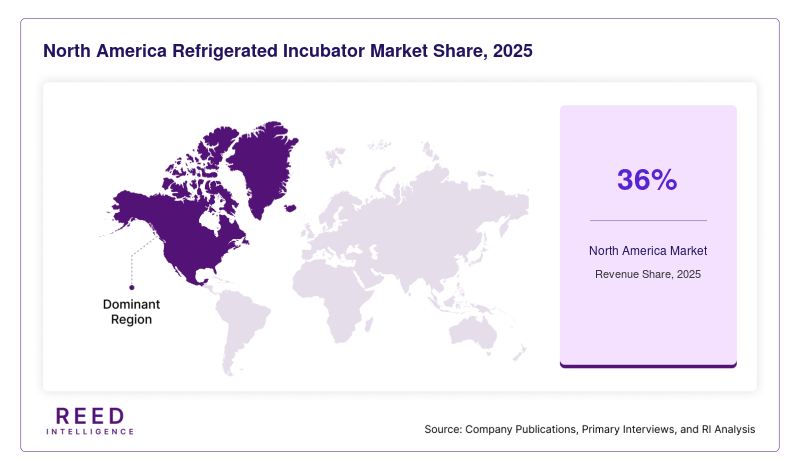
North America accounted for 36% of the Refrigerated Incubator Market share in 2025. The region will grow at a CAGR of 5.6% during the forecast period. Strong laboratory infrastructure, high research spending, and established pharmaceutical manufacturing activities contributed to the region’s leading position in the market. Academic research institutions, biotechnology firms, and contract testing laboratories across the United States and Canada have widely adopted refrigerated incubators for microbiological and biochemical research.
The United States represented the dominant country in the region due to the presence of advanced life sciences research facilities and pharmaceutical companies. Growth in biologics production and vaccine research has increased laboratory demand for precision incubation systems. Pharmaceutical companies in the country frequently upgrade laboratory equipment to maintain regulatory compliance and ensure high-quality research output. This factor continues to strengthen the demand for refrigerated incubators across the U.S. life sciences industry.
Europe
Europe held approximately 27% share of the Refrigerated Incubator Market in 2025 and will expand at a CAGR of 5.4% through 2034. The region has a strong pharmaceutical manufacturing base and a large network of academic research institutions. Laboratories across Europe conduct extensive microbiological research and environmental monitoring, supporting demand for refrigerated incubators.
Germany dominated the regional market due to its advanced pharmaceutical production sector and biotechnology research ecosystem. The country hosts numerous research institutes and life sciences clusters that focus on microbiology and molecular biology studies. Continuous investments in laboratory modernization and research facilities are supporting the adoption of advanced incubation systems across German laboratories.
Asia Pacific
Asia Pacific represented 23% of the Refrigerated Incubator Market in 2025 and will record the fastest growth with a CAGR of 7.4% during the forecast period. The expansion of biotechnology research, pharmaceutical manufacturing, and food testing laboratories is driving demand for refrigerated incubators across the region.
China led the regional market due to rapid expansion in pharmaceutical manufacturing and biotechnology research investments. Government initiatives aimed at strengthening domestic biotechnology capabilities have encouraged the development of new research laboratories and innovation centers. As a result, laboratories across the country are increasingly adopting modern refrigerated incubation equipment to support microbiological research and pharmaceutical testing activities.
Middle East & Africa
The Middle East & Africa region accounted for 7% of the Refrigerated Incubator Market share in 2025 and will grow at a CAGR of 5.8% between 2025 and 2034. Growth in healthcare research infrastructure and laboratory testing capacity has supported gradual market expansion in the region.
Saudi Arabia emerged as the leading country in the regional market. The government has been investing in healthcare modernization and biomedical research infrastructure as part of its long-term economic diversification initiatives. Research centers and medical laboratories in the country are expanding their laboratory equipment capacity, which is expected to support the adoption of refrigerated incubators in the coming years.
Latin America
Latin America accounted for 7% of the Refrigerated Incubator Market in 2025 and will grow at a CAGR of 5.5% through 2034. The region has experienced steady growth in laboratory testing activities across pharmaceutical manufacturing and food safety monitoring.
Brazil dominated the regional market due to its expanding pharmaceutical industry and increasing investment in biomedical research. Research universities and biotechnology laboratories across the country are upgrading laboratory equipment to support microbiological studies. This growth in research activities continues to drive demand for refrigerated incubators in Brazil.
Competitive Landscape
The Refrigerated Incubator Market is moderately competitive, with several global laboratory equipment manufacturers offering a wide range of incubation systems. Companies compete through technological innovation, product reliability, and expanded distribution networks across research institutions and industrial laboratories.
Thermo Fisher Scientific Inc. remains a key market participant due to its broad laboratory equipment portfolio and global distribution capabilities. The company continues to introduce refrigerated incubators equipped with digital monitoring systems and energy-efficient cooling technologies.
Other major participants include Eppendorf AG, PHC Holdings Corporation, Memmert GmbH, and Binder GmbH, which offer advanced incubation systems designed for research laboratories and industrial testing facilities. Many companies are focusing on product innovation and laboratory automation compatibility to strengthen their position in the global Refrigerated Incubator Market.
Key Players
- Thermo Fisher Scientific Inc.
- Eppendorf AG
- PHC Holdings Corporation
- Memmert GmbH
- Binder GmbH
- Panasonic Healthcare Co., Ltd.
- Sheldon Manufacturing Inc.
- Labnet International Inc.
- Jeio Tech Co., Ltd.
- N-BIOTEK Inc.
- NuAire Inc.
- BMT Medical Technology s.r.o.
- Froilabo SAS
- Yamato Scientific Co., Ltd.
- Caron Products & Services, Inc.
Recent Developments
- Thermo Fisher Scientific introduced a new series of energy-efficient refrigerated incubators designed for microbiology laboratories in 2024.
- Eppendorf AG expanded its laboratory equipment portfolio with compact refrigerated incubation systems for research facilities.
- Binder GmbH launched advanced incubators with improved temperature uniformity and digital monitoring capabilities.
- PHC Holdings Corporation upgraded its laboratory incubator line with enhanced temperature stability technology.
- Memmert GmbH introduced a new generation of refrigerated incubators focusing on energy efficiency and laboratory automation compatibility.
Refrigerated Incubator Market Segments
Product Type
- Benchtop Refrigerated Incubators
- Floor-Standing Refrigerated Incubators
- CO₂ Refrigerated Incubators
Application
- Microbiological Testing
- Cell Culture Research
- Stability Testing
- Environmental Studies
End Use
- Pharmaceutical & Biotechnology Companies
- Academic & Research Institutes
- Food Testing Laboratories
- Clinical Laboratories
By Region
- North America
- Europe
- APAC
- Middle East and Africa
- LATAM