Refrigeration Equipment Market Size, Share & Demand Report By Product Type (Commercial Refrigeration Equipment, Industrial Refrigeration Equipment, Residential Refrigeration Equipment), By Application (Food & Beverage Storage and Processing, Pharmaceutical Cold Storage, Chemical Storage), By Distribution Channel (Direct Sales, Distributors & Dealers, Online Sales), By Region & Segment Forecasts, 2026–2034
USD 3950
Market Overview
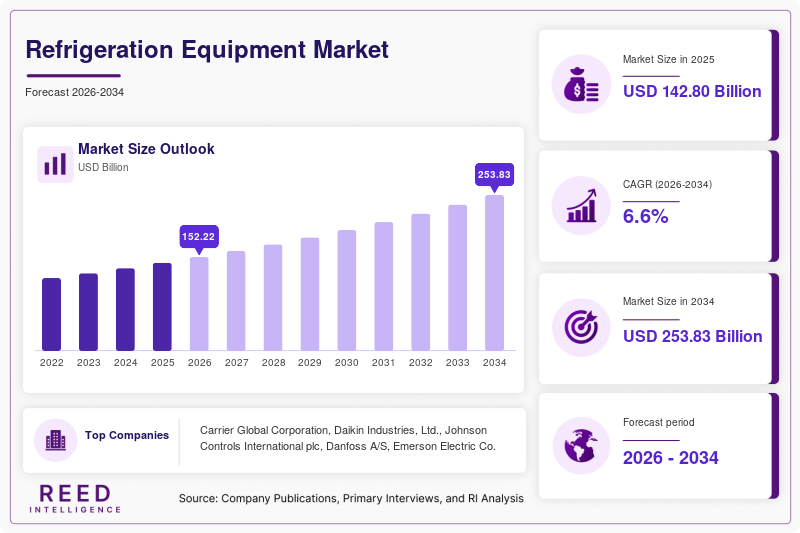
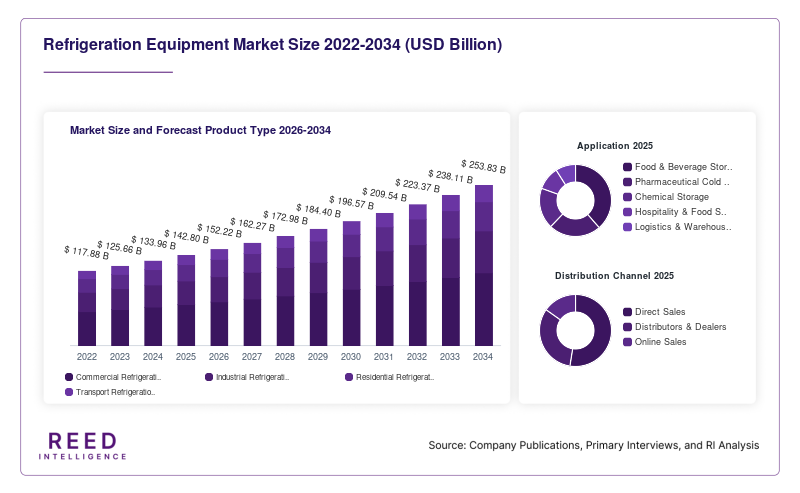
The Refrigeration Equipment Market Size was valued at USD 142.8 billion in 2026 and is projected to reach USD 238.6 billion by 2034, expanding at a CAGR of 6.6% during the forecast period (2026–2034). The market is experiencing steady expansion due to rising demand for temperature-controlled storage, growing food safety requirements, and the rapid development of global cold-chain infrastructure. Refrigeration equipment plays a critical role across residential, commercial, industrial, pharmaceutical, and food processing sectors by ensuring product preservation, quality maintenance, and regulatory compliance.
A major global factor supporting market growth has been the expansion of the cold-chain logistics industry. The increasing international trade of perishable food products, vaccines, biologics, and temperature-sensitive chemicals has generated strong demand for advanced refrigeration systems. Governments and private enterprises are investing in refrigerated warehouses, transportation networks, and energy-efficient cooling technologies to reduce spoilage and improve supply chain reliability. Simultaneously, urbanization and changing consumer lifestyles have increased the consumption of frozen foods, ready-to-eat meals, and fresh produce, creating additional demand for refrigeration equipment worldwide.
Key Highlights
- Asia Pacific dominated the market with 38.6% share in 2025, while Middle East & Africa is expected to register the fastest CAGR of 7.8% during 2026–2034.
- By Product Type, Commercial Refrigeration Equipment accounted for 44.2% share in 2025, while Industrial Refrigeration Equipment is projected to grow at a 7.5% CAGR.
- By Refrigerant Type, Hydrofluorocarbon (HFC)-Based Systems held 46.7% share in 2025, whereas Natural Refrigerant Systems are forecast to expand at a 9.1% CAGR.
- By Application, Food & Beverage Storage and Processing represented 49.4% share in 2025, while Pharmaceutical Cold Storage is expected to grow at a 8.8% CAGR.
- By End User, Retail & Supermarket Chains accounted for 35.8% share in 2025, while Healthcare & Pharmaceutical Facilities are anticipated to grow at a 8.6% CAGR.
- China, the dominant country market, was valued at USD 21.8 billion in 2024 and USD 23.5 billion in 2025.
Market Trends
Adoption of Natural Refrigerants
The transition toward natural refrigerants is becoming a major trend within the Refrigeration Equipment Market. Businesses are increasingly adopting refrigerants such as ammonia, carbon dioxide, and hydrocarbons to comply with environmental regulations and sustainability objectives. These alternatives offer lower global warming potential and support long-term regulatory compliance. Food processing facilities, supermarkets, and industrial refrigeration operators are gradually replacing conventional refrigerants with environmentally compatible solutions.
Integration of Smart Monitoring Technologies
Digitalization is reshaping refrigeration system management. Smart refrigeration platforms equipped with IoT sensors, cloud connectivity, and predictive analytics are enabling operators to monitor equipment performance in real time. These systems improve energy efficiency, reduce downtime, and optimize maintenance schedules. As organizations prioritize operational visibility and asset management, connected refrigeration equipment is becoming increasingly common across commercial and industrial environments.
Market Drivers
Expansion of Frozen and Processed Food Consumption
The growing demand for frozen foods, packaged meals, and processed food products is a key driver of market growth. Consumers increasingly seek convenience-oriented food products with extended shelf life. Manufacturers, distributors, and retailers require advanced refrigeration infrastructure to preserve product quality throughout production, transportation, and storage processes. This trend continues to generate sustained demand for refrigeration equipment globally.
Growth of Pharmaceutical Cold Chain Infrastructure
The pharmaceutical industry relies heavily on temperature-controlled storage for vaccines, biologics, blood products, and specialty medicines. Expanding healthcare infrastructure and increasing production of temperature-sensitive therapies have strengthened demand for reliable refrigeration systems. Investments in pharmaceutical logistics facilities and medical storage networks continue to support market expansion across developed and emerging economies.
Market Restraint
High Installation and Energy Consumption Costs
The significant capital investment required for advanced refrigeration systems remains a major market restraint. Installation expenses, energy consumption, maintenance requirements, and compliance costs can limit adoption among small and medium-sized enterprises. Rising electricity prices in certain regions may further increase operational expenditures and impact purchasing decisions.
Market Opportunities
Development of Sustainable Cooling Solutions
Growing environmental awareness is creating opportunities for manufacturers to develop energy-efficient refrigeration systems using low-emission refrigerants. Demand for sustainable cooling technologies is expected to increase across commercial, industrial, and institutional sectors as organizations pursue carbon reduction initiatives and environmental compliance goals.
Expansion of Refrigerated Warehousing Facilities
The rapid growth of e-commerce grocery services and global food distribution networks is increasing demand for modern refrigerated warehouses. New cold storage facilities require advanced refrigeration systems capable of maintaining stable temperatures while minimizing energy consumption. This trend presents significant opportunities for equipment manufacturers and technology providers.
Segmental Analysis
By Product Type
Commercial Refrigeration Equipment
Commercial refrigeration equipment accounted for 44.2% market share in 2025. The segment maintained leadership due to widespread deployment in supermarkets, convenience stores, restaurants, hotels, and food service establishments. Increasing demand for food preservation and display solutions supported continued adoption.
Industrial Refrigeration Equipment
Industrial refrigeration equipment is projected to grow at a 7.5% CAGR through 2034. Growth will be driven by increasing investments in large-scale cold storage facilities and industrial processing plants. Expanding food manufacturing operations and specialized storage requirements will contribute to segment development.
By Refrigerant Type
Hydrofluorocarbon (HFC)-Based Systems
HFC-based systems represented 46.7% share in 2025. These systems remained widely used due to established infrastructure, broad equipment compatibility, and proven cooling performance across commercial and industrial applications.
Natural Refrigerant Systems
Natural refrigerant systems are expected to expand at a 9.1% CAGR during the forecast period. Increasing environmental regulations and corporate sustainability objectives will encourage adoption of low-emission refrigeration technologies utilizing ammonia, carbon dioxide, and hydrocarbon refrigerants.
By Application
Food & Beverage Storage and Processing
Food and beverage storage and processing accounted for 49.4% of market revenue in 2025. The segment remained dominant because refrigeration is essential throughout food manufacturing, distribution, retailing, and preservation processes. Rising demand for quality-controlled food products continued to support equipment deployment.
Pharmaceutical Cold Storage
Pharmaceutical cold storage is forecast to grow at a 8.8% CAGR through 2034. Growth will result from increasing production of biologics, specialty medicines, and temperature-sensitive vaccines requiring controlled storage environments.
By End User
Retail & Supermarket Chains
Retail and supermarket chains held 35.8% share in 2025. Extensive utilization of display refrigerators, freezers, and walk-in cooling systems supported segment dominance. Continuous expansion of organized retail infrastructure further contributed to demand.
Healthcare & Pharmaceutical Facilities
Healthcare and pharmaceutical facilities are projected to register a 8.6% CAGR during the forecast period. The increasing need for secure storage of vaccines, laboratory samples, and specialty drugs will strengthen adoption of advanced refrigeration solutions.
By Distribution Channel
Direct Sales
Direct sales accounted for 52.3% market share in 2025. Large commercial and industrial customers preferred direct procurement due to customized equipment specifications, technical consultation, and after-sales support services.
Online Sales
Online sales are anticipated to grow at a 9.3% CAGR through 2034. The availability of digital procurement platforms and expanding e-commerce channels for commercial equipment purchases will support segment growth.
Regional Analysis
North America
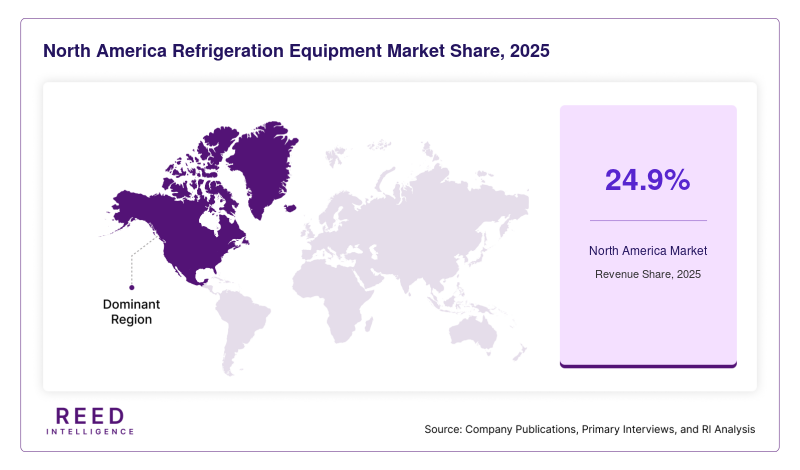
North America accounted for 24.9% of the Refrigeration Equipment Market share in 2025 and is projected to grow at a CAGR of 5.9% during 2026–2034.
The United States dominated the regional market due to widespread adoption of advanced refrigeration technologies in retail chains and food distribution networks. The country's extensive cold storage infrastructure and increasing demand for temperature-controlled pharmaceutical logistics contributed significantly to market growth.
Europe
Europe represented 22.4% market share in 2025 and is forecast to expand at a CAGR of 6.1% through 2034.
Germany emerged as the leading market within the region. Growth was supported by industrial modernization initiatives and increasing implementation of environmentally compliant cooling systems. Investments in energy-efficient refrigeration technologies across manufacturing and logistics facilities strengthened market demand.
Asia Pacific
Asia Pacific held 38.6% share of the global market in 2025 and is expected to grow at a CAGR of 7.1% during the forecast period.
China remained the dominant country market. The expansion of large-scale food processing operations, growth in refrigerated transportation networks, and rising demand for cold storage infrastructure supported regional development. Continued industrialization and urban population growth further increased demand for refrigeration equipment.
Middle East & Africa
The Middle East & Africa accounted for 8.1% market share in 2025 and is anticipated to register the fastest CAGR of 7.8% through 2034.
Saudi Arabia led the regional market due to investments in food security programs and temperature-controlled logistics infrastructure. The development of large-scale warehousing facilities and modernization of food distribution systems contributed to increased equipment deployment.
Latin America
Latin America captured 6.0% share of the Refrigeration Equipment Market in 2025 and is projected to expand at a CAGR of 6.4% during the forecast period.
Brazil dominated regional demand because of its extensive agricultural production and food export industry. Growing requirements for refrigerated storage and transportation solutions supported continuous market expansion across the country.
Competitive Landscape
The Refrigeration Equipment Market is characterized by technological innovation, product diversification, strategic partnerships, and investments in sustainable cooling technologies. Companies focus on improving energy efficiency, integrating smart controls, and developing environmentally compliant refrigerant solutions.
Carrier Global Corporation
Carrier Global remains a leading participant in the Refrigeration Equipment Market. The company continues expanding its portfolio of energy-efficient refrigeration systems and recently introduced advanced digital monitoring capabilities for commercial cold-chain applications.
Daikin Industries, Ltd.
Daikin maintains a strong market position through its extensive refrigeration and cooling technology portfolio. The company focuses on environmentally sustainable refrigerants and high-efficiency system designs.
Johnson Controls International plc
Johnson Controls develops refrigeration solutions for industrial, commercial, and institutional applications. Its integrated building management technologies support optimized energy performance and operational efficiency.
Danfoss A/S
Danfoss specializes in refrigeration controls, compressors, and energy management technologies. The company continues investing in natural refrigerant solutions and intelligent cooling platforms.
Emerson Electric Co.
Emerson provides advanced refrigeration technologies, monitoring systems, and automation solutions. Its focus on predictive maintenance and connected refrigeration infrastructure strengthens its competitive position across global markets.
Key Players List
- Carrier Global Corporation
- Daikin Industries, Ltd.
- Johnson Controls International plc
- Danfoss A/S
- Emerson Electric Co.
- Whirlpool Corporation
- Electrolux AB
- Haier Smart Home Co., Ltd.
- LG Electronics Inc.
- Panasonic Holdings Corporation
- Mitsubishi Electric Corporation
- Hussmann Corporation
- GEA Group AG
- Bitzer SE
- Mayekawa Mfg. Co., Ltd.
Refrigeration Equipment Market Segments
Product Type
- Commercial Refrigeration Equipment
- Industrial Refrigeration Equipment
- Residential Refrigeration Equipment
- Transport Refrigeration Equipment
Application
- Food & Beverage Storage and Processing
- Pharmaceutical Cold Storage
- Chemical Storage
- Hospitality & Food Service
- Logistics & Warehousing
Distribution Channel
- Direct Sales
- Distributors & Dealers
- Online Sales
By Region
- North America
- Europe
- APAC
- Middle East and Africa
- LATAM