Relaxor Ferroelectric Ceramics Market Size, Share & Demand Report By Material Type (Lead Magnesium Niobate (PMN)-Based Ceramics), By Application (Multilayer Ceramic Capacitors, Ultrasonic Transducers), By End-Use Industry (Consumer Electronics, Healthcare Equipment, Automotive Electronics, Aerospace and Defense), By Device Type (Capacitors, Transducers, Resonators, Sensors), By Distribution Channel (Direct OEM Supply, Electronic Component Distributors), By Region & Segment Forecasts, 2026–2034
USD 3950
Market Overview
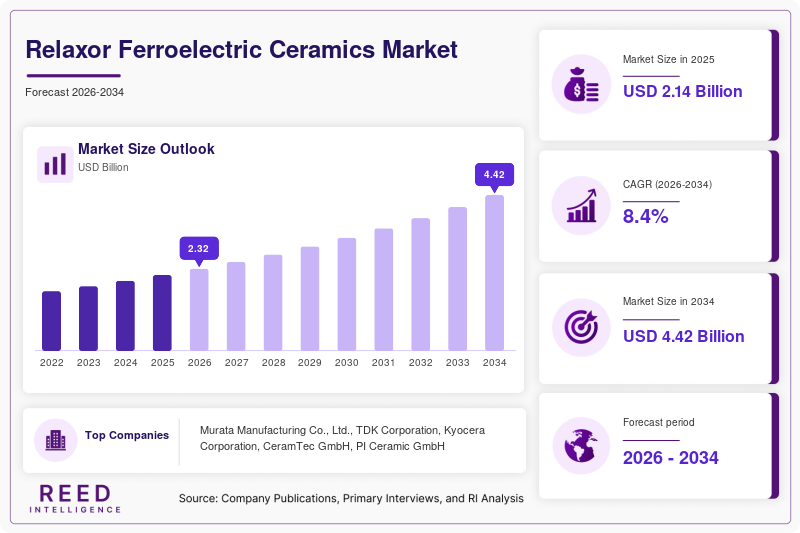
The global Relaxor Ferroelectric Ceramics Market size was valued at USD 2.14 billion in 2026 and is projected to reach USD 4.08 billion by 2034, expanding at a CAGR of 8.4% during the forecast period (2026–2034). The market growth has been supported by increasing global demand for advanced piezoelectric materials across electronics, medical imaging, aerospace, defense, and telecommunications industries. Rising adoption of high-performance ceramic materials in sensors, actuators, capacitors, and ultrasonic devices has significantly accelerated market expansion.
Relaxor ferroelectric ceramics are advanced functional materials characterized by high dielectric constants, excellent electromechanical coupling, strong piezoelectric properties, and broad temperature stability. These materials are widely used in high-frequency electronic applications, transducers, multilayer ceramic capacitors, sonar systems, and energy harvesting devices. The growing demand for miniaturized electronic components and precision sensing technologies has strengthened the adoption of relaxor ferroelectric ceramics across multiple industrial sectors.
Key Highlights
- Asia Pacific accounted for 41.8% of the global Relaxor Ferroelectric Ceramics Market share in 2025, while North America is projected to register the fastest CAGR of 8.9% during the forecast period.
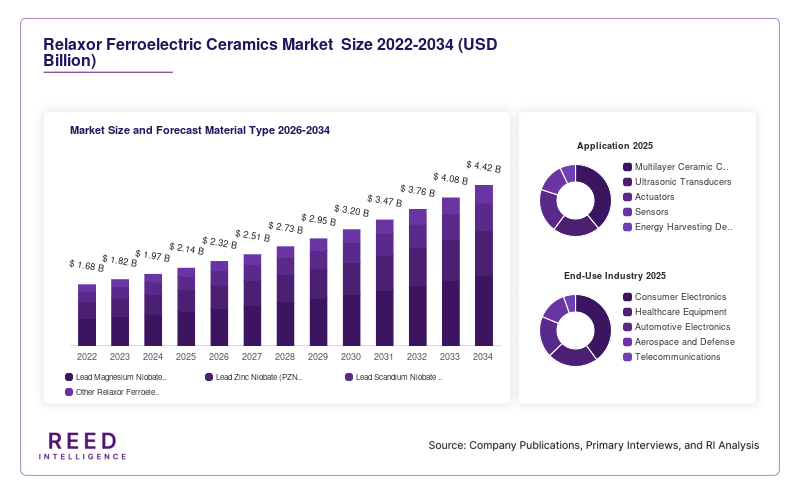
- By material type, lead magnesium niobate (PMN)-based ceramics dominated with a 39.6% market share in 2025, whereas lead zinc niobate (PZN)-based ceramics are anticipated to grow at a CAGR of 9.1% through 2034.
- By application, multilayer ceramic capacitors held the largest market share of 33.4% in 2025, while ultrasonic transducers are expected to expand at a CAGR of 9.3%.
- By end-use industry, consumer electronics captured 36.2% of the market in 2025, whereas healthcare equipment is forecast to grow at a CAGR of 9.0%.
- China remained the dominant country market, valued at USD 342.5 million in 2024 and USD 367.8 million in 2025.
Market Trends
Rising Integration of Relaxor Ceramics in Advanced Medical Devices
The healthcare industry is increasingly integrating relaxor ferroelectric ceramics into advanced medical imaging systems and precision diagnostic devices. These materials provide superior electromechanical properties required for ultrasonic imaging equipment, minimally invasive surgical devices, and biomedical sensors. Manufacturers are developing compact and high-sensitivity ceramic components to improve imaging quality and diagnostic efficiency. This trend is expected to support long-term growth in the Relaxor Ferroelectric Ceramics Market.
Growing Development of High-Frequency Electronic Components
Rapid expansion of high-frequency communication systems and miniaturized electronics is increasing the adoption of relaxor ferroelectric ceramic materials. Advanced dielectric performance and thermal stability make these ceramics suitable for multilayer capacitors, RF filters, resonators, and antenna systems. Increasing deployment of 5G communication networks and smart electronic devices is expected to accelerate demand for high-performance ceramic components.
Market Drivers
Increasing Demand for Piezoelectric Sensors and Actuators
The growing adoption of piezoelectric sensors and actuators across industrial automation, automotive electronics, and aerospace systems has significantly supported the Relaxor Ferroelectric Ceramics Market. Relaxor ceramics provide excellent electromechanical coupling and high dielectric properties, making them suitable for precision sensing applications. Industries are increasingly utilizing advanced piezoelectric materials to improve operational accuracy and system responsiveness.
Expansion of Consumer Electronics Manufacturing
The expansion of consumer electronics manufacturing activities has driven demand for advanced ceramic materials with improved dielectric and thermal performance. Relaxor ferroelectric ceramics are widely used in smartphones, wearable devices, tablets, and compact electronic systems. Increasing global demand for miniaturized and energy-efficient electronic products continues to support market growth.
Market Restraint
High Manufacturing Complexity and Processing Costs
The production of relaxor ferroelectric ceramics involves complex processing methods, controlled sintering environments, and specialized raw materials. These factors increase manufacturing costs and create challenges for large-scale commercial production. Variations in raw material availability and processing consistency may also affect product performance and supply chain stability.
Market Opportunities
Emerging Applications in Energy Harvesting Systems
The growing development of energy harvesting technologies is creating opportunities for relaxor ferroelectric ceramic manufacturers. These materials are increasingly utilized in vibration energy harvesting devices and self-powered electronic systems due to their strong piezoelectric response and dielectric efficiency. Expanding demand for sustainable energy solutions is expected to support market growth.
Expansion of Smart Automotive Electronics
The automotive industry is increasingly adopting advanced ceramic components for driver assistance systems, ultrasonic sensors, and vehicle communication modules. Relaxor ferroelectric ceramics offer high reliability and temperature stability required for automotive electronic systems. Rising investments in electric vehicles and smart mobility technologies are expected to create favorable opportunities for the market.
Segmental Analysis
By Material Type
PMN-Based Ceramics Dominated the Market
Lead magnesium niobate (PMN)-based ceramics accounted for 39.6% of the Relaxor Ferroelectric Ceramics Market share in 2025. The segment maintained dominance due to excellent dielectric permittivity, strong piezoelectric response, and broad utilization in capacitors and actuator systems. Manufacturers increasingly adopted PMN-based formulations for high-performance electronic applications.
PZN-Based Ceramics to Witness Fastest Growth
Lead zinc niobate (PZN)-based ceramics are projected to expand at a CAGR of 9.1% during the forecast period. The segment is expected to gain traction because of superior electromechanical properties and increasing utilization in ultrasonic transducers and advanced sensing devices. Growing demand for high-frequency precision systems is anticipated to support segment growth.
By Application
Multilayer Ceramic Capacitors Held the Largest Share
Multilayer ceramic capacitors represented 33.4% of the global Relaxor Ferroelectric Ceramics Market share in 2025. The segment dominated because of increasing demand for compact and high-capacitance electronic components across consumer electronics and communication systems. Rapid miniaturization of electronic devices further strengthened segment growth.
Ultrasonic Transducers Expected to Grow Rapidly
Ultrasonic transducers are anticipated to register a CAGR of 9.3% during the forecast period. The expansion of medical imaging technologies and industrial ultrasonic inspection systems is expected to increase demand for high-performance relaxor ceramic materials in transducer manufacturing.
By End-Use Industry
Consumer Electronics Led the Market
Consumer electronics accounted for 36.2% of the Relaxor Ferroelectric Ceramics Market share in 2025. The segment benefited from strong demand for compact capacitors, sensors, resonators, and dielectric components in smartphones, tablets, and wearable devices. Expanding production of connected consumer devices supported segment expansion.
Healthcare Equipment to Register Strong Growth
The healthcare equipment segment is projected to grow at a CAGR of 9.0% through 2034. Increasing deployment of advanced diagnostic imaging systems and portable healthcare devices is expected to drive demand for relaxor ferroelectric ceramic components with enhanced precision and reliability.
By Device Type
Capacitors Segment Dominated the Market
The capacitors segment held 34.7% of the Relaxor Ferroelectric Ceramics Market share in 2025. The segment maintained leadership because relaxor ceramics are widely utilized in multilayer ceramic capacitor manufacturing for electronic and telecommunication systems. Rising demand for high-frequency electronic performance supported segment growth.
Sensors Segment to Expand Significantly
The sensors segment is expected to grow at a CAGR of 8.8% during the forecast period. Increasing adoption of advanced sensing technologies in industrial automation, healthcare monitoring, and automotive systems is anticipated to accelerate segment expansion.
Regional Analysis
Asia Pacific
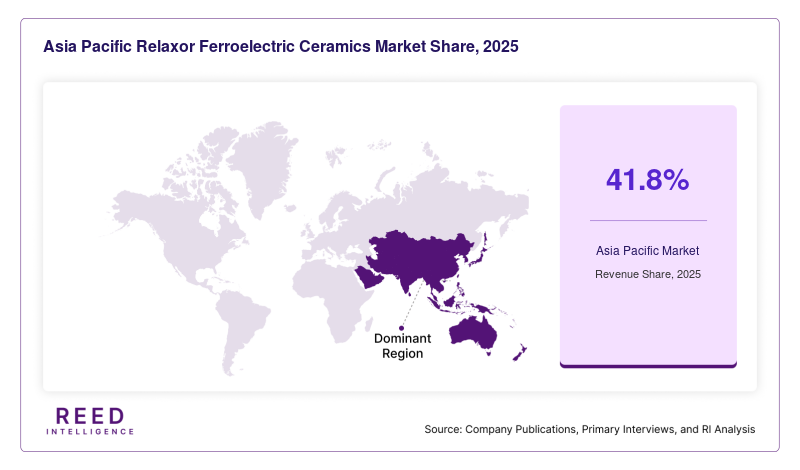
Asia Pacific accounted for 41.8% of the global Relaxor Ferroelectric Ceramics Market share in 2025 and is projected to grow at a CAGR of 8.6% during the forecast period. The regional market benefited from strong electronics manufacturing infrastructure and increasing semiconductor production activities. China dominated the regional market due to large-scale production of electronic components and rising investments in telecommunications infrastructure. Expanding consumer electronics exports also contributed to market demand.
North America
North America held 24.2% of the global Relaxor Ferroelectric Ceramics Market share in 2025 and is anticipated to expand at a CAGR of 8.9% through 2034. The regional market was supported by increasing demand for advanced aerospace electronics and medical imaging systems. The United States emerged as the leading country market due to rising investments in defense technologies and high-frequency communication systems. Growing adoption of smart healthcare devices also strengthened regional market expansion.
Europe
Europe represented 19.6% of the global Relaxor Ferroelectric Ceramics Market share in 2025 and is forecast to grow at a CAGR of 7.9% during the forecast period. Germany dominated the regional market owing to strong automotive electronics manufacturing capabilities and increasing industrial automation investments. The regional market also benefited from expanding research activities related to smart electronic materials and sensor technologies.
Middle East & Africa
The Middle East & Africa accounted for 8.1% of the global Relaxor Ferroelectric Ceramics Market share in 2025 and is projected to grow at a CAGR of 7.4% between 2026 and 2034. The United Arab Emirates led the regional market due to increasing investments in telecommunications infrastructure and advanced electronic systems. Growing adoption of smart industrial technologies is expected to support regional market growth.
Latin America
Latin America captured 6.3% of the global Relaxor Ferroelectric Ceramics Market share in 2025 and is expected to grow at a CAGR of 7.1% during the forecast period. Brazil dominated the regional market because of increasing demand for electronic manufacturing and industrial sensing technologies. Expanding investments in healthcare equipment and telecommunications infrastructure are anticipated to support regional market expansion.
Competitive Landscape
The Relaxor Ferroelectric Ceramics Market remains moderately competitive with the presence of global electronic material manufacturers and advanced ceramic technology providers. Companies are focusing on advanced material formulations, environmentally compliant ceramic technologies, and high-performance piezoelectric systems to strengthen market competitiveness.
Murata Manufacturing Co., Ltd. emerged as a leading market participant due to its strong portfolio of advanced ceramic electronic components and global manufacturing network. The company recently expanded production capabilities for multilayer ceramic capacitors designed for next-generation communication systems.
TDK Corporation strengthened its advanced ceramic materials business through investments in miniaturized electronic component technologies.
Kyocera Corporation focused on developing high-performance piezoelectric ceramic systems for industrial applications.
CeramTec GmbH expanded its advanced ceramic solutions for medical and industrial sensing technologies.
PI Ceramic GmbH invested in precision piezoelectric ceramic manufacturing for aerospace and healthcare applications.
Key Players List
- Murata Manufacturing Co., Ltd.
- TDK Corporation
- Kyocera Corporation
- CeramTec GmbH
- PI Ceramic GmbH
- KEMET Corporation
- CTS Corporation
- Taiyo Yuden Co., Ltd.
- Samsung Electro-Mechanics
- Vishay Intertechnology, Inc.
- Hitachi Metals, Ltd.
- Noliac A/S
- Morgan Advanced Materials
- APC International, Ltd.
- Fuji Ceramics Corporation
Recent Developments
- In 2025, Murata Manufacturing Co., Ltd. expanded multilayer ceramic capacitor production for high-frequency communication systems.
- In 2024, TDK Corporation introduced advanced piezoelectric ceramic materials for next-generation automotive sensors.
- In 2025, Kyocera Corporation invested in high-performance relaxor ceramic technologies for industrial automation systems.
- In 2024, CeramTec GmbH expanded medical ceramic component manufacturing capabilities.
- In 2025, PI Ceramic GmbH launched precision piezoelectric solutions for aerospace sensing applications.
Relaxor Ferroelectric Ceramics Market Segments
Material Type
- Lead Magnesium Niobate (PMN)-Based Ceramics
- Lead Zinc Niobate (PZN)-Based Ceramics
- Lead Scandium Niobate (PSN)-Based Ceramics
- Other Relaxor Ferroelectric Ceramics
Application
- Multilayer Ceramic Capacitors
- Ultrasonic Transducers
- Actuators
- Sensors
- Energy Harvesting Devices
End-Use Industry
- Consumer Electronics
- Healthcare Equipment
- Automotive Electronics
- Aerospace and Defense
- Telecommunications
Device Type
- Capacitors
- Transducers
- Resonators
- Sensors
- Actuation Devices
Distribution Channel
- Direct OEM Supply
- Electronic Component Distributors
- Online Electronics Platforms
- Industrial Suppliers
- Specialty Ceramic Material Providers
By Region
- North America
- Europe
- APAC
- Middle East and Africa
- LATAM