Remote Breathalyzer Market Size, Share Demand Report By Product Type (Handheld Remote Breathalyzers, Vehicle-Integrated Breathalyzers, Smartphone-Connected Breathalyzers, Wearable Alcohol Monitoring Devices), By Application (Law Enforcement and DUI Monitoring, Workplace Alcohol Testing, Rehabilitation and Addiction Treatment Programs, Personal Alcohol Monitoring), By End-User (Law Enforcement Agencies, Corporate and Industrial Organizations, Healthcare and Rehabilitation Centers, Individual Cons
USD 3950
Market Overview
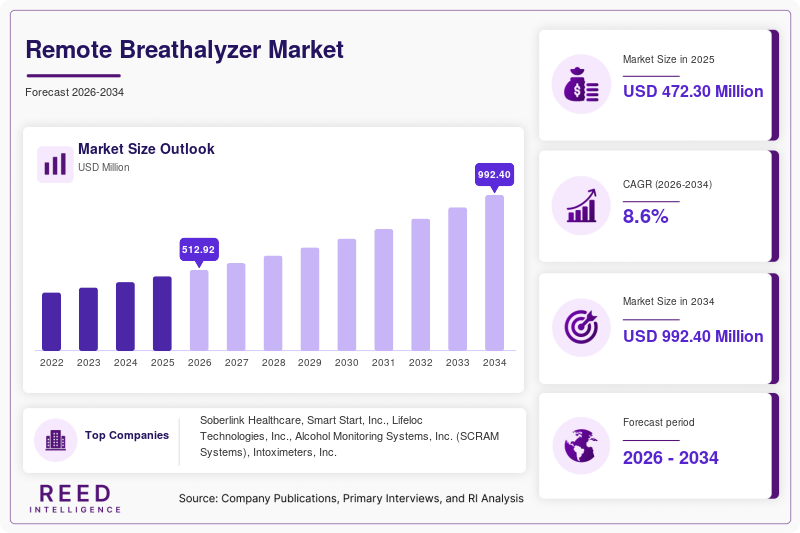
The global Remote Breathalyzer Market size was valued at USD 472.3 million in 2025 and is projected to reach USD 915.6 million by 2033, expanding at a compound annual growth rate (CAGR) of 8.6% during 2025–2034. The market is experiencing steady expansion as digital alcohol monitoring technologies gain wider adoption across law enforcement, workplace safety programs, and court-mandated offender monitoring systems. Remote breathalyzer devices allow authorities and organizations to conduct alcohol testing without requiring in-person supervision, improving compliance monitoring and operational efficiency.
A key global factor supporting the growth of the Remote Breathalyzer Marketis the increasing adoption of digital monitoring technologies within criminal justice and rehabilitation programs. Courts and probation departments in several countries are implementing remote alcohol monitoring solutions to supervise individuals with alcohol-related offenses. These systems typically combine breathalyzer hardware with mobile connectivity, facial recognition verification, and cloud-based data reporting platforms.
Key Highlights
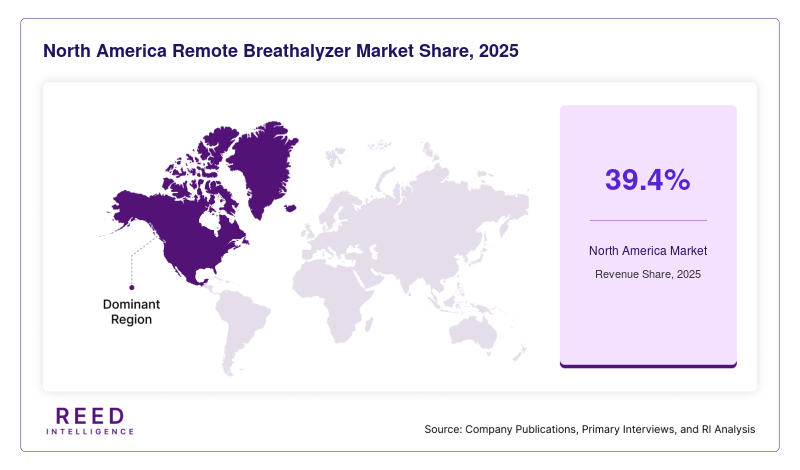
- North America held the dominant 39.4% share of the Remote Breathalyzer Market in 2025, while Asia Pacific is projected to register the fastest CAGR of 9.4% during 2025–2034.
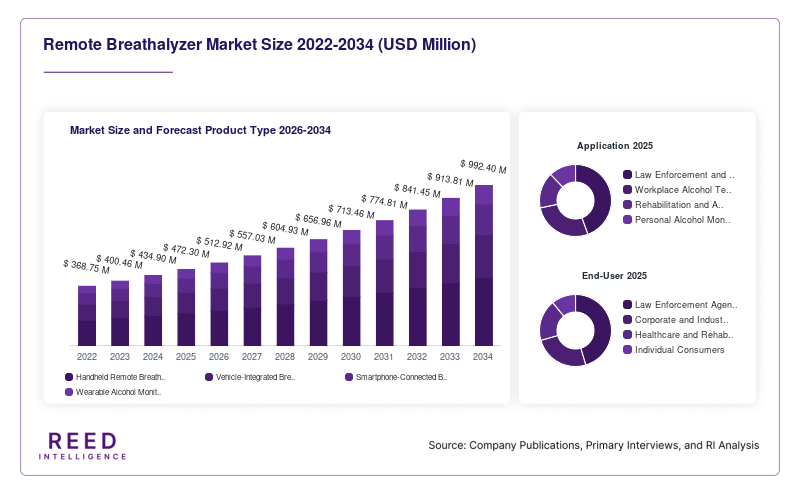
- By product type, handheld remote breathalyzer devices accounted for 53.7% share in 2025, while smartphone-connected breathalyzer systems are expected to grow at 9.8% CAGR.
- By application, law enforcement and offender monitoring represented 47.6% share, whereas workplace safety testing programs are projected to expand at 9.2% CAGR.
- The United States remained the dominant national market with USD 162.8 million in 2025 and is estimated to reach USD 176.4 million in 2026.
Market Trends
Integration of Mobile Connectivity and Cloud Monitoring
One notable trend shaping the Remote Breathalyzer Marketis the integration of mobile connectivity and cloud-based monitoring platforms. Modern remote breathalyzer devices increasingly incorporate Bluetooth, cellular, and Wi-Fi connectivity features that allow test results to be transmitted instantly to monitoring authorities. This connectivity enables probation officers, employers, and rehabilitation programs to track alcohol testing compliance in real time.
Cloud-based platforms also provide automated reporting and secure data storage, which simplifies record management and improves monitoring efficiency. As digital monitoring infrastructure continues to evolve, manufacturers are designing remote breathalyzer solutions that integrate seamlessly with mobile applications and compliance monitoring software.
Adoption of Biometric Identity Verification Features
Another emerging trend in the Remote Breathalyzer Marketis the adoption of biometric identity verification technologies. Remote monitoring systems must confirm that the correct individual is completing each alcohol test. To address this requirement, manufacturers are incorporating facial recognition cameras, voice recognition systems, and identity authentication software into breathalyzer devices.
These features improve reliability and reduce the possibility of fraudulent testing attempts. Biometric verification technologies are becoming an important component of remote alcohol monitoring systems used in legal supervision programs and workplace compliance initiatives.
Market Drivers
Increasing Enforcement of Alcohol Monitoring Regulations
Stricter alcohol monitoring regulations are significantly influencing the Remote Breathalyzer Market. Governments and judicial authorities are expanding alcohol monitoring programs to address issues related to impaired driving, workplace safety violations, and alcohol-related offenses. Remote breathalyzer devices provide an efficient solution for monitoring individuals required to undergo regular alcohol testing.
These systems allow testing to be conducted remotely while automatically transmitting results to monitoring authorities. This capability reduces administrative workload and ensures timely compliance reporting. As regulatory agencies adopt technology-driven monitoring approaches, demand for remote breathalyzer systems is increasing.
Growing Demand for Workplace Safety Monitoring Solutions
The growing emphasis on workplace safety is another major driver supporting the Remote Breathalyzer Market. Industries such as transportation, manufacturing, construction, and oil and gas maintain strict safety policies to prevent alcohol-related incidents. Remote alcohol testing systems enable employers to conduct regular testing without requiring physical supervision or on-site testing personnel.
These solutions support compliance with occupational safety standards while improving operational efficiency. As companies continue to implement digital monitoring systems to enhance workplace safety, remote breathalyzer technologies are gaining broader adoption.
Market Restraint
Data Privacy and Security Concerns
A significant restraint affecting the Remote Breathalyzer Marketis the concern regarding data privacy and security associated with digital monitoring systems. Remote breathalyzer devices often collect personal information, including biometric data, facial recognition images, and testing history. This sensitive information is typically transmitted through cloud-based platforms for monitoring and recordkeeping purposes.
Organizations implementing remote monitoring solutions must ensure that these systems comply with data protection regulations and cybersecurity standards. Failure to protect sensitive information may lead to legal and reputational risks for both service providers and monitoring agencies.
Additionally, some individuals may express concerns regarding privacy and surveillance when participating in remote alcohol monitoring programs. These concerns can influence the adoption of monitoring technologies in certain environments.
Manufacturers and service providers must invest in secure encryption technologies and regulatory compliance measures to address these challenges and ensure the responsible use of remote breathalyzer systems.
Market Opportunities
Expansion of Telehealth and Rehabilitation Monitoring
The expansion of telehealth services presents an opportunity for the Remote Breathalyzer Market. Remote alcohol testing devices can support digital rehabilitation programs by enabling healthcare professionals to monitor patient compliance with sobriety requirements. These systems allow patients undergoing treatment for alcohol dependency to complete scheduled alcohol tests from home.
Healthcare providers can track test results through secure digital platforms and provide counseling support when necessary. As telehealth infrastructure continues to expand, remote breathalyzer technologies may become integrated into broader digital healthcare monitoring systems.
Integration with Smart Vehicle Safety Systems
Another emerging opportunity in the Remote Breathalyzer Marketinvolves integration with connected vehicle safety technologies. Automotive manufacturers and safety technology providers are exploring systems that monitor driver sobriety and prevent impaired driving.
Remote breathalyzer solutions may be integrated with vehicle telematics systems to ensure drivers meet safety requirements before operating vehicles. Such solutions could support commercial fleet safety programs and insurance monitoring services, creating new avenues for market growth.
Segmental Analysis
By Product Type
Handheld remote breathalyzer devices represented the largest product segment, accounting for 53.7% share of the Remote Breathalyzer Market in 2025. These devices are widely used in law enforcement and workplace monitoring programs due to their portability and ease of operation.
Smartphone-connected breathalyzer systems are projected to be the fastest-growing segment with a CAGR of 9.8% during the forecast period. These systems allow users to perform alcohol tests while transmitting results directly to monitoring platforms through mobile applications.
By Technology
Fuel cell sensor technology accounted for the largest share of the Remote Breathalyzer Market at 48.9% in 2025. Fuel cell sensors are widely used because they provide reliable alcohol detection and high measurement accuracy.
Infrared spectroscopy-based breathalyzer systems are projected to record the fastest CAGR of 9.1%. These advanced sensors provide precise alcohol detection and are increasingly used in digital monitoring solutions.
By Application
Law enforcement and offender monitoring represented the largest application segment with 47.6% share in 2025. Courts and probation departments frequently use remote breathalyzer devices to supervise individuals involved in alcohol-related legal cases.
Workplace safety testing programs are expected to expand at the fastest CAGR of 9.2% during the forecast period. Companies are adopting digital monitoring technologies to improve employee safety and regulatory compliance.
By Distribution Channel
Direct sales accounted for the largest distribution channel share at 45.8% in 2025. Manufacturers often supply breathalyzer devices directly to government agencies and corporate clients. Online sales channels are projected to record the fastest CAGR of 9.3%as organizations increasingly purchase safety equipment through digital procurement platforms.
Regional Analysis
North America
North America accounted for 39.4% share of the Remote Breathalyzer Market in 2025. The region benefited from widespread adoption of digital monitoring technologies within law enforcement and judicial supervision programs. Over the forecast period, the regional market is expected to grow at a CAGR of 8.1% between 2025 and 2034.
The United Statesrepresented the dominant country market in North America. The expansion of court-mandated alcohol monitoring programs and probation supervision systems has increased the adoption of remote breathalyzer technologies. Additionally, transportation and logistics companies are implementing digital alcohol testing solutions to strengthen workplace safety practices.
Europe
Europe held 26.7% share of the Remote Breathalyzer Market in 2025. The regional market is projected to grow at a CAGR of 7.8% during the forecast period. Demand is supported by safety regulations and alcohol monitoring programs implemented by regulatory authorities.
Germanyemerged as the leading country market in Europe. Industrial safety standards and workplace monitoring policies are encouraging organizations to adopt alcohol testing technologies. Remote breathalyzer systems provide a practical solution for conducting regular employee safety checks.
Asia Pacific
Asia Pacific represented 19.8% share of the Remote Breathalyzer Market in 2025and is expected to expand at the fastest CAGR of 9.4% during 2025–2034. Increasing road safety initiatives and digital monitoring adoption are contributing to market growth.
Chinadominated the regional market due to expanding transportation infrastructure and regulatory enforcement related to impaired driving. Government initiatives promoting road safety awareness are encouraging the adoption of alcohol monitoring technologies.
Middle East & Africa
The Middle East & Africa accounted for 7.1% share of the Remote Breathalyzer Market in 2025. The regional market is anticipated to grow at a CAGR of 8.3% during the forecast period.
The United Arab Emiratesemerged as the dominant market in the region. Government-led road safety initiatives and strict traffic regulations have encouraged the use of alcohol testing technologies within law enforcement operations.
Latin America
Latin America held 7.0% share of the Remote Breathalyzer Market in 2025and is projected to grow at a CAGR of 8.2% between 2025 and 2034. Brazilrepresented the dominant country market due to increasing road safety campaigns and the expansion of workplace alcohol testing programs in transportation and industrial sectors.
Competitive Landscape
The Remote Breathalyzer Marketincludes technology providers and safety equipment manufacturers focusing on digital alcohol monitoring solutions. Companies compete by offering devices with advanced sensor technology, mobile connectivity, and secure cloud-based monitoring platforms.
Among the leading companies, Soberlink Healthcarehas established a strong presence by developing remote alcohol monitoring systems used in judicial supervision and rehabilitation programs. The company recently introduced upgraded devices featuring improved biometric identity verification and enhanced cloud monitoring capabilities.
Other notable companies in the market include Lifeloc Technologies, Inc., BACtrack, Drägerwerk AG & Co. KGaA, and Intoximeters, Inc.. These firms focus on technological innovation and product reliability to meet the evolving requirements of alcohol monitoring programs worldwide.
Key Players in the Remote Breathalyzer Market
- Soberlink Healthcare
- Lifeloc Technologies, Inc.
- BACtrack
- Drägerwerk AG & Co. KGaA
- Intoximeters, Inc.
- AlcoPro, Inc.
- Alcohol Countermeasure Systems Corp.
- Quest Products, Inc.
- Lion Laboratories Ltd.
- Alcolizer Technology
- Andatech Pty Ltd.
- Lifeloc Technologies
- Abbott Toxicology
- EnviteC-Wismar GmbH
- C4 Development Ltd.
Recent Developments
- 2024: Soberlink Healthcare introduced upgraded remote breathalyzer devices featuring advanced facial recognition verification.
- 2024: BACtrack launched smartphone-connected breathalyzer systems with enhanced mobile application integration.
- 2023: Drägerwerk AG & Co. KGaA expanded its alcohol testing technology portfolio with digital monitoring solutions.
- 2023: Lifeloc Technologies, Inc. introduced updated cloud monitoring platforms for remote alcohol testing programs.
- 2022: Intoximeters, Inc. developed portable breathalyzer devices designed for remote compliance monitoring.
Remote Breathalyzer Market Segments
Product Type
- Handheld Remote Breathalyzers
- Vehicle-Integrated Breathalyzers
- Smartphone-Connected Breathalyzers
- Wearable Alcohol Monitoring Devices
Application
- Law Enforcement and DUI Monitoring
- Workplace Alcohol Testing
- Rehabilitation and Addiction Treatment Programs
- Personal Alcohol Monitoring
End-User
- Law Enforcement Agencies
- Corporate and Industrial Organizations
- Healthcare and Rehabilitation Centers
- Individual Consumers
Distribution Channel
- Direct Sales
- Online Retail
- Medical and Safety Equipment Distributors
By Region
- North America
- Europe
- APAC
- Middle East and Africa
- LATAM