Remote Valve Tissue Expander Market Size, Share & Demand Report By Type (Saline-Based, Silicone-Based, IoT-Enabled Remote Valve Expanders), By Material (Silicone, Saline, Biocompatible Polymer), By Application (Breast Reconstruction, Burn & Trauma Reconstruction, Cosmetic Surgery), By End-Use (Hospitals, Specialty Clinics, Ambulatory Surgical Centers), By Distribution Channel (Direct Sales, Distributors, Online/E-commerce) By Region & Segment Forecasts, 2026–2034
USD 3950
Market Overview
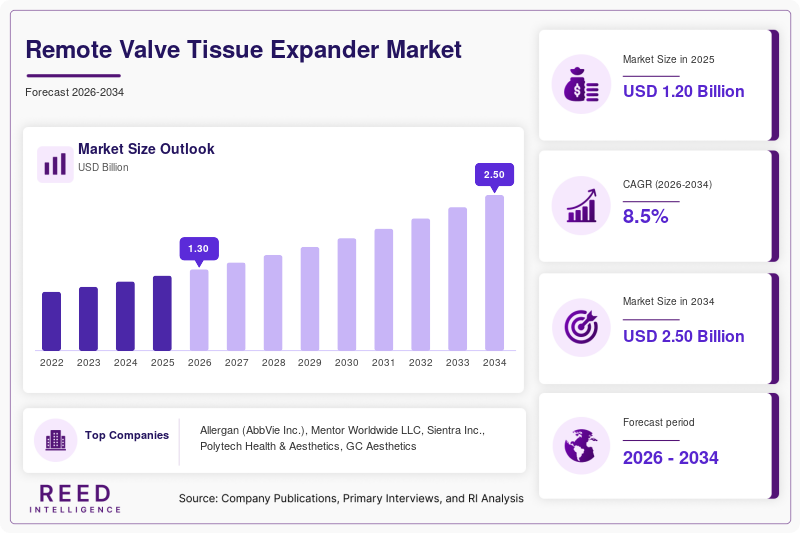
The Remote Valve Tissue Expander Market size was valued at approximately USD 1.2 billion in 2026 and is projected to reach USD 2.45 billion by 2034, growing at a CAGR of 8.5% during the forecast period. The market growth is primarily driven by the increasing prevalence of reconstructive surgeries following mastectomies and burn injuries, combined with technological advancements in remote-controlled tissue expansion systems. Growing adoption of minimally invasive procedures across developed and emerging economies has further fueled demand, as remote valve tissue expanders allow clinicians to adjust expansion rates with greater precision while reducing patient discomfort.
One notable global factor supporting market growth is the rising focus on patient-centric surgical solutions. Remote valve systems enable better customization of tissue expansion protocols, which improves surgical outcomes, reduces hospitalization duration, and lowers post-operative complications. Additionally, the integration of IoT-enabled monitoring and automated control systems provides surgeons with real-time feedback, further encouraging adoption in tertiary hospitals and specialty clinics.
Key Highlights:
- Dominant region share: North America accounted for approximately 42% of the market in 2025.
- Fastest-growing region CAGR: Asia Pacific expected to grow at 10.3% CAGR (2026–2034).
- Leading subsegments: Saline-based tissue expanders dominated by material type (2025 share 55%), breast reconstruction in applications (2025 share 48%).
- Fastest-growing subsegments: IoT-enabled remote valve expanders projected CAGR 11.2%.
- Dominant country market values: United States USD 480 million (2024) and USD 510 million (2025).
Market Trends
Digital Integration in Surgical Expansion
The market is witnessing a trend toward digitalization of tissue expansion procedures. Remote valve tissue expanders with IoT connectivity, cloud-based data analytics, and app-based control interfaces allow surgeons to remotely monitor expansion rates and predict tissue response. This reduces the frequency of hospital visits, increases patient adherence, and streamlines post-operative care. The digital integration trend also supports interoperability with electronic health records, enabling holistic patient management and long-term outcome tracking.
Preference for Minimally Invasive Procedures
Patients and clinicians increasingly prefer minimally invasive reconstructive techniques. Remote valve tissue expanders align with this trend by enabling controlled expansion without repeated invasive adjustments. Smaller incision sizes, reduced scarring, and enhanced procedural predictability are driving adoption in cosmetic and reconstructive surgery segments. This trend is particularly notable in developed countries, where patient awareness and access to advanced surgical technologies are higher, fostering market growth.
Market Drivers
Rising Incidence of Breast Cancer and Reconstructive Surgeries
The prevalence of breast cancer has steadily increased globally, leading to a higher demand for post-mastectomy breast reconstruction. Remote valve tissue expanders provide an efficient solution for gradual tissue expansion, allowing safe and comfortable reconstruction. Hospitals and clinics are increasingly investing in these devices to enhance procedural efficiency and patient satisfaction.
Technological Advancements in Remote Valve Systems
Continuous innovations in valve design, saline delivery mechanisms, and sensor integration have strengthened the appeal of remote valve tissue expanders. Advanced models allow precise volumetric control, automated expansion schedules, and integration with monitoring software. These innovations reduce complication risks, shorten recovery times, and enhance surgeon confidence, which collectively drive market expansion.
Market Restraint
High Cost of Advanced Remote Valve Tissue Expanders
Despite technological advantages, the high upfront and maintenance costs of remote valve tissue expanders remain a significant restraint. Many small clinics and emerging markets struggle to afford these devices, limiting adoption outside major hospitals. Additionally, reimbursement policies in certain regions do not fully cover these advanced systems, which can further discourage procurement. The cost barrier is particularly pronounced for IoT-enabled models, where connectivity and monitoring software add to overall expenditure.
Market Opportunities
Expansion in Emerging Markets
Emerging economies in Asia Pacific, Latin America, and the Middle East present significant growth opportunities. Rising awareness of reconstructive surgery benefits, expanding healthcare infrastructure, and increasing government initiatives for cancer care are likely to drive demand for remote valve tissue expanders. Market players can focus on cost-effective solutions and partnerships with local distributors to capture untapped segments.
Integration with AI and Predictive Analytics
The convergence of remote valve tissue expanders with AI-based predictive analytics offers substantial market potential. AI-enabled devices can forecast tissue response, optimize expansion schedules, and reduce complication risks. Companies investing in AI-driven solutions will likely benefit from enhanced clinical adoption and improved patient outcomes, creating new revenue streams in advanced surgical technologies.
Segmental Analysis
By Type
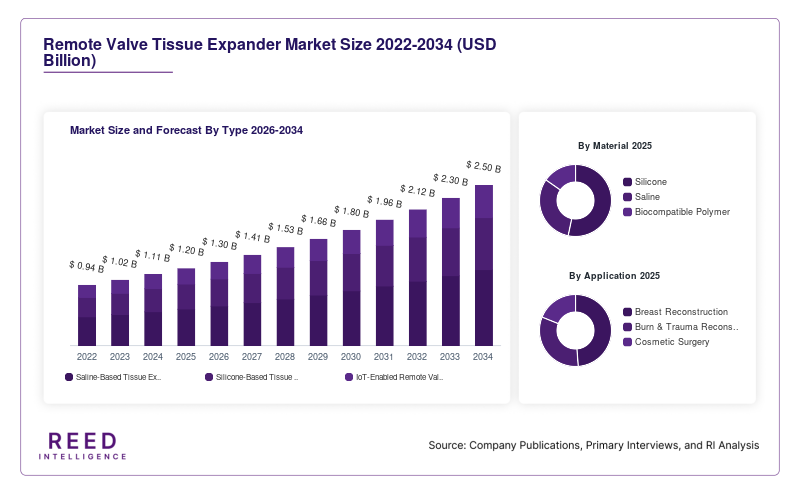
The saline-based tissue expanders were the dominant subsegment in 2025, accounting for approximately 55% of the market. Their widespread adoption stems from safety, proven clinical efficacy, and ease of use in post-mastectomy reconstruction.
The IoT-enabled remote valve tissue expanders are the fastest-growing subsegment, projected to achieve a CAGR of 11.2% during 2026–2034. Real-time remote monitoring and automated expansion protocols are expected to drive adoption, particularly in technologically advanced hospitals and private clinics.
By Material
Silicone-based expanders led the market in 2025 with a 47% share, favored for their flexibility, durability, and patient comfort during expansion. These devices are standard in reconstructive surgeries and have established clinical acceptance.
Bio-compatible polymer expanders are expected to register the fastest growth at a CAGR of 10.8%, driven by advancements in material science allowing reduced inflammation and enhanced tissue integration, which appeal to high-end surgical centers.
By Application
Breast reconstruction was the leading application in 2025, representing 48% of the market. The prevalence of post-mastectomy procedures and growing awareness of reconstructive options contributed to this dominance.
Burn and trauma reconstruction applications are projected to be the fastest-growing subsegment, achieving a CAGR of 9.9%, as rising industrial accidents and enhanced emergency care infrastructure in emerging economies increase demand for tissue expansion solutions.
By End-Use
Hospitals represented the largest end-use segment in 2025 with a 62% share, owing to high procedural volumes and availability of specialized surgical teams.
Specialty clinics are expected to grow at the highest CAGR of 10.5%, supported by increasing outpatient surgeries, patient preference for private care, and adoption of remote-controlled expansion devices that reduce procedural time and improve patient experience.
By Distribution Channel
Direct sales through manufacturer channels held a 53% share in 2025, favored by hospital procurement policies and after-sales support.
Online and e-commerce channels are projected to grow fastest with a CAGR of 11%, particularly in regions where digital procurement platforms facilitate access to advanced surgical devices for smaller clinics and emerging markets.
Regional Analysis
North America
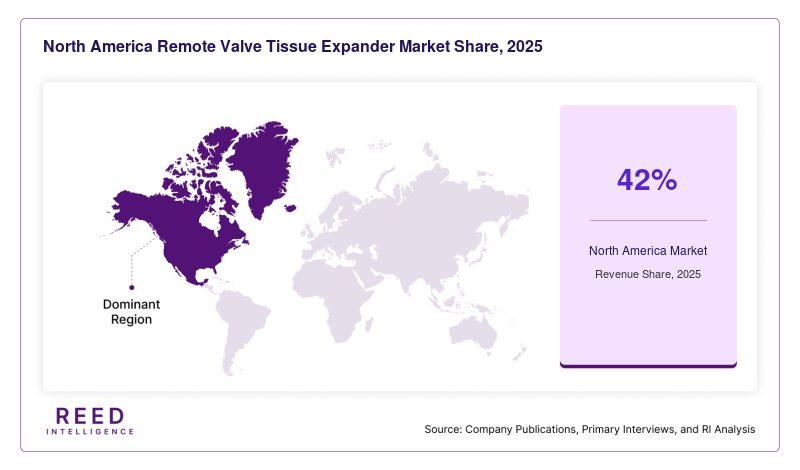
North America accounted for approximately 42% of the global market in 2025. The region is expected to grow at a CAGR of 7.8% from 2026 to 2034. Advanced healthcare infrastructure, high patient awareness, and favorable reimbursement policies contributed to the region’s past market dominance.
The United States is the dominant country, driven by widespread adoption of reconstructive surgeries and presence of leading medical device manufacturers. Hospitals and specialty clinics increasingly implement remote valve tissue expanders with IoT-enabled controls to improve surgical outcomes. Rising demand for breast reconstruction post-mastectomy also supports market growth, alongside ongoing clinical trials that validate device efficacy.
Europe
Europe held approximately 27% market share in 2025 and is expected to witness a CAGR of 7.5% during 2026–2034. The region benefits from established regulatory frameworks, high-quality healthcare services, and strong adoption of technologically advanced surgical devices.
Germany leads in the region due to its advanced medical technology sector and growing reconstructive surgery volume. Initiatives to standardize post-operative care and integration of digital health solutions have encouraged widespread use of remote valve tissue expanders in German hospitals.
Asia Pacific
Asia Pacific accounted for about 18% of the market in 2025, with a projected CAGR of 10.3% from 2026 to 2034, representing the fastest-growing region globally. Increased healthcare investment, rising cancer prevalence, and growing patient awareness are key growth factors.
China is the dominant country, experiencing high demand for remote valve tissue expanders due to expanding hospital networks, government support for cancer care, and increased accessibility to advanced reconstructive technologies. Urban centers and private hospitals are particularly adopting IoT-enabled systems for breast and reconstructive surgeries.
Middle East & Africa
Middle East & Africa held 8% of the market share in 2025 and is projected to grow at a CAGR of 9.1% over 2026–2034. Rising investment in healthcare infrastructure and modernization of surgical facilities are driving growth.
Saudi Arabia stands out, with its Vision 2030 initiative promoting healthcare technology adoption. Hospitals in Riyadh and Jeddah increasingly integrate remote valve tissue expanders in plastic and reconstructive surgery departments to enhance procedural efficiency and patient care.
Latin America
Latin America accounted for roughly 5% of the market in 2025, with a forecast CAGR of 8.4%. Improving healthcare access, increasing medical tourism, and adoption of advanced surgical devices are the primary growth enablers.
Brazil dominates the regional market due to a strong reconstructive surgery segment and expanding private healthcare infrastructure. Market growth is driven by urban hospital investments in minimally invasive and remote-controlled expansion devices.
Competitive Landscape
The Remote Valve Tissue Expander Market is moderately consolidated, with top players dominating global revenue. Allergan (AbbVie Inc.) continues to lead due to its innovative product portfolio, strong global presence, and recent launch of IoT-enabled expanders with remote monitoring features. Other prominent players include Mentor Worldwide LLC, Sientra Inc., Polytech Health & Aesthetics, and GC Aesthetics, which focus on product development, strategic partnerships, and regional expansion. Companies are investing in R&D to enhance valve technology, integrate smart monitoring systems, and improve material biocompatibility. Competitive strategies such as mergers, acquisitions, and collaborations with hospitals and specialty clinics further strengthen their market positions. Emerging regional players are also entering the market, particularly in Asia Pacific and Latin America, by offering cost-competitive devices tailored for local surgical practices.
Key Players List
- Allergan (AbbVie Inc.)
- Mentor Worldwide LLC
- Sientra Inc.
- Polytech Health & Aesthetics
- GC Aesthetics
- Establishment Labs
- Arion Laboratories
- HansBiomed Co., Ltd.
- CEREPLAS Ltd.
- Gufic Biosciences
- Juno Surgical Devices
- OrthoTissue Technologies
- BioForm Medical
- Integra LifeSciences
- Becton Dickinson (Tissue Expansion Division)
Recent Developments
- 2025: Allergan launched a next-generation IoT-enabled remote valve tissue expander with AI-guided expansion protocol.
- 2025: Mentor Worldwide expanded distribution in Asia Pacific through strategic partnerships with leading hospital networks in China and India.
- 2024: GC Aesthetics introduced bio-compatible polymer expanders targeting high-end reconstructive procedures in Europe.
- 2024: Sientra Inc. initiated clinical trials for a minimally invasive saline-based remote valve expander in the U.S. market.
- 2023: Establishment Labs integrated cloud-based monitoring systems to enhance remote device management for hospitals in the Middle East.
Remote Valve Tissue Expander Market Segments
By Type
- Saline-Based Tissue Expanders
- Silicone-Based Tissue Expanders
- IoT-Enabled Remote Valve Expanders
By Material
- Silicone
- Saline
- Biocompatible Polymer
By Application
- Breast Reconstruction
- Burn & Trauma Reconstruction
- Cosmetic Surgery
By End-Use
- Hospitals
- Specialty Clinics
- Ambulatory Surgical Centers
By Distribution Channel
- Direct Sales
- Distributors
- Online/E-commerce
By Region
- North America
- Europe
- APAC
- Middle East and Africa
- LATAM