Renewable Energy Contactor Market Size, Share Demand Report By Type (AC Contactors, DC Contactors, Electromechanical Contactors), By Voltage Range (Low Voltage, Medium Voltage), By Application (Solar Energy Systems, Wind Energy Systems, Battery Energy Storage Systems), By End-Use (Utility Sector, Industrial Sector, Commercial Sector, Residential Sector), By Mounting Type (Panel Mounted, DIN Rail Mounted) By Region & Segment Forecasts, 2026–2034
USD 3950
Market Overview
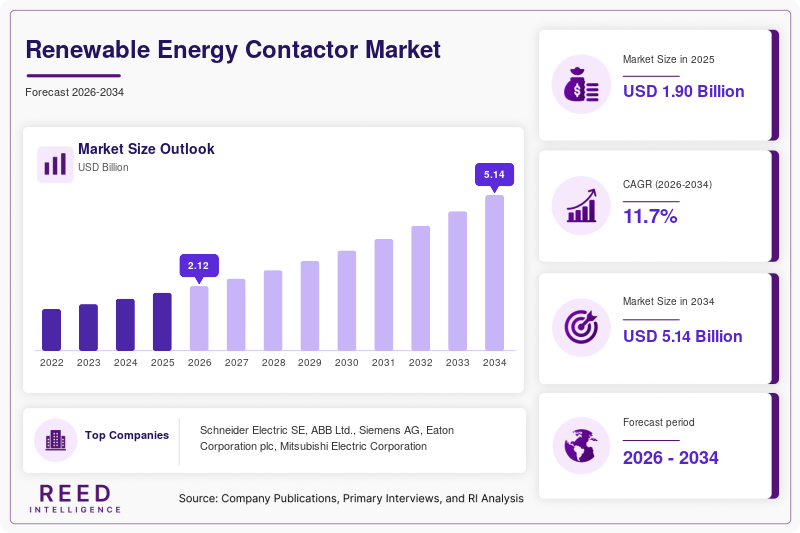
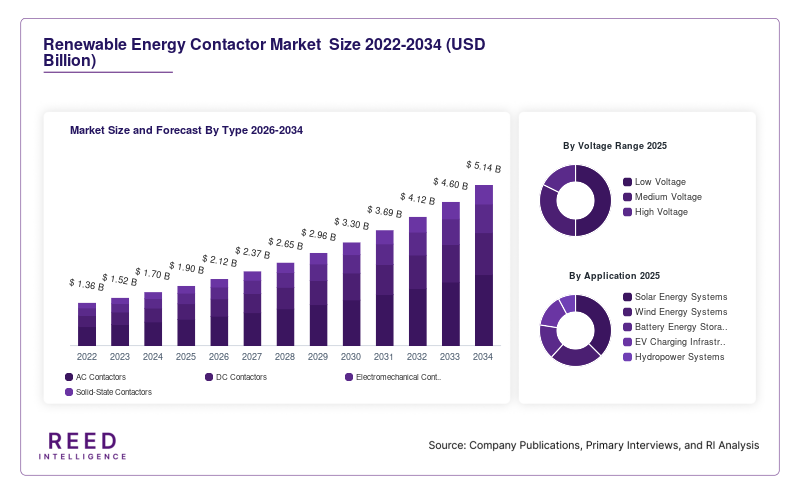
The Renewable Energy Contactor Market size was valued at USD 1.9 billion in 2026 and is projected to reach USD 4.6 billion by 2034, expanding at a CAGR of 11.7% during the forecast period (2026–2034). The market growth has been supported by rising investments in renewable power infrastructure, particularly across utility-scale solar farms, wind power installations, battery energy storage systems, and electric grid modernization projects. Renewable energy contactors are increasingly used to manage high-voltage switching operations, improve operational safety, and enhance energy distribution efficiency across renewable power systems.
The global transition toward low-carbon energy generation accelerated the deployment of renewable energy assets in both developed and emerging economies. Governments across Asia Pacific, Europe, and North America introduced clean energy mandates and carbon neutrality targets, increasing demand for efficient electrical switching components. Renewable energy contactors have become essential in photovoltaic systems, wind turbines, battery storage systems, and electric vehicle charging infrastructure due to their reliability and thermal resistance capabilities.
Key Highlights
- Asia Pacific accounted for 41.6% of the Renewable Energy Contactor Market share in 2025, while the Middle East & Africa region is projected to witness the fastest CAGR of 13.9% during 2026–2034.
- By type, DC contactors held the dominant market share of 57.3% in 2025, while solid-state contactors are projected to grow at a CAGR of 14.1% during the forecast period.
- By application, solar energy systems accounted for 38.8% of the Renewable Energy Contactor Market share in 2025, whereas battery energy storage systems are anticipated to expand at a CAGR of 14.7%.
- By voltage range, medium-voltage contactors dominated with 46.2% market share in 2025, while high-voltage contactors are expected to grow rapidly at a CAGR of 13.5%.
- China remained the dominant country in the market, with market values reaching USD 286 million in 2024 and USD 318 million in 2025.
Market Trends
Integration of Smart Monitoring Features
Manufacturers in the Renewable Energy Contactor Market increasingly integrated smart monitoring and predictive maintenance capabilities into contactor systems. Advanced contactors now include temperature monitoring, current sensing, and digital communication protocols to improve system reliability. Renewable energy operators adopted intelligent switching solutions to reduce maintenance costs and improve power system uptime. Smart monitoring technologies also enhanced operational visibility across distributed renewable installations.
Rising Adoption of Solid-State Contactors
Solid-state contactors gained traction across renewable power applications due to their low maintenance requirements and faster switching performance. These contactors offered improved durability and arc-free operation, making them suitable for solar inverters, energy storage systems, and electric mobility infrastructure. The transition toward compact and energy-efficient power systems further accelerated the adoption of solid-state technologies across the Renewable Energy Contactor Market.
Market Drivers
Expansion of Utility-Scale Renewable Energy Projects
The rapid expansion of utility-scale renewable energy projects significantly supported the Renewable Energy Contactor Market growth. Governments and private energy developers increased investments in large-scale solar parks and wind farms to meet carbon reduction targets. Renewable energy contactors became essential components for managing power flow, switching operations, and equipment protection within these facilities. Increasing renewable electricity generation capacity directly increased demand for durable electrical switching systems.
Growth in Battery Energy Storage Infrastructure
The rising deployment of battery energy storage systems created substantial demand for renewable energy contactors. Grid operators and industrial energy users increasingly adopted energy storage technologies to stabilize renewable power supply and improve grid reliability. Contactors are widely used within battery management systems for safe connection and disconnection of high-current loads. Expanding investments in energy storage projects across North America, Europe, and Asia Pacific accelerated market growth.
Market Restraint
High Initial Cost of Advanced Contactor Systems
Advanced renewable energy contactors equipped with digital monitoring and high-voltage capabilities involve significant installation and procurement costs. Small-scale renewable project developers often face budget limitations, restricting adoption of premium contactor systems. Additionally, fluctuations in raw material prices impacted manufacturing costs and created pricing challenges across the Renewable Energy Contactor Market.
Market Opportunities
Expansion of Green Hydrogen Infrastructure
Green hydrogen production facilities increasingly require reliable high-voltage electrical switching components for electrolyzer systems and renewable power integration. Renewable energy contactors are expected to witness growing demand across hydrogen generation plants due to their ability to manage fluctuating electrical loads. Investments in hydrogen infrastructure across Europe and Asia Pacific are anticipated to create long-term market opportunities.
Growth of EV Charging Networks
The rapid deployment of electric vehicle charging infrastructure is projected to generate new opportunities for the Renewable Energy Contactor Market. EV charging stations require efficient switching systems for power distribution and charging management. Rising adoption of renewable-powered charging stations and smart grid integration will further support demand for compact and high-performance contactors.
Segmental Analysis
By Type
DC Contactors
DC contactors accounted for 57.3% of the Renewable Energy Contactor Market share in 2025. These contactors were widely used in solar photovoltaic systems, battery storage infrastructure, and electric vehicle charging systems due to their capability to handle direct current loads efficiently. Their strong thermal performance and arc suppression characteristics supported adoption across renewable power installations.
Solid-State Contactors
Solid-state contactors are projected to witness the fastest CAGR of 14.1% during the forecast period. Their silent operation, high switching speed, and reduced maintenance requirements make them suitable for smart renewable power systems. Increasing integration of automated energy management technologies will support the expansion of this segment.
By Application
Solar Energy Systems
Solar energy systems dominated the Renewable Energy Contactor Market with 38.8% share in 2025. Solar farms and rooftop photovoltaic installations increasingly used contactors for inverter protection and power distribution management. Expanding global solar capacity installations supported strong segment demand.
Battery Energy Storage Systems
Battery energy storage systems are anticipated to grow at a CAGR of 14.7% during 2026–2034. Energy storage projects require reliable switching systems for safe battery operation and load balancing. Rising deployment of grid-scale storage systems and renewable hybrid projects will drive segment growth.
By Voltage Range
Medium-Voltage Contactors
Medium-voltage contactors accounted for 46.2% market share in 2025. These systems were extensively deployed across industrial renewable energy applications and utility-scale infrastructure. Their operational efficiency and compatibility with renewable power networks contributed to market dominance.
High-Voltage Contactors
High-voltage contactors are projected to grow at a CAGR of 13.5% during the forecast period. Increasing offshore wind installations and large-scale energy transmission projects will accelerate demand for advanced high-voltage switching systems capable of handling extreme operating conditions.
By End-Use
Utility Sector
The utility sector held the dominant Renewable Energy Contactor Market share of 52.6% in 2025. Utility companies increasingly upgraded renewable power distribution networks with advanced switching technologies to improve energy reliability and operational efficiency.
Commercial Sector
The commercial sector is expected to expand at a CAGR of 12.9% during the forecast period. Commercial facilities increasingly adopted rooftop solar systems and integrated battery storage infrastructure, increasing the need for compact renewable contactor systems.
By Mounting Type
Panel Mounted Contactors
Panel mounted contactors represented 61.4% of the Renewable Energy Contactor Market share in 2025. These systems were widely used in industrial renewable control panels and inverter systems due to ease of installation and maintenance.
DIN Rail Mounted Contactors
DIN rail mounted contactors are expected to witness strong growth at a CAGR of 13.2% during the forecast period. Their compact size and modular integration capabilities make them suitable for smart renewable control systems and distributed energy applications.
Regional Analysis
North America
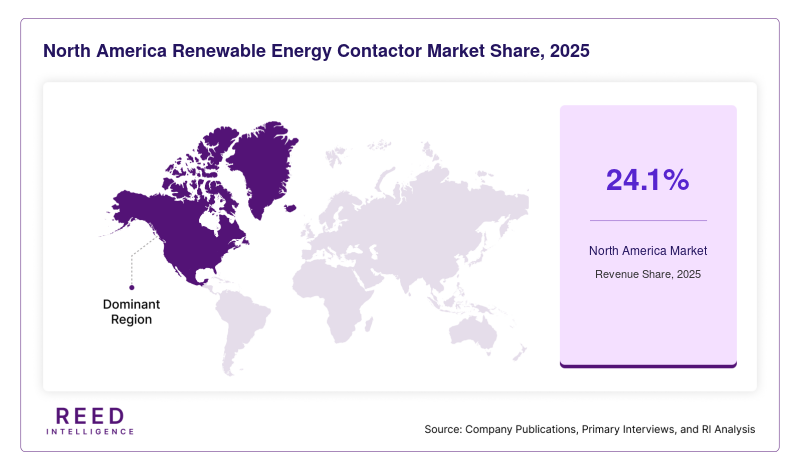
North America accounted for 24.1% of the Renewable Energy Contactor Market share in 2025 and is projected to expand at a CAGR of 10.8% during 2026–2034. The region benefited from large-scale investments in renewable energy modernization and energy storage deployment. The United States dominated the regional market due to increasing investments in utility-scale battery storage projects. Grid modernization initiatives across the country increased demand for advanced electrical switching infrastructure compatible with renewable energy systems.
Europe
Europe held 27.4% of the Renewable Energy Contactor Market share in 2025 and will grow at a CAGR of 11.1% during the forecast period. The region witnessed strong adoption of renewable contactors across offshore wind projects and distributed solar installations. Germany remained the leading country due to expanding renewable integration into industrial manufacturing facilities. Industrial electrification and smart grid upgrades supported the adoption of digitally enabled contactors across the country.
Asia Pacific
Asia Pacific represented the largest share of the Renewable Energy Contactor Market at 41.6% in 2025 and is expected to grow at a CAGR of 12.8% during 2026–2034. The region experienced substantial renewable energy capacity additions supported by government incentives and infrastructure investments. China dominated the regional market due to extensive solar and wind energy deployments. Rapid industrialization and domestic renewable equipment manufacturing strengthened the demand for medium- and high-voltage contactor systems.
Middle East & Africa
The Middle East & Africa region accounted for 3.8% of the Renewable Energy Contactor Market share in 2025 and is projected to register the fastest CAGR of 13.9% during the forecast period. Utility-scale solar projects and smart city developments accelerated demand for renewable energy switching systems. Saudi Arabia emerged as the leading country owing to large renewable energy diversification initiatives under national energy transition programs. Expanding investments in desert solar farms increased the need for durable high-temperature contactor solutions.
Latin America
Latin America held 3.1% of the Renewable Energy Contactor Market share in 2025 and is expected to expand at a CAGR of 10.4% during 2026–2034. The region experienced increasing renewable electricity generation from solar and hydropower projects. Brazil dominated the regional market due to rising investments in distributed solar systems and renewable industrial infrastructure. Modernization of electricity transmission networks contributed to increasing adoption of advanced switching technologies.
Competitive Landscape
The Renewable Energy Contactor Market remains moderately consolidated with the presence of multinational electrical component manufacturers and specialized renewable equipment providers. Companies focus on product innovation, thermal efficiency improvements, and expansion of high-voltage product portfolios to strengthen market positioning.
Schneider Electric SE
Schneider Electric SE remained a leading player in the Renewable Energy Contactor Market due to its broad renewable energy automation portfolio and global distribution network. The company recently introduced advanced contactor systems with integrated digital diagnostics for renewable energy storage applications.
ABB Ltd.
ABB Ltd. expanded its renewable electrical infrastructure solutions through smart switching technologies designed for solar and wind applications. The company focused on enhancing energy efficiency and remote monitoring capabilities.
Siemens AG
Siemens AG strengthened its renewable power control product portfolio by developing high-performance contactors suitable for industrial renewable energy projects and microgrid applications.
Eaton Corporation plc
Eaton Corporation focused on compact contactor solutions designed for energy storage systems and EV charging infrastructure. The company expanded manufacturing capabilities to meet rising renewable energy demand.
Mitsubishi Electric Corporation
Mitsubishi Electric Corporation enhanced its medium-voltage renewable contactor offerings for industrial and utility-scale renewable projects. The company emphasized durability and operational safety improvements.
Key Players List
- Schneider Electric SE
- ABB Ltd.
- Siemens AG
- Eaton Corporation plc
- Mitsubishi Electric Corporation
- Rockwell Automation Inc.
- TE Connectivity Ltd.
- Sensata Technologies Inc.
- Fuji Electric Co., Ltd.
- LS Electric Co., Ltd.
- Panasonic Holdings Corporation
- Lovato Electric S.p.A.
- Toshiba Corporation
- Crompton Greaves Consumer Electricals Ltd.
- WEG S.A.
Recent Developments
- Schneider Electric launched smart renewable contactors featuring predictive maintenance capabilities for battery energy storage applications in 2025.
- ABB Ltd. expanded its renewable switching product line for offshore wind energy projects in 2024.
- Siemens AG introduced digitally integrated medium-voltage contactors designed for microgrid infrastructure in 2025.
- Eaton Corporation announced new compact DC contactor systems optimized for fast EV charging applications in 2024.
- Mitsubishi Electric Corporation expanded manufacturing capacity for industrial renewable electrical components in Asia Pacific during 2025.
Renewable Energy Contactor Market Segments
By Type
- AC Contactors
- DC Contactors
- Electromechanical Contactors
- Solid-State Contactors
By Voltage Range
- Low Voltage
- Medium Voltage
- High Voltage
By Application
- Solar Energy Systems
- Wind Energy Systems
- Battery Energy Storage Systems
- EV Charging Infrastructure
- Hydropower Systems
By End-Use
- Utility Sector
- Industrial Sector
- Commercial Sector
- Residential Sector
By Mounting Type
- Panel Mounted
- DIN Rail Mounted
- PCB Mounted
By Region
- North America
- Europe
- APAC
- Middle East and Africa
- LATAM