Residential HVAC Market Size, Share & Demand Report By Equipment Type (Air Conditioning Systems, Heating Systems, Ventilation Systems, Heat Pumps), By Installation Type (New Construction Installations, Retrofit Installations), By Distribution Channel (Direct Sales, Specialty Stores, Online Retail Channels, Third-Party Distributors), By Region & Segment Forecasts, 2026–2034
USD 3950
Market Overview
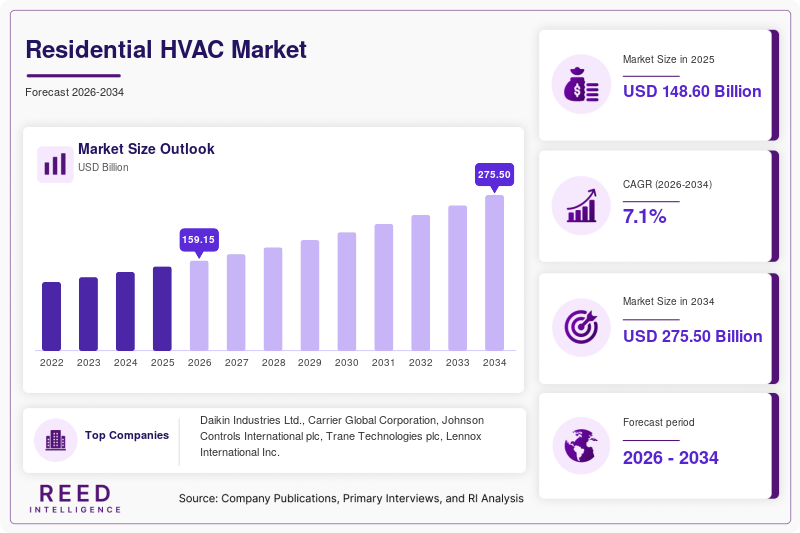
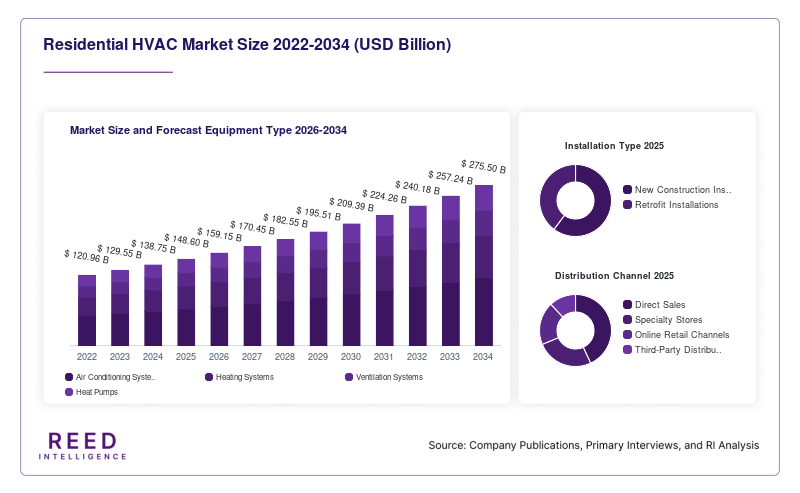
The global Residential HVAC Market size was valued at USD 148.6 billion in 2026 and is projected to reach USD 257.4 billion by 2034, expanding at a CAGR of 7.1% during the forecast period from 2026 to 2034. Rising urban housing construction, growing consumer preference for energy-efficient indoor climate systems, and increasing replacement demand for aging heating and cooling infrastructure are supporting long-term market expansion. Residential HVAC systems have become a central component in modern housing projects due to changing temperature patterns, stricter energy efficiency regulations, and growing adoption of smart home technologies across developed and developing economies.
The market is also benefiting from government initiatives encouraging the installation of energy-efficient heating and cooling systems. Rebates for heat pumps, tax credits for efficient air conditioning systems, and policies supporting green buildings are encouraging homeowners to replace traditional systems with advanced HVAC equipment. The integration of IoT-enabled thermostats, zoning systems, and AI-based energy optimization solutions is improving operational efficiency and enhancing user convenience. In addition, rapid urbanization in Asia Pacific and the Middle East is creating consistent demand for residential air conditioning systems in newly constructed housing units.
Key Highlights
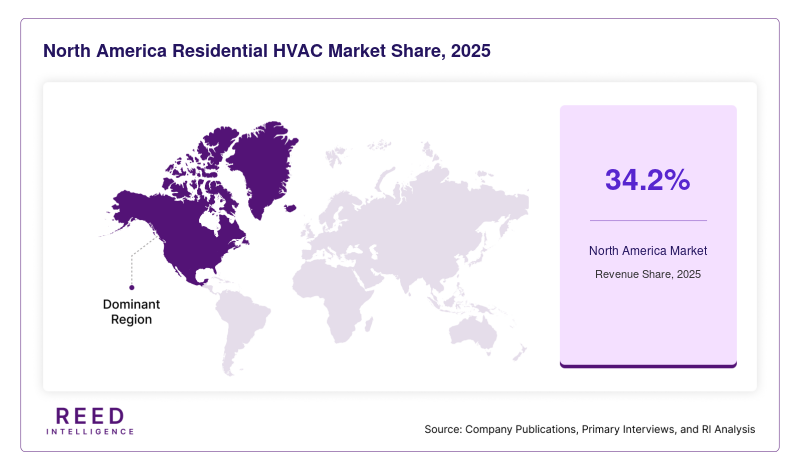
- North America dominated the market with a 34.2% share in 2025, while Asia Pacific is expected to grow at the fastest CAGR of 9.4% during 2026–2034.
- By equipment type, air conditioning systems accounted for the largest share of 39.1%, while heat pumps are projected to grow at a CAGR of 10.1%.
- By installation type, new construction installations led with a 56.8% share, whereas retrofit installations are expected to expand at a CAGR of 8.7%.
- By distribution channel, direct sales dominated with a 44.5% share, while online retail channels are projected to grow at a CAGR of 11.3%.
- The United States remained the dominant country, with market values of USD 41.8 billion in 2024 and USD 45.6 billion in 2025.
Market Trends
Smart HVAC Integration Across Residential Buildings
The adoption of smart HVAC systems is becoming a major trend across the Residential HVAC Market as homeowners increasingly prioritize energy optimization and connected living environments. Smart thermostats, wireless sensors, predictive maintenance tools, and cloud-connected HVAC management systems are gaining widespread acceptance in developed economies. These systems help users monitor indoor temperatures remotely, reduce electricity consumption, and optimize system performance through automated scheduling. The increasing penetration of smart home ecosystems is supporting demand for HVAC systems that integrate with voice assistants and mobile applications. Manufacturers are also introducing AI-enabled HVAC platforms capable of identifying energy usage patterns and adjusting cooling or heating output automatically. Growing awareness regarding residential energy efficiency is encouraging consumers to invest in advanced HVAC systems that offer long-term cost savings and better indoor air quality management.
Rising Adoption of Heat Pumps and Sustainable Refrigerants
The transition toward sustainable heating and cooling technologies is another important trend shaping the Residential HVAC Market. Governments across Europe, North America, and parts of Asia Pacific are introducing regulations to reduce carbon emissions from residential buildings, which is increasing demand for electric heat pumps and environmentally friendly refrigerants. Consumers are gradually replacing conventional gas-based systems with air-source and ground-source heat pumps due to lower operational costs and reduced environmental impact. HVAC manufacturers are also investing in refrigerants with low global warming potential to comply with evolving environmental regulations. Inverter-based systems and variable refrigerant flow technologies are becoming more common because they improve operational efficiency while minimizing energy waste. This trend is expected to strengthen as sustainability goals and climate-conscious construction practices continue to influence residential infrastructure development worldwide.
Market Drivers
Increasing Residential Construction and Urbanization
Rapid urbanization and large-scale residential construction projects are supporting the expansion of the Residential HVAC Market across both developed and emerging economies. Population growth in urban centers is increasing demand for apartments, townships, and smart housing projects that require modern heating, ventilation, and air conditioning systems. Governments in countries such as India, China, and Saudi Arabia are investing heavily in affordable housing and urban infrastructure development, which is creating long-term opportunities for HVAC manufacturers and installers. In developed economies, renovation and remodeling activities are contributing to replacement demand for energy-efficient HVAC equipment. Rising disposable income levels and improved living standards are encouraging homeowners to invest in advanced indoor comfort systems with improved energy efficiency and air filtration capabilities. The combination of new housing construction and replacement installations continues to generate strong market demand.
Growing Demand for Energy-Efficient HVAC Systems
Energy efficiency regulations and rising electricity prices are driving consumers toward advanced residential HVAC technologies with lower power consumption. Governments and utility providers are offering incentives and rebates for homeowners who install high-efficiency heating and cooling systems, especially heat pumps and inverter-based air conditioners. Consumers are becoming increasingly aware of the long-term cost benefits associated with efficient HVAC systems, including reduced utility expenses and lower maintenance requirements. The growing focus on indoor air quality after the global health crisis has also accelerated adoption of HVAC systems equipped with advanced filtration and ventilation technologies. Manufacturers are introducing systems with smart monitoring features, variable-speed compressors, and zoning capabilities to improve energy performance and comfort levels. These innovations are strengthening product demand across urban households and environmentally conscious residential consumers.
Market Restraint
High Installation and Maintenance Costs of Advanced Systems
The high initial cost associated with advanced residential HVAC systems remains a major restraint affecting market expansion, particularly in price-sensitive economies. Installation of modern heat pumps, ductless systems, and smart HVAC technologies often requires specialized labor, upgraded electrical infrastructure, and customized installation procedures, increasing the overall ownership cost for homeowners. Many residential consumers in developing countries continue to prefer low-cost conventional cooling systems due to affordability concerns. Maintenance expenses and periodic servicing requirements also create financial pressure for middle-income households. In addition, fluctuations in raw material prices and semiconductor shortages have increased manufacturing costs for HVAC equipment, resulting in higher product pricing across several markets. Small contractors and local distributors often face operational challenges in maintaining inventory and skilled technicians for advanced systems. These factors may slow the adoption rate of premium HVAC solutions in regions where purchasing power remains limited.
Market Opportunities
Expansion of Green Building and Net-Zero Housing Projects
The increasing development of green buildings and net-zero residential housing projects is creating strong growth opportunities for the Residential HVAC Market. Governments and real estate developers are integrating energy-efficient HVAC technologies into sustainable housing designs to reduce carbon emissions and improve energy performance. Residential projects certified under green building standards are increasingly incorporating heat pumps, energy recovery ventilation systems, and smart temperature control technologies. Demand for solar-powered HVAC systems and hybrid heating solutions is also increasing among environmentally conscious homeowners. This opportunity is particularly strong in Europe and North America, where climate policies and carbon neutrality targets are accelerating investments in low-emission residential infrastructure. HVAC manufacturers that offer energy-efficient and environmentally compliant solutions are expected to benefit significantly from the rising adoption of sustainable housing concepts.
Growth of Online Distribution and Aftermarket Services
The rapid expansion of digital sales platforms and aftermarket HVAC services is creating additional opportunities for market participants. Consumers are increasingly using online channels to compare HVAC products, evaluate energy ratings, and schedule installation or maintenance services. E-commerce platforms are helping manufacturers reach residential customers in smaller cities and suburban regions where physical dealer networks remain limited. The growing adoption of subscription-based maintenance contracts and remote diagnostic services is also improving recurring revenue opportunities for HVAC service providers. Smart HVAC systems with predictive maintenance capabilities are enabling companies to provide proactive servicing and reduce equipment downtime for homeowners. In addition, digital marketing and online customer support are strengthening consumer engagement and improving product accessibility across emerging economies. These developments are expected to support market growth throughout the forecast period.
Segmental Analysis
By Equipment Type
Air conditioning systems held the dominant share of the Residential HVAC Market in 2024, accounting for 39.1% of total revenue. The strong position of this segment is linked to increasing global temperatures, rising urbanization, and growing dependence on residential cooling solutions across both developed and emerging economies. Split air conditioners and centralized cooling systems are widely installed in apartments, villas, and residential complexes because they provide efficient temperature control and improved indoor comfort. Consumers are increasingly replacing conventional cooling systems with inverter-based units that reduce electricity consumption and improve energy performance. The segment is also benefiting from smart air conditioning technologies that allow remote operation and real-time monitoring through connected devices. Demand remains particularly strong in densely populated urban regions with prolonged summer seasons and high residential occupancy rates.
Heat pumps are projected to register the fastest CAGR of 10.1% during the forecast period due to growing environmental concerns and increasing government support for low-emission heating technologies. Residential consumers are adopting air-source and ground-source heat pumps because they offer both heating and cooling functionality while consuming less energy compared to traditional systems. Countries across Europe and North America are providing tax credits and financial incentives to encourage homeowners to transition toward electric heating technologies. Manufacturers are introducing advanced cold-climate heat pumps capable of operating efficiently in lower temperatures, expanding their suitability across wider geographical regions. The growing focus on carbon neutrality and energy-efficient residential construction is expected to further strengthen demand for heat pump systems in the coming years.
By Installation Type
New construction installations dominated the Residential HVAC Market in 2024 with a share of 56.8%, supported by increasing residential housing development across urban and suburban areas. Real estate developers are integrating advanced HVAC systems into newly constructed homes to comply with energy efficiency standards and meet evolving consumer expectations regarding indoor comfort. Demand for centralized air conditioning systems, ventilation units, and smart climate control solutions is rising in modern residential communities and high-rise apartment projects. The increasing development of smart homes and green residential buildings is also contributing to the expansion of this segment. Builders are prioritizing HVAC systems with low energy consumption and advanced filtration capabilities to improve property value and long-term operational efficiency. Emerging economies are witnessing particularly strong demand due to rapid urbanization and population growth.
Retrofit installations are expected to expand at the fastest CAGR of 8.7% during the forecast period due to rising replacement demand for aging residential HVAC systems. Homeowners are increasingly upgrading outdated equipment to reduce electricity expenses and improve indoor air quality. Government incentive programs supporting energy-efficient renovations are encouraging residential consumers to replace traditional heating and cooling units with advanced systems such as heat pumps and ductless mini-splits. Retrofit projects are gaining momentum in developed economies where older housing infrastructure requires modernization to meet updated environmental regulations. HVAC service providers are also benefiting from increasing demand for maintenance, component replacement, and smart control upgrades. The growing preference for connected home technologies is further driving retrofit installations across residential buildings.
By Distribution Channel
Direct sales accounted for the largest share of the Residential HVAC Market in 2024, representing 44.5% of total revenue. Major HVAC manufacturers continue to rely on direct distribution channels to strengthen relationships with contractors, developers, and residential customers. Direct sales models enable companies to provide installation support, maintenance services, warranty management, and customized product recommendations. This channel is particularly important for centralized HVAC systems and premium residential projects that require technical consultation and professional installation services. Strong dealer networks and authorized service centers also contribute to customer trust and long-term brand loyalty. Manufacturers are increasingly investing in digital platforms and customer engagement tools to improve direct communication with residential buyers and streamline product selection processes.
Online retail channels are projected to register the fastest CAGR of 11.3% during the forecast period as consumers increasingly prefer digital purchasing platforms for residential appliances and home improvement products. Online channels provide easier product comparison, transparent pricing, and access to customer reviews, helping buyers make informed purchasing decisions. HVAC manufacturers and retailers are expanding their e-commerce presence to reach consumers in smaller cities and suburban regions where traditional dealer networks may be limited. The growth of online installation booking services and remote customer support is also strengthening this segment. Smart HVAC systems with app-based controls and simplified installation requirements are particularly popular through online sales channels. Increasing internet penetration and digital payment adoption are expected to support long-term growth in online HVAC retailing.
Regional Analysis
North America
North America accounted for the largest share of the Residential HVAC Market in 2025, representing 34.2% of global revenue, and the region is expected to expand at a CAGR of 6.5% during the forecast period. The market is supported by high replacement demand for aging HVAC infrastructure, widespread adoption of smart home technologies, and strong consumer awareness regarding energy efficiency. Government tax incentives for heat pumps and efficient cooling systems are encouraging homeowners to replace older equipment with environmentally compliant alternatives. Rising demand for indoor air purification systems and connected HVAC controls is also strengthening market growth across residential applications.
The United States remains the dominant country within North America due to large-scale residential renovation activities and the strong presence of major HVAC manufacturers. Increasing occurrences of heatwaves and seasonal temperature fluctuations are encouraging households to invest in reliable cooling and heating solutions. Demand for ductless mini-split systems and variable refrigerant flow technologies is rising in urban housing developments and energy-efficient homes. Canada is also witnessing steady growth due to increasing adoption of cold-climate heat pumps and government-backed energy conservation programs targeting residential buildings.
Europe
Europe represented a significant share of the Residential HVAC Market in 2025 and is projected to register a CAGR of 6.8% through 2034. The regional market is primarily driven by sustainability regulations, energy transition initiatives, and increasing investments in low-carbon residential infrastructure. Governments across Germany, France, and the Nordic countries are promoting heat pump adoption to reduce dependency on fossil fuel-based heating systems. Demand for smart thermostats and energy-efficient ventilation systems is increasing due to stricter building efficiency standards. Rising electricity optimization measures are also encouraging consumers to adopt advanced HVAC technologies with improved energy ratings.
Germany remains the leading country in the European market due to its strong focus on renewable energy integration and green building construction. Residential consumers are increasingly replacing oil- and gas-based boilers with electric heat pumps and hybrid HVAC systems. The country’s emphasis on carbon reduction targets and building modernization programs is generating consistent demand for advanced residential climate control technologies. France and the United Kingdom are also witnessing growing demand for HVAC retrofitting projects supported by government rebate schemes and residential insulation improvement initiatives.
Asia Pacific
Asia Pacific is projected to witness the fastest growth in the Residential HVAC Market, expanding at a CAGR of 9.4% from 2026 to 2034. The region is experiencing rapid urbanization, increasing disposable income levels, and strong residential construction activity across major economies. Rising temperatures and changing climate conditions are increasing dependence on residential cooling systems, particularly in densely populated urban areas. Governments in several countries are investing in energy-efficient housing infrastructure and encouraging adoption of inverter-based air conditioning systems. The growing middle-class population and improving consumer purchasing power are supporting long-term demand for premium HVAC technologies.
China remains the dominant country in Asia Pacific due to extensive residential development projects and the strong manufacturing presence of HVAC companies. Urban migration and large-scale smart city initiatives are increasing installations of advanced air conditioning and ventilation systems in apartment complexes and residential communities. India is also emerging as a high-growth market because of increasing electrification, rising summer temperatures, and rapid expansion of affordable housing projects. Japan and South Korea continue to contribute to regional growth through demand for technologically advanced and energy-efficient residential HVAC solutions.
Middle East & Africa
The Middle East & Africa region is experiencing steady growth in the Residential HVAC Market and is expected to register a CAGR of 7.3% during the forecast period. The market is primarily supported by extreme climatic conditions, rising urban housing construction, and increasing investments in smart residential infrastructure. Countries across the Gulf region are witnessing continuous demand for high-capacity air conditioning systems due to prolonged summer temperatures. In addition, smart city projects and luxury residential developments are increasing the adoption of integrated HVAC solutions with advanced temperature control and air purification capabilities.
Saudi Arabia remains the dominant country in the regional market because of extensive residential development under economic diversification initiatives and growing urbanization. Large-scale housing projects and modern residential communities are increasing demand for centralized and ductless HVAC systems. The United Arab Emirates is also witnessing growth due to rising investments in premium residential apartments and smart buildings equipped with connected HVAC technologies. In Africa, expanding urban populations and increasing electrification rates are gradually supporting the adoption of residential cooling systems in metropolitan areas.
Latin America
Latin America accounted for a moderate share of the Residential HVAC Market in 2025 and is projected to expand at a CAGR of 6.1% through 2034. The market is driven by rising temperatures, improving residential infrastructure, and increasing consumer awareness regarding indoor comfort systems. Demand for residential air conditioning units is growing steadily in urban centers due to expanding middle-income populations and increasing housing development projects. Manufacturers are introducing energy-efficient and affordable HVAC products to strengthen market penetration in countries with growing urban residential sectors.
Brazil remains the dominant country in Latin America due to strong residential construction activity and increasing demand for cooling systems in densely populated cities. Growing consumer spending on home improvement and modern appliances is supporting HVAC installations in both new and existing residential properties. Mexico is also experiencing market growth due to rising urbanization and increasing investments in energy-efficient building technologies. Regional demand for inverter-based systems and compact ductless air conditioners is increasing as consumers seek lower electricity consumption and improved cooling performance.
Competitive Landscape
The Residential HVAC Market is characterized by the presence of established global manufacturers competing through product innovation, energy efficiency improvements, strategic partnerships, and geographic expansion. Companies are investing heavily in smart HVAC technologies, environmentally compliant refrigerants, and connected home integration features to strengthen their market position. Competition is increasing across both premium and mid-range product categories as manufacturers target growing residential demand in emerging economies.
Daikin Industries Ltd. remains one of the leading players in the global Residential HVAC Market due to its extensive product portfolio, strong global distribution network, and continuous investment in energy-efficient technologies. The company has expanded its focus on inverter-based systems and low-global-warming refrigerants to align with evolving sustainability regulations. Carrier Global Corporation, Johnson Controls International plc, Trane Technologies plc, and Lennox International Inc. also maintain strong market positions through innovation and strategic partnerships.
Key Players
- Daikin Industries Ltd.
- Carrier Global Corporation
- Johnson Controls International plc
- Trane Technologies plc
- Lennox International Inc.
- Mitsubishi Electric Corporation
- LG Electronics Inc.
- Samsung Electronics Co., Ltd.
- Panasonic Holdings Corporation
- Fujitsu General Limited
- Haier Smart Home Co., Ltd.
- Rheem Manufacturing Company
- Bosch Thermotechnology GmbH
- Midea Group Co., Ltd.
- Hitachi Global Life Solutions, Inc.
Recent Developments
- In March 2026, Daikin Industries Ltd. expanded its residential heat pump manufacturing capacity in North America to address growing demand for energy-efficient home heating systems.
- In September 2025, Carrier Global Corporation introduced an AI-enabled smart thermostat platform designed to optimize residential energy consumption and improve indoor comfort management.
- In January 2026, LG Electronics Inc. launched a new line of inverter-based residential air conditioning systems using low-global-warming refrigerants for improved sustainability compliance.
- In July 2025, Trane Technologies plc partnered with home automation providers to integrate voice-enabled HVAC control features into connected residential ecosystems.
- In November 2025, Johnson Controls International plc expanded its residential HVAC service network across Asia Pacific to strengthen aftermarket support and installation capabilities.
Residential HVAC Market Segments
Equipment Type
- Air Conditioning Systems
- Heating Systems
- Ventilation Systems
- Heat Pumps
Installation Type
- New Construction Installations
- Retrofit Installations
Distribution Channel
- Direct Sales
- Specialty Stores
- Online Retail Channels
- Third-Party Distributors
By Region
- North America
- Europe
- APAC
- Middle East and Africa
- LATAM