Residential Vacuum Circuit Breaker Market Size, Share & Demand Report By Voltage Type (Low-Voltage Vacuum Circuit Breakers, Medium-Voltage), By Installation Type (Indoor Vacuum Circuit Breakers, Outdoor Vacuum Circuit Breakers), By Application (Residential Apartment Complexes, Smart Homes), By Distribution Channel (Direct Sales, Electrical Equipment Distributors), By End User (Homeowners, Residential Contractors, Property Developers) By Region & Segment Forecasts, 2026–2034
USD 3950
Market Overview
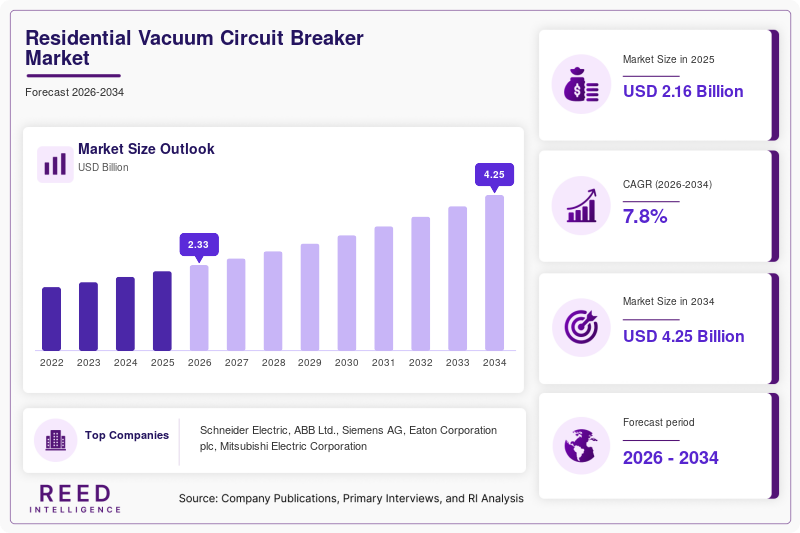
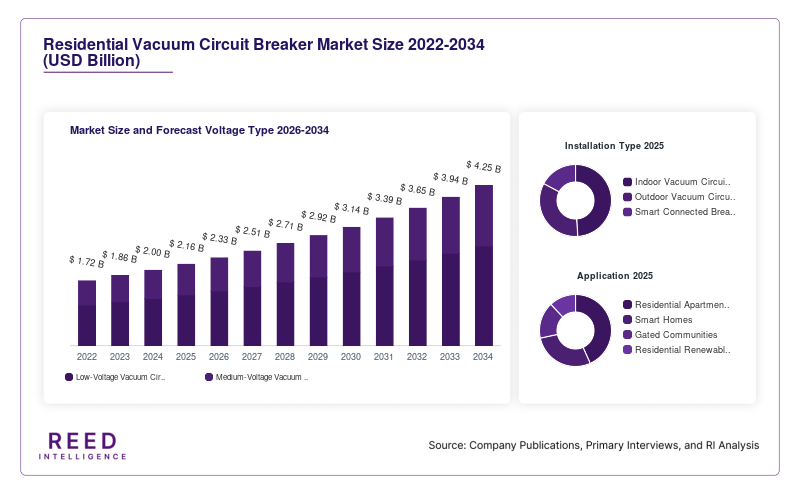
The Residential Vacuum Circuit Breaker Market size was valued at USD 2.16 billion in 2026 and is projected to reach USD 3.94 billion by 2034, expanding at a CAGR of 7.8% during the forecast period from 2026 to 2034. The global Residential Vacuum Circuit Breaker Market growth has been supported by the increasing global emphasis on residential electrical safety and energy-efficient power distribution systems. Governments, utility providers, and residential developers are increasingly investing in modern electrical infrastructure to reduce power interruptions and improve household safety standards.
The Residential Vacuum Circuit Breaker Market has gained significant momentum due to the rapid expansion of residential construction projects and urban housing developments. Vacuum circuit breakers are widely used for interrupting electrical faults safely and efficiently in residential distribution systems. Their compact design, low maintenance requirements, and improved arc extinguishing capabilities make them suitable for modern housing infrastructure.
Key Highlights
- Asia Pacific accounted for 39.5% of the global Residential Vacuum Circuit Breaker Market share in 2025, while the Middle East & Africa is projected to register the fastest CAGR of 8.5% during the forecast period.
- By voltage type, low-voltage vacuum circuit breakers held the leading market share of 63.8% in 2025, whereas medium-voltage vacuum circuit breakers are anticipated to expand at a CAGR of 8.2% through 2034.
- By installation type, indoor vacuum circuit breakers dominated with 68.4% share in 2025, while smart connected breakers are forecast to grow at a CAGR of 8.8%.
- By application, residential apartment complexes accounted for 41.7% of the Residential Vacuum Circuit Breaker Market share in 2025, whereas smart homes are expected to grow at a CAGR of 9.1%.
- By distribution channel, electrical equipment distributors represented 46.5% of the market share in 2025, while online sales channels are projected to register a CAGR of 9.4% during the study period.
- China Residential Vacuum Circuit Breaker Market was valued at USD 328.6 million in 2024 and increased to USD 354.2 million in 2025 due to expanding urban housing and electrification projects.
Market Trends
Increasing Integration of Smart Electrical Protection Systems
One of the major trends shaping the Residential Vacuum Circuit Breaker Market is the increasing integration of smart electrical protection systems. Residential consumers are adopting intelligent energy management solutions that provide real-time monitoring, fault detection, and automated electrical protection.
Manufacturers are developing vacuum circuit breakers equipped with IoT connectivity, remote diagnostics, and predictive maintenance features. These technologies improve operational efficiency and allow homeowners to monitor electrical systems through smart devices. The trend toward connected residential infrastructure is expected to accelerate demand for digitally enabled circuit breakers.
Growing Preference for Environmentally Safer Switching Technologies
Another important trend influencing the Residential Vacuum Circuit Breaker Market is the growing preference for environmentally safer switching technologies. Vacuum circuit breakers are increasingly replacing conventional gas-insulated breakers because they eliminate the use of greenhouse gas-based insulation materials.
Governments and utility regulators are encouraging the adoption of eco-friendly electrical equipment to support sustainability goals. Manufacturers are responding by introducing compact and recyclable vacuum breaker systems with improved energy efficiency and reduced environmental impact.
Market Drivers
Expansion of Residential Construction Activities
The rapid expansion of residential construction projects has become a primary driver for the Residential Vacuum Circuit Breaker Market. Urban population growth and rising housing demand are encouraging governments and private developers to invest in large-scale residential infrastructure projects.
Modern housing developments require advanced electrical protection systems capable of supporting higher energy consumption and smart appliances. Residential vacuum circuit breakers are increasingly preferred due to their reliability, safety performance, and operational durability.
Increasing Focus on Electrical Safety Standards
The growing focus on electrical safety standards has significantly contributed to Residential Vacuum Circuit Breaker Market growth. Governments and regulatory agencies are implementing stricter safety requirements for residential electrical systems to reduce fire hazards and power-related accidents.
Consumers are increasingly adopting advanced circuit protection equipment to ensure uninterrupted electricity supply and improve household safety. Rising awareness regarding electrical fault prevention has strengthened demand for reliable vacuum circuit breaker systems.
Market Restraint
High Initial Product and Installation Costs
High product and installation costs remain a major restraint for the Residential Vacuum Circuit Breaker Market. Vacuum circuit breakers involve advanced engineering components and insulation systems, resulting in higher prices compared to conventional residential breakers.
Cost-sensitive residential consumers and small-scale developers may hesitate to adopt advanced vacuum breaker systems due to budget limitations. Installation and maintenance expenses can also impact purchasing decisions in price-sensitive markets.
Market Opportunities
Rising Deployment of Residential Renewable Energy Systems
The increasing deployment of residential renewable energy systems presents a strong opportunity for the Residential Vacuum Circuit Breaker Market. Solar rooftop installations and home battery storage systems require advanced switching and protection equipment to maintain electrical stability.
Manufacturers are expected to introduce specialized vacuum circuit breakers designed for distributed residential energy networks. Growing investments in residential clean energy adoption are likely to support long-term market demand.
Growth of Smart City Housing Projects
The growth of smart city housing projects offers significant opportunities for the Residential Vacuum Circuit Breaker Market. Governments are increasingly developing digitally connected residential communities equipped with advanced power management systems.
Smart housing infrastructure requires intelligent electrical protection equipment capable of supporting automated energy distribution and monitoring. This trend is expected to create favorable opportunities for manufacturers offering connected vacuum breaker technologies.
Segmental Analysis
By Voltage Type
Based on voltage type, the Residential Vacuum Circuit Breaker Market is segmented into low-voltage vacuum circuit breakers and medium-voltage vacuum circuit breakers.
Low-voltage vacuum circuit breakers dominated the market with a 63.8% share in 2025 due to their widespread use in residential power distribution systems and household electrical panels.
Medium-voltage vacuum circuit breakers are projected to witness the fastest CAGR of 8.2% during the forecast period. Increasing deployment in high-rise residential complexes and smart residential communities is expected to strengthen segment growth.
By Installation Type
Based on installation type, the Residential Vacuum Circuit Breaker Market is categorized into indoor vacuum circuit breakers, outdoor vacuum circuit breakers, and smart connected breakers.
Indoor vacuum circuit breakers held the largest market share of 68.4% in 2025 because they are extensively used in residential buildings and apartment distribution systems.
Smart connected breakers are expected to grow at a CAGR of 8.8% through 2034. Rising adoption of home automation and connected energy management systems is anticipated to accelerate segment demand.
By Application
Based on application, the Residential Vacuum Circuit Breaker Market is segmented into residential apartment complexes, smart homes, gated communities, and residential renewable energy systems.
Residential apartment complexes accounted for the highest market share of 41.7% in 2025 due to increasing urban housing development and large-scale residential construction projects.
Smart homes are forecast to register the fastest CAGR of 9.1% during the study period. Growing consumer demand for automated electrical protection and intelligent energy management systems is expected to support segment growth.
By Distribution Channel
Based on distribution channel, the Residential Vacuum Circuit Breaker Market is segmented into direct sales, electrical equipment distributors, online sales channels, and retail electrical stores.
Electrical equipment distributors dominated the market with a 46.5% share in 2025 because of their extensive supply chain networks and strong relationships with residential contractors and developers.
Online sales channels are projected to expand at a CAGR of 9.4% through 2034. Increasing digital procurement trends and the availability of smart electrical products on e-commerce platforms are expected to drive segment growth.
By End User
Based on end user, the Residential Vacuum Circuit Breaker Market is segmented into homeowners, residential contractors, property developers, and utility-supported housing projects.
Residential contractors accounted for the leading market share of 43.9% in 2025 due to increasing deployment of vacuum breakers in newly constructed housing infrastructure.
Property developers are expected to witness the fastest CAGR of 8.6% during the forecast period. Rising investment in premium residential projects and integrated smart housing communities is likely to strengthen demand.
Regional Analysis
Asia Pacific
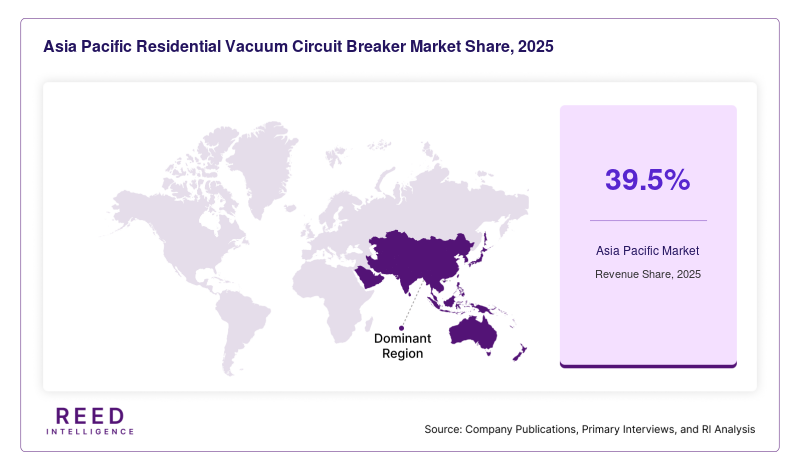
Asia Pacific accounted for 39.5% of the Residential Vacuum Circuit Breaker Market share in 2025 and is projected to grow at a CAGR of 8.1% during the forecast period. The region maintained a dominant market position due to rapid urbanization, residential electrification programs, and increasing housing construction activities.
China represented the leading country within the regional market. The country experienced strong demand for residential electrical protection systems because of large-scale urban development projects and rising smart home adoption.
North America
North America held 24.8% of the global Residential Vacuum Circuit Breaker Market share in 2025 and is expected to expand at a CAGR of 7.2% through 2034. The regional market benefited from modernization of residential electrical infrastructure and growing adoption of home automation systems.
The United States emerged as the dominant country within North America due to increasing investments in smart housing developments and residential renewable energy installations. The expansion of home energy storage systems also supported breaker demand.
Europe
Europe accounted for 21.3% of the Residential Vacuum Circuit Breaker Market share in 2025 and is forecast to grow at a CAGR of 7.4% during the study period. The regional market benefited from strict electrical safety regulations and increasing adoption of sustainable residential energy systems.
Germany represented the dominant country within Europe due to rising smart home penetration and strong investments in energy-efficient residential infrastructure. The growing installation of rooftop solar systems also contributed to market expansion.
Middle East & Africa
The Middle East & Africa region represented 8.2% of the Residential Vacuum Circuit Breaker Market share in 2025 and is anticipated to register the fastest CAGR of 8.5% during the forecast period. The market growth was supported by expanding urban housing projects and electrification initiatives.
Saudi Arabia dominated the regional market due to large-scale smart city development projects and increasing residential infrastructure investments. Rising electricity consumption in urban areas further supported demand for advanced circuit protection systems.
Latin America
Latin America accounted for 6.2% of the Residential Vacuum Circuit Breaker Market share in 2025 and is projected to expand at a CAGR of 7.0% through 2034. The regional market expanded because of increasing residential electrification and urban infrastructure modernization programs.
Brazil emerged as the leading country within the region due to growing residential construction activities and rising investments in energy-efficient housing projects. Government initiatives aimed at improving electricity reliability also supported market growth.
Competitive Landscape
The Residential Vacuum Circuit Breaker Market remains moderately competitive, with major electrical equipment manufacturers focusing on product innovation, smart technology integration, and expansion of regional distribution networks. Companies are investing in energy-efficient switching technologies and compact circuit protection systems to strengthen market competitiveness.
Schneider Electric maintained a leading position in the market due to its broad residential electrical solutions portfolio and strong global distribution network. The company recently introduced a smart residential vacuum circuit breaker integrated with remote monitoring and predictive maintenance capabilities for connected homes.
ABB Ltd. continued to strengthen its smart electrical protection segment through investments in digital circuit management technologies. Siemens AG focused on expanding eco-friendly residential breaker systems designed for sustainable housing projects.
Eaton Corporation plc increased investments in connected residential power management systems. Mitsubishi Electric Corporation expanded its smart breaker product line targeting high-rise residential infrastructure and modern apartment developments.
Key Players List
- Schneider Electric
- ABB Ltd.
- Siemens AG
- Eaton Corporation plc
- Mitsubishi Electric Corporation
- Toshiba Corporation
- Fuji Electric Co., Ltd.
- Hitachi Energy Ltd.
- Hyundai Electric & Energy Systems Co., Ltd.
- Legrand SA
- Larsen & Toubro Limited
- CG Power and Industrial Solutions Ltd.
- Chint Group
- Havells India Ltd.
- Panasonic Corporation
Recent Developments
- In February 2026, Schneider Electric launched a smart residential vacuum circuit breaker with integrated IoT-based monitoring features for connected housing systems.
- In May 2026, ABB Ltd. introduced eco-friendly vacuum breaker solutions designed for energy-efficient residential infrastructure projects.
- In August 2025, Siemens AG expanded its residential electrical equipment manufacturing capacity in Asia Pacific.
- In October 2025, Eaton Corporation plc developed upgraded digital fault detection technology for residential vacuum circuit breakers.
- In January 2026, Mitsubishi Electric Corporation launched compact medium-voltage residential breakers targeting premium apartment complexes and smart housing developments.
Residential Vacuum Circuit Breaker Market Segments
Voltage Type
- Low-Voltage Vacuum Circuit Breakers
- Medium-Voltage Vacuum Circuit Breakers
Installation Type
- Indoor Vacuum Circuit Breakers
- Outdoor Vacuum Circuit Breakers
- Smart Connected Breakers
Application
- Residential Apartment Complexes
- Smart Homes
- Gated Communities
- Residential Renewable Energy Systems
Distribution Channel
- Direct Sales
- Electrical Equipment Distributors
- Online Sales Channels
- Retail Electrical Stores
End User
- Homeowners
- Residential Contractors
- Property Developers
- Utility-Supported Housing Projects
By Region
- North America
- Europe
- APAC
- Middle East and Africa
- LATAM