Resorcinol Market Size, Share Demand Report By Application (Rubber Adhesives, UV Stabilizers, Flame Retardants, Wood Adhesives, Others), By End-Use Industry (Tire Manufacturing, Construction Materials, Automotive, Electrical & Electronics, Others), By Grade (Industrial Grade, Pharmaceutical Grade), By Distribution Channel (Direct Sales, Distributors & Wholesalers, Online Channels), By Region & Segment Forecasts, 2025–2034
USD 3950
Market Overview
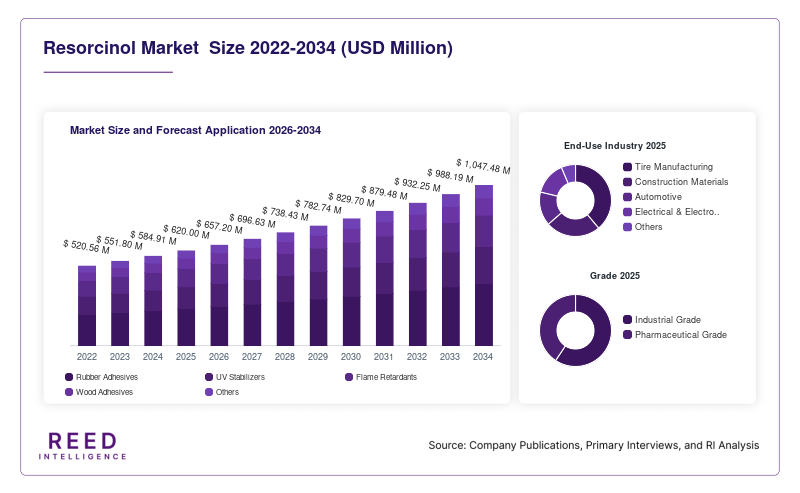
The Resorcinol Market size was valued at approximately USD 620 million in 2025 and is projected to reach USD 1,045 million by 2034, expanding at a CAGR of 6.0% during the forecast period (2025–2034). The market is experiencing steady growth due to its widespread application in rubber bonding, wood adhesives, UV stabilizers, and specialty chemical formulations. Resorcinol plays a critical role in enhancing product durability and performance, particularly in industrial applications such as tire manufacturing and construction materials.
A key global factor supporting the growth of the Resorcinol Market is the expansion of the automotive industry, especially in developing economies. The increasing production of vehicles has driven demand for high-performance tires, where resorcinol-based adhesives are essential for improving bonding strength and longevity. This trend has created a stable demand base for resorcinol manufacturers worldwide.
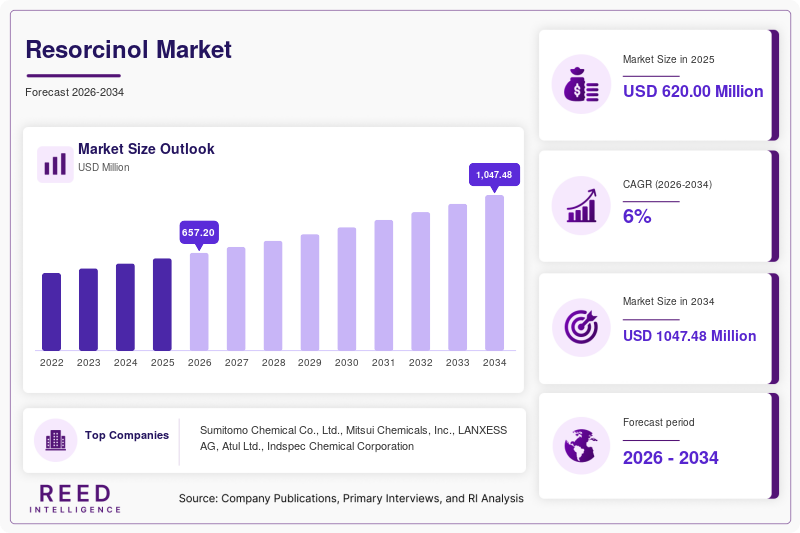
Key Highlights
- Asia Pacific dominated the Resorcinol Market with a 41% share in 2025 and will grow at a CAGR of 6.7%.
- The Middle East & Africa is the fastest-growing region, projected to expand at a CAGR of 7.1%.
- By application, rubber adhesives held the largest share at 48%, while UV stabilizers will grow fastest at a CAGR of 6.8%.
- By end-use, tire manufacturing dominated with 45% share, while construction materials will register the fastest growth at 6.5% CAGR.
- China remained the dominant country, with market values of USD 155 million in 2025 and USD 163 million in 2026
Market Trends
Increasing Adoption in High-Performance Tire Manufacturing
The Resorcinol Market is witnessing a growing focus on high-performance tire production, driven by the rising demand for durable and fuel-efficient vehicles. Resorcinol-based adhesives are widely used in tire cord bonding to enhance strength and resistance to wear. As automotive manufacturers prioritize safety and performance, the use of advanced materials in tire manufacturing is increasing, supporting the steady demand for resorcinol.
Expansion of Specialty Chemical Applications
Another notable trend shaping the Resorcinol Market is the expansion of its use in specialty chemical formulations. Resorcinol is increasingly utilized in UV stabilizers, flame retardants, and coatings due to its chemical stability and versatility. The growing demand for high-performance materials in construction, electronics, and coatings industries is encouraging manufacturers to explore new applications, thereby broadening the market scope.
Market Drivers
Growth in Automotive and Tire Industry
The expansion of the global automotive sector is a major driver of the Resorcinol Market. The increasing production of passenger and commercial vehicles has led to higher demand for durable tires, where resorcinol plays a key role in bonding rubber components. The need for improved tire performance, safety, and longevity continues to drive its adoption.
Rising Demand for Industrial Adhesives
The growing use of industrial adhesives in construction, woodworking, and manufacturing industries is contributing to market growth. Resorcinol-based adhesives offer strong bonding properties and resistance to environmental conditions, making them suitable for structural applications. This demand is particularly strong in infrastructure development projects across emerging economies.
Market Restraint
Volatility in Raw Material Prices
A significant challenge in the Resorcinol Market is the fluctuation in raw material prices, particularly benzene and related petrochemical derivatives. These fluctuations can impact production costs and profit margins for manufacturers. Price instability often leads to uncertainty in supply chains, affecting long-term planning and investment decisions.
Additionally, the dependence on petrochemical feedstocks raises concerns regarding sustainability and environmental impact. Increasing regulatory pressure to reduce emissions and adopt greener alternatives may further challenge market growth. Manufacturers are required to invest in process optimization and alternative raw materials to mitigate these risks, which can increase operational costs.
Market Opportunities
Development of Bio-Based Resorcinol Alternatives
The development of bio-based resorcinol presents a promising opportunity for market players. As industries shift toward sustainable and eco-friendly materials, the demand for renewable chemical solutions is increasing. Bio-based resorcinol can reduce environmental impact and align with regulatory requirements, creating new growth avenues.
Expansion in Emerging Infrastructure Projects
The growth of infrastructure development projects in emerging economies offers significant opportunities for the Resorcinol Market. The increasing construction of residential, commercial, and industrial buildings is driving demand for high-performance adhesives and coatings. Resorcinol-based products are widely used in these applications due to their durability and resistance to environmental conditions.
Segmental Analysis
By Application
Rubber adhesives dominated the Resorcinol Market with a 48% share in 2025. This dominance was driven by the extensive use of resorcinol in tire manufacturing, where it enhances bonding between rubber and reinforcing materials. The segment benefited from the consistent demand for high-performance tires.
UV stabilizers are expected to be the fastest-growing segment, with a projected CAGR of 6.8%. The increasing use of resorcinol in coatings, plastics, and electronic components will drive this growth. Its ability to improve resistance to UV degradation makes it valuable in outdoor and high-exposure applications.
By End-Use Industry
Tire manufacturing held the largest share of 45% in 2025. The segment’s dominance was supported by the global demand for vehicles and replacement tires. Resorcinol-based adhesives are essential in ensuring tire durability and performance.
Construction materials are projected to grow at the fastest CAGR of 6.5%. The increasing demand for durable and weather-resistant building materials will drive the use of resorcinol-based adhesives and coatings in construction applications.
By Grade
Industrial grade resorcinol accounted for the largest share of 52% in 2025. This segment was widely used in adhesives, coatings, and rubber applications due to its cost-effectiveness and performance characteristics.
Pharmaceutical grade is expected to witness the fastest growth, with a CAGR of 6.6%. The increasing use of resorcinol in dermatological products and medical formulations will support this growth.
By Distribution Channel
Direct sales dominated the market with a 56% share in 2025. Large-scale manufacturers preferred direct procurement to ensure product quality and supply reliability.
Online channels are expected to grow at the fastest CAGR of 6.9%. The adoption of digital platforms for chemical procurement and improved logistics infrastructure will drive this segment’s growth.
Regional Analysis
North America
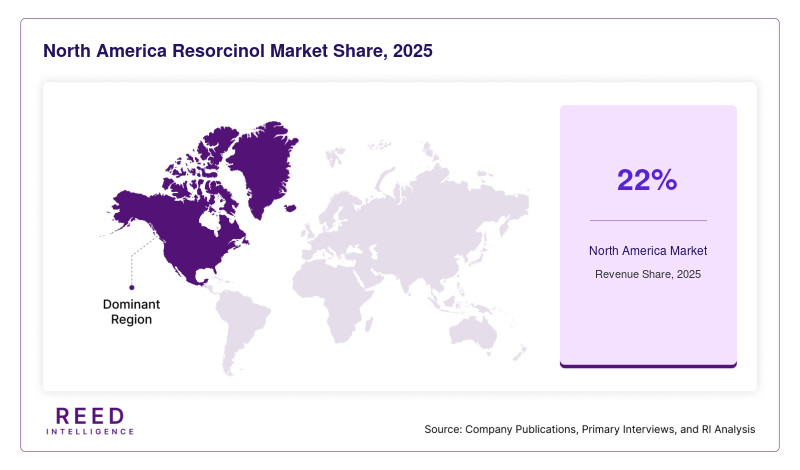
North America accounted for 22% of the Resorcinol Market share in 2025 and is expected to grow at a CAGR of 5.5% during the forecast period. The region experienced stable demand due to its mature automotive and construction industries. The presence of advanced manufacturing facilities supported consistent consumption of resorcinol in industrial applications.
The United States dominated the regional market, driven by its strong automotive production and infrastructure development activities. The demand for high-performance materials in tire manufacturing and construction applications contributed to steady growth in the country.
Europe
Europe held a 20% share of the Resorcinol Market in 2025 and will expand at a CAGR of 5.2%. The market in this region was influenced by strict environmental regulations and a focus on sustainable materials. Despite these challenges, demand remained stable due to the presence of established automotive and chemical industries.
Germany led the European market, supported by its robust manufacturing sector and innovation in specialty chemicals. The country’s emphasis on quality and performance materials encouraged the use of resorcinol in industrial applications.
Asia Pacific
Asia Pacific dominated the Resorcinol Market with a 41% share in 2025 and is projected to grow at a CAGR of 6.7%. The region’s growth was driven by rapid industrialization, expanding automotive production, and increasing infrastructure development activities.
China emerged as the dominant country due to its large-scale manufacturing capabilities and strong demand from the automotive and construction sectors. The availability of raw materials and cost-effective production processes further supported market growth.
Middle East & Africa
The Middle East & Africa accounted for 9% of the Resorcinol Market in 2025 and is anticipated to grow at the fastest CAGR of 7.1%. The region is witnessing increasing investments in infrastructure and industrial development, which is driving demand for resorcinol-based products.
Saudi Arabia dominated the regional market due to its growing construction sector and economic diversification efforts. The expansion of infrastructure projects contributed to increased consumption of industrial adhesives and coatings.
Latin America
Latin America held an 8% share of the Resorcinol Market in 2025 and is expected to grow at a CAGR of 6.1%. The region’s growth was supported by rising demand for automotive products and construction materials.
Brazil led the market in Latin America due to its expanding automotive industry and infrastructure development. The increasing adoption of durable materials in construction and manufacturing applications contributed to market growth.
Competitive Landscape
The Resorcinol Market is characterized by moderate competition, with several global and regional players operating across the value chain. Companies are focusing on expanding production capacity, improving product quality, and developing sustainable solutions to maintain their market position.
Sumitomo Chemical Co., Ltd. is a leading player in the market, known for its strong product portfolio and global presence. The company recently expanded its production capacity to meet rising demand from the automotive and construction industries.
Other key players are investing in research and development to explore new applications and improve production efficiency. Strategic collaborations and regional expansions are common approaches adopted by market participants to strengthen their presence.
Key Players
- Sumitomo Chemical Co., Ltd.
- Mitsui Chemicals, Inc.
- LANXESS AG
- Atul Ltd.
- Indspec Chemical Corporation
- Akrochem Corporation
- SI Group, Inc.
- Shandong Haili Chemical Industry Co., Ltd.
- Nippon Steel Chemical & Material Co., Ltd.
- Merck KGaA
- Alfa Aesar
- Tokyo Chemical Industry Co., Ltd.
- Santa Cruz Biotechnology, Inc.
- Spectrum Chemical Manufacturing Corp.
- Parchem Fine & Specialty Chemicals
Recent Developments
- In 2024, Sumitomo Chemical Co., Ltd. expanded its resorcinol production capacity in Asia.
- In 2023, SI Group, Inc. introduced improved adhesive formulations using resorcinol.
- In 2024, LANXESS AG invested in sustainable chemical production technologies.
- In 2023, Atul Ltd. strengthened its export capabilities for specialty chemicals.
- In 2024, Mitsui Chemicals, Inc. focused on developing eco-friendly resorcinol derivatives.
Resorcinol Market Segments
Application
- Rubber Adhesives
- UV Stabilizers
- Flame Retardants
- Wood Adhesives
- Others
End-Use Industry
- Tire Manufacturing
- Construction Materials
- Automotive
- Electrical & Electronics
- Others
Grade
- Industrial Grade
- Pharmaceutical Grade
Distribution Channel
- Direct Sales
- Distributors & Wholesalers
- Online Channels
By Region
- North America
- Europe
- APAC
- Middle East and Africa
- LATAM