Retail Asset Protection Market Size, Share & Demand Report By Component (Hardware, Software, Services), By Deployment Mode (On-Premises, Cloud-Based), By End Use (Supermarkets & Hypermarkets, Department Stores, Specialty Stores, Convenience Stores, E-commerce & Omnichannel Retailers, Others), By Region & Segment Forecasts, 2026–2034
USD 3950
Market Overview
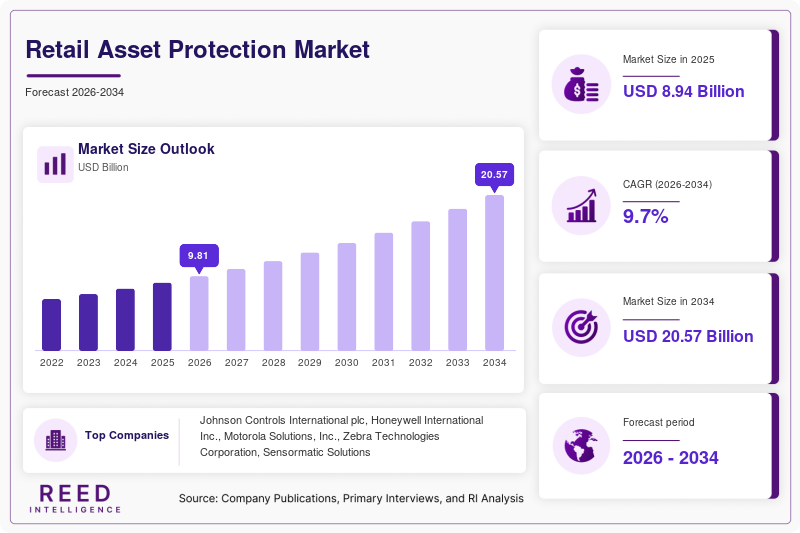
The global Retail Asset Protection Market size was valued at USD 8.94 billion in 2026 and is projected to reach USD 18.76 billion by 2034, expanding at a CAGR of 9.7% during 2026–2034. The market continues to evolve as retailers increasingly invest in technologies and services designed to reduce inventory shrinkage, prevent theft, improve operational visibility, and enhance store security. Retail asset protection solutions encompass electronic article surveillance systems, video surveillance platforms, RFID-based tracking solutions, inventory intelligence software, access control systems, and loss prevention analytics.
A major global factor supporting market growth is the steady rise in organized retail crime and inventory shrinkage across developed and emerging economies. Retailers are facing increasing losses from shoplifting, employee theft, return fraud, supply chain diversion, and cyber-enabled retail fraud. As a result, businesses are allocating larger portions of operational budgets toward integrated asset protection systems that combine physical security infrastructure with advanced analytics and artificial intelligence capabilities.
Key Highlights
- North America dominated the market with a 35.4% share in 2025.
- while Asia Pacific is expected to grow at the fastest CAGR of 11.6% during 2026–2034.
- By component, hardware solutions accounted for the largest share of 42.8%.
- while software platforms are projected to grow at a CAGR of 12.8%.
- By deployment mode, on-premises solutions held a 58.6% share.
- whereas cloud-based deployment is expected to expand at a CAGR of 13.2%.
- By end-use, supermarkets and hypermarkets led with a 37.9% share.
- while e-commerce and omnichannel retailers are expected to grow at a CAGR of 14.1%.
- The United States remained the dominant country, with market values of USD 2.24 billion in 2024 and USD 2.41 billion in 2025.
Market Trends
Integration of Artificial Intelligence and Predictive Analytics
Artificial intelligence is becoming a central component of retail asset protection strategies. Retailers are deploying AI-powered surveillance systems capable of identifying suspicious behavior, detecting theft patterns, and generating automated alerts before incidents escalate. Modern platforms analyze data collected from cameras, sensors, point-of-sale systems, and inventory management tools to provide comprehensive risk assessments. Predictive analytics further enables organizations to identify high-risk locations, vulnerable product categories, and recurring loss patterns. These capabilities help retailers reduce shrinkage while improving operational efficiency. As AI algorithms become more accurate and accessible, adoption is increasing across both large retail chains and mid-sized retailers seeking data-driven asset protection solutions.
Expansion of Cloud-Based Security Ecosystems
Cloud-based asset protection platforms are transforming how retailers manage security operations across multiple locations. Traditional standalone systems are increasingly being replaced by centralized cloud ecosystems that provide real-time monitoring, remote management, and unified reporting. These solutions allow retailers to consolidate surveillance footage, inventory records, access control data, and incident reports within a single platform. Cloud deployment also reduces infrastructure costs and supports scalability as businesses expand store networks. The growing demand for flexible and remotely accessible solutions is encouraging retailers to migrate toward cloud-native security architectures, particularly among organizations operating large omnichannel retail environments with geographically dispersed assets.
Market Drivers
Rising Incidence of Organized Retail Crime
The increasing prevalence of organized retail crime is a significant growth driver for the Retail Asset Protection Market. Criminal networks are becoming more sophisticated, targeting high-value merchandise through coordinated theft operations that can generate substantial financial losses for retailers. These incidents extend beyond traditional shoplifting and include cargo theft, fraudulent returns, inventory diversion, and supply chain manipulation. Retailers are responding by investing in advanced surveillance systems, RFID tracking technologies, and intelligent monitoring platforms. Enhanced security infrastructure enables businesses to identify threats more effectively and improve incident response capabilities. Growing concerns regarding profit erosion from retail crime continue to encourage long-term investment in comprehensive asset protection solutions across multiple retail segments.
Growing Adoption of Omnichannel Retail Models
The rapid expansion of omnichannel retailing is creating new asset protection requirements throughout the retail value chain. Retailers now manage inventory across physical stores, warehouses, distribution centers, and digital fulfillment operations. This interconnected environment increases the complexity of tracking merchandise and maintaining visibility over assets. Asset protection solutions provide real-time monitoring, inventory accuracy, and operational transparency across diverse channels. Retailers are implementing integrated technologies that connect inventory systems with security platforms to reduce losses and improve efficiency. As omnichannel strategies continue to expand globally, the demand for scalable and intelligent asset protection solutions is expected to strengthen throughout the forecast period.
Market Restraint
High Implementation and Integration Costs
The substantial cost associated with deploying comprehensive asset protection systems remains a key restraint for market expansion. Advanced surveillance networks, RFID infrastructure, access control systems, analytics software, and cloud-based monitoring platforms require significant capital investment. In addition to hardware and software expenses, retailers must allocate resources toward employee training, system maintenance, cybersecurity measures, and integration with existing operational platforms. Small and medium-sized retailers often face budget limitations that restrict large-scale implementation. The challenge becomes more pronounced when organizations operate legacy infrastructure that requires extensive upgrades before new technologies can be deployed effectively. For example, a regional retail chain may need to replace outdated inventory management systems before implementing advanced analytics tools, increasing total project costs. These financial barriers can delay adoption decisions and extend procurement cycles, particularly in cost-sensitive retail markets.
Market Opportunities
Growth of RFID-Enabled Inventory Intelligence
The increasing adoption of RFID technology presents significant opportunities within the Retail Asset Protection Market. Retailers are leveraging RFID-enabled systems to improve inventory visibility, reduce shrinkage, and enhance operational efficiency. These solutions provide real-time asset tracking across stores, warehouses, and distribution centers, enabling businesses to identify discrepancies quickly and improve inventory accuracy. Enhanced visibility supports loss prevention initiatives while also improving customer satisfaction through better product availability. As RFID deployment costs continue to decline and technology performance improves, adoption is expanding across apparel, electronics, grocery, and specialty retail segments, creating substantial growth opportunities for solution providers.
Emergence of Smart Retail Stores
The development of smart retail environments is creating new opportunities for asset protection vendors. Modern stores increasingly incorporate connected devices, intelligent shelving systems, automated checkout technologies, and AI-driven surveillance networks. These innovations generate valuable operational data that can be integrated with asset protection platforms to improve security and reduce losses. Retailers are seeking solutions capable of monitoring customer behavior, inventory movement, and transaction activity in real time. Asset protection providers that offer integrated ecosystems combining security, analytics, and inventory intelligence are positioned to benefit from the continued expansion of smart retail infrastructure across global markets.
Segmental Analysis
By Component
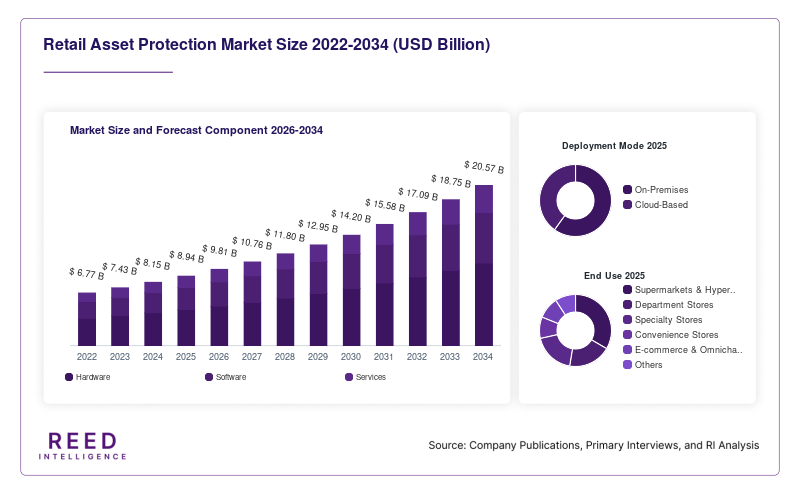
Hardware solutions represented the dominant subsegment, accounting for approximately 42.8% of the market share in 2024. This category includes surveillance cameras, RFID readers, sensors, electronic article surveillance systems, access control devices, and related infrastructure. Hardware remains essential because it forms the foundation of retail security ecosystems. Large retailers continue to invest in upgraded surveillance networks and intelligent sensing technologies capable of supporting advanced analytics platforms. The widespread deployment of security hardware across supermarkets, department stores, specialty retailers, and distribution centers contributes significantly to market revenue generation. Continuous technological improvements in imaging quality, sensor accuracy, and connectivity capabilities further strengthen demand for hardware-based asset protection systems.
Software platforms are projected to be the fastest-growing subsegment, expanding at a CAGR of 12.8% during the forecast period. Retailers increasingly require centralized systems capable of processing large volumes of security and inventory data. Advanced software solutions support real-time monitoring, predictive analytics, incident management, and automated reporting. The growing use of artificial intelligence and machine learning is enhancing the value proposition of software-based asset protection tools. Organizations are adopting integrated platforms that connect surveillance systems, inventory databases, and point-of-sale systems to improve visibility and decision-making. These advantages are expected to drive sustained growth throughout the forecast period.
By Deployment Mode
On-premises deployment held the largest market share of approximately 58.6% in 2024. Many large retailers continue to prefer on-premises infrastructure because it offers greater control over sensitive security data and operational processes. Organizations with extensive store networks often maintain dedicated IT resources capable of managing complex security environments. On-premises systems are commonly utilized in regions with strict data governance requirements and among retailers seeking customized asset protection configurations. The established installed base of legacy infrastructure also contributes to continued dominance. These factors collectively support the strong market position of on-premises deployment models.
Cloud-based deployment is expected to record the fastest CAGR of 13.2% through 2034. Retailers are increasingly recognizing the benefits of scalable, remotely accessible, and cost-efficient security platforms. Cloud solutions enable centralized monitoring across multiple locations while reducing hardware maintenance requirements. They also facilitate rapid software updates and support advanced analytics capabilities. The growth of distributed retail networks and omnichannel operations is increasing demand for flexible deployment models. Small and medium-sized retailers, in particular, are adopting cloud platforms because they offer enterprise-level functionality without substantial upfront infrastructure investments.
By End Use
Supermarkets and hypermarkets accounted for the largest share of approximately 37.9% in 2024. These retail formats manage large volumes of merchandise, extensive store footprints, and significant daily customer traffic, making asset protection a critical operational priority. Retailers within this segment deploy surveillance systems, RFID technologies, inventory tracking platforms, and access control solutions to reduce losses and improve efficiency. The broad product mix and high transaction volumes characteristic of supermarkets create numerous opportunities for shrinkage, further driving investment in comprehensive asset protection infrastructure. Continued expansion of organized retail chains supports sustained demand within this segment.
E-commerce and omnichannel retailers are projected to grow at the fastest CAGR of 14.1% during the forecast period. The increasing integration of online and offline retail operations requires enhanced visibility across complex inventory networks. Retailers must protect assets throughout fulfillment centers, distribution facilities, and last-mile delivery channels. Advanced asset protection solutions provide real-time inventory tracking, anomaly detection, and operational intelligence across interconnected systems. Rising consumer expectations for rapid order fulfillment and inventory accuracy are encouraging greater investment in sophisticated monitoring technologies. These factors position e-commerce and omnichannel retail as the fastest-growing end-use category.
Regional Analysis
North America
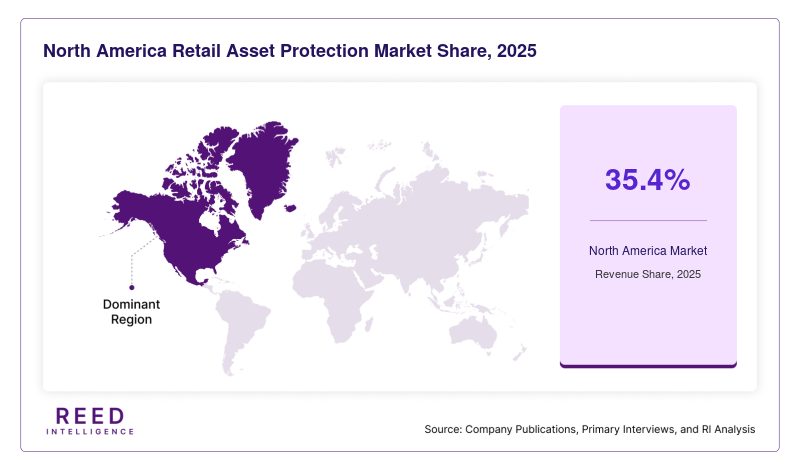
North America accounted for approximately 35.4% of the Retail Asset Protection Market in 2025 and continues to represent the largest regional market. The region is projected to expand at a CAGR of 8.9% during the forecast period. Strong adoption of advanced surveillance technologies, widespread deployment of RFID systems, and significant investment in loss prevention programs contribute to market leadership. Large retail chains across the United States and Canada continue to prioritize asset protection initiatives as shrinkage-related losses remain a major operational concern.
The United States remains the dominant country within the region. A unique growth factor is the increasing use of AI-driven retail crime detection systems across large retail networks. Retailers are implementing predictive analytics platforms capable of identifying suspicious activity patterns before losses occur. These investments support enhanced operational visibility and contribute to sustained demand for sophisticated asset protection technologies.
Europe
Europe represented approximately 27.1% of the global market in 2025 and is expected to grow at a CAGR of 8.5% through 2034. The region benefits from established retail infrastructure, increasing digital transformation initiatives, and growing investments in inventory visibility solutions. Retailers are adopting integrated asset protection systems that combine surveillance, access control, and inventory management capabilities. Regulatory emphasis on operational transparency further encourages technology adoption.
Germany remains the leading country within the European market. A distinctive growth factor is the country's strong focus on warehouse automation and supply chain modernization. Retailers are integrating asset protection technologies into automated logistics environments to improve inventory control and minimize losses. These initiatives support ongoing market expansion across both physical and digital retail channels.
Asia Pacific
Asia Pacific held approximately 22.8% of the market in 2025 and is projected to register the fastest CAGR of 11.6% during the forecast period. Rapid retail expansion, urbanization, and increasing adoption of digital commerce are driving demand for advanced asset protection solutions. Retailers are investing heavily in security technologies to support growing store networks and complex supply chains. Rising awareness regarding shrinkage management is also contributing to market growth.
China remains the dominant country across the region. A unique growth factor is the rapid development of smart retail ecosystems integrating AI, IoT, and automated inventory management technologies. Retailers are increasingly deploying intelligent monitoring systems capable of supporting both traditional and digital retail operations. These developments continue to create favorable conditions for asset protection technology providers.
Middle East & Africa
The Middle East & Africa accounted for approximately 7.4% of global revenue in 2025 and is expected to expand at a CAGR of 9.2% through 2034. Growing retail infrastructure investments and the emergence of large shopping destinations are supporting market development. Retail operators are implementing advanced security solutions to protect assets, improve operational efficiency, and enhance customer experiences. Modernization initiatives across the retail sector are further accelerating adoption.
Saudi Arabia remains the dominant country within the region. A distinctive growth factor is the rapid expansion of large-scale retail and commercial developments linked to economic diversification programs. New retail projects increasingly incorporate advanced security and monitoring systems from the planning stage, creating substantial opportunities for asset protection vendors and technology providers.
Latin America
Latin America captured approximately 7.3% of the global market in 2025 and is anticipated to grow at a CAGR of 8.7% during the forecast period. Retailers across the region are investing in surveillance systems, inventory tracking technologies, and integrated security platforms to address shrinkage challenges. Expanding organized retail networks and improving digital infrastructure continue to support market growth. Increasing awareness of operational risk management is also contributing to technology adoption.
Brazil remains the leading country within the regional market. A unique growth factor is the growing implementation of digital inventory management solutions among large retail chains. Businesses are combining inventory intelligence with security technologies to improve asset visibility and reduce losses. This integrated approach is driving increased demand for comprehensive retail asset protection platforms.
Competitive Landscape
The Retail Asset Protection Market is characterized by the presence of established security technology providers, retail analytics companies, and inventory intelligence specialists. Market participants focus on innovation, strategic partnerships, cloud platform development, and artificial intelligence integration to strengthen competitive positioning. Solution providers increasingly offer unified platforms that combine surveillance, inventory management, access control, and analytics capabilities within a single ecosystem.
Johnson Controls International plc remains a leading market participant due to its extensive portfolio of retail security and monitoring solutions. The company recently expanded its AI-enabled analytics capabilities to improve real-time threat detection and operational intelligence for retail customers. Other major companies continue investing in cloud-native platforms, advanced RFID technologies, and predictive loss prevention solutions. Competitive activity is expected to intensify as retailers seek integrated systems capable of addressing evolving security and inventory management requirements across omnichannel environments.
Key Players
- Johnson Controls International plc
- Honeywell International Inc.
- Axis Communications AB
- Bosch Security Systems
- Motorola Solutions, Inc.
- Zebra Technologies Corporation
- Sensormatic Solutions
- Checkpoint Systems, Inc.
- Hikvision Digital Technology Co., Ltd.
- Dahua Technology Co., Ltd.
- Nedap N.V.
- Genetec Inc.
- Verkada Inc.
- Securitas Technology
- ADT Commercial
Recent Developments
- Johnson Controls introduced enhanced AI-based retail monitoring capabilities designed to improve incident detection and operational visibility.
- Zebra Technologies expanded its RFID inventory intelligence portfolio to support real-time asset tracking across omnichannel retail networks.
- Sensormatic Solutions launched advanced analytics features integrating surveillance data with inventory management platforms.
- Motorola Solutions strengthened its cloud-based video security offerings through expanded retail-focused analytics functionality.
- Checkpoint Systems introduced next-generation loss prevention solutions combining RFID technology with intelligent merchandise protection systems.
Retail Asset Protection Market Segments
Component
- Hardware
- Software
- Services
Deployment Mode
- On-Premises
- Cloud-Based
End Use
- Supermarkets & Hypermarkets
- Department Stores
- Specialty Stores
- Convenience Stores
- E-commerce & Omnichannel Retailers
- Others
By Region
- North America
- Europe
- APAC
- Middle East and Africa
- LATAM