Retargeting Software Market Size, Share & Trends Analysis Report By Component (Solutions, Services), By Deployment (Cloud-Based, On-Premises), By Enterprise Size (Large Enterprises, SMEs), By Application (E-commerce & Retail, BFSI, Travel & Hospitality, Media & Entertainment, Others) and By Region (North America, Europe, Asia-Pacific, Middle East and Africa, Latin America) Forecasts, 2026–2034
USD 3950
Retargeting Software Market Size
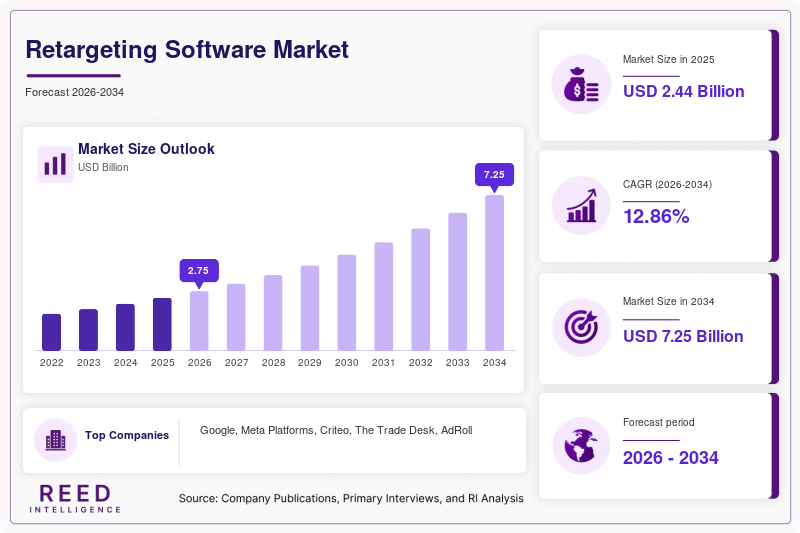
The retargeting software market was valued at USD 2.44 billion in 2025 and is estimated to reach USD 2.75 billion in 2026. The market is projected to reach USD 7.24 billion by 2034, registering a CAGR of 12.86% during 2026–2034.
The retargeting software market is shifting from cookie-dependent visitor tracking toward first-party data activation, consent-based audience management, automated bidding, dynamic creative optimization, and cross-channel re-engagement. Google now refers to remarketing audiences as "your data" segments and supports targeting users who previously interacted with websites, applications, products, or businesses.
The commercial demand base is concentrated among e-commerce companies, digital-first brands, retailers, travel businesses, financial services providers, and other advertisers where a previous website or app interaction provides a meaningful signal of purchase intent. Dynamic remarketing can combine product feeds with prior visitor behavior to present users with products or services they previously viewed.
Retargeting Software Market Drivers
First-Party Data Is Becoming More Valuable as Retargeting Moves Beyond Third-Party Tracking
The shift toward first-party data is changing the architecture of retargeting software. Google allows advertisers to build "your data" segments from website visitors, app users, and customers who have shared information with a business. The Trade Desk has likewise expanded partnerships built around retailer and advertiser first-party data, including integrations designed to activate authenticated audiences across the open internet.
The market mechanism is that advertisers increasingly need software capable of collecting, organizing, matching and activating consented customer signals rather than depending solely on third-party cookies. This favors platforms with CRM, CDP, analytics, identity and advertising integrations. The counterbalance is that first-party data requires direct customer relationships and adequate consent, limiting addressable audiences for businesses with weak digital data infrastructure.
AI-Based Optimization Is Expanding the Functional Scope of Retargeting Platforms
AI is moving retargeting software beyond audience list creation toward automated decisions on bidding, creative selection, audience expansion and campaign allocation. IAB's 2025 research identifies AI applications across media planning, audience segmentation, media-partner selection, forecasting and sales attribution.
Google's dynamic remarketing infrastructure already combines product or service feeds with visitor behavior and uses automated systems to determine suitable products and ad layouts. Criteo has also integrated AI-powered optimization into its retargeting and social advertising capabilities.
The commercial implication is that software vendors can capture more value by providing automated campaign management rather than basic retargeting tags. Adoption can nevertheless be constrained by limited data quality, insufficient conversion signals and advertiser concerns about algorithmic transparency.
Cross-Channel Retargeting Increases Demand for Unified Audience Activation
Retargeting is increasingly being executed across display, social, mobile, video, connected TV and retail-media environments rather than through a single website-display workflow. The Trade Desk's retail-media partnerships illustrate how first-party retail data can be activated across websites, mobile applications, gaming, streaming and other channels.
This creates a software requirement for audience synchronization, frequency management, attribution and campaign measurement across multiple environments. AdRoll similarly combines first-party-data retargeting with display, native, video, mobile, social and connected-TV campaigns.
The opportunity is strongest for platforms that reduce fragmentation for advertisers. However, walled gardens, incompatible identity systems and different measurement methodologies can prevent completely unified campaign execution.
Retargeting Software Market Restraints
Privacy Regulation Reduces the Availability of Addressable User Signals
Privacy regulation is increasing the operational requirements for personalized advertising. Google requires appropriate consent for remarketing and conversion-related data use where legally required in the European Economic Area and the UK. Google also provides mechanisms allowing users to disable personalized advertising data collection.
The economic mechanism is a potential reduction in the size or usability of retargetable audiences when consumers decline consent or when advertisers cannot lawfully process particular data. IAB's 2025 survey also identifies data minimization, sensitive information, vendor due diligence and de-identification as active compliance issues for the advertising ecosystem.
This favors vendors with consent-management, first-party-data and privacy-safe activation capabilities but raises implementation costs.
Fragmented Identity and Measurement Systems Increase Integration Complexity
Retargeting software must operate across browsers, mobile applications, social platforms, retail-media networks and advertising exchanges, each with different identity and measurement mechanisms. Google, for example, distinguishes website and app audiences and supports multiple data and conversion integrations for remarketing.
The resulting integration burden can increase implementation time and make performance comparisons less consistent between channels. Advertisers may therefore consolidate spending with platforms offering broader integrations, while smaller software vendors can face higher development and interoperability costs.
Retargeting Software Market Opportunities
Privacy-Safe First-Party Audience Activation Creates a Clear Software Gap
Advertisers need to preserve the commercial value of customer data while complying with increasingly restrictive privacy requirements. Google's consent-mode architecture allows consent signals to be communicated to advertising systems, while its advertising policies restrict the use of personally identifiable information in personalized advertising.
This creates an opportunity for retargeting software that combines consent management, CRM/CDP integration, audience matching, server-side data transmission and campaign activation within a single workflow.
The commercial opportunity is particularly relevant to large retailers, subscription businesses and digital platforms with substantial first-party customer information. Adoption may be limited by integration costs, legal review requirements and differences between regional privacy regimes.
Retail-Media Integration Expands the Addressable Retargeting Workflow
Retailers possess purchase and browsing information that can improve audience qualification for advertising campaigns. The Trade Desk's partnerships with retailers demonstrate how first-party shopping data can be used to construct audiences and activate campaigns outside retailer-owned environments.
For retargeting software vendors, the opportunity lies in connecting retailer data with advertising activation, measurement and audience expansion. Such systems can support advertisers that want to reconnect with shoppers based on prior purchase or browsing behavior without relying exclusively on conventional third-party tracking.
The principal barrier is data governance: retailers and advertisers need appropriate consent, secure data matching and commercially acceptable data-sharing arrangements.
Retargeting Software Market Component Analysis
Solutions Hold the Largest Share as Advertisers Seek Automated Audience-to-Campaign Workflows
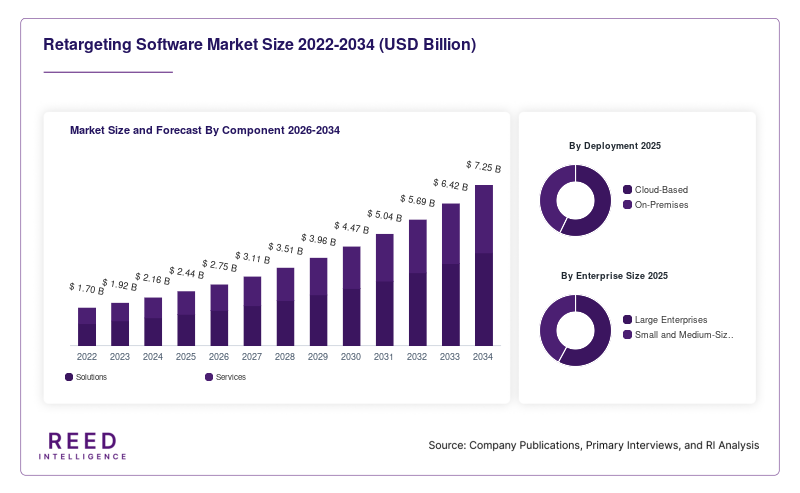
Solutions account for approximately 68% of the market in 2025, making them the dominant component. The segment includes audience management, campaign activation, dynamic retargeting, analytics, optimization and integrations with advertising platforms.
The reason for its larger share is that the core commercial value of retargeting lies in the software workflow that converts behavioral or first-party signals into advertising actions. Google's dynamic remarketing tools demonstrate this workflow by connecting visitor activity and product feeds with personalized advertising.
Solutions also benefit from increasing demand for automated optimization. Platforms such as Criteo and AdRoll combine retargeting with AI-based campaign management and multi-channel activation.
Services Expand Faster as Privacy and Data Integration Increase Implementation Complexity
Services are projected to record the fastest component CAGR of approximately 14.20% during 2026–2034. The growth mechanism is linked to increasing implementation requirements involving consent, customer-data integration, audience matching, analytics, campaign configuration and cross-channel measurement.
As advertisers move away from simple cookie-based workflows, implementation increasingly involves CRM, analytics, advertising platforms and privacy controls. Google's requirements for consent and appropriate data handling illustrate the technical and compliance work surrounding personalized advertising.
The segment can expand particularly among enterprises with complex technology stacks. However, standardized SaaS integrations may reduce the amount of external consulting required over time.
Retargeting Software Market Deployment Analysis
Cloud-based deployment accounts for approximately 76% of the 2025 market. Retargeting workflows require connections with advertising exchanges, social platforms, analytics systems, customer databases and product feeds, making continuously connected infrastructure commercially advantageous.
Google's advertising ecosystem illustrates the need to link website, app, analytics and advertising data for audience activation.
Cloud-based deployment is projected to grow at approximately 13.70% CAGR through 2034. Its growth is supported by subscription-based software delivery, remote campaign management and the need to connect multiple data sources without maintaining extensive local advertising infrastructure.
On-premises systems retain relevance among organizations with strict internal data-management requirements, but integration and maintenance requirements can constrain expansion.
Retargeting Software Market Enterprise Size Analysis
Large enterprises account for approximately 63% of the 2025 market. These organizations typically manage larger customer databases, multiple digital properties, several advertising channels and more complex measurement requirements.
The Trade Desk's work with global advertisers illustrates the importance of activating first-party data across multiple channels and identity environments.
SMEs are projected to register the fastest enterprise-size CAGR of approximately 14.10% during 2026–2034. Cloud-based retargeting products allow smaller advertisers to access audience segmentation, automated bidding and cross-channel campaign functions without building their own advertising infrastructure.
AdRoll explicitly targets D2C businesses with integrated acquisition, conversion and retention capabilities using first-party data and AI-powered advertising.
The constraint is budget sensitivity: smaller advertisers remain more exposed to advertising-cost volatility and may reduce software spending when campaign economics weaken.
Retargeting Software Market Application Analysis
E-commerce & Retail accounts for approximately 39% of the 2025 market. The segment benefits from highly measurable customer journeys in which product views, searches, cart additions and purchases generate behavioral signals that can be used for re-engagement.
Google's dynamic remarketing specifically supports ads based on products or services previously viewed by website or app users. Retail-media platforms are also increasingly connecting first-party shopping behavior with advertising activation outside retailer-owned properties.
Travel & Hospitality is projected to register the fastest application CAGR of approximately 14.60% during 2026–2034. Travel purchases typically involve research, comparison and delayed booking, creating multiple points where retargeting can reconnect potential customers with previously viewed destinations, hotels or travel products.
Google's app remarketing documentation includes travel-search behaviors among events that can be used to tailor subsequent advertising.
The constraint is seasonal demand and high competition for advertising inventory, which can increase acquisition costs during peak travel periods.
Retargeting Software Market Regional Analysis
North America Holds the Largest Regional Share Through Advanced Digital Advertising Infrastructure
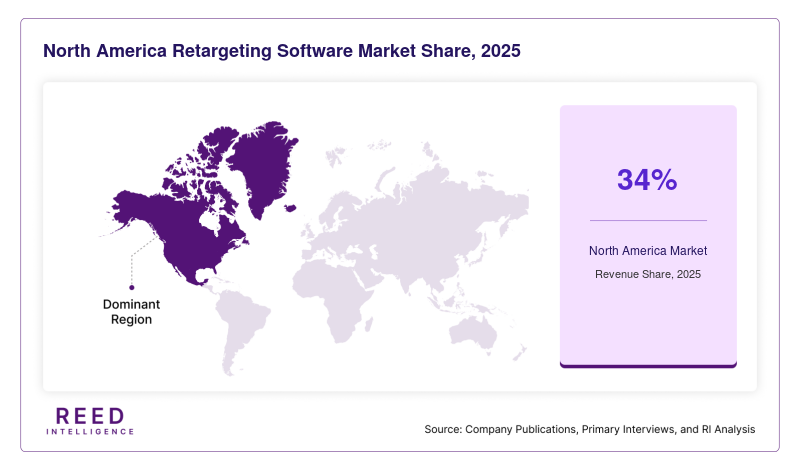
North America accounts for approximately 34% of the 2025 market. The region's position is supported by extensive adoption of programmatic advertising, e-commerce, retail media, CRM platforms and performance marketing technologies.
The market mechanism increasingly involves first-party data activation and cross-channel identity. The Trade Desk's work with major advertisers and retail-data partners demonstrates the region's movement toward privacy-conscious audience activation across the open internet.
Large advertisers also have greater incentives to consolidate campaign data and automate audience management because they operate across numerous digital channels. The counterbalance is the increasingly complex U.S. privacy environment and platform-level restrictions on user-level data.
Europe Maintains a Mature Market Driven by Privacy-Compliant Personalization
Europe accounts for approximately 25% of the 2025 market. Demand is supported by sophisticated digital commerce and advertising markets, but deployment is strongly influenced by consent and privacy requirements.
Google requires appropriate consent for remarketing and personalized advertising involving European Economic Area and UK users where legally required. IAB's 2025 privacy survey also identifies compliance harmonization, data minimization and vendor due diligence as active industry concerns.
This environment creates demand for software with consent-aware data collection, audience governance and privacy-safe activation. However, consent requirements can reduce addressable audiences and increase implementation complexity.
Asia-Pacific Is the Fastest-Growing Region as Digital Commerce and First-Party Data Ecosystems Expand
Asia-Pacific is projected to record the fastest regional CAGR of approximately 14.35% during 2026–2034. The region's expansion is linked to growing digital commerce, mobile-first customer journeys and increasing use of retail and platform-owned customer data.
The Trade Desk's partnership with foodpanda demonstrates how first-party retail data can be activated across mobile apps, websites, streaming and other advertising environments in Asia-Pacific.
The market opportunity is particularly relevant to e-commerce, travel, food delivery and financial-services advertisers with high volumes of digitally identifiable customer interactions. Fragmented regulatory frameworks and differences in advertising-platform maturity can slow deployment.
Middle East and Africa Develop Through Digital Commerce and Advertising Modernization
Middle East and Africa account for approximately 7% of the 2025 market. Demand is associated with the expansion of digital commerce, mobile applications and performance-oriented advertising.
The commercial mechanism is strongest among businesses that can capture customer interactions through websites and applications and then use those signals for personalized re-engagement. Cloud-based platforms can reduce infrastructure requirements for advertisers entering more sophisticated digital advertising workflows.
Adoption remains constrained by differences in digital maturity, data availability and privacy frameworks between individual markets.
Latin America Represents a Developing Market With Increasing Digital Advertising Adoption
Latin America accounts for approximately 6% of the 2025 market. Retargeting demand is supported by e-commerce expansion, mobile engagement and the increasing importance of measurable customer acquisition.
The market opportunity centers on SaaS-based tools that can combine customer data, advertising activation and performance measurement without requiring large internal marketing-technology teams.
Budget sensitivity and inconsistent data infrastructure remain constraints, particularly for smaller advertisers.
Retargeting Software Market Competitive Landscape
Competition is increasingly shifting from standalone retargeting functionality toward integrated audience intelligence, first-party data activation, AI optimization, identity resolution, cross-channel buying and measurement.
Google controls a major advertising ecosystem in which remarketing is integrated into Search, Display, YouTube, Analytics and app advertising workflows. Its terminology has shifted from "remarketing" toward "your data," reflecting the broader movement toward advertiser-owned customer data.
Meta competes through data-driven audience activation, Custom Audiences and machine-learning-based Advantage+ campaign systems. Meta's advertising infrastructure can use legitimately acquired customer data to construct Custom Audiences and support audience expansion.
Key Market Players
- Meta Platforms
- Criteo
- The Trade Desk
- AdRoll
- RTB House
- Adobe
- Salesforce
- Amazon Ads
- Microsoft Advertising
Retargeting Software Market Recent Developments
- IAB's 2025 State of Data report identified AI adoption across media planning, activation and analysis, including audience segmentation, media-partner selection, forecasting and attribution.
- In October 2024, Criteo introduced a Meta integration within its Commerce Growth platform to extend retargeting into Facebook and Instagram while retaining its broader open-web workflow.
Retargeting Software Market Segments
By Component
- Solutions
- Services
By Deployment
- Cloud-Based
- On-Premises
By Enterprise Size
- Large Enterprises
- Small and Medium-Sized Enterprises
By Application
- E-commerce & Retail
- BFSI
- Travel & Hospitality
- Media & Entertainment
- Others
By Region
- North America
- Europe
- APAC
- Middle East and Africa
- LATAM