Global Retinoscope Market Size, Share & Demand Report By Type (Handheld Retinoscope, Streak Retinoscope), By Application (Hospitals, Ophthalmic Clinics, Others), By End-Use (Optometrists, Ophthalmologists, Academic & Research Institutes), By Region & Segment Forecasts, 2025–2034
USD 3950
Market Overview
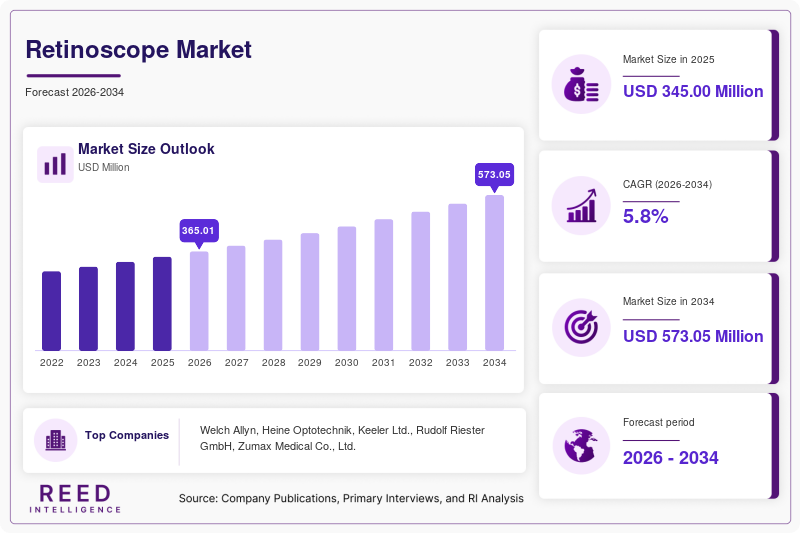
The Retinoscope Market size is witnessing steady expansion driven by the rising prevalence of vision disorders and increasing adoption of diagnostic ophthalmic devices across both developed and emerging economies. In 2025, the global retinoscope market size is estimated to reach approximately USD 345 million, with growth to around USD 362 million in 2026. Over the forecast period from 2025 to 2034, the market is projected to expand at a CAGR of 5.8%, reaching nearly USD 585 million by 2034. This growth trajectory reflects consistent demand from hospitals, ophthalmology clinics, and optometry practices.
One of the primary growth factors is the increasing incidence of refractive errors such as myopia, hyperopia, and astigmatism. With rising screen exposure and aging populations globally, the need for accurate and early diagnosis of vision problems is increasing. Retinoscopes remain essential tools in eye examinations, particularly for pediatric and non-verbal patients, where subjective feedback is limited.
Key Highlights
- Market size projected to reach USD 585 million by 2034
- CAGR of 5.8% from 2025 to 2034
- Growing prevalence of refractive errors globally
- Expansion of eye care infrastructure in emerging economies
- Technological advancements improving diagnostic accuracy
Market Trends
Integration of Advanced Optical Technologies
The retinoscope market is experiencing a shift toward advanced optical and illumination technologies that enhance diagnostic precision. Manufacturers are focusing on LED-based retinoscopes that provide consistent brightness, longer lifespan, and reduced heat generation compared to traditional halogen models. These innovations improve visibility during eye examinations, especially in low-light environments. Additionally, digital integration is becoming more prominent, allowing retinoscopes to connect with electronic medical record systems and other diagnostic tools. This trend supports workflow efficiency in clinical settings and improves data accuracy. The adoption of lightweight and ergonomic designs is also contributing to increased usage among practitioners who perform high volumes of examinations daily.
Rising Demand for Portable and Handheld Devices
Another notable trend in the retinoscope market is the growing demand for portable and handheld devices. Healthcare providers, particularly in rural and underserved areas, require compact diagnostic tools that are easy to transport and operate. Portable retinoscopes enable outreach programs and mobile eye clinics to deliver vision care services efficiently. This trend is particularly strong in developing regions where access to permanent healthcare infrastructure is limited. Manufacturers are responding by introducing battery-operated models with durable designs and user-friendly interfaces. The convenience offered by portable devices is also driving adoption among independent practitioners and small clinics.
Market Drivers
Increasing Prevalence of Vision Disorders
The rising prevalence of vision-related conditions is a major driver for the retinoscope market. Factors such as prolonged digital screen exposure, lifestyle changes, and aging populations are contributing to a higher incidence of refractive errors worldwide. Myopia, in particular, is becoming more common among children and young adults, increasing the need for early detection and management. Retinoscopes play a crucial role in diagnosing these conditions, especially in cases where patients cannot provide reliable subjective responses. The growing awareness about eye health and the importance of regular eye examinations is further supporting market growth. Governments and healthcare organizations are also promoting vision screening programs, which directly increase the demand for retinoscopes.
Expansion of Ophthalmic Healthcare Services
The expansion of ophthalmic healthcare services across both urban and rural regions is another significant growth driver. Investments in healthcare infrastructure are enabling the establishment of specialized eye care centers and clinics. These facilities require reliable diagnostic equipment, including retinoscopes, to deliver accurate assessments. In emerging economies, public health initiatives aimed at reducing preventable blindness are driving the procurement of ophthalmic devices. Additionally, the increasing number of trained optometrists and ophthalmologists is contributing to higher utilization rates of retinoscopes. The combination of infrastructure development and workforce expansion is creating a favorable environment for market growth.
Market Restraint
Availability of Alternative Diagnostic Technologies
One of the key restraints affecting the retinoscope market is the growing availability of alternative diagnostic technologies such as autorefractors and wavefront analyzers. These devices offer automated and highly precise measurements of refractive errors, reducing the reliance on manual techniques like retinoscopy. In advanced healthcare settings, practitioners often prefer automated solutions due to their speed and ease of use. This shift can limit the adoption of traditional retinoscopes, particularly in well-equipped hospitals and clinics.
However, this restraint has varying impacts across regions. In developed markets, the adoption of advanced diagnostic systems may reduce the demand for retinoscopes. In contrast, in resource-limited settings, retinoscopes remain essential due to their affordability and versatility. For example, smaller clinics and outreach programs often rely on retinoscopes as primary diagnostic tools due to budget constraints. Despite the competition from automated technologies, retinoscopes continue to hold relevance in clinical practice, especially for specific patient groups and scenarios.
Market Opportunities
Growth in Emerging Markets
Emerging markets present significant opportunities for the retinoscope market due to increasing healthcare investments and rising awareness of eye health. Countries in Asia, Africa, and Latin America are expanding their healthcare systems to address unmet medical needs, including vision care. Government initiatives aimed at reducing visual impairment are driving the establishment of eye care facilities and screening programs. Retinoscopes, being cost-effective and easy to use, are widely adopted in these initiatives. The growing middle-class population and improving access to healthcare services are further supporting market expansion. Manufacturers can capitalize on this opportunity by offering affordable and durable products tailored to the needs of these regions.
Increasing Focus on Pediatric Eye Care
The rising focus on pediatric eye care is another promising opportunity for the retinoscope market. Early detection of vision problems in children is critical for preventing long-term complications and supporting proper visual development. Retinoscopes are particularly useful in pediatric examinations as they do not rely on patient feedback. Schools and healthcare organizations are increasingly conducting vision screening programs for children, which boosts demand for retinoscopes. Additionally, advancements in device design are making retinoscopes more suitable for pediatric use, with features such as improved illumination and ease of handling. This growing emphasis on early diagnosis is expected to drive sustained demand in the coming years.
Segmental Analysis
By Type
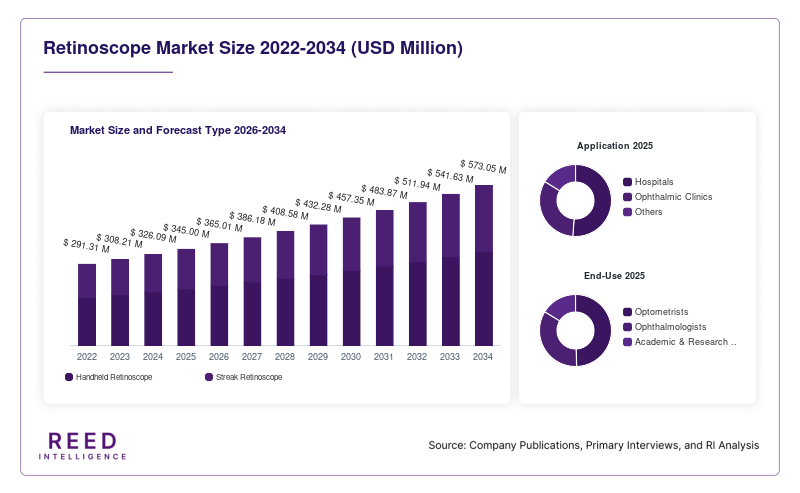
The handheld retinoscope segment dominated the market in 2024, accounting for approximately 62% of the total market share. These devices are widely used due to their portability, ease of use, and affordability. Handheld retinoscopes are particularly popular in small clinics and outreach programs where mobility is essential. Their versatility allows practitioners to conduct examinations in various settings, including remote and underserved areas. Additionally, advancements in LED technology have improved the performance of handheld devices, making them more efficient and reliable.
The streak retinoscope segment is expected to be the fastest-growing, with a projected CAGR of 6.5% during the forecast period. These devices offer enhanced accuracy and flexibility in diagnosing refractive errors, making them increasingly popular among ophthalmologists. The ability to adjust the streak orientation allows for more precise measurements, which is a key factor driving their adoption. The growing emphasis on accurate diagnosis and improved patient outcomes is supporting the growth of this segment.
By Application
The hospitals segment held the largest market share in 2024, accounting for around 48% of the total market. Hospitals are major users of retinoscopes due to the high volume of patients and the availability of comprehensive diagnostic facilities. These institutions require reliable and accurate diagnostic tools to support a wide range of ophthalmic procedures. The presence of skilled professionals and advanced infrastructure further supports the dominance of this segment.
The ophthalmic clinics segment is projected to grow at the fastest CAGR of 6.2% during the forecast period. The increasing number of specialized eye care clinics and the growing preference for outpatient services are driving this growth. Clinics offer focused and efficient care, making them a preferred choice for many patients. The rising demand for personalized healthcare services is also contributing to the expansion of this segment.
By End-Use
The optometrists segment dominated the market in 2024, holding a share of approximately 55%. Optometrists are primary providers of vision care and frequently use retinoscopes for diagnosing refractive errors. The increasing number of optometry practices and the growing awareness of eye health are supporting the growth of this segment. Retinoscopes are essential tools in routine eye examinations, making them indispensable for optometrists.
The academic and research institutes segment is expected to witness the fastest growth, with a CAGR of 6.7% over the forecast period. The increasing focus on research and training in ophthalmology is driving demand for retinoscopes in educational institutions. These devices are used for teaching purposes and for conducting studies related to vision care. The growing emphasis on skill development and professional training is supporting the expansion of this segment.
Regional Analysis
North America
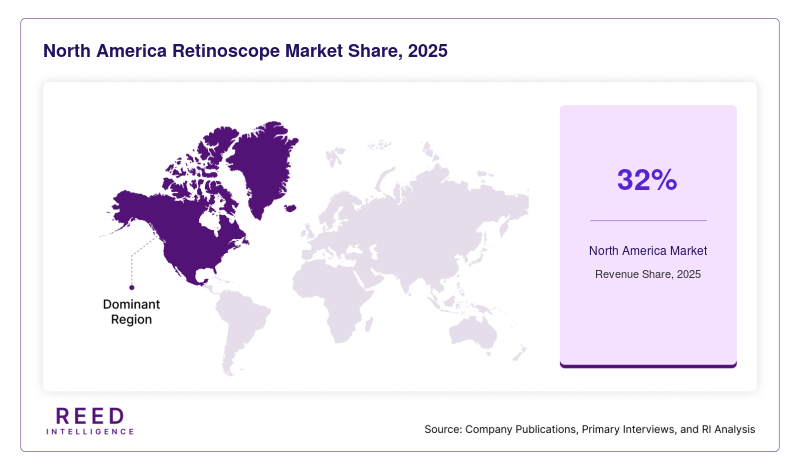
North America held a significant share of the retinoscope market in 2025, accounting for approximately 32% of the global market. The region is expected to maintain steady growth with a CAGR of 5.2% during the forecast period. The presence of advanced healthcare infrastructure and high awareness of eye health are key factors supporting market growth. Additionally, the increasing prevalence of vision disorders among both adults and children contributes to consistent demand for diagnostic devices.
The United States dominates the North American market due to its well-established healthcare system and strong adoption of advanced medical technologies. A unique growth factor in this region is the widespread implementation of routine eye examinations as part of preventive healthcare practices. This trend ensures continuous demand for retinoscopes in clinics and hospitals.
Europe
Europe accounted for around 27% of the global retinoscope market in 2025 and is projected to grow at a CAGR of 5.0% through 2034. The region benefits from strong healthcare policies and government support for vision care programs. Increasing aging populations in several European countries are contributing to higher demand for eye examinations and diagnostic devices.
Germany is a leading market within Europe due to its advanced medical infrastructure and focus on precision diagnostics. A unique growth factor in this region is the integration of retinoscopes into comprehensive ophthalmic diagnostic systems, which enhances their utility in clinical settings and supports market expansion.
Asia Pacific
Asia Pacific is the fastest-growing region in the retinoscope market, with a CAGR of 6.8% and a market share of approximately 24% in 2025. Rapid urbanization, increasing healthcare investments, and a large population base are key factors driving growth. The rising prevalence of myopia in countries such as China and India is also contributing to increased demand.
China dominates the Asia Pacific market due to its large population and expanding healthcare infrastructure. A unique growth factor in this region is the increasing number of government-led vision screening programs, particularly in schools, which significantly boosts the adoption of retinoscopes.
Middle East & Africa
The Middle East & Africa region accounted for about 9% of the global market in 2025 and is expected to grow at a CAGR of 5.6%. Improving healthcare infrastructure and increasing awareness of eye health are supporting market growth. The region is also witnessing a gradual increase in the number of specialized eye care facilities.
South Africa is a key market within this region, driven by efforts to improve access to healthcare services. A unique growth factor is the expansion of mobile eye clinics that provide diagnostic services in remote areas, increasing the demand for portable retinoscopes.
Latin America
Latin America held a market share of approximately 8% in 2025 and is projected to grow at a CAGR of 5.4% over the forecast period. The region is experiencing steady growth due to increasing healthcare investments and rising awareness of vision care. Government initiatives aimed at reducing visual impairment are also contributing to market expansion.
Brazil is the dominant country in Latin America, supported by its large healthcare system and growing focus on preventive care. A unique growth factor in this region is the increasing collaboration between public and private sectors to improve access to eye care services, which drives demand for diagnostic equipment.
Competitive Landscape
The retinoscope market is moderately competitive, with several established players focusing on product innovation and strategic collaborations to strengthen their market position. Leading companies are investing in research and development to introduce advanced retinoscopes with improved functionality and user-friendly designs. The market also features regional players that cater to specific geographic markets with cost-effective solutions.
A leading company in the market is Welch Allyn, known for its high-quality diagnostic devices. The company has recently introduced upgraded LED retinoscopes with enhanced illumination and durability. Other key players are focusing on expanding their distribution networks and entering emerging markets to capture growth opportunities. Partnerships with healthcare providers and participation in government initiatives are also common strategies adopted by market participants.
Key Players
- Welch Allyn
- Heine Optotechnik
- Keeler Ltd.
- Rudolf Riester GmbH
- Zumax Medical Co., Ltd.
- 66 Vision-Tech Co., Ltd.
- Neitz Instruments Co., Ltd.
- Halma plc
- Iridex Corporation
- NIDEK Co., Ltd.
- Topcon Corporation
- Volk Optical Inc.
- Takagi Seiko Co., Ltd.
- Reichert Technologies
- Medline Industries
Recent Developments
- In 2024, a major manufacturer launched a new LED-based retinoscope with extended battery life and improved illumination consistency.
- In 2023, a leading company expanded its distribution network in Asia Pacific to strengthen its presence in emerging markets.
- In 2023, a strategic partnership was established between a device manufacturer and a healthcare provider to support vision screening programs in rural areas.
Retinoscope Market Segments
Type
- Handheld Retinoscope
- Streak Retinoscope
Application
- Hospitals
- Ophthalmic Clinics
- Others
End-Use
- Optometrists
- Ophthalmologists
- Academic & Research Institutes
By Region
- North America
- Europe
- APAC
- Middle East and Africa
- LATAM