Returnable Glass Bottle Ink Market Size, Share, Demand Report by Ink Type (Water-Based Inks, UV-Curable Inks, Solvent-Based Inks, Bio-Based Inks), By Application (Beverage Bottle Labeling, Pharmaceutical Packaging, Industrial Containers, Logistics & Tracking Systems), By End-Use Industry (Beverage, Pharmaceutical, Food Packaging, Logistics & Industrial Packaging), By Region & Segment Forecasts, 2026–2034
USD 3950
Market Overview
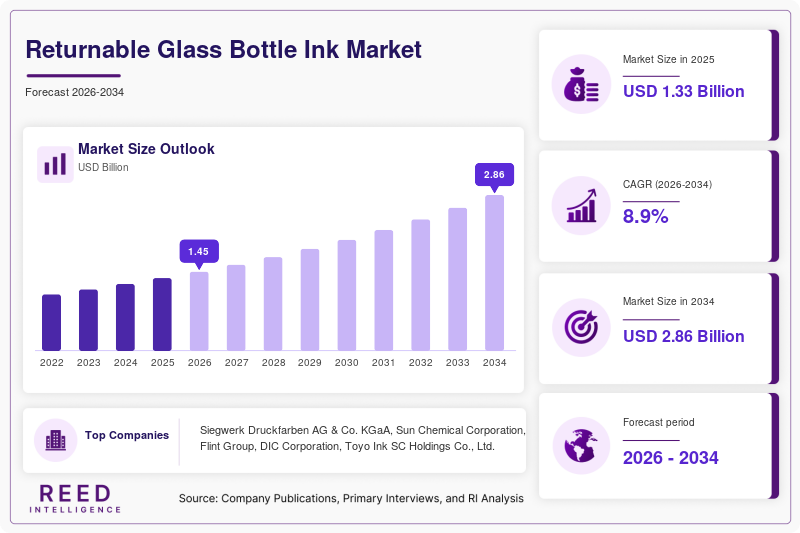
The global Returnable Glass Bottle Ink Market size is estimated at approximately USD 1.45 billion, and it is projected to reach nearly USD 2.85 billion by 2034, registering a CAGR of 8.9% during the forecast period (2026–2034). Growth is primarily supported by the global shift toward circular economy practices, where manufacturers increasingly adopt reusable packaging systems to reduce environmental impact and compliance costs. Returnable glass bottle ink plays a critical role in ensuring durable, washable, and high-contrast coding on reusable bottles used in repeated supply chain cycles.
One major global factor supporting market expansion is the strengthening of environmental regulations targeting single-use plastics and non-recyclable labeling materials. Governments across Europe and Asia Pacific are encouraging beverage producers to adopt returnable glass packaging systems, which require specialized inks capable of withstanding multiple wash cycles without fading or contamination. This regulatory push has accelerated innovation in eco-friendly ink formulations, including water-based and UV-curable variants designed specifically for returnable glass surfaces.
Key Highlights
- North America dominated the market with a 33.8% share in 2025.
- Asia Pacific is expected to grow at the fastest CAGR of 11.6% during 2026–2034.
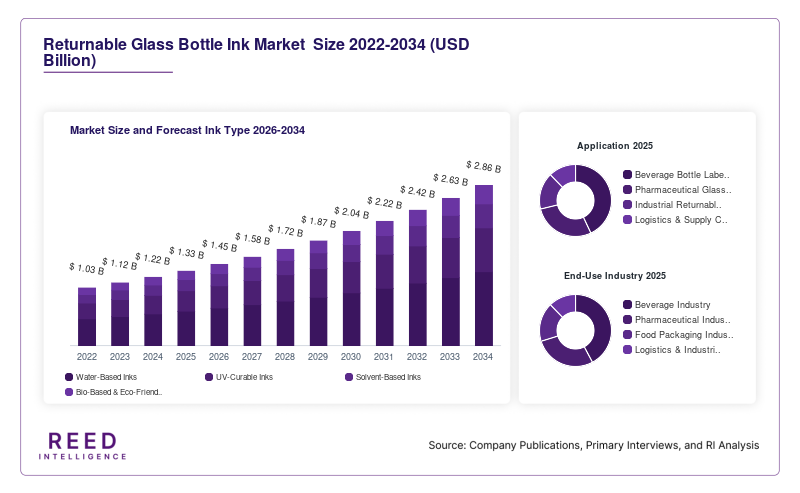
- By ink type, water-based inks accounted for the largest share of 39.2%.
- while UV-curable inks are projected to grow at a CAGR of 12.1%.
- By application, beverage bottle labeling led with a 44.5% share, whereas pharmaceutical returnable packaging is expected to expand at a CAGR of 10.8%.
- The United States remained the dominant country, with market values of USD 520 million in 2024 and USD 565 million in 2025.
Market Trends
Shift Toward Eco-Friendly and Low-VOC Ink Formulations
A significant trend shaping the Returnable Glass Bottle Ink Market is the transition toward eco-friendly and low-VOC (volatile organic compound) ink formulations. Manufacturers are increasingly developing water-based and bio-based inks that minimize environmental impact while maintaining high adhesion and durability on glass surfaces. This shift is largely driven by sustainability commitments from beverage giants and regulatory pressure in Europe and North America. These inks are designed to withstand repeated washing cycles in industrial cleaning systems without degrading, making them ideal for returnable bottle applications. Additionally, advancements in pigment dispersion technology have improved color stability and print clarity, enabling better brand visibility across multiple reuse cycles.
Integration of High-Durability UV-Curable Printing Technologies
Another key trend is the rising adoption of UV-curable ink systems in returnable glass bottle labeling. These inks offer superior resistance to abrasion, chemicals, and high-temperature washing processes commonly used in bottle return systems. UV-curable inks are gaining traction due to their fast curing times, reduced energy consumption, and compatibility with automated printing lines. Beverage manufacturers are increasingly investing in UV-based printing equipment to enhance production efficiency and reduce downtime. Furthermore, the ability of UV inks to maintain sharp print quality across multiple reuse cycles is making them a preferred choice in premium beverage packaging and pharmaceutical glass container labeling.
Market Drivers
Rising Demand for Sustainable Packaging Solutions
The increasing global emphasis on sustainability is a major driver for the Returnable Glass Bottle Ink Market. Beverage and pharmaceutical companies are actively shifting from single-use plastic packaging to reusable glass bottle systems to reduce carbon footprints and meet ESG goals. This transition has created strong demand for durable inks that can remain intact through repeated washing, sterilization, and refilling cycles. Returnable glass bottle inks are engineered to provide long-lasting adhesion while ensuring compliance with food safety regulations. The growing consumer preference for environmentally responsible packaging has further accelerated adoption, particularly in urban markets where recycling infrastructure and reuse systems are well established.
Expansion of Beverage Industry and Returnable Packaging Systems
The global expansion of the beverage industry, particularly in carbonated drinks, beer, and premium bottled water segments, is significantly driving market growth. Many manufacturers are reintroducing returnable glass bottle systems to optimize supply chain costs and improve sustainability ratings. This shift requires specialized ink solutions capable of enduring repeated handling and industrial cleaning. Emerging markets in Asia Pacific and Latin America are witnessing increased investment in bottling infrastructure, further boosting demand. Additionally, the rise of local craft beverage producers has strengthened the need for customized, high-quality labeling inks that ensure brand differentiation in competitive retail environments.
Market Restraint
High Cost and Technical Complexity of Specialized Ink Systems
A key restraint in the Returnable Glass Bottle Ink Market is the relatively high cost and technical complexity associated with advanced ink formulations. Eco-friendly and UV-curable inks require specialized raw materials and manufacturing processes, which increase production costs compared to conventional inks. Additionally, ensuring compatibility with various glass surfaces and industrial washing systems adds further complexity. Small and medium-sized beverage producers often face challenges in adopting these inks due to budget constraints. Moreover, the need for precision printing equipment and maintenance of curing systems increases overall operational expenses, limiting widespread adoption in cost-sensitive markets.
Market Opportunities
Expansion of Circular Economy and Reuse Infrastructure
The global transition toward circular economy models presents a strong growth opportunity for the Returnable Glass Bottle Ink Market. Governments and industries are investing in reuse and refill infrastructure, particularly in Europe and Asia Pacific. This shift is creating sustained demand for durable, washable inks that can maintain print integrity across multiple reuse cycles. Beverage companies are increasingly adopting standardized returnable bottle systems, which require high-performance labeling solutions. As circular packaging initiatives expand, ink manufacturers have opportunities to develop innovative formulations tailored for long-life durability and compatibility with automated reuse systems.
Technological Advancements in Smart and Functional Inks
Another major opportunity lies in the development of smart and functional inks integrated with traceability and authentication features. Innovations such as QR-code-enabled inks and temperature-sensitive pigments are gaining attention in supply chain tracking and anti-counterfeiting applications. These advanced inks enhance product traceability across returnable bottle cycles, improving inventory management and brand protection. As digital transformation accelerates in packaging industries, demand for multifunctional inks is expected to rise. This creates opportunities for manufacturers to collaborate with IoT and packaging technology firms to deliver integrated smart labeling solutions.
Segmental Analysis
Ink Type Segment
Water-based inks dominated the segment with a 39.2% share in 2024, driven by strong demand for eco-friendly and low-emission formulations in beverage packaging. These inks are widely preferred due to their compatibility with food-grade glass bottles and ability to withstand repeated industrial washing cycles without fading.
UV-curable inks are the fastest-growing subsegment, projected to expand at a CAGR of 12.1%, supported by their high durability and fast curing capabilities. Increasing adoption of automated printing systems in large-scale bottling facilities is significantly driving demand for UV-based solutions.
Application Segment
Beverage labeling led the market with a 44.5% share in 2024, as returnable glass bottles are extensively used in beer, soft drinks, and mineral water packaging. This segment benefits from high-volume production and strong brand labeling requirements.
Pharmaceutical packaging is the fastest-growing application, with a projected CAGR of 10.8%, driven by increasing use of reusable glass containers in drug storage and transport systems. Strict regulatory standards are encouraging adoption of durable ink systems.
End-Use Industry Segment
The beverage industry accounted for a 46.8% share in 2024, making it the dominant end-use segment. Its leadership is supported by widespread returnable bottle systems in both developed and emerging markets.
The logistics and industrial packaging segment is growing at a CAGR of 9.9%, driven by rising demand for durable labeling solutions in reusable transport containers and supply chain tracking systems.
Regional Analysis
North America
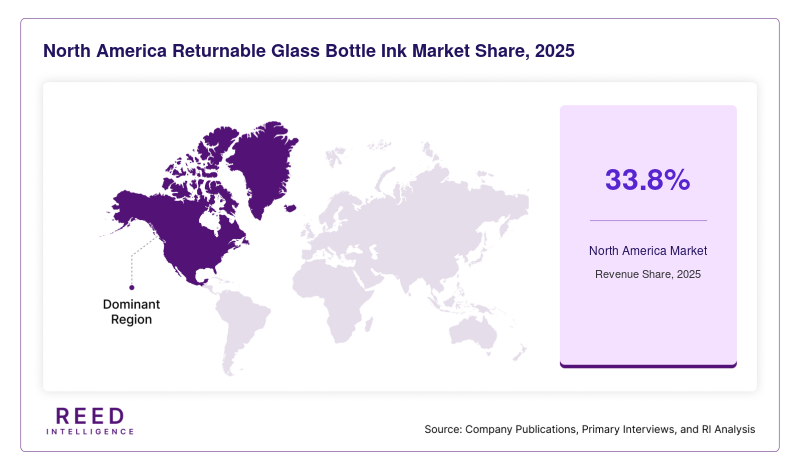
North America accounted for approximately 33.8% of the global market share in 2025, with steady growth expected at a CAGR of 8.2% during 2026–2034. The region benefits from strong adoption of sustainable packaging practices and advanced beverage manufacturing infrastructure. Regulatory initiatives promoting recyclable and reusable packaging have significantly boosted demand for returnable glass bottle inks across the United States and Canada.
The United States remains the dominant country in the region due to its large beverage production industry and early adoption of circular packaging systems. A key growth factor is the increasing investment by major beverage brands in returnable glass bottle logistics networks, which require high-performance, durable ink solutions for repeated usage cycles.
Europe
Europe held around 29.6% market share in 2025, with a projected CAGR of 9.1% through 2034. The region’s strong environmental regulations and packaging waste directives are driving widespread adoption of returnable glass bottle systems. Countries such as Germany, France, and the UK are leading in reusable beverage packaging infrastructure.
Germany dominates the European market due to its well-established deposit return systems. A major growth factor is the country’s advanced recycling ecosystem, which encourages beverage companies to invest in durable labeling inks that withstand multiple reuse and washing cycles.
Asia Pacific
Asia Pacific accounted for 24.7% market share in 2025, and is expected to grow at the fastest CAGR of 11.6% during 2026–2034. Rapid urbanization, rising beverage consumption, and expanding manufacturing bases are driving demand for returnable glass bottle systems across China, India, and Southeast Asia.
China leads the region due to its massive beverage production capacity. A key growth factor is government-led sustainability initiatives encouraging reduced plastic usage, which is accelerating adoption of reusable glass packaging and supporting ink market expansion.
Middle East & Africa
The Middle East & Africa region held a 7.2% share in 2025, with a CAGR of 7.8% projected through 2034. Growth is supported by expanding beverage import-export activities and rising hospitality sector demand. Countries such as UAE and South Africa are key contributors.
The UAE dominates due to its strong beverage distribution networks. A key growth factor is the rising adoption of premium bottled water and hospitality packaging solutions that rely on reusable glass bottles.
Latin America
Latin America accounted for 4.7% market share in 2025, with a CAGR of 8.4% during 2026–2034. Growth is driven by increasing beverage consumption and expanding returnable bottle programs in Brazil and Mexico.
Brazil leads the region due to its strong beer and soft drink industries. A key growth factor is the widespread adoption of returnable glass packaging in retail beverage distribution systems.
Competitive Landscape
The Returnable Glass Bottle Ink Market is moderately consolidated, with a strong presence of global chemical and printing ink manufacturers competing on sustainability, wash resistance, UV stability, and regulatory compliance. Market competition is shaped by continuous innovation in eco-friendly formulations, long-life adhesion technologies, and compatibility with high-speed bottling systems used in beverage and pharmaceutical industries.
Leading companies are focusing on water-based, UV-curable, and hybrid ink systems designed specifically for reusable glass bottle cycles. Strategic collaborations with beverage OEMs, glass bottle manufacturers, and packaging automation firms are also intensifying. Competitive intensity is further driven by sustainability regulations in Europe and North America, which force companies to innovate faster in low-VOC and recyclable ink solutions.
Key Players List
- Siegwerk
- Sun Chemical
- Flint Group
- DIC Corporation
- Toyo Ink SC Holdings
- Huber Group
- Sakata INX
- Altana AG
- Zeller+Gmelin
- Marabu GmbH
- Nazdar Ink Technologies
- Micro Inks Limited
- T&K Toka
- Flint Group Packaging Inks
- Tokyo Printing Ink Mfg. Co.
Recent Developments
- Siegwerk expanded its eco-friendly ink production capacity in Germany to support rising demand for sustainable packaging solutions in returnable glass systems.
- Sun Chemical introduced a new UV-curable ink series designed specifically for high-speed glass bottle printing lines with improved chemical resistance.
- Flint Group announced collaboration with beverage manufacturers in Asia Pacific to develop advanced washable ink technologies for circular packaging systems.
Returnable Glass Bottle Ink Market Segments
Ink Type
- Water-Based Inks
- UV-Curable Inks
- Solvent-Based Inks
- Bio-Based & Eco-Friendly Inks
Application
- Beverage Bottle Labeling
- Pharmaceutical Glass Packaging
- Industrial Returnable Containers
- Logistics & Supply Chain Tracking
End-Use Industry
- Beverage Industry
- Pharmaceutical Industry
- Food Packaging Industry
- Logistics & Industrial Packaging
By Region
- North America
- Europe
- APAC
- Middle East and Africa
- LATAM