Returns Management Software Market Size, Share & Trends Analysis Report By Deployment (Cloud-Based, On-Premise), By Enterprise Size (Large Enterprises, Small & Medium Enterprises), By Application (E-commerce & DTC Returns, Omnichannel & Store Returns, Reverse Logistics & 3PL Operations, Fraud & Abuse Prevention, Recommerce & Disposition Management) and By Region (North America, Europe, APAC, Middle East and Africa, LATAM) Forecasts, 2026–2034
USD 3950
Returns Management Software Market Size
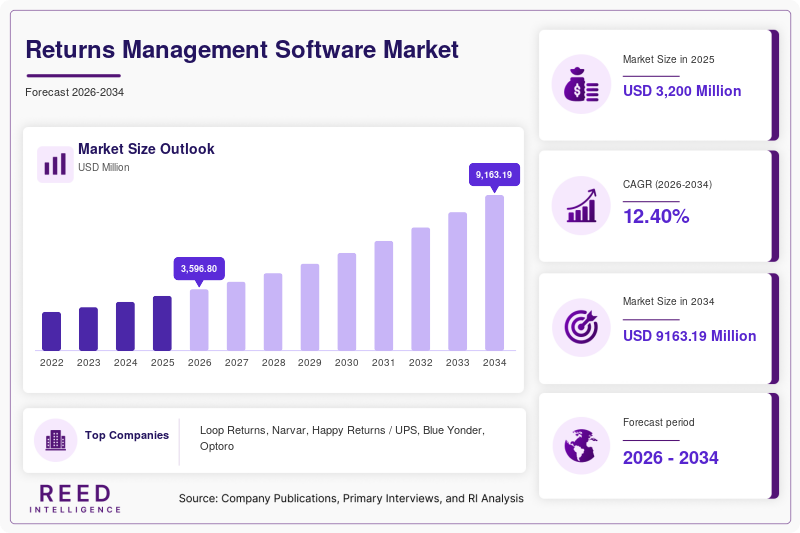
The global returns management software market is valued at USD 3,200 Million in 2025 and USD 3,600 Million in 2026. The market is projected to reach USD 9,163.19 Million by 2034, registering a 12.40% CAGR during the forecast period.
The returns management software market comprises cloud and on-premise platforms that digitize and automate product-return workflows, including return initiation, eligibility checks, authorization, label generation, exchange and refund processing, return tracking, inventory disposition, fraud controls, analytics and reverse-logistics coordination. Modern platforms increasingly connect returns with ecommerce storefronts, order-management systems, warehouse-management systems, payment systems, carriers and customer-service applications, making returns a connected post-purchase workflow rather than an isolated service function. Shopify's 2026 market guide describes returns-management software as technology that automates workflows such as approval, labeling, tracking, refunding and exchanging returned merchandise.
The economic importance of the category is being reinforced by the scale of merchandise returns. The National Retail Federation and Happy Returns estimated that U.S. retail merchandise returns would reach USD 849.9 Billion in 2025, with approximately 19.3% of online sales returned. Retailers also reported that returns-process upgrades were a priority, while 85% of retailers that track fraud prevention said they were using artificial intelligence to detect or prevent return fraud.
Returns Management Software Market Drivers
High return volumes are turning returns automation into a core retail operating requirement
The scale and frequency of ecommerce returns are creating sustained demand for software that can reduce manual handling and improve visibility. NRF estimates that U.S. online returns represented 19.3% of online sales in 2025, while total merchandise returns reached USD 849.9 Billion. Retailers also identified returns-process modernization as an important near-term operational priority.
High return volumes create pressure at multiple points: customer-service teams must answer status questions, operations teams must inspect and grade products, warehouses must update inventory, finance teams must reconcile refunds, and merchants must decide whether returned items should be restocked, exchanged, refurbished, resold or liquidated.
Returns-management platforms address these bottlenecks through automated authorization, return routing, carrier-label generation, refund rules, warehouse integration and centralized analytics. As transaction volumes grow, the economic advantage shifts from processing individual returns efficiently to automating exceptions across thousands or millions of transactions.
Customer experience expectations are linking returns technology directly to retention and revenue
Returns increasingly influence purchase decisions before the transaction occurs. NRF found that 82% of consumers consider free returns an important consideration, 76% favor return choices providing immediate refunds or exchanges, and 71% are less likely to shop with a retailer again after a poor return experience.
This changes the software-buying decision. Retailers are no longer evaluating a platform only by its ability to generate labels or issue RMAs; they are increasingly looking at the platform's ability to offer exchanges, store credit, instant refunds, convenient drop-off choices, accurate communications and personalized policies.
Narvar's current returns proposition, for example, combines exchange and store-credit mechanisms with AI-driven eligibility and fraud controls, while Loop's platform is designed to convert more returns into exchanges, store credit and subsequent purchasing activity.
AI and machine learning are moving returns software from rule automation toward predictive decision-making
AI is becoming embedded at the point where returns decisions affect margin, risk and inventory recovery. NRF reported that 85% of retailers using return-fraud controls employ AI to detect or prevent fraudulent activity.
Platform vendors are extending this use beyond fraud. Loop's 2026 releases include AI product recommendations, Fraud Tools 2.0 and return-prediction capabilities. Narvar uses its IRIS intelligence layer for fraud detection and personalized return decisions. Blue Yonder has introduced machine-learning capabilities that estimate resale potential and determine better disposition paths. Appriss Retail's Sidekick adds agentic workflow intelligence to returns and loss-prevention operations.
The commercial effect is a shift toward systems that predict the likely outcome of a return before a cost is incurred, rather than simply recording what happened after the return was initiated.
Returns Management Software Market Restraints
Integration complexity can slow returns-platform deployments
Returns-management software sits between several systems, including ecommerce platforms, order management, payment systems, warehouse management, inventory, transportation and customer-service applications. Enterprise retailers may also need integrations with multiple regional carriers, stores, marketplaces and 3PLs.
Optoro emphasizes API-first architecture and integrations with WMS, OMS, recommerce, robotics, labor-management and shipping systems, illustrating the breadth of the technical environment surrounding modern returns operations.
Integration work can therefore extend implementation schedules, increase testing requirements and make data consistency important to the success of automation. Businesses with fragmented legacy infrastructure may need additional middleware, custom interfaces or process redesign before advanced returns functionality can be fully deployed.
Retailers must balance fraud controls with legitimate customer convenience
Returns software is increasingly expected to prevent abuse without creating unnecessary friction for good customers. NRF reported that 9% of all returns were fraudulent in its 2025 returns research, while its findings also showed that consumers attach significant value to simple and immediate return experiences.
Aggressive policy enforcement can therefore create a commercial trade-off. A platform that blocks too many legitimate returns may damage customer trust, while an overly permissive platform can expose retailers to avoidable refund and inventory losses.
This is driving investment in customer-level risk scoring, conditional refund timing, selective return fees and AI-supported exception management rather than blanket restrictions.
Returns Management Software Market Opportunities
Agentic AI can transform returns from workflow automation into autonomous decision orchestration
The next generation of returns platforms is likely to combine rules, predictive models and agentic actions. Narvar's NAVI is positioned as an agentic post-purchase assistant that can help resolve delivery issues, returns, refunds and exchanges, while Appriss Retail's Sidekick can surface anomalies, create investigations, assign work items and track outcomes within returns and total-loss workflows.
Loop and Blue Yonder are also embedding intelligence into decision points such as exchange recommendations, fraud scoring, return prediction, disposition and resale-value estimation.
This creates opportunities for software vendors to move beyond dashboards toward systems capable of automatically selecting the appropriate return method, refund timing, inspection requirement, disposition channel or customer incentive based on real-time context.
Recommerce and automated disposition can increase the economic value recovered from returned merchandise
Returns are increasingly being connected to resale, refurbishment, liquidation and circular-commerce channels. NRF's 2026 Rev conference highlighted returns, recommerce and circularity as increasingly strategic components of reverse logistics.
Blue Yonder's 2026 returns enhancements include recommerce and liquidation workflows alongside machine-learning-based resale-value predictions, while ReturnPro's Shopify application combines returns processing with inspection, refurbishment and resale capabilities.
Software that can determine the most profitable destination for a returned item can therefore address not only operational cost but also recovery value, inventory velocity, waste reduction and secondary-market revenue.
Deployment Analysis
Cloud-Based deployment dominates and is accelerating with platform-centric returns orchestration
Cloud-based returns-management software accounts for the largest portion of the market because SaaS delivery enables faster deployment, centralized updates, easier integration with ecommerce platforms and scalable processing across multiple stores and geographies.
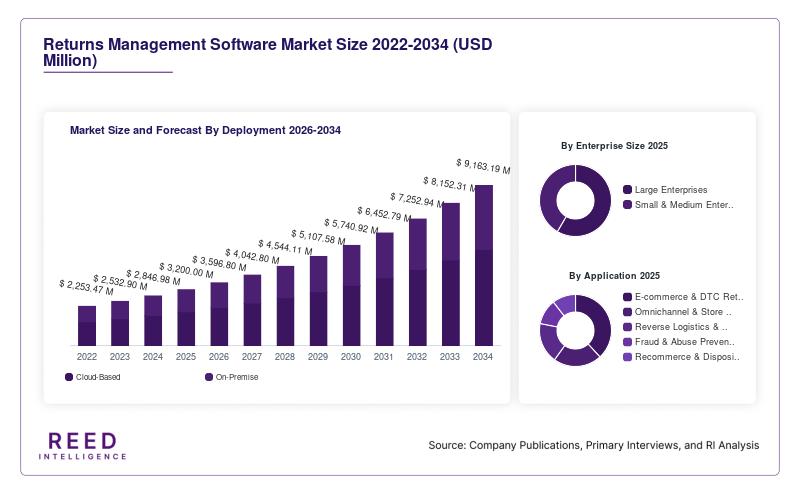
The Cloud-Based segment accounts for 79% of the global market in 2026 and is projected to register a 13.10% CAGR, making it both the dominant and fastest-growing deployment category.
The segment is benefiting from merchants' preference for API-based integrations and continuously updated functionality. Modern vendors increasingly connect returns platforms directly with ecommerce, loyalty, warehouse, carrier, payment and analytics systems rather than requiring retailers to maintain isolated returns infrastructure. Optoro's API-first approach and Loop's broad ecommerce integrations illustrate this architecture.
On-Premise deployment remains relevant for tightly controlled enterprise environments
On-premise returns software continues to serve organizations requiring greater infrastructure control, customized data environments or integration with legacy enterprise systems.
The segment is projected to register a 9.40% CAGR, supported by large retailers and organizations where internal IT architecture, governance requirements or legacy applications limit rapid migration to SaaS. however, the slower pace reflects the wider software market's movement toward cloud-based and composable architectures.
Application Analysis
E-commerce & DTC Returns remain the dominant application
E-commerce and direct-to-consumer returns represent the largest application because online transactions produce a high requirement for self-service return initiation, digital authorization, label creation, exchange handling, refund automation and return-status communications.
The E-commerce & DTC Returns segment accounts for 41% of the global market in 2026 and is projected to register a 12.30% CAGR.
High digital-return volumes and the need for branded post-purchase experiences make this application a central deployment area for Loop, Narvar, AfterShip and comparable platforms. Shopify's 2026 market guide also identifies automated returns workflows and branded self-service experiences as core capabilities of modern returns systems.
Omnichannel & Store Returns are the fastest-growing application
The growth of buy-online-return-in-store and other hybrid retail models is increasing the need to connect online return authorization with physical-store processing, inventory availability, refunds and customer accounts.
The Omnichannel & Store Returns segment accounts for 22% of the global market in 2026 and is projected to register a 14.40% CAGR, making it the fastest-growing application category.
The expansion is supported by physical return networks and POS integration. Happy Returns combines digital return authorization with box-free, label-free drop-off, while AfterShip introduced a Shopify POS extension in July 2026 allowing store staff to process online and in-store returns through the POS environment.
Regional Analysis
North America Returns Management Software Market
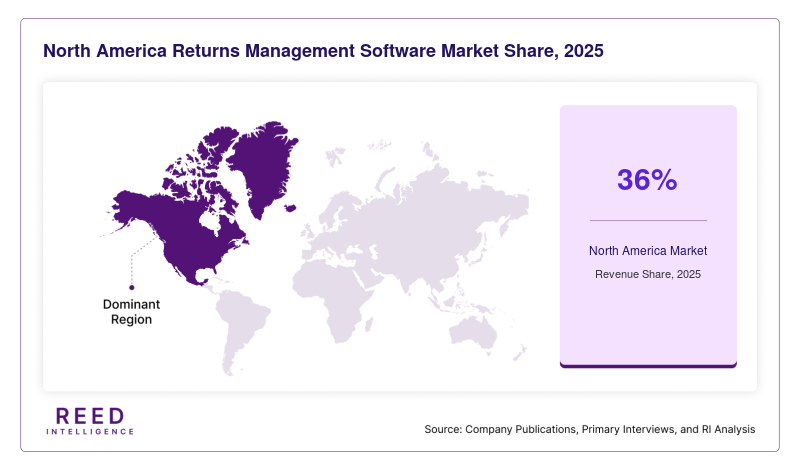
North America remains the dominant regional market because of its large ecommerce base, high returns volumes, mature retail-technology ecosystem and rapid adoption of fraud, omnichannel and reverse-logistics software.
The North America region accounts for 36% of the global market in 2026 and is projected to register an 11.90% CAGR.
The region has also become an important innovation center for returns technology. NRF's 2025 research documented the scale of U.S. returns and the rising priority of returns modernization, while UPS and Happy Returns expanded their U.S. Return Bar network to 10,000 locations in April 2026.
The U.S. market is also experiencing rapid integration between returns software, AI-driven fraud controls, retail POS and reverse logistics.
Europe Returns Management Software Market
Europe is supported by sophisticated ecommerce markets, strong cross-border retail activity and growing demand for localized carrier and returns infrastructure.
The region is projected to register a 12.10% CAGR, with demand concentrated in apparel, footwear, beauty, consumer goods and other categories where return frequency and cross-border complexity are significant.
ZigZag and Shipup's combined platform, for example, integrates delivery intelligence, customer communications and returns infrastructure across multiple European markets. A 2026 Shipup study among French consumers also reported that return convenience and post-purchase quality have material links to repurchase behavior.
The region is additionally relevant for compliance-driven digital workflows. EU Directive 2023/2673 requires an easy-to-find online withdrawal function for covered distance contracts, with member-state measures applying from June 19, 2026.
APAC Returns Management Software Market
APAC is the fastest-growing regional market as ecommerce penetration, digital payments, omnichannel retail and cross-border commerce continue expanding across China, India, Southeast Asia, Japan, South Korea and Australia.
The APAC region accounts for 27% of the global market in 2026 and is projected to register a 14.30% CAGR, making it the fastest-growing regional market.
Demand is increasingly influenced by the need for localized return methods, carrier integration, regional warehouses, multilingual portals and automated refund workflows. The expansion of ecommerce-native SaaS platforms also lowers the adoption barrier for mid-sized merchants.
Middle East and Africa Returns Management Software Market
The Middle East and Africa market is projected to register a 13.00% CAGR, supported by ecommerce growth, modernization of retail infrastructure and increasing investment in digital logistics.
The region's returns-management requirements are becoming more complex as retailers operate across multiple markets with different carrier structures, payment methods, return policies and customs processes.
Cloud-based systems are particularly suited to this environment because they can centralize policies and workflows while integrating regional carriers and logistics providers.
LATAM Returns Management Software Market
LATAM is projected to register a 13.40% CAGR, supported by expanding ecommerce, marketplace activity, digital payments and the professionalization of reverse logistics.
Retailers are increasingly seeking automated self-service return portals, localized shipping options, fraud controls and inventory recovery tools to manage operational complexity as online sales grow.
The growing presence of international returns platforms with carrier and multi-country integrations is further supporting adoption.
Competitive Landscape
The returns management software market is characterized by competition among dedicated returns platforms, post-purchase experience providers, reverse-logistics specialists, retail-loss software companies and broader supply-chain software vendors.
Loop Returns is strongly positioned around ecommerce returns, exchanges, store credit, order editing, fraud controls and post-purchase workflows. Its 2026 product roadmap adds AI product recommendations, enhanced fraud scoring, return prediction, loyalty integrations and additional logistics integrations. Loop states that its platform supports more than 5,000 ecommerce brands.
Narvar competes through an end-to-end post-purchase platform combining tracking, communications, returns, exchanges and fraud prevention. Its IRIS intelligence layer is used across its returns offering, while NAVI extends the platform toward agentic post-purchase automation.
Key Market Players
- Loop Returns
- Narvar
- Happy Returns / UPS
- Blue Yonder
- Optoro
- ZigZag Global
- AfterShip
- ReturnLogic
- ReturnGO
- ReturnPro
- ClickPost
- Appriss Retail
- parcelLab
- ReBOUND Returns
- Claimlane
Recent Developments
June 2026 – ClickPost launched Returns Protection, an AI-priced return-fee program for U.S. merchants. The offering dynamically prices a shopper-facing return-protection fee using factors such as SKU risk, geographic return patterns and historical claims data, connecting return-risk analysis with margin management.
May 2026 – Appriss Retail launched Sidekick, an agentic AI layer for returns and total retail loss. Sidekick is designed to identify anomalies and trends, open investigations, assign work and track outcomes within returns, shrink and incident-management workflows.
Returns Management Software Market Segments
By Deployment
- Cloud-Based
- On-Premise
By Enterprise Size
- Large Enterprises
- Small & Medium Enterprises
By Application
- E-commerce & DTC Returns
- Omnichannel & Store Returns
- Reverse Logistics & 3PL Operations
- Fraud & Abuse Prevention
- Recommerce & Disposition Management
By Region
- North America
- Europe
- APAC
- Middle East and Africa
- LATAM