Revenue Based Financing Market Size, Share & Demand Report By Provider Type (Fintech Platforms, Banks, Institutional Investors, Venture Debt Firms), By Enterprise Size (Startups, Small and Medium Enterprises, Large Enterprises), By End-Use Industry (Technology, Healthcare, Retail and E-commerce, Media and Entertainment, Consumer Services, Others), By Region & Segment Forecasts, 2026–2034
USD 3950
Market Overview
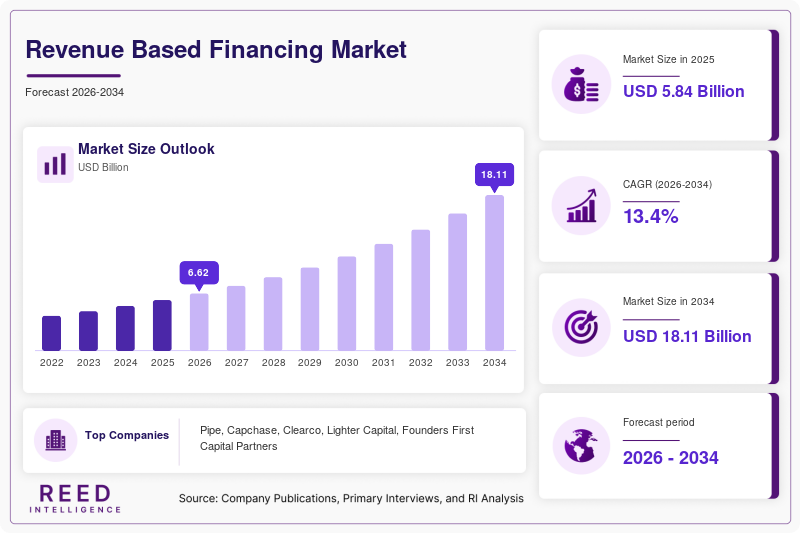
The global Revenue Based Financing Market size was valued at USD 5.84 billion in 2026 and is projected to reach USD 15.92 billion by 2034, expanding at a CAGR of 13.4% during the forecast period from 2026 to 2034. Revenue-based financing has emerged as a flexible capital solution for startups, digital-first enterprises, subscription businesses, and small-to-medium enterprises seeking non-dilutive funding options. Unlike conventional lending models, revenue-based financing allows businesses to repay investors through a fixed percentage of future monthly revenues, making it attractive for firms with recurring income streams and limited collateral assets.
The market continues to gain momentum as financial technology platforms expand access to alternative funding products across emerging and developed economies. The growing adoption of SaaS business models, digital commerce platforms, and recurring subscription ecosystems has created favorable conditions for revenue-based financing providers. Businesses increasingly prefer financing structures that avoid equity dilution while maintaining operational control. Investors are also attracted to this financing approach due to predictable repayment mechanisms and scalable portfolio diversification opportunities.
Key Highlights
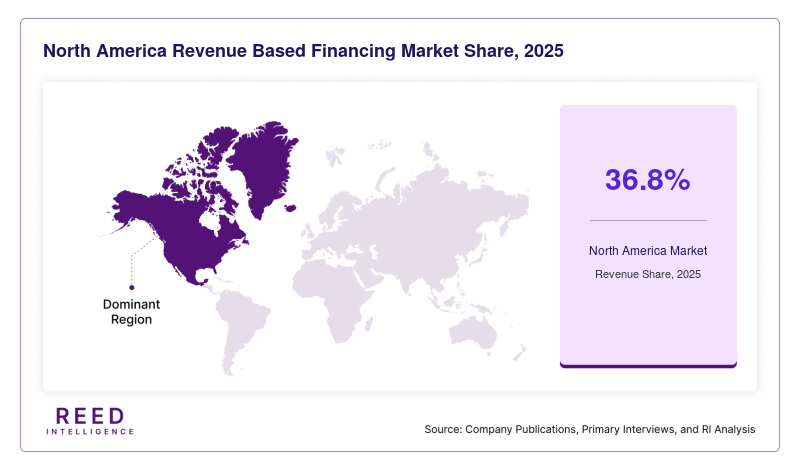
- North America dominated the market with a 36.8% share in 2025.
- Asia Pacific is expected to grow at the fastest CAGR of 15.1% during 2026–2034.
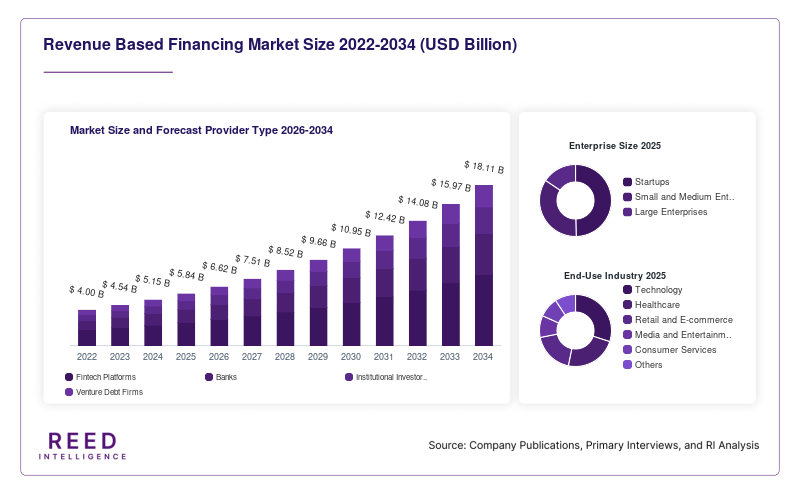
- By provider type, fintech platforms accounted for the largest share of 48.6%, while institutional investors are projected to grow at a CAGR of 14.8%.
- By enterprise size, small and medium enterprises led with a 57.9% share, whereas startups are expected to expand at a CAGR of 15.4%.
- The United States remained the dominant country, with market values of USD 1.82 billion in 2024 and USD 2.05 billion in 2025.
Market Trends
Expansion of AI-Driven Underwriting Platforms
Artificial intelligence and predictive analytics are reshaping operational processes within the Revenue Based Financing Market. Financing providers are increasingly deploying machine learning algorithms to assess borrower performance, evaluate recurring revenue quality, and predict future cash flows. These technologies enable lenders to process large volumes of transactional and operational data in real time, significantly reducing manual underwriting limitations. Automated assessment systems are helping providers approve financing requests within shorter timelines while maintaining portfolio quality and minimizing default risks.
The increasing integration of open banking systems and cloud accounting software has also improved data accessibility for revenue-based financing firms. Platforms can now connect directly with payment gateways, ERP tools, subscription billing software, and e-commerce systems to obtain accurate business performance insights. This trend is improving funding efficiency for digital businesses and strengthening investor confidence. As competition intensifies among fintech providers, AI-enabled personalization and dynamic repayment structures are expected to become standard features across the market.
Rising Demand from Subscription-Based Businesses
The growing adoption of subscription-based business models across software, media, healthcare, and e-commerce industries is creating significant opportunities for the Revenue Based Financing Market. Businesses with recurring monthly revenues are increasingly selecting revenue-based financing because repayment structures align closely with their cash flow cycles. This financing approach allows companies to avoid equity dilution while obtaining growth capital for customer acquisition, marketing expansion, and operational scaling.
SaaS startups and digital commerce companies are among the most active users of revenue-based financing products due to predictable revenue streams and scalable customer retention models. Investors also favor subscription-driven businesses because they provide transparent performance metrics such as churn rates, monthly recurring revenue, and customer lifetime value. As subscription economies continue to expand globally, financing providers are developing specialized funding products tailored for recurring revenue enterprises, strengthening market penetration across technology-driven sectors.
Market Drivers
Growing Preference for Non-Dilutive Capital Solutions
Businesses across multiple industries are increasingly seeking financing models that preserve ownership structures and minimize equity dilution. This shift is significantly driving the Revenue Based Financing Market, particularly among startup founders and growth-stage enterprises. Traditional venture capital funding often requires founders to surrender significant ownership stakes and strategic control. Revenue-based financing provides an alternative mechanism that enables companies to secure growth capital while retaining operational independence.
The demand for non-dilutive financing is particularly strong among SaaS providers, e-commerce firms, and digital service companies with consistent revenue generation capabilities. These businesses frequently require working capital to scale operations, expand marketing campaigns, and invest in product development. Revenue-based financing aligns repayment obligations with business performance, offering flexibility during slower revenue periods. This structure has improved adoption rates among SMEs that lack access to conventional banking credit but maintain healthy recurring income streams.
Expansion of Fintech Ecosystems and Digital Lending Infrastructure
The rapid growth of fintech ecosystems worldwide has substantially accelerated the adoption of revenue-based financing products. Digital lending platforms are simplifying funding accessibility through automated onboarding systems, cloud-based analytics, and API-driven financial integrations. These innovations are helping financing providers reduce administrative costs, enhance borrower evaluation accuracy, and improve customer acquisition efficiency.
In several economies, regulatory authorities are supporting fintech innovation through sandbox programs and digital banking reforms. These developments are encouraging institutional investors and venture debt firms to participate in alternative financing ecosystems. Furthermore, embedded finance solutions are allowing revenue-based financing products to integrate directly into e-commerce platforms, accounting software, and payment gateways. This seamless accessibility is increasing awareness among SMEs and expanding the addressable market for financing providers across global regions.
Market Restraint
Limited Awareness and Repayment Complexity Across Traditional SMEs
Despite strong market expansion, limited awareness regarding alternative financing structures remains a major restraint for the Revenue Based Financing Market. Many traditional SMEs continue to rely on conventional banking loans due to familiarity with fixed repayment structures and lower perceived financing complexity. Revenue-based financing agreements often involve variable repayment percentages linked to monthly revenues, which some businesses find difficult to forecast and manage over longer repayment cycles.
Additionally, financing costs associated with revenue-based funding may exceed traditional bank lending rates in certain cases, particularly for businesses experiencing rapid revenue growth. Some SMEs also face difficulties understanding revenue-sharing agreements, performance covenants, and repayment caps. This lack of financial literacy can delay adoption among enterprises operating outside technology-driven sectors. For example, manufacturing and retail firms with inconsistent seasonal revenues may hesitate to adopt variable repayment financing structures due to concerns about operational cash flow volatility. These challenges continue to limit penetration rates in several developing economies where awareness of fintech lending remains relatively low.
Market Opportunities
Increasing Penetration in Emerging Economies
Emerging economies present substantial growth opportunities for the Revenue Based Financing Market due to rising entrepreneurial activity and limited access to conventional credit systems. Small businesses in regions such as Southeast Asia, Latin America, and Africa often face challenges securing funding through traditional banks because of collateral limitations and insufficient credit histories. Revenue-based financing offers a flexible alternative that evaluates real-time business performance instead of relying heavily on fixed assets.
The expansion of digital payments, online marketplaces, and cloud accounting adoption in emerging markets is creating favorable conditions for alternative financing providers. Fintech companies are increasingly entering underserved regions through mobile-first lending platforms and embedded financial services. As internet penetration and digital commerce continue to rise, financing providers are expected to develop localized funding products designed for regional SMEs. This opportunity is likely to support broader market diversification and long-term revenue expansion across developing economies.
Growth Potential in Healthcare and Creator Economy Sectors
The healthcare sector and creator economy are becoming attractive end-user categories within the Revenue Based Financing Market. Healthcare startups, telemedicine providers, wellness subscription platforms, and digital health companies often require flexible financing to support technology investments and customer acquisition. Revenue-based financing enables these firms to access capital without sacrificing ownership or intellectual property rights.
Similarly, the creator economy is generating new financing demand among content creators, digital media businesses, and online education platforms. These businesses frequently generate recurring income through subscriptions, sponsorships, and advertising revenue. Financing providers are introducing specialized funding products tailored for influencers, digital educators, and content-driven enterprises with measurable monthly revenues. As monetization models continue to diversify across digital platforms, revenue-based financing is expected to become a preferred funding mechanism for emerging creative and technology-enabled industries.
Segmental Analysis
By Provider Type
Fintech platforms accounted for the dominant share of the Revenue Based Financing Market in 2024, representing approximately 48.6% of total revenue. These platforms have gained significant traction due to their ability to provide rapid funding approvals, automated underwriting, and digital-first customer experiences. Fintech lenders leverage AI-driven analytics, cloud integrations, and open banking systems to assess business performance efficiently. Their operational flexibility allows them to serve startups, subscription-based businesses, and SMEs that often face limitations in accessing traditional bank loans. The growing demand for embedded finance and digital lending services is further strengthening the position of fintech providers within the market. Additionally, partnerships with payment processors and accounting software providers are enabling fintech platforms to streamline borrower onboarding and repayment monitoring processes.
Institutional investors are projected to register the fastest CAGR of 14.8% during the forecast period. Pension funds, private credit firms, venture debt companies, and asset managers are increasingly allocating capital toward revenue-based financing portfolios due to attractive risk-adjusted returns. Institutional investors are focusing on recurring revenue businesses that demonstrate predictable cash flow generation and scalable growth potential. Technological advancements in portfolio analytics and risk management tools are also supporting institutional participation in alternative lending ecosystems. As the market matures, institutional capital is expected to improve funding availability and support larger transaction volumes. Furthermore, collaboration between fintech platforms and institutional investors is creating hybrid financing structures that enhance market liquidity and operational scalability across global regions.
By Enterprise Size
Small and medium enterprises held the leading share of the Revenue Based Financing Market in 2024, accounting for nearly 57.9% of overall revenue. SMEs continue to represent the primary customer base for revenue-based financing providers because many small businesses struggle to secure conventional loans due to limited collateral and insufficient credit history. Revenue-based financing offers SMEs flexible repayment mechanisms that align with business performance, reducing financial strain during periods of lower revenue generation. The increasing digitization of SMEs across retail, technology, healthcare, and service industries has further accelerated adoption rates. Many small businesses prefer this financing model because it allows founders to maintain ownership control while accessing growth capital for marketing, inventory expansion, and operational scaling initiatives.
Startups are expected to witness the fastest CAGR of 15.4% during the forecast period. Early-stage companies frequently require rapid access to capital to support product development, customer acquisition, and market expansion activities. Revenue-based financing has become particularly attractive for startups operating subscription-based or recurring revenue business models because repayment obligations fluctuate with monthly income levels. The rise of digital entrepreneurship and creator economy platforms is further increasing demand among startup enterprises globally. Financing providers are also developing specialized products tailored for emerging businesses with shorter operating histories but strong revenue growth potential. Improved access to alternative lending platforms and venture debt ecosystems is expected to accelerate adoption rates among startups over the coming years.
By End-Use Industry
The technology sector dominated the Revenue Based Financing Market in 2024, capturing approximately 42.3% of total market share. Technology companies, particularly SaaS providers, digital platforms, and cloud service businesses, represent ideal candidates for revenue-based financing due to predictable recurring revenue structures. These businesses often prioritize rapid growth and customer acquisition while seeking alternatives to equity financing. Revenue-based financing enables technology firms to scale operations without reducing founder ownership stakes. The increasing adoption of subscription pricing models and digital services across global markets continues to strengthen demand from this segment. Additionally, financing providers are increasingly offering industry-specific funding solutions tailored for software companies, cybersecurity firms, and cloud infrastructure providers with measurable monthly recurring revenues.
Healthcare and digital wellness industries are projected to expand at the fastest CAGR of 14.6% through 2034. Healthcare startups and telemedicine providers are increasingly utilizing revenue-based financing to fund technology integration, regulatory compliance, and customer acquisition initiatives. The expansion of digital healthcare ecosystems and subscription-driven wellness services is supporting strong financing demand within the segment. Revenue-based financing is particularly attractive for healthcare technology firms because it provides operational flexibility during scaling phases while avoiding ownership dilution. In addition, rising investments in healthtech innovation and remote healthcare platforms are creating new funding opportunities for financing providers. The growing integration of AI-based diagnostics, virtual care systems, and digital therapeutics is expected to further strengthen segment growth during the forecast period.
Regional Analysis
North America
North America accounted for the largest share of the Revenue Based Financing Market in 2025, representing approximately 36.8% of global revenue. The region is projected to maintain stable expansion at a CAGR of 12.4% during the forecast period. Strong fintech infrastructure, widespread SaaS adoption, and high venture capital activity continue to support regional market growth. The presence of established revenue-based financing providers and increasing demand for non-dilutive funding among startups are strengthening adoption rates across the United States and Canada.
The United States remains the dominant country within the regional market due to its mature startup ecosystem and advanced digital lending infrastructure. High penetration of subscription-based businesses and cloud-native enterprises continues to drive financing demand. Additionally, the rapid expansion of embedded finance platforms and AI-based underwriting systems is improving funding efficiency for SMEs. Strong institutional investor participation and favorable fintech regulations are further contributing to sustained market development in the country.
Europe
Europe represented a significant share of the Revenue Based Financing Market in 2025 and is expected to witness a CAGR of 11.8% through 2034. The region is benefiting from increasing fintech innovation, digital banking reforms, and rising adoption of alternative lending models among SMEs. Businesses across technology, e-commerce, and renewable energy sectors are increasingly utilizing revenue-based financing to support operational expansion while avoiding ownership dilution.
The United Kingdom dominates the European market due to its well-developed fintech ecosystem and strong investor participation. London remains a major hub for alternative financing companies and digital banking platforms. One key regional growth factor is the increasing adoption of open banking regulations, which improve access to real-time financial data for lenders. These regulatory initiatives are enabling financing providers to strengthen risk analysis capabilities and deliver faster approvals for growing enterprises.
Asia Pacific
Asia Pacific is anticipated to record the fastest CAGR of 15.1% during the forecast period in the Revenue Based Financing Market. Rapid digitalization, increasing startup activity, and expanding e-commerce ecosystems are driving strong financing demand across the region. Countries such as India, China, Singapore, and Indonesia are witnessing substantial growth in fintech investments and alternative lending adoption among SMEs.
China remains the dominant country within Asia Pacific due to its large digital commerce sector and expanding fintech infrastructure. The widespread use of digital payments and cloud accounting systems has improved accessibility for revenue-based financing providers. Additionally, government support for technology startups and innovation-focused enterprises is encouraging funding activity. The increasing number of subscription-driven businesses and creator economy platforms is also contributing to sustained market expansion throughout the region.
Middle East & Africa
The Middle East & Africa region is gradually emerging as a promising market for revenue-based financing solutions, supported by expanding entrepreneurial ecosystems and digital transformation initiatives. The market recorded moderate growth in 2025 and is projected to expand at a CAGR of 10.7% during the forecast period. Increasing fintech investments and rising adoption of alternative funding models among SMEs are supporting regional demand.
The United Arab Emirates leads the regional market due to its growing startup ecosystem and supportive fintech regulations. Dubai and Abu Dhabi have become important centers for digital banking innovation and venture funding activities. One notable growth factor is the increasing government focus on economic diversification strategies beyond oil-based industries. This shift is encouraging investments in technology startups, e-commerce platforms, and digital healthcare companies that actively seek flexible financing solutions.
Latin America
Latin America continues to witness rising adoption of alternative lending products, creating favorable conditions for the Revenue Based Financing Market. The region accounted for a developing yet expanding market share in 2025 and is forecast to grow at a CAGR of 12.1% through 2034. Increasing mobile banking penetration and growth in digital commerce are helping financing providers access underserved SME segments across regional economies.
Brazil dominates the Latin American market due to its large entrepreneurial base and expanding fintech ecosystem. The country has experienced rapid growth in online retail, digital payments, and subscription-based business models. A key growth factor is the increasing collaboration between fintech lenders and e-commerce marketplaces, enabling embedded financing access for small businesses. These partnerships are improving capital accessibility for SMEs while supporting broader adoption of revenue-based financing solutions throughout the region.
Competitive Landscape
The Revenue Based Financing Market is moderately fragmented, with fintech platforms, venture debt providers, and institutional investors competing to expand market presence through technology innovation and strategic partnerships. Leading companies are focusing on AI-driven underwriting systems, embedded finance integration, and sector-specific funding products to strengthen competitive positioning. Several providers are also expanding internationally to access underserved SME markets and diversify portfolio exposure.
Among key participants, Pipe remains one of the leading companies due to its strong subscription financing infrastructure and recurring revenue monetization capabilities. The company recently expanded its AI-powered risk assessment platform to improve funding speed and portfolio monitoring efficiency. Capchase, Clearco, Lighter Capital, and Founders First Capital Partners are also strengthening their market positions through partnerships with SaaS platforms and e-commerce ecosystems. Competitive intensity is expected to increase as traditional financial institutions enter the alternative lending space and institutional investors expand participation in revenue-based financing portfolios.
Key Players
- Pipe
- Capchase
- Clearco
- Lighter Capital
- Founders First Capital Partners
- Uncapped
- Effortless Capital
- GetVantage
- Outfund
- Velocity Capital Group
- Nexxus Capital
- Boost Capital Group
- Efficient Capital Labs
- Bigfoot Capital
- Decathlon Capital Partners
Recent Developments
- In March 2026, Capchase launched an AI-powered analytics dashboard designed to improve recurring revenue forecasting for SaaS borrowers.
- In January 2026, Pipe expanded its embedded financing partnership network with multiple subscription billing software providers across North America.
- In September 2025, Clearco introduced flexible repayment structures tailored for creator economy businesses and digital media startups.
- In July 2025, GetVantage expanded operations in Southeast Asia to support alternative financing demand among e-commerce SMEs.
Revenue Based Financing Market Segments
Provider Type
- Fintech Platforms
- Banks
- Institutional Investors
- Venture Debt Firms
Enterprise Size
- Startups
- Small and Medium Enterprises
- Large Enterprises
End-Use Industry
- Technology
- Healthcare
- Retail and E-commerce
- Media and Entertainment
- Consumer Services
- Others
By Region
- North America
- Europe
- APAC
- Middle East and Africa
- LATAM