Reverse Transcriptase Enzyme Market Size, Share & Trends Analysis Report By Type, By Application, By End User and By Region, Forecasts 2026–2034
USD 3950
Reverse Transcriptase Enzyme Market Size
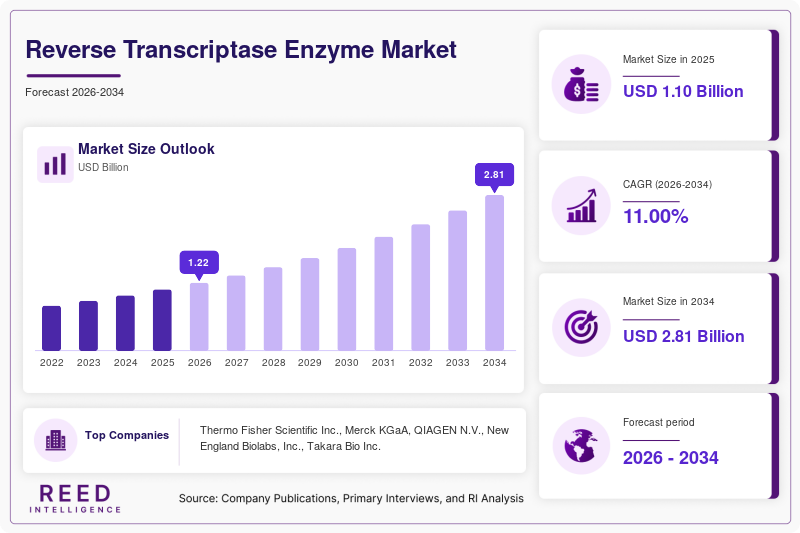
The global reverse transcriptase enzyme market was valued at USD 1.10 billion in 2025 and is projected to grow from USD 1.21 billion in 2026 to USD 2.91 billion by 2034, registering a CAGR of 11.00% during the forecast period from 2026 to 2034.
Reverse transcriptase enzymes are specialized enzymes that synthesize complementary DNA (cDNA) from RNA templates. They are essential components of molecular biology workflows involving reverse transcription, gene-expression analysis, RNA sequencing, molecular diagnostics, cloning and research involving RNA viruses.
The market is supported by increasing adoption of molecular biology techniques, growth in genomics and transcriptomics research, expanding molecular diagnostics and increasing demand for research enzymes in pharmaceutical and biotechnology applications.
Reverse Transcriptase Enzyme Market Drivers
Growth in Molecular Diagnostics
Reverse transcriptase enzymes are widely used in RNA-based molecular diagnostic workflows.
Increasing testing for RNA viruses and other RNA targets is supporting demand for reverse-transcription reagents and enzyme formulations.
Expansion of Genomics and Transcriptomics
Growth in RNA sequencing, transcriptome analysis and gene-expression research is increasing the use of reverse transcriptase enzymes.
Academic, pharmaceutical and biotechnology laboratories use these enzymes to convert RNA into cDNA for downstream analysis.
Increasing Biotechnology Research
Expansion of biotechnology research is generating demand for enzymes used in molecular cloning, recombinant DNA workflows and nucleic-acid analysis.
Growth of RNA-Based Research
RNA biology has become increasingly important across drug discovery, gene regulation, infectious disease research and therapeutic development.
This is expanding the potential applications for reverse transcriptase technologies.
Increasing Demand for High-Performance Enzymes
Researchers increasingly require enzymes capable of operating at higher temperatures, tolerating inhibitors and generating longer or more accurate cDNA products.
Product improvements are therefore supporting premium enzyme demand.
Reverse Transcriptase Enzyme Market Restraints
High Cost of Advanced Enzymes
Specialized reverse transcriptase formulations with enhanced thermostability, fidelity and processivity can command higher prices.
This can affect adoption among laboratories operating under constrained research budgets.
Availability of Alternative Technologies
Different nucleic-acid amplification and analysis approaches can reduce dependence on conventional reverse-transcription workflows in selected applications.
Complex Storage Requirements
Many enzyme products require controlled storage and handling conditions to preserve activity.
Cold-chain requirements can increase distribution complexity and costs.
Research Budget Constraints
Academic and smaller biotechnology laboratories can be sensitive to the cost of molecular biology reagents.
Changes in research funding can therefore influence demand.
Reverse Transcriptase Enzyme Market Opportunities
Expansion of RNA-Based Diagnostics
Increasing use of RNA-based molecular diagnostics creates opportunities for reverse transcriptase manufacturers to supply optimized enzyme formulations for diagnostic workflows.
Growth of RNA Sequencing
RNA sequencing and transcriptomic analysis require reliable conversion of RNA into sequencing-compatible cDNA.
Increasing sequencing activity is therefore creating opportunities for specialized reverse transcriptases.
Development of Thermostable Enzymes
Thermostable reverse transcriptases can improve reaction performance and facilitate workflows involving structured RNA templates.
Development of enzymes with enhanced thermal stability represents an important product-development opportunity.
Point-of-Care Molecular Testing
The expansion of rapid molecular diagnostics is creating demand for compact, robust and highly efficient enzyme systems suitable for decentralized testing.
Growth of Biotechnology and Biopharmaceutical Research
Increasing investment in biotechnology and RNA-related therapeutic research is expanding the customer base for specialized molecular biology enzymes.
Type Segment Analysis
By Type
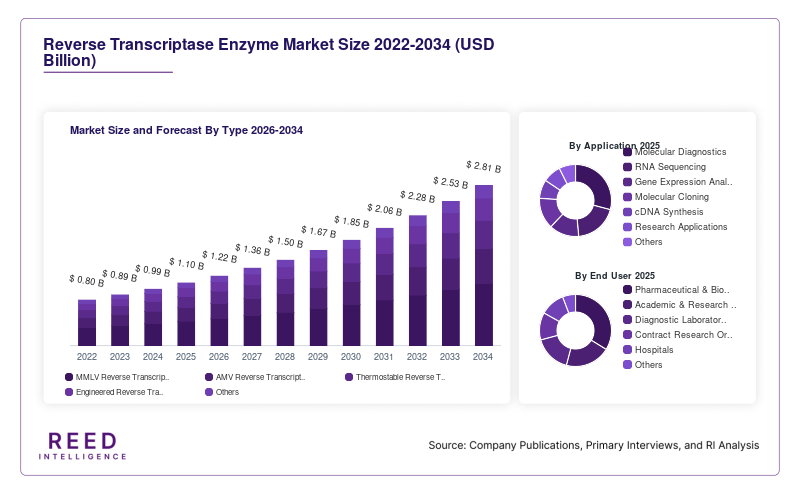
MMLV reverse transcriptase accounted for approximately 36% of the reverse transcriptase enzyme market in 2025, making it the largest type segment. Its established use in cDNA synthesis, cloning and gene-expression workflows supports widespread adoption.
Thermostable reverse transcriptase accounted for approximately 21% and is projected to grow at approximately 13.4% CAGR, making it the fastest-growing major type segment. Demand is supported by applications requiring higher reaction temperatures and improved performance with structured RNA templates.
AMV reverse transcriptase represented approximately 19%, engineered reverse transcriptase 17%, and other enzyme types approximately 7%.
Application Segment Analysis
By Application
cDNA synthesis accounted for approximately 28% of the market in 2025, making it the largest application segment. Reverse transcription is a fundamental step in converting RNA into DNA for downstream molecular analysis.
RNA sequencing accounted for approximately 22% and is projected to grow at approximately 14.0% CAGR, making it the fastest-growing major application segment. Increasing transcriptomics research and sequencing activity are supporting demand.
Gene-expression analysis represented approximately 20%, molecular diagnostics 17%, molecular cloning 8%, research applications 3%, and other applications approximately 2%.
End-User Segment Analysis
By End User
Pharmaceutical and biotechnology companies accounted for approximately 35% of the market in 2025, making them the largest end-user segment. These organizations use reverse transcriptase enzymes in drug discovery, RNA research, molecular assay development and biotechnology workflows.
Diagnostic laboratories accounted for approximately 18% and are projected to grow at approximately 12.7% CAGR, making them the fastest-growing major end-user segment. Increasing molecular diagnostic testing and RNA-based assay development are supporting growth.
Academic and research institutes represented approximately 29%, contract research organizations 9%, hospitals 6%, and other end users approximately 3%.
Reverse Transcriptase Enzyme Market Regional Analysis
North America Holds the Largest Share
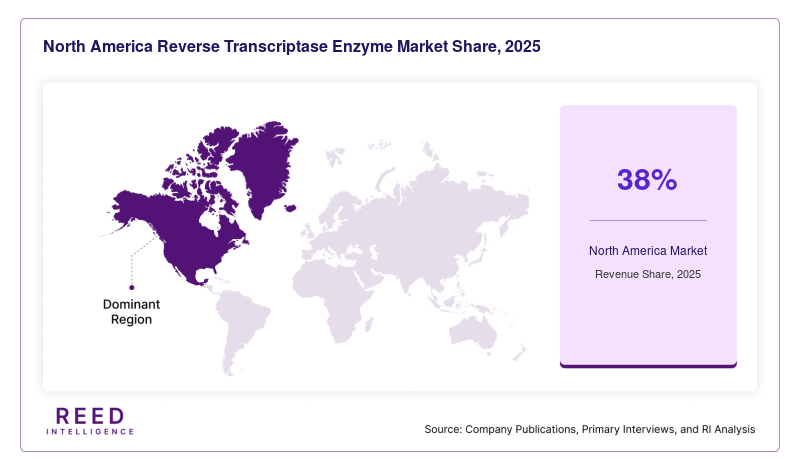
North America accounted for approximately 38% of the global reverse transcriptase enzyme market in 2025, making it the largest regional market. The region benefits from strong biotechnology and pharmaceutical industries, extensive molecular biology research and established molecular diagnostics infrastructure.
Asia-Pacific accounted for approximately 28% and is projected to grow at approximately 13.2% CAGR, making it the fastest-growing major region. Expansion of biotechnology research, diagnostics, pharmaceutical manufacturing and genomics infrastructure is supporting regional demand.
Europe Maintains Strong Research Demand
Europe accounted for approximately 25% of the market in 2025 and is projected to grow at approximately 9.5% CAGR.
The region's established life-sciences sector, academic research infrastructure and increasing adoption of molecular diagnostic technologies support demand.
Latin America Shows Emerging Demand
Latin America accounted for approximately 5% of the market in 2025 and is projected to grow at approximately 9.0% CAGR.
Increasing molecular diagnostics and biotechnology research are creating additional opportunities.
Middle East & Africa Represents an Emerging Market
Middle East & Africa accounted for approximately 4% of the market in 2025 and is projected to grow at approximately 8.7% CAGR.
Investment in healthcare laboratories, diagnostics and research infrastructure is supporting gradual market expansion.
Reverse Transcriptase Enzyme Market Competitive Landscape
Competition in the reverse transcriptase enzyme market is based on enzyme performance, thermostability, fidelity, processivity, inhibitor tolerance, reaction speed, product consistency, technical support and pricing.
Companies are focusing on enzyme engineering and formulation improvements to address increasingly demanding molecular biology and diagnostic applications.
Key Market Players
- Thermo Fisher Scientific Inc.
- Merck KGaA
- QIAGEN N.V.
- New England Biolabs, Inc.
- Takara Bio Inc.
- Promega Corporation
- Agilent Technologies, Inc.
- Bio-Rad Laboratories, Inc.
- Jena Bioscience GmbH
- Bioneer Corporation
Reverse Transcriptase Enzyme Market Recent Developments
- Researchers are increasingly adopting reverse transcriptases capable of operating at elevated temperatures. Higher operating temperatures can improve cDNA synthesis from structured RNA templates and support demanding molecular workflows.
- Increasing adoption of transcriptomics and RNA sequencing is creating additional demand for reverse transcription enzymes. Improved library-preparation workflows are supporting the development of specialized enzyme formulations.
Reverse Transcriptase Enzyme Market Segments
By Type
- MMLV Reverse Transcriptase
- AMV Reverse Transcriptase
- Thermostable Reverse Transcriptase
- Engineered Reverse Transcriptase
- Others
By Application
- Molecular Diagnostics
- RNA Sequencing
- Gene Expression Analysis
- Molecular Cloning
- cDNA Synthesis
- Research Applications
- Others
By End User
- Pharmaceutical & Biotechnology Companies
- Academic & Research Institutes
- Diagnostic Laboratories
- Contract Research Organizations
- Hospitals
- Others
By Form
- Enzyme Only
- Enzyme Kits
- Ready-to-Use Master Mixes
By Region
- North America
- Europe
- APAC
- Middle East and Africa
- LATAM