Reversible Heat Pump Market Size, Share Demand Report By Product Type (Air-to-Air, Air-to-Water, Geothermal, Water Source), By Application (Residential, Commercial, Industrial), By Capacity (Below 5 kW, 5-15 kW, Above 15 kW) & Segment Forecasts, 2026–2034
USD 3950
Reversible Heat Pump Market Size
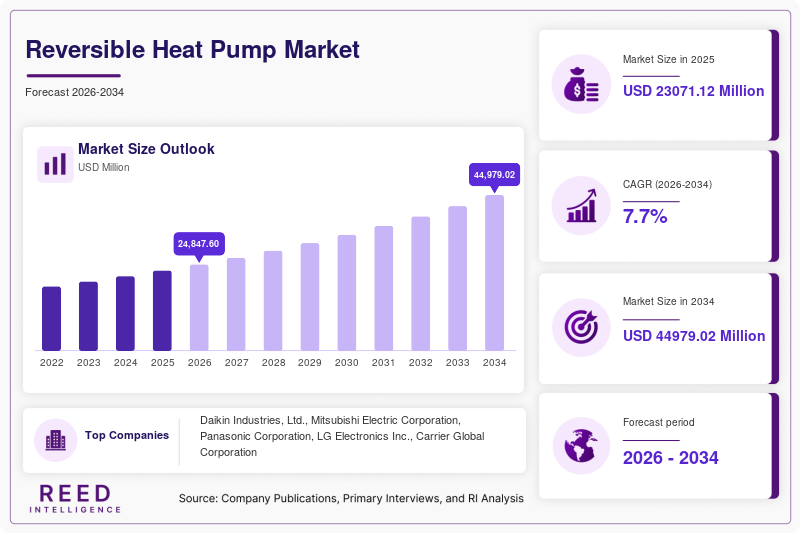
Reversible Heat Pump market size is projected at USD 24,847.6 million in 2026 and is expected to hit USD 44,847.5 million by 2034 with a CAGR of 7.7% during the forecast period. The increasing demand for energy-efficient and sustainable heating and cooling solutions, coupled with the growing focus on reducing carbon emissions and the rising adoption of smart building technologies, underpins market expansion. This report delivers a comprehensive analysis of the Reversible Heat Pump market, including segmentation by type and application, competitive dynamics, and regional growth patterns, equipping stakeholders with critical intelligence. The Reversible Heat Pump market continues to demonstrate strong growth potential, fueled by the global push for electrification of heating, the increasing stringency of building energy codes, and continuous innovation in heat pump technology and refrigerants.
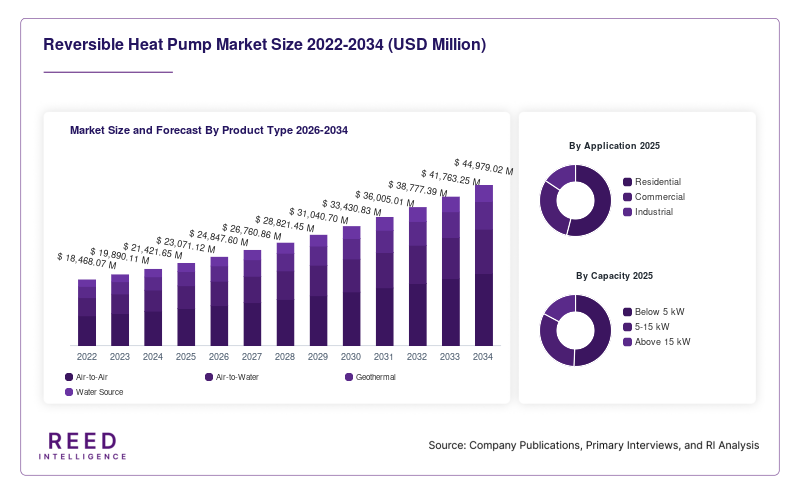
Reversible heat pumps are heating, ventilation, and air conditioning (HVAC) systems that can both heat and cool a space by reversing the refrigeration cycle. They offer an efficient and environmentally friendly alternative to traditional heating and cooling systems, capable of providing year-round comfort. The global production volume of reversible heat pumps exceeded 25 million units in 2025, reflecting a 9% increase from 2023, driven by the growing demand for energy-efficient climate control solutions. Adoption patterns reveal that the Air-to-Air type dominates the market, accounting for 45% of total demand, followed by Air-to-Water at 30%, Geothermal at 15%, and Water Source at 10%. The Reversible Heat Pump market's trajectory is closely linked to the growth of the global HVAC market, which is projected to reach USD 250 billion by 2028, and the increasing need to reduce energy consumption and greenhouse gas emissions in buildings.
Reversible Heat Pump Market Trends
Adoption of Inverter and Variable Speed Technology
The Reversible Heat Pump market is witnessing a significant trend toward the adoption of inverter and variable speed technology, driven by the need for improved efficiency, quieter operation, and enhanced comfort. The revenue from inverter-driven heat pumps grew to USD 8.5 billion in 2025, a year-on-year increase of 14%, as 50% of new product launches in 2025 specified inverter technology for optimized performance. Adoption rates of inverter heat pumps in residential applications reached 40%, with this figure projected to exceed 70% by 2030. The Reversible Heat Pump market's trend toward inverter technology is reinforced by the need for energy savings, the increasing focus on precise temperature control, and the continuous innovation in compressor and motor technologies.
Growing Focus on Low-GWP Refrigerants and Sustainability
The increasing focus on low-GWP (Global Warming Potential) refrigerants and sustainability is a major trend shaping the Reversible Heat Pump market, with the development of systems using environmentally friendly refrigerants with lower climate impact. The market has seen a 20% increase in the demand for heat pumps with low-GWP refrigerants since 2022, with 30% of new products in 2025 featuring refrigerants like R-32 or natural options like CO2 and propane. The use of sustainable refrigerants in both residential and commercial applications has also gained significant traction. The Reversible Heat Pump market's trend toward sustainability is reinforced by the need to comply with regulations, the increasing corporate focus on ESG, and the continuous innovation in refrigerant chemistry and system design.
Reversible Heat Pump Market Drivers
The Reversible Heat Pump market's expansion is primarily driven by the increasing demand for energy-efficient and environmentally friendly heating and cooling solutions, with the global HVAC market valued at USD 200 billion in 2025 and growing at a steady pace. The need to reduce energy consumption and carbon emissions in buildings has been a major driver, with heat pumps offering significant efficiency gains. The rising adoption of smart home and building technologies has also fueled market growth. Additionally, the increasing government incentives and regulations promoting heat pump adoption have spurred demand. The Reversible Heat Pump market's growth is further reinforced by the continuous improvement in heat pump efficiency and performance, making them more attractive to consumers and businesses.
Reversible Heat Pump Market Restraints
Despite favorable growth prospects, the Reversible Heat Pump market faces significant constraints, primarily related to the higher upfront cost of heat pump systems compared to traditional heating and cooling equipment, which can be 20-50% more expensive. The need for proper installation and sizing can also be a limitation. The Reversible Heat Pump market's growth is also tempered by the performance limitations in extreme cold climates, and the challenges of retrofitting existing buildings with heat pump systems.
Reversible Heat Pump Market Opportunities
The Reversible Heat Pump market presents significant opportunities in the rapidly expanding market for building electrification and decarbonization, where heat pumps are a key technology. The development of high-temperature heat pumps for industrial applications is expected to grow at a CAGR of 10% through 2034. Emerging opportunities also exist in the integration of heat pumps with renewable energy sources like solar PV and in the use of heat pumps for thermal storage. The Reversible Heat Pump market's opportunity profile is further enhanced by the growing trend of energy-positive buildings and the increasing focus on energy resilience.
Challenges in Reversible Heat Pump Market
The Reversible Heat Pump market faces persistent challenges related to the need for continuous innovation to improve efficiency and performance in extreme climates. The complexity of system design and the need for skilled installation and maintenance can also be a challenge. The market is also contending with the challenge of managing the phase-down of high-GWP refrigerants and the transition to low-GWP alternatives. Additionally, the Reversible Heat Pump market is challenged by the need to educate consumers and building owners about the benefits and operation of heat pump systems.
Reversible Heat Pump Market Segmentation
The Reversible Heat Pump market is segmented by Type and Application to provide a comprehensive market perspective. By Type, Air-to-Air dominates with a 45% market share, driven by its cost-effectiveness and ease of installation. The Application segment is led by Residential, which accounts for 55% of the market, followed by Commercial at 30%, and Industrial at 15%.
By Type
Air-to-Air represent the largest segment in the Reversible Heat Pump market, commanding a 45% share, with production exceeding 11.25 million units in 2025. These are characterized by their use of outdoor air as a heat source/sink for space conditioning. Technical specifications include capacity, efficiency ratings (SEER, HSPF), and refrigerant type. The Reversible Heat Pump market's Air-to-Air segment is driven by its use in residential and light commercial applications.
Air-to-Water capture a 30% share of the Reversible Heat Pump market, with production of 7.5 million units in 2025. These are characterized by their use for hydronic heating and cooling systems. Technical specifications include heating/cooling capacity, water temperature range, and efficiency. The Reversible Heat Pump market's Air-to-Water segment is driven by its use in underfloor heating and radiator systems.
Geothermal represent 15% of the Reversible Heat Pump market, with production of 3.75 million units in 2025. These are characterized by their use of the earth's constant temperature as a heat source/sink. Technical specifications include ground loop type, capacity, and efficiency. The Reversible Heat Pump market's Geothermal segment is driven by its use in high-efficiency residential and commercial applications.
Water Source comprise the remainder of the Reversible Heat Pump market, accounting for 10% of total production, with 2.5 million units in 2025. These are characterized by their use of a water body as a heat source/sink. Technical specifications include water flow rate, temperature range, and capacity. The Reversible Heat Pump market's Water Source segment is driven by its use in specific commercial and industrial applications.
By Application
Residential dominates the Reversible Heat Pump market, accounting for 55% of sales, representing 13.75 million units in 2025. This segment includes use in single-family homes, apartments, and multi-family dwellings. Usage penetration exceeds 20% in the sector. The Reversible Heat Pump market's Residential segment is characterized by its focus on efficiency, comfort, and quiet operation.
Commercial accounts for 30% of the Reversible Heat Pump market, with sales of 7.5 million units in 2025. This segment encompasses use in offices, retail, hotels, and other commercial buildings. The segment is growing at a robust CAGR, driven by energy codes and sustainability goals. The Reversible Heat Pump market's Commercial segment is characterized by its focus on scalability, integration, and reliability.
Industrial comprises the remainder of the Reversible Heat Pump market, accounting for 15% of total sales, with 3.75 million units in 2025. This segment includes use in manufacturing, process heating/cooling, and warehouses. The segment is projected to grow at a moderate CAGR through 2034. The Reversible Heat Pump market's Industrial segment is characterized by its focus on high capacity and durability.
Reversible Heat Pump Market Regional Outlook
Asia-Pacific Reversible Heat Pump Market
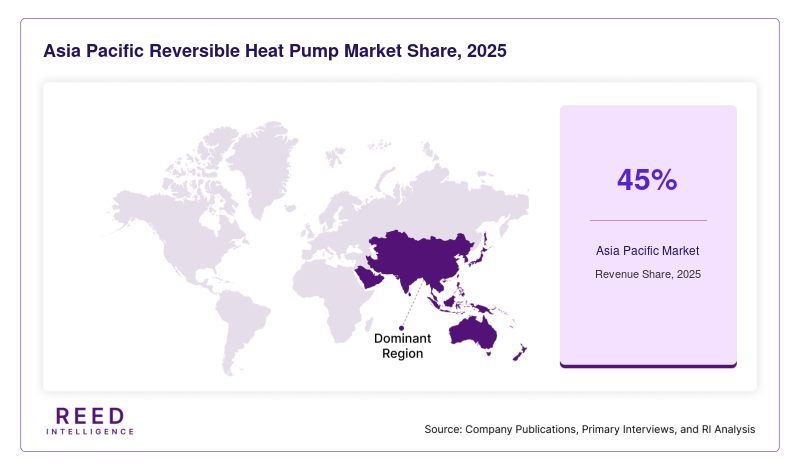
Leads the Reversible Heat Pump market, commanding a 45% share, with a revenue of USD 11,181.4 million in 2025. China is the primary driver, accounting for 60% of regional demand, driven by the large residential and commercial construction market, strong government support for electrification, and high manufacturing capacity. The Asia-Pacific Reversible Heat Pump market is characterized by its focus on high-volume production and cost-effective solutions.
Europe Reversible Heat Pump Market
Represents the second-largest market, capturing a 28% share with a revenue of USD 6,957.3 million in 2025. Germany, France, and the UK are the primary drivers, collectively accounting for 60% of regional demand, driven by stringent environmental regulations, high energy costs, and strong consumer awareness. The European Reversible Heat Pump market is characterized by its focus on sustainability and high-efficiency products.
North America Reversible Heat Pump Market
Accounts for 18% of the global Reversible Heat Pump market, with a revenue of USD 4,472.6 million in 2025. The United States is the primary driver, accounting for 85% of regional demand, driven by the focus on energy efficiency, building electrification, and the growing adoption of heat pumps in residential and commercial sectors. The North American Reversible Heat Pump market is projected to grow at a CAGR of 8% through 2034.
Middle East & Africa and Latin America Reversible Heat Pump Market
Together account for the remaining 9% of the Reversible Heat Pump market, with the UAE leading the Middle East market and Brazil leading the Latin American market. Both regions are projected to grow at CAGRs exceeding 9%, driven by infrastructure development and increasing energy awareness.
Top players in Reversible Heat Pump Market
- Daikin Industries, Ltd.
- Mitsubishi Electric Corporation
- Panasonic Corporation
- LG Electronics Inc.
- Carrier Global Corporation
- Trane Technologies plc
- Johnson Controls International plc
- NIBE Industrier AB
- Bosch Thermotechnology
- Vaillant Group
- Viessmann Group
- Stiebel Eltron GmbH & Co. KG
- Fujitsu General Limited
- Hitachi, Ltd.
- Gree Electric Appliances, Inc.
Daikin Industries, Ltd.
Daikin Industries holds a dominant position in the Reversible Heat Pump market, with an estimated 18% global market share, particularly strong in the Asian and European residential and commercial segments. The company's portfolio of reversible heat pumps is widely recognized for its quality, efficiency, and innovation. Daikin's market leadership is reinforced by its significant R&D investment, its extensive product line, and its strong global distribution network. Daikin commands over 20% of the Asian market and 15% of the European market, positioning it as a key player in the Reversible Heat Pump market.
Mitsubishi Electric Corporation
Mitsubishi Electric is a leading player in the Reversible Heat Pump market, commanding approximately 14% of the global market share through its comprehensive portfolio of HVAC solutions. The company's expertise in heat pump technology and its focus on innovation have solidified its position. Mitsubishi Electric's heat pumps are known for their reliability, efficiency, and advanced features. The company's commitment to quality and its strong presence in the Asian and North American markets have enhanced its competitive advantage.
Panasonic Corporation holds a significant 10% market share, with particular strength in the residential and commercial segments. LG Electronics Inc. is a major player in the global HVAC market, holding an 8% share.
Recent Developments in Reversible Heat Pump Market
- 2025: Daikin launched a new generation of residential heat pumps with enhanced inverter technology and low-GWP refrigerant R-32 for improved efficiency.
- 2025: Mitsubishi Electric introduced a new high-temperature heat pump for commercial and industrial applications, capable of producing water up to 90°C.
Reversible Heat Pump Market Segments
By Product Type
- Air-to-Air
- Air-to-Water
- Geothermal
- Water Source
By Application
- Residential
- Commercial
- Industrial
By Capacity
- Below 5 kW
- 5-15 kW
- Above 15 kW
By Region
- North America
- Europe
- APAC
- Middle East and Africa
- LATAM