Revolving Door Market Size, Share Demand Report By Type (Automatic Revolving Doors, Manual Revolving Doors), By Application (Commercial Buildings, Transportation Hubs, Healthcare Facilities, Others), By End-Use (Commercial, Institutional, Residential), By Region & Segment Forecasts, 2026–2034
USD 3950
Market Overview
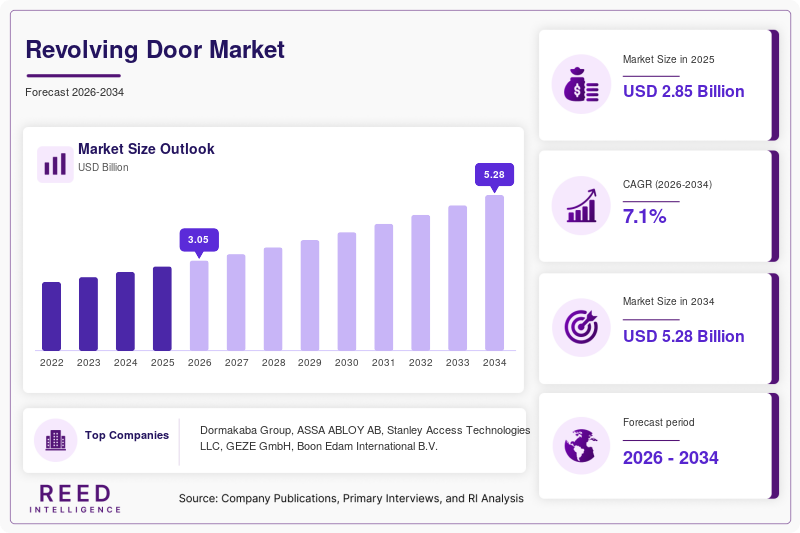
The global Revolving Door Market was valued at approximately USD 2.85 billion in 2026 and is projected to reach USD 4.92 billion by 2034, expanding at a CAGR of 7.1% during 2026–2034. The market is driven by increasing demand for energy-efficient building solutions, particularly in commercial and institutional infrastructure. Revolving doors play a critical role in minimizing energy loss by maintaining indoor temperature stability, which aligns with rising sustainability regulations and green building certifications worldwide.
A key global factor supporting market growth is the increasing adoption of smart and automated building systems. As urbanization accelerates and smart cities gain traction, developers are incorporating intelligent entry solutions that enhance security, accessibility, and energy efficiency. Revolving doors integrated with sensors and automation technologies are becoming a preferred choice in airports, shopping malls, hotels, and office buildings. Furthermore, the need for improved crowd management and hygiene standards in high-traffic areas has strengthened demand for touchless and automated revolving door systems.
Key Highlights
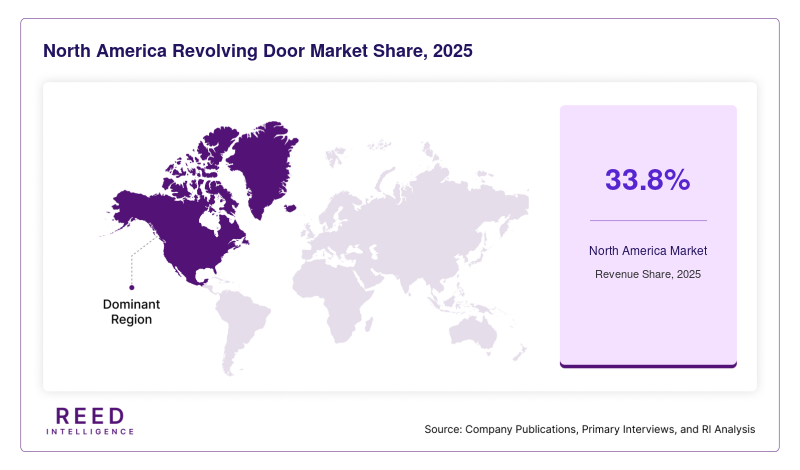
- North America dominated the market with a 33.8% share in 2025.
- Asia Pacific is expected to grow at the fastest CAGR of 8.4% during 2026–2034.
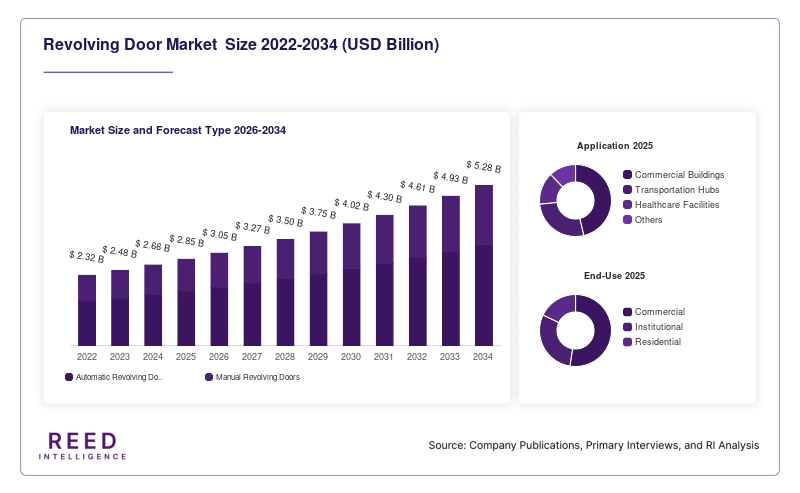
- By type, automatic revolving doors accounted for the largest share of 46.2%.
- while manual revolving doors are projected to grow at a CAGR of 6.5%.
- By application, commercial buildings led with a 52.7% share, whereas transportation hubs are expected to expand at a CAGR of 8.9%.
- The United States remained the dominant country, with market values of USD 610 million in 2024 and USD 655 million in 2025.
Market Trends
Integration of Smart Technologies in Revolving Doors
The integration of smart technologies is shaping the evolution of the revolving door market. Manufacturers are increasingly embedding sensors, IoT-enabled systems, and AI-driven automation to enhance user experience and operational efficiency. These smart revolving doors can detect user movement, adjust rotation speed, and ensure safety compliance. Building operators are adopting these systems to align with smart building management platforms, enabling centralized monitoring and predictive maintenance. Additionally, advanced features such as touchless entry and facial recognition are gaining attention in high-security environments. This trend is particularly evident in developed economies where digital infrastructure is more advanced, but it is also expanding rapidly in emerging markets due to growing investments in modern infrastructure.
Growing Demand for Energy-Efficient Architectural Solutions
Energy efficiency remains a central trend driving the adoption of revolving doors across commercial and institutional buildings. Compared to traditional swinging doors, revolving doors significantly reduce heat exchange between indoor and outdoor environments. This capability supports building owners in achieving energy savings and complying with stringent environmental regulations. Green building certifications, such as LEED and BREEAM, are encouraging the installation of energy-efficient entry systems. As organizations focus on reducing operational costs and carbon footprints, revolving doors are increasingly viewed as a long-term investment. This trend is further supported by government incentives promoting sustainable construction practices and eco-friendly building designs.
Market Drivers
Rapid Urbanization and Infrastructure Development
Rapid urbanization across emerging and developed economies is a major driver of the revolving door market. Increasing construction of commercial complexes, airports, hospitals, and retail centers is creating strong demand for advanced entrance solutions. Urban population growth has intensified the need for efficient crowd management systems, especially in high-traffic environments. Revolving doors provide a practical solution by enabling continuous flow of people while maintaining security and energy efficiency. Governments and private developers are investing heavily in modern infrastructure projects, particularly in Asia Pacific and the Middle East. These investments are directly contributing to the adoption of revolving door systems in both new constructions and renovation projects.
Rising Emphasis on Building Safety and Security
Safety and security concerns are becoming increasingly important in commercial and public spaces, driving demand for advanced revolving door systems. These doors are equipped with safety sensors, emergency stop mechanisms, and controlled access features that enhance building security. In sectors such as banking, hospitality, and transportation, the ability to regulate entry and exit points is critical. Revolving doors help prevent unauthorized access and improve surveillance capabilities. Additionally, the integration of access control systems and biometric authentication is further enhancing their appeal. As security regulations become stricter worldwide, the adoption of technologically advanced revolving doors is expected to increase steadily.
Market Restraint
High Installation and Maintenance Costs
The high installation and maintenance costs associated with revolving doors pose a significant restraint to market growth. Compared to conventional doors, revolving doors require complex mechanical and electronic components, including sensors, motors, and control systems. These components increase the initial investment required for installation, making them less accessible for small and medium-sized enterprises. Additionally, regular maintenance is essential to ensure smooth operation and compliance with safety standards. Maintenance costs can be substantial, especially for automated and sensor-based systems that require specialized technical expertise.
This cost factor is particularly challenging in developing regions where budget constraints limit the adoption of advanced building technologies. For example, small commercial establishments may opt for traditional door systems due to lower upfront costs, even though revolving doors offer long-term energy savings. Furthermore, downtime caused by maintenance issues can disrupt business operations, leading to additional financial implications. As a result, cost sensitivity among end-users remains a key barrier to widespread adoption, especially in price-sensitive markets.
Market Opportunities
Expansion of Smart Cities and Green Buildings
The global expansion of smart cities presents a significant opportunity for the revolving door market. Governments and urban planners are increasingly focusing on sustainable infrastructure that integrates advanced technologies and energy-efficient solutions. Revolving doors align well with these objectives by offering both energy conservation and smart functionality. As smart city projects continue to expand, particularly in Asia Pacific and the Middle East, demand for automated and connected revolving door systems is expected to rise. These doors can be integrated into centralized building management systems, enhancing operational efficiency and user experience. The growing emphasis on green buildings further strengthens this opportunity.
Increasing Adoption in Healthcare and Transportation Sectors
The healthcare and transportation sectors offer promising growth opportunities for the revolving door market. Hospitals require controlled entry systems to maintain hygiene standards and regulate patient flow, making revolving doors an ideal solution. Similarly, transportation hubs such as airports and railway stations demand high-capacity entry systems that can handle large volumes of passengers efficiently. The need for touchless and automated solutions in these sectors has increased significantly in recent years. As infrastructure development in these sectors continues to accelerate, the demand for revolving doors is expected to grow, providing new revenue streams for manufacturers.
Segmental Analysis
By Type
Automatic revolving doors dominated the market with a share of approximately 46.2% in 2024. These doors are widely used in commercial and institutional buildings due to their convenience and advanced features. Automatic systems are equipped with sensors and control mechanisms that ensure smooth operation and enhanced safety. Their ability to handle high traffic volumes efficiently makes them a preferred choice in airports, shopping malls, and office buildings. Additionally, the integration of smart technologies has further increased their adoption, as building operators seek to improve operational efficiency and user experience.
Manual revolving doors are expected to be the fastest-growing subsegment, with a CAGR of 6.5% during the forecast period. Despite being less technologically advanced, manual doors offer cost advantages and are suitable for low-traffic environments. They are commonly used in small commercial establishments and heritage buildings where simplicity and aesthetic appeal are important. The lower installation and maintenance costs associated with manual doors make them an attractive option for budget-conscious buyers. As demand for cost-effective solutions increases, this segment is expected to witness steady growth.
By Application
Commercial buildings held the largest share of approximately 52.7% in 2024. The widespread use of revolving doors in office complexes, shopping malls, and hotels is driving this segment’s dominance. These buildings require efficient entry systems that can manage large volumes of people while maintaining energy efficiency. Revolving doors help reduce energy loss and enhance indoor comfort, making them a preferred choice for commercial applications. Additionally, the growing trend of smart buildings is further boosting demand in this segment.
Transportation hubs are projected to be the fastest-growing application segment, with a CAGR of 8.9% during the forecast period. Airports, railway stations, and metro stations require high-capacity entry systems that can handle continuous passenger flow. Revolving doors provide an effective solution by ensuring smooth movement while maintaining security and energy efficiency. The expansion of transportation infrastructure worldwide is expected to drive growth in this segment. Increasing passenger traffic and the need for advanced entry systems are key factors contributing to this trend.
By End-Use
The commercial sector dominated the market with a share of around 58.4% in 2024. This segment includes office buildings, retail spaces, and hospitality establishments. The high footfall in these environments necessitates the use of efficient and durable entry systems. Revolving doors offer several advantages, including energy savings, improved security, and enhanced aesthetic appeal. These factors have contributed to their widespread adoption in the commercial sector. Additionally, the growing emphasis on sustainability is encouraging businesses to invest in energy-efficient solutions.
The institutional sector is expected to be the fastest-growing segment, with a CAGR of 7.8% during the forecast period. This segment includes healthcare facilities, educational institutions, and government buildings. The increasing need for controlled access and hygiene standards in these environments is driving demand for revolving doors. Hospitals, in particular, require touchless entry systems to minimize the spread of infections. As investments in institutional infrastructure continue to grow, this segment is expected to witness significant expansion.
Regional Analysis
North America
North America held a dominant share of approximately 33.8% in 2025 and is expected to grow at a CAGR of 6.8% during the forecast period. The region’s mature construction industry and early adoption of advanced building technologies have contributed to its leading position. High demand for energy-efficient solutions and strict building regulations are encouraging the use of revolving doors in commercial spaces. The presence of established manufacturers and continuous technological advancements further support market growth in this region.
The United States remains the dominant country in North America, driven by strong investments in commercial real estate and smart infrastructure. A key growth factor is the widespread adoption of green building certifications, which promote energy-efficient solutions. Developers are increasingly incorporating revolving doors in office buildings and retail complexes to meet sustainability standards and reduce operational costs.
Europe
Europe accounted for a significant share of around 27.5% in 2025 and is projected to grow at a CAGR of 6.5% through 2034. The region’s focus on environmental sustainability and energy efficiency is a major driver of market growth. Strict regulations related to building energy performance are encouraging the adoption of revolving doors across various sectors, including hospitality and healthcare.
Germany is the leading country in the European market, supported by its strong manufacturing base and emphasis on sustainable construction. A unique growth factor in Germany is the integration of advanced engineering solutions in building design. This approach has led to increased adoption of automated revolving doors that enhance both energy efficiency and user convenience.
Asia Pacific
Asia Pacific is the fastest-growing region, with a CAGR of 8.4% during the forecast period and a market share of approximately 21.3% in 2025. Rapid urbanization and infrastructure development are key factors driving growth in this region. Increasing investments in commercial and public infrastructure projects are creating strong demand for advanced entry systems.
China dominates the Asia Pacific market due to its large-scale construction activities and growing urban population. A unique growth factor is the government’s focus on smart city initiatives, which include the adoption of intelligent building technologies. This has led to increased demand for automated revolving doors in commercial and public spaces.
Middle East & Africa
The Middle East & Africa region held a share of around 9.6% in 2025 and is expected to grow at a CAGR of 7.6% during the forecast period. The region’s expanding construction sector and increasing focus on modern infrastructure are driving market growth. High-end commercial projects and luxury developments are key contributors to demand.
The United Arab Emirates is the dominant country in this region, driven by its strong focus on tourism and commercial development. A unique growth factor is the increasing number of high-end hotels and shopping malls, which require advanced entry solutions to enhance customer experience and maintain energy efficiency.
Latin America
Latin America accounted for approximately 7.8% of the market share in 2025 and is projected to grow at a CAGR of 6.9% during the forecast period. The region’s growing urban population and increasing investments in commercial infrastructure are supporting market expansion. Adoption of revolving doors is gradually increasing in major urban centers.
Brazil leads the Latin American market, supported by its expanding retail and commercial sectors. A unique growth factor is the modernization of urban infrastructure, which includes the adoption of energy-efficient building solutions. This trend is expected to drive demand for revolving doors in the coming years.
Competitive Landscape
The revolving door market is moderately fragmented, with several global and regional players competing based on product innovation, quality, and pricing. Leading companies are focusing on integrating advanced technologies such as IoT, automation, and energy-efficient designs to strengthen their market position. Strategic partnerships, mergers, and product launches are common strategies adopted by key players to expand their presence.
One of the leading players in the market is Dormakaba Group, which has established a strong global presence through its comprehensive product portfolio and focus on innovation. The company recently introduced a new range of energy-efficient revolving doors equipped with advanced sensor technology, aimed at enhancing user safety and reducing energy consumption. Other major players are also investing in research and development to introduce innovative solutions that meet evolving customer requirements. The competitive landscape is expected to remain dynamic as companies continue to focus on technological advancements and market expansion.
Key Players List
- Dormakaba Group
- ASSA ABLOY AB
- Stanley Access Technologies LLC
- GEZE GmbH
- Boon Edam International B.V.
- Horton Automatics
- Royal Boon Edam
- KBB Automatic Door Systems
- TORMAX Group
- Manusa Gest S.L.
- ERREKA Group
- Nabtesco Corporation
- Gilgen Door Systems AG
- Porta KMI Poland
- Record Holding AG
Recent Developments
- In 2025, Dormakaba Group launched a new series of smart revolving doors integrated with IoT-based monitoring systems.
- In 2024, ASSA ABLOY expanded its product portfolio by introducing energy-efficient revolving doors designed for commercial buildings.
- In 2025, Boon Edam International announced a strategic partnership with a smart building solutions provider to enhance automation capabilities in its products.
Revolving Door Market Segments
Type
- Automatic Revolving Doors
- Manual Revolving Doors
Application
- Commercial Buildings
- Transportation Hubs
- Healthcare Facilities
- Others
End-Use
- Commercial
- Institutional
- Residential
Distribution Channel
- Direct Sales
- Distributors & Dealers
- Online Sales
- Specialty Construction Suppliers
By Region
- North America
- Europe
- APAC
- Middle East and Africa
- LATAM