RF Chip Inductor Market Size, Share & Demand Report By Type (Multilayer RF Chip Inductors, Thin-Film RF Chip Inductors, Wire-Wound RF Chip Inductors, Ceramic Core RF Chip Inductors), By Application (Smartphones and Consumer Electronics, Automotive Electronics, Industrial Equipment, Networking and Communication Devices, Healthcare Electronics), By End-Use Industry (Telecommunications, Automotive Manufacturing, Consumer Electronics, Industrial Automation, Healthcare, Aerospace and Defense) By Regi
USD 3950
Market Overview
The global RF Chip Inductor Market size was valued at approximately USD 1.84 billion in 2026 and is projected to reach nearly USD 3.96 billion by 2034, expanding at a compound annual growth rate (CAGR) of 10.1% during the forecast period from 2026 to 2034. RF chip inductors are essential passive electronic components used for impedance matching, filtering, signal processing, and noise suppression in radio frequency circuits. These inductors are widely integrated into smartphones, wireless communication infrastructure, automotive electronics, IoT devices, industrial automation systems, and consumer electronics. The increasing penetration of 5G networks, connected devices, and advanced automotive communication modules has strengthened market demand across both developed and emerging economies.
A major global factor supporting market growth is the rapid expansion of high-frequency communication technologies. The deployment of 5G infrastructure, satellite communication systems, and advanced Wi-Fi standards has increased the need for compact and high-performance RF components. Manufacturers are focusing on miniaturized chip inductors with improved frequency stability and low power loss to meet the requirements of next-generation electronic devices. In addition, the rising adoption of electric vehicles and advanced driver assistance systems has accelerated the use of RF modules in automotive applications. Growing investments in semiconductor manufacturing and consumer electronics production in Asia Pacific are also contributing to long-term market expansion.
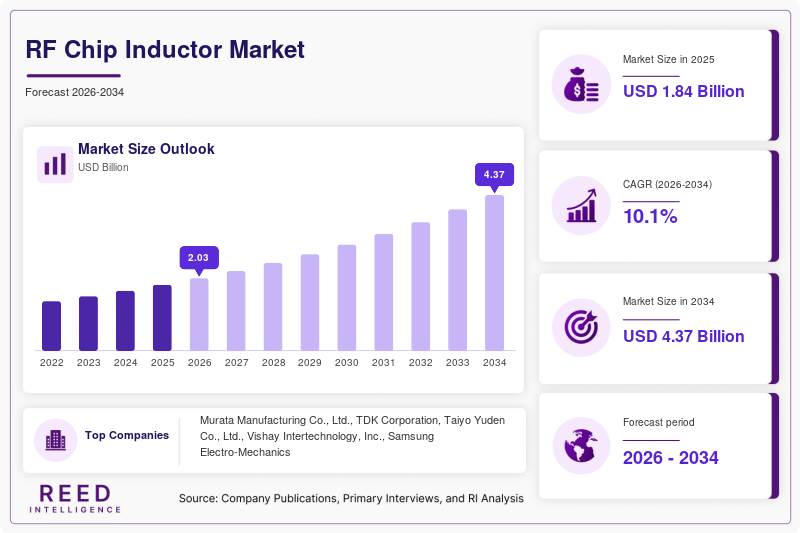
Key Highlights
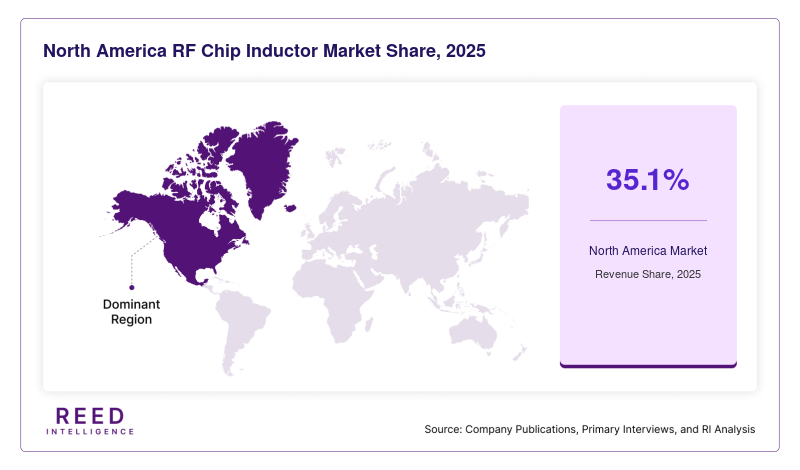
- North America dominated the market with a 35.1% share in 2025, while Asia Pacific is expected to grow at the fastest CAGR of 11.6% during 2026–2034.
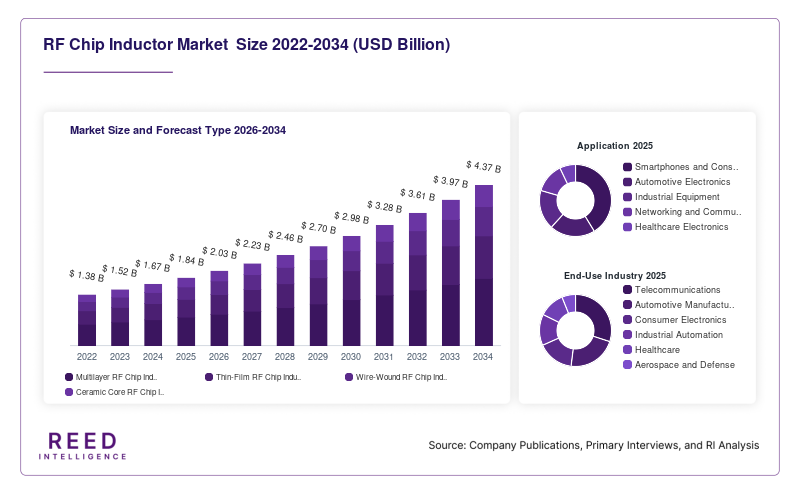
- By type, multilayer RF chip inductors accounted for the largest share of 44.8%, while thin-film RF chip inductors are projected to grow at a CAGR of 12.3%.
- By application, smartphones and consumer electronics led with a 39.4% share, whereas automotive electronics are expected to expand at a CAGR of 12.8%.
- By end-use industry, telecommunications accounted for the highest share of 36.7%, while automotive manufacturing is anticipated to register a CAGR of 12.1%.
- The United States remained the dominant country, with market values of USD 420 million in 2024 and USD 462 million in 2025.
Market Trends
Rising Integration of 5G-Enabled Consumer Electronics
The growing adoption of 5G-enabled smartphones, tablets, wearable devices, and wireless communication modules is reshaping the RF Chip Inductor Market. Device manufacturers are increasingly demanding compact passive components capable of handling higher frequencies with minimal signal loss. RF chip inductors play a critical role in antenna matching circuits, RF amplifiers, and signal filtering applications within advanced communication devices. As telecom operators continue expanding 5G coverage, electronics manufacturers are accelerating production of compatible hardware, thereby increasing component consumption. In addition, consumers are upgrading to devices with faster connectivity and improved performance, creating sustained demand for miniaturized RF components. Manufacturers are responding by developing high-frequency multilayer and thin-film inductors designed for space-constrained devices while maintaining thermal stability and operational reliability.
Expansion of Automotive Connectivity and Advanced Electronics
The automotive industry is emerging as a major contributor to the RF Chip Inductor Market due to rising integration of connected technologies and electronic control systems. Modern vehicles rely heavily on RF communication modules for navigation systems, infotainment units, vehicle-to-vehicle communication, radar systems, and advanced driver assistance systems. Electric vehicles and hybrid vehicles also require reliable RF circuitry for battery management and wireless connectivity. Automotive manufacturers are prioritizing lightweight and compact electronic architectures, which is increasing the use of surface-mounted RF chip inductors. In addition, the transition toward autonomous mobility solutions is strengthening demand for high-frequency signal processing components. Growing investments in smart transportation infrastructure and connected vehicle ecosystems across North America, Europe, and Asia Pacific are expected to support continued market growth over the forecast period.
Market Drivers
Increasing Demand for High-Speed Wireless Communication Infrastructure
The global expansion of wireless communication infrastructure is a significant growth driver for the RF Chip Inductor Market. Telecom providers are investing heavily in 5G base stations, high-speed broadband systems, and advanced networking equipment to support increasing data consumption. RF chip inductors are widely used in communication hardware for impedance matching, frequency tuning, and signal filtering applications. As network speeds continue to improve, the demand for components capable of operating efficiently at high frequencies has increased substantially. Semiconductor manufacturers are also integrating advanced RF modules into compact devices, creating additional opportunities for component suppliers. Furthermore, the growth of cloud computing, edge computing, and data-intensive applications has accelerated the need for reliable wireless communication systems, directly contributing to the increased deployment of RF chip inductors worldwide.
Growth in IoT Devices and Smart Consumer Applications
The rapid adoption of Internet of Things devices and smart consumer electronics is creating strong demand for RF chip inductors across multiple industries. Smart home devices, wearable technologies, industrial automation systems, and healthcare monitoring equipment all require efficient RF circuitry to enable wireless communication. RF chip inductors help optimize signal transmission, reduce electromagnetic interference, and improve energy efficiency in connected devices. As consumers increasingly adopt wireless and portable electronics, manufacturers are focusing on miniaturized electronic components that deliver high performance within compact designs. In addition, industrial IoT deployment across manufacturing, logistics, and energy sectors is accelerating the integration of wireless sensors and communication modules. These factors are driving the need for advanced RF chip inductors capable of supporting stable performance in high-frequency and low-power applications.
Market Restraint
Volatility in Raw Material Pricing and Supply Chain Challenges
Fluctuations in the prices of ceramic materials, specialty metals, and semiconductor-related raw materials present a major challenge for the RF Chip Inductor Market. Manufacturers rely on stable access to materials such as ferrite compounds, copper, silver, and nickel for component production. Disruptions in the global supply chain, geopolitical tensions, transportation bottlenecks, and semiconductor shortages have increased procurement costs and production delays in recent years. These factors can directly impact profit margins for component suppliers and create uncertainty for electronics manufacturers.
In addition, the RF chip inductor industry requires precision manufacturing and strict quality control standards, which increase operational complexity. Smaller manufacturers often face difficulties maintaining cost competitiveness while investing in advanced production technologies. The pressure to reduce product size while improving performance also creates design and engineering challenges. For example, smartphone manufacturers demand compact components with higher operating frequencies and lower power consumption, forcing suppliers to continuously upgrade manufacturing processes. Such investments can increase capital expenditure and extend production timelines. The combination of raw material price instability and technological complexity may limit market expansion in cost-sensitive regions and affect overall industry profitability during the forecast period.
Market Opportunities
Increasing Adoption of Electric Vehicles and Smart Mobility Solutions
The growing transition toward electric vehicles and connected mobility systems is creating significant opportunities for the RF Chip Inductor Market. Electric vehicles require advanced electronic architectures for communication, navigation, infotainment, battery management, and safety applications. RF chip inductors are widely used in wireless communication modules and radar systems integrated into modern automotive platforms. Governments across multiple regions are promoting electric vehicle adoption through subsidies, emission reduction policies, and investments in charging infrastructure. This trend is encouraging automotive manufacturers to increase production of electronically advanced vehicles, thereby boosting demand for RF components.
Expansion of Industrial Automation and Smart Manufacturing
The increasing implementation of industrial automation technologies is generating new growth avenues for the RF Chip Inductor Market. Manufacturing companies are adopting wireless sensors, robotics, industrial IoT systems, and real-time monitoring solutions to improve operational efficiency and productivity. These technologies require stable wireless communication and high-frequency signal management, increasing the demand for RF chip inductors. Smart factories rely on connected equipment and automated systems that require reliable electronic components capable of operating in demanding industrial environments.
Furthermore, governments and private organizations are investing in digital manufacturing infrastructure to improve supply chain visibility and production efficiency. RF chip inductors are being integrated into industrial communication devices, wireless modules, and sensor-based monitoring systems used across automotive, electronics, healthcare, and energy sectors. Manufacturers are also focusing on developing durable and low-power RF components for industrial applications where long-term reliability is essential. The continued expansion of Industry 4.0 initiatives across Asia Pacific, Europe, and North America is expected to create sustained opportunities for RF chip inductor suppliers over the forecast period.
Segmental Analysis
By Type
Multilayer RF chip inductors accounted for the largest market share of approximately 44.8% in 2024 due to their compact structure, stable electrical performance, and cost efficiency. These inductors are widely used in smartphones, tablets, wireless routers, and consumer electronic devices where space optimization is essential. Multilayer designs support high-frequency applications while maintaining low electromagnetic interference and improved reliability. Manufacturers prefer these inductors because they are compatible with automated surface-mount assembly processes, enabling large-scale production at competitive costs. The increasing production of portable electronic devices and wireless communication modules has strengthened demand for multilayer RF chip inductors globally. In addition, advancements in ceramic material technologies have improved the thermal stability and operational efficiency of these components, supporting their adoption across telecommunications and industrial applications.
By Application
Smartphones and consumer electronics represented the dominant application segment with a market share of nearly 39.4% in 2024. RF chip inductors are essential components in smartphones, smartwatches, tablets, gaming devices, and wireless earbuds because they support signal filtering, antenna matching, and impedance control. The growing global demand for portable electronics with advanced wireless connectivity features has significantly increased component consumption. Consumers increasingly prefer devices with high-speed internet connectivity, improved battery efficiency, and compact form factors, encouraging manufacturers to adopt advanced RF solutions. The expansion of 5G-enabled smartphones has further strengthened market demand, as these devices require sophisticated RF architectures capable of operating across multiple frequency bands. In addition, rising disposable income and increasing digital adoption in emerging economies continue to support growth in consumer electronics production worldwide.
By End-Use Industry
The telecommunications industry accounted for the highest share of approximately 36.7% in 2024 due to increasing investments in wireless communication infrastructure and high-speed connectivity networks. RF chip inductors are extensively used in base stations, routers, signal amplifiers, and wireless communication equipment because they help maintain signal integrity and frequency control. The expansion of 5G networks across developed and developing economies has significantly increased the deployment of RF-enabled communication hardware. Telecom operators are upgrading existing infrastructure to handle growing mobile data traffic and support advanced digital services. In addition, the adoption of cloud computing, video streaming, and remote work technologies has accelerated the need for reliable communication networks. These factors have strengthened the demand for high-frequency RF components within the telecommunications industry.
Regional Analysis
North America
North America accounted for approximately 35.1% of the global RF Chip Inductor Market share in 2025 and is expected to maintain steady growth with a projected CAGR of 9.4% during the forecast period. The region benefits from strong demand for advanced communication infrastructure, consumer electronics, and automotive technologies. Telecom companies across the United States and Canada continue investing in 5G deployment and wireless network expansion, which has increased the use of RF components in communication equipment. The presence of leading semiconductor manufacturers and strong research activities also contribute to market development.
The United States remained the dominant country in North America due to its large electronics manufacturing ecosystem and high adoption of connected technologies. A major growth factor supporting the market is the increasing investment in defense communication systems and aerospace electronics. RF chip inductors are widely integrated into radar systems, satellite communication devices, and secure wireless applications used by defense agencies. Growing demand for connected vehicles and advanced medical electronics is also contributing to component consumption across the country.
Europe
Europe represented nearly 24.3% of the global RF Chip Inductor Market share in 2025 and is anticipated to expand at a CAGR of 8.9% between 2026 and 2034. The region is characterized by strong automotive manufacturing capabilities, rising adoption of industrial automation, and increasing investments in telecommunications infrastructure. European manufacturers are focusing on energy-efficient electronic systems and compact RF solutions to support advanced industrial and automotive applications. Demand for connected consumer devices and smart home technologies is also supporting market growth.
Germany emerged as the leading country within the European market due to its established automotive and industrial electronics industries. A key growth factor in the country is the rapid integration of advanced driver assistance systems and electric vehicle technologies. Automotive manufacturers are incorporating RF communication modules into modern vehicle platforms to improve safety, navigation, and infotainment functionality. In addition, the country’s focus on industrial digitization and smart manufacturing initiatives is increasing the deployment of wireless industrial systems.
Asia Pacific
Asia Pacific held around 28.7% of the RF Chip Inductor Market share in 2025 and is projected to witness the fastest CAGR of 11.6% during the forecast period. The region has become a major global manufacturing hub for smartphones, semiconductors, and consumer electronics. Countries such as China, Japan, South Korea, and Taiwan are driving production volumes for compact electronic devices that require advanced RF components. The rapid rollout of 5G infrastructure and rising consumer demand for connected devices are accelerating market expansion across the region.
China dominated the Asia Pacific market owing to its large-scale electronics production capabilities and expanding semiconductor ecosystem. One major growth factor is the strong government support for domestic semiconductor manufacturing and communication infrastructure development. Chinese manufacturers are investing in advanced production technologies to reduce dependence on imported electronic components. In addition, the increasing adoption of smart appliances, wearable devices, and industrial automation systems is creating continuous demand for RF chip inductors in the country.
Middle East & Africa
The Middle East & Africa region accounted for nearly 5.4% of the global RF Chip Inductor Market share in 2025 and is expected to grow at a CAGR of 7.8% through 2034. Market growth is supported by increasing investments in telecommunications infrastructure, smart city projects, and digital transformation initiatives. Governments across the Gulf countries are focusing on expanding high-speed internet connectivity and advanced communication systems to support economic diversification strategies. These developments are increasing the deployment of RF communication equipment and related electronic components.
Saudi Arabia remained the dominant country within the regional market due to ongoing investments in smart infrastructure and digital connectivity programs. A unique growth factor supporting the market is the rapid development of smart city projects integrated with IoT-based communication systems. RF chip inductors are increasingly used in wireless communication modules, surveillance systems, and smart utility networks across urban development projects. Rising demand for connected healthcare and industrial monitoring systems is also contributing to regional market growth.
Latin America
Latin America captured approximately 6.5% of the global RF Chip Inductor Market share in 2025 and is projected to register a CAGR of 8.2% during the forecast period. Increasing smartphone penetration, expanding telecom infrastructure, and rising adoption of consumer electronics are supporting regional market development. Countries across the region are focusing on improving internet connectivity and digital communication capabilities, which is increasing demand for RF-enabled devices and supporting components.
Brazil dominated the Latin American market due to its large consumer electronics sector and expanding telecommunications industry. One important growth factor is the increasing adoption of digital banking and mobile commerce platforms, which is driving smartphone usage across the country. Electronics manufacturers and telecom providers are expanding wireless communication networks to support growing data traffic. In addition, rising investments in industrial automation and connected energy infrastructure are contributing to demand for RF chip inductors in Brazil.
Competitive Landscape
The RF Chip Inductor Market is characterized by strong competition among global electronic component manufacturers focusing on product innovation, miniaturization technologies, and strategic partnerships. Leading companies are investing in research and development activities to improve high-frequency performance, reduce power loss, and support advanced communication applications. Market participants are also expanding manufacturing capabilities in Asia Pacific to strengthen supply chain efficiency and meet rising demand from consumer electronics and automotive industries.
Murata Manufacturing Co., Ltd. maintained a leading position in the market due to its extensive product portfolio, strong global distribution network, and focus on advanced multilayer RF components. The company continues investing in next-generation communication technologies and compact electronic solutions for 5G and automotive applications. Other major companies are focusing on mergers, production capacity expansion, and collaboration with semiconductor manufacturers to strengthen their market presence.
Key Players
- Murata Manufacturing Co., Ltd.
- TDK Corporation
- Taiyo Yuden Co., Ltd.
- Vishay Intertechnology, Inc.
- Samsung Electro-Mechanics
- AVX Corporation
- Coilcraft Inc.
- Yageo Corporation
- Würth Elektronik Group
- Panasonic Corporation
- Bourns, Inc.
- Delta Electronics, Inc.
- Chilisin Electronics Corp.
- Sumida Corporation
- Pulse Electronics Corporation
Recent Developments
- Murata Manufacturing Co., Ltd. introduced a new series of ultra-compact RF chip inductors designed for high-frequency 5G smartphone applications with improved thermal performance in 2025.
- TDK Corporation expanded its production capacity in Asia Pacific to support increasing demand for automotive-grade RF components used in electric vehicles and connected mobility systems in 2024.
- Taiyo Yuden Co., Ltd. launched advanced thin-film RF chip inductors optimized for wearable electronics and compact IoT devices, focusing on lower signal loss and enhanced miniaturization in 2025.
- Samsung Electro-Mechanics announced investments in next-generation semiconductor packaging technologies to improve RF component integration for high-speed communication devices in 2024.
- Vishay Intertechnology, Inc. expanded its RF passive component portfolio with high-reliability inductors targeted at industrial automation and aerospace communication systems in 2025.
RF Chip Inductor Market Segments
Type
- Multilayer RF Chip Inductors
- Thin-Film RF Chip Inductors
- Wire-Wound RF Chip Inductors
- Ceramic Core RF Chip Inductors
Application
- Smartphones and Consumer Electronics
- Automotive Electronics
- Industrial Equipment
- Networking and Communication Devices
- Healthcare Electronics
End-Use Industry
- Telecommunications
- Automotive Manufacturing
- Consumer Electronics
- Industrial Automation
- Healthcare
- Aerospace and Defense
By Region
- North America
- Europe
- APAC
- Middle East and Africa
- LATAM