Rf Isolator Market Size, Share Demand Report By Type (Coaxial Isolators, Drop-in Isolators, Waveguide Isolators), By Frequency Range (Below 1 GHz, 1 GHz–6 GHz, 6 GHz–18 GHz, Above 18 GHz), By Application (Telecommunication Infrastructure, Satellite Communication, Radar Systems), By End Use (Commercial Electronics, Defense & Aerospace, Industrial) By Region & Segment Forecasts, 2026–2034
USD 3950
Market Overview
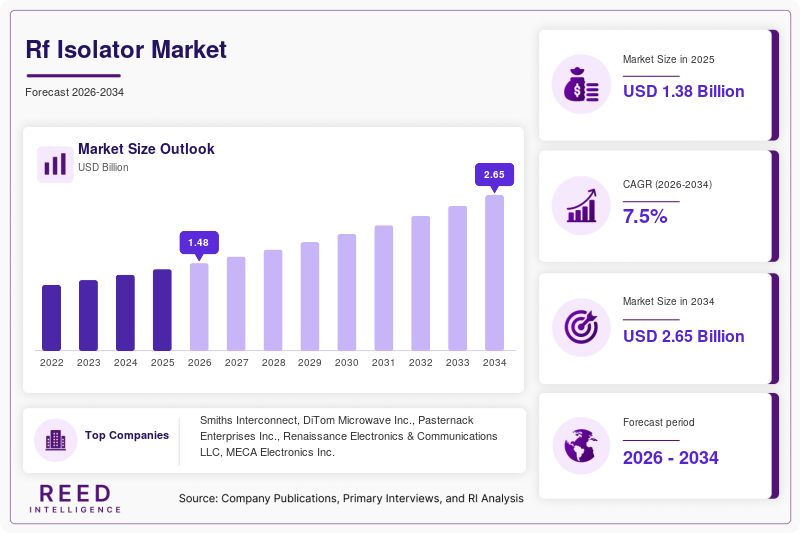
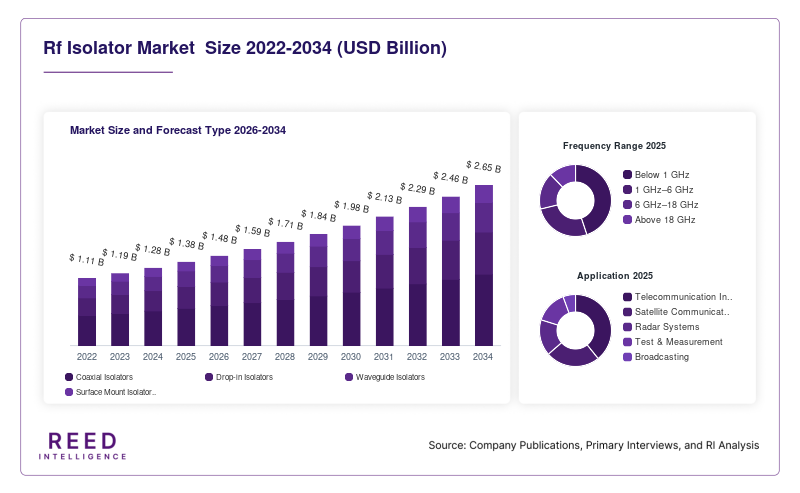
The Rf Isolator Market size was valued at USD 1.38 billion in 2026 and is projected to reach USD 2.47 billion by 2034, expanding at a CAGR of 7.5% during 2026–2034. RF isolators are passive microwave components designed to allow radio frequency energy to pass in one direction while minimizing reflected power in the reverse direction. These components are essential in communication systems, radar modules, satellite payloads, wireless infrastructure, and defense electronics where signal integrity and equipment protection are critical.
A major global factor supporting growth in the Rf Isolator Market has been the accelerated deployment of advanced wireless communication networks. Expansion of 5G base stations, private industrial networks, IoT ecosystems, and satellite communication platforms has increased the need for high-frequency components that improve system efficiency and reduce interference. RF isolators help stabilize performance in transmitters, receivers, and amplifiers, making them increasingly important across telecom and aerospace applications.
Key Highlights
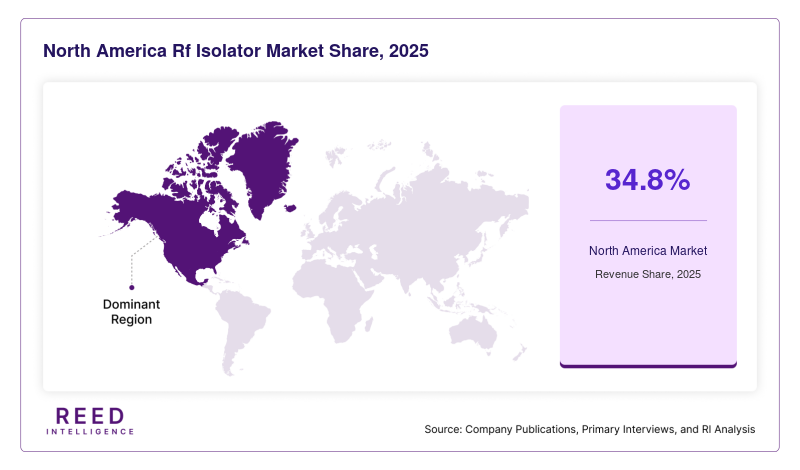
- North America accounted for the dominant 34.8% market share in 2025.
- Asia Pacific is expected to register the fastest growth at 8.9% CAGR through 2034.
- By Type, Coaxial Isolators led with 41.6% share in 2025.
- By Type, Drop-in Isolators are projected to grow fastest at 8.7% CAGR.
- By Frequency Range, 1 GHz–6 GHz dominated with 46.2% share in 2025.
- By Frequency Range, Above 18 GHz will grow fastest at 9.4% CAGR.
- By Application, Telecommunication Infrastructure held 39.5% share in 2025.
- By Application, Satellite Communication is expected to expand at 9.1% CAGR.
- The U.S. market was valued at USD 372 million in 2024 and USD 398 million in 2025.
Market Trends
Miniaturization of RF Components
System designers are increasingly demanding compact devices that fit into dense circuit architectures. This has driven innovation in smaller RF isolators with lower insertion loss and improved thermal stability. Miniaturized units are being widely adopted in small cells, portable defense systems, and compact satellite payloads.
Growing Use in High-Frequency Communication Systems
The migration toward millimeter-wave communication, phased-array radar, and advanced satellite links is increasing the use of high-frequency RF isolators. Suppliers are introducing products capable of stable operation above 18 GHz, supporting next-generation broadband and aerospace applications.
Market Drivers
Expansion of 5G and Wireless Infrastructure
Rapid rollout of 5G networks has created sustained demand for components that maintain signal quality and protect amplifiers from reflected power. RF isolators are widely integrated into base stations, repeaters, and distributed antenna systems, supporting growth of the Rf Isolator Market.
Increasing Defense and Aerospace Electronics Spending
Modern radar systems, electronic warfare platforms, and secure communication equipment require precise microwave signal management. Rising procurement of advanced military electronics has increased demand for rugged RF isolators with high reliability and wide operating ranges.
Market Restraint
High Cost of Precision Materials and Manufacturing
RF isolators rely on ferrite materials, precision magnetic assemblies, and stringent quality control. These factors raise production costs, particularly for high-frequency or defense-grade units, which can limit adoption in price-sensitive commercial markets.
Market Opportunities
Emergence of Low Earth Orbit Satellite Networks
Large-scale satellite constellations require compact, lightweight, and efficient RF components. RF isolators designed for space environments will create new revenue streams for manufacturers serving satellite communication programs.
Industrial Automation and Private Networks
Factories deploying private wireless networks for automation need stable communication hardware. RF isolators integrated into routers, gateways, and machine connectivity modules will gain opportunities as Industry 4.0 expands.
Segmental Analysis
By Type
Dominant Subsegment: Coaxial Isolators held the leading 41.6% share in 2025. Their durability, broad frequency compatibility, and ease of integration made them widely used in telecom systems, laboratory instruments, and defense hardware.
Fastest-Growing Subsegment: Drop-in isolators are expected to grow at 8.7% CAGR through 2034. Their compact footprint and PCB-level integration advantages will support adoption in small cells, aerospace modules, and miniaturized RF assemblies.
By Frequency Range
Dominant Subsegment: 1 GHz–6 GHz The 1 GHz–6 GHz segment accounted for 46.2% share in 2025. This range aligned strongly with cellular infrastructure, Wi-Fi systems, and industrial communication networks.
Fastest-Growing Subsegment: Above 18 GHz The above 18 GHz segment will grow at 9.4% CAGR. Rising demand for millimeter-wave broadband, automotive radar, and satellite backhaul applications will accelerate adoption.
By Application
Dominant Subsegment: Telecommunication Infrastructure captured 39.5% share in 2025. RF isolators were heavily used in base stations, repeaters, and signal amplification systems to improve network reliability.
Fastest-Growing Subsegment:Satellite communication is forecast to expand at 9.1% CAGR. New commercial constellations and broadband coverage initiatives will require lightweight and high-performance RF isolators.
By End Use
Dominant Subsegment: Commercial Electronics Commercial electronics held 44.7% share in 2025 owing to wide usage in communication equipment, test instruments, and wireless systems.
Fastest-Growing Subsegment: Defense & Aerospace will grow at 8.8% CAGR as governments invest in secure communication, radar modernization, and airborne electronic systems.
Regional Analysis
North America
North America held 34.8% share of the Rf Isolator Market in 2025 and will grow at a 7.1% CAGR through 2034. The region benefits from strong defense electronics production and established telecom infrastructure upgrades. The United States remains dominant due to large investments in radar modernization and domestic semiconductor packaging capabilities.
Europe
Europe captured 24.1% market share in 2025 and will expand at a 6.8% CAGR during the forecast period. Growth is supported by aerospace manufacturing, industrial communication systems, and regional satellite programs. Germany leads the region due to strong industrial electronics engineering and automotive radar development.
Asia Pacific
Asia Pacific represented 28.7% share in 2025 and will register the fastest 8.9% CAGR by 2034. Demand is being driven by telecom tower expansion, consumer electronics production, and semiconductor assembly. China dominates owing to large-scale 5G infrastructure deployment and robust RF component manufacturing ecosystems.
Middle East & Africa
Middle East & Africa accounted for 6.1% share in 2025 and will grow at 7.4% CAGR through 2034. Increasing investment in smart cities, defense communication systems, and telecom coverage upgrades support demand. Saudi Arabia leads due to national digital transformation and security communication projects.
Latin America
Latin America held 6.3% market share in 2025 and will witness 7.0% CAGR during 2026–2034. Market expansion is linked to mobile network modernization and broadcasting upgrades. Brazil remains the leading country due to growing telecom infrastructure investments and industrial connectivity needs.
Competitive Landscape
The Rf Isolator Market remains moderately consolidated, with established microwave component manufacturers competing through frequency innovation, compact design, and reliability standards. Leading players focus on telecom, defense, and aerospace contracts while expanding custom-engineered product lines.
Smiths Interconnect remains a market leader due to its broad RF portfolio and strong presence in aerospace and defense applications. The company recently expanded high-frequency passive component production to support next-generation communication programs. DiTom Microwave is recognized for custom isolator and circulator solutions across military and laboratory markets. Pasternack Enterprises serves rapid-delivery commercial applications with broad catalog offerings. Renaissance Electronics & Communications focuses on rugged microwave assemblies for defense systems. MECA Electronics maintains a solid presence in telecom and test equipment components.
Competition is expected to intensify as Asian manufacturers increase capacity and customers seek lower-cost, compact RF isolator solutions for 5G and satellite systems.
Key Players List
- Smiths Interconnect
- DiTom Microwave Inc.
- Pasternack Enterprises Inc.
- Renaissance Electronics & Communications LLC
- MECA Electronics Inc.
- JQL Electronics Inc.
- Raditek Inc.
- Atlantic Microwave Ltd.
- Fairview Microwave Inc.
- UIY Inc.
- Anatech Electronics Inc.
- Microwave Devices Inc.
- ADMOTECH Co., Ltd.
- ETL Systems Ltd.
- SigaTek Microwave
Recent Developments
- Smiths Interconnect launched a new compact RF isolator range for high-density aerospace electronics integration.
- DiTom Microwave introduced broadband isolators optimized for satellite ground station networks.
- Pasternack Enterprises expanded same-day shipping inventory for coaxial RF isolators.
- Several Asian suppliers increased production of drop-in isolators for telecom OEM customers.
- Defense integrators adopted ruggedized waveguide isolators for advanced radar platforms.
Rf Isolator Market Segments
Type
- Coaxial Isolators
- Drop-in Isolators
- Waveguide Isolators
- Surface Mount Isolators
Frequency Range
- Below 1 GHz
- 1 GHz–6 GHz
- 6 GHz–18 GHz
- Above 18 GHz
Application
- Telecommunication Infrastructure
- Satellite Communication
- Radar Systems
- Test & Measurement
- Broadcasting
End Use
- Commercial Electronics
- Defense & Aerospace
- Industrial
- Research Institutions
By Region
- North America
- Europe
- APAC
- Middle East and Africa
- LATAM