RFID Middleware Market Size, Share & Demand Report By Component (Software, Services, Hardware Integration), By Application (Inventory Management, Asset Tracking, Supply Chain Management, Access Control), By End-Use Industry (Retail, Healthcare, Manufacturing, Logistics & Transportation, Government) By Region & Segment Forecasts, 2026–2034
USD 3950
Market Overview
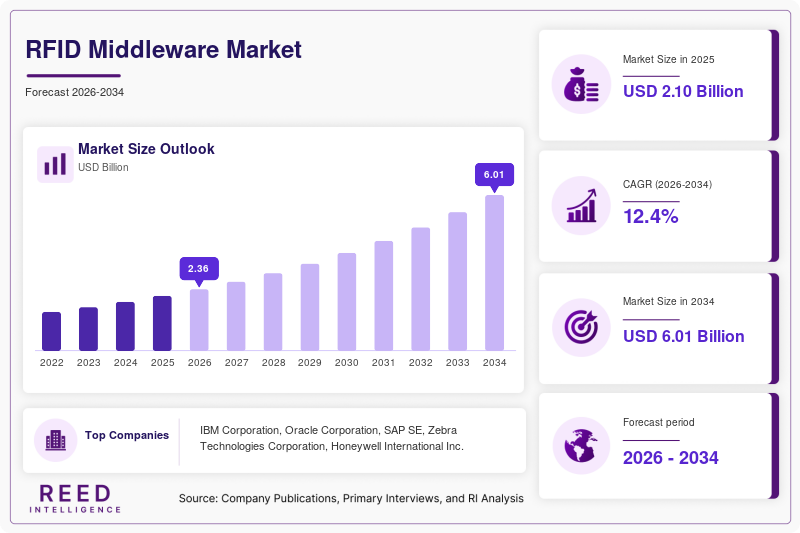
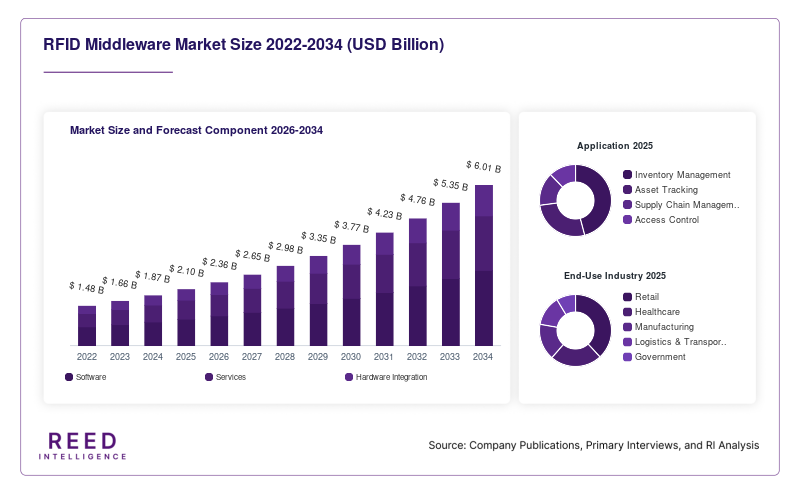
The RFID Middleware Market was valued at approximately USD 2.1 billion in 2026 and is projected to reach USD 5.4 billion by 2034, expanding at a CAGR of 12.4% during 2026–2034. RFID middleware serves as a critical integration layer between RFID hardware and enterprise applications, enabling real-time data processing, filtering, and analytics. The increasing adoption of digital supply chain solutions across manufacturing, retail, and logistics sectors has significantly supported market growth. Organizations are deploying RFID middleware to streamline asset tracking, enhance inventory accuracy, and improve operational visibility across distributed networks.
A major global factor driving market expansion is the rapid shift toward Industry 4.0 and smart automation ecosystems. Enterprises are investing in intelligent infrastructure that connects IoT devices, RFID tags, and cloud platforms. Middleware solutions play a vital role in managing data complexity and ensuring seamless interoperability between systems. Additionally, the rise of e-commerce and omnichannel retail has intensified the need for real-time tracking systems, further strengthening demand for RFID middleware platforms.
Key Highlights
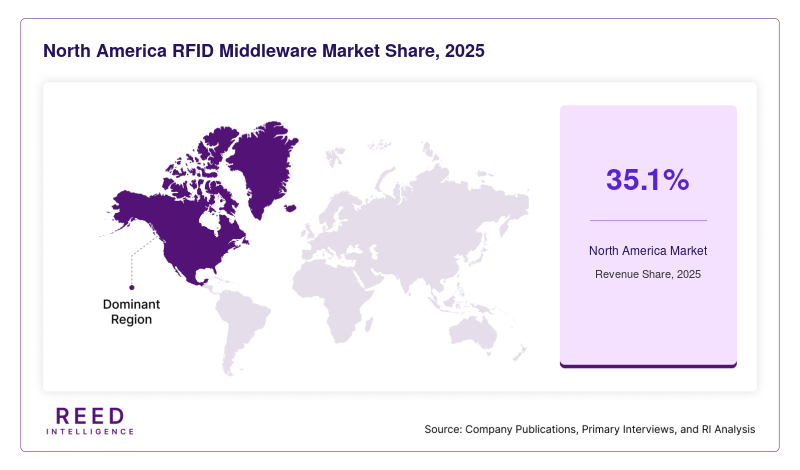
- North America dominated the market with a 35.1% share in 2025.
- Asia Pacific is expected to grow at the fastest CAGR of 13.2% during 2026–2034.
- By component, software solutions accounted for the largest share of 42.8%.
- while cloud-based middleware is projected to grow at a CAGR of 14.1%.
- By application, inventory management led with a 39.6% share, whereas asset tracking is expected to expand at a CAGR of 13.5%.
- The United States remained the dominant country, with market values of USD 620 million in 2024 and USD 690 million in 2025.
Market Trends
Integration of RFID Middleware with Cloud and Edge Computing
A notable trend shaping the RFID middleware market is the growing integration with cloud and edge computing technologies. Enterprises are increasingly adopting hybrid architectures that combine centralized cloud platforms with edge processing capabilities. RFID middleware is evolving to support distributed data processing, allowing real-time decision-making closer to the data source. This reduces latency and enhances operational efficiency in industries such as logistics and manufacturing. Cloud-based middleware solutions also provide scalability, enabling organizations to handle increasing volumes of RFID data without significant infrastructure investments. Furthermore, the ability to integrate middleware with analytics tools and AI-driven platforms is enhancing predictive insights, making it a key trend driving digital transformation initiatives.
Rising Adoption in Retail and E-commerce for Inventory Visibility
Retailers and e-commerce companies are adopting RFID middleware to improve inventory visibility and optimize supply chain operations. With increasing consumer expectations for fast and accurate deliveries, businesses are leveraging RFID-enabled systems to track goods across warehouses and stores. Middleware solutions help filter and process large volumes of RFID data, ensuring accurate stock levels and minimizing shrinkage. This trend is particularly evident in omnichannel retail strategies, where seamless integration between online and offline systems is essential. Additionally, retailers are using RFID middleware to enhance customer experiences through automated checkout and smart shelf technologies, reinforcing its growing importance in the retail sector.
Market Drivers
Increasing Demand for Real-Time Data and Supply Chain Visibility
The rising need for real-time data across supply chains is a primary driver of the RFID middleware market. Organizations are under pressure to improve operational transparency and respond quickly to disruptions. RFID middleware enables real-time tracking of goods, assets, and inventory, providing actionable insights that enhance decision-making. This capability is particularly important in industries such as healthcare, logistics, and manufacturing, where delays or inaccuracies can lead to significant losses. By integrating RFID data with enterprise systems, middleware solutions help streamline workflows and reduce manual errors. As global supply chains become more complex, the demand for advanced middleware solutions continues to grow.
Expansion of IoT Ecosystems Across Industries
The rapid expansion of IoT ecosystems is significantly driving the adoption of RFID middleware. Businesses are deploying interconnected devices to monitor operations and gather data in real time. RFID technology forms a critical component of these ecosystems, and middleware solutions act as the bridge between hardware and applications. With increasing IoT adoption in sectors such as agriculture, transportation, and industrial automation, the need for robust middleware platforms is rising. These solutions enable efficient data aggregation, filtering, and integration, ensuring seamless communication between devices and systems. As IoT deployments continue to expand, RFID middleware is becoming essential for managing data complexity and ensuring system interoperability.
Market Restraint
High Implementation Costs and Integration Complexity
One of the key restraints in the RFID middleware market is the high cost associated with implementation and system integration. Deploying RFID infrastructure requires significant investment in hardware, software, and network capabilities. Middleware solutions, while essential, add another layer of complexity to the overall system architecture. Small and medium-sized enterprises often face challenges in justifying these costs, especially when immediate returns on investment are not evident. Additionally, integrating RFID middleware with existing enterprise systems such as ERP and warehouse management systems can be technically challenging and time-consuming.
The complexity of customization and compatibility issues further limits adoption, particularly in industries with legacy infrastructure. Organizations may require specialized expertise to configure middleware platforms, leading to increased operational costs. For example, in manufacturing environments with diverse equipment and systems, achieving seamless integration can be difficult. These challenges can delay deployment timelines and hinder market growth. Despite these restraints, ongoing advancements in cloud-based solutions and standardized protocols are expected to gradually reduce implementation barriers.
Market Opportunities
Growth in Smart Warehousing and Logistics Automation
The increasing adoption of smart warehousing solutions presents a significant opportunity for the RFID middleware market. Warehouses are evolving into highly automated environments where real-time tracking and data analytics are essential for efficiency. RFID middleware enables seamless communication between RFID readers, sensors, and warehouse management systems, facilitating accurate inventory tracking and faster order fulfillment. As logistics companies invest in automation technologies such as robotics and AI, the demand for advanced middleware solutions is expected to rise. This trend is particularly strong in regions experiencing rapid e-commerce growth, where efficient logistics operations are critical for competitiveness.
Expansion in Healthcare Asset Tracking and Patient Management
Healthcare is emerging as a promising application area for RFID middleware. Hospitals and healthcare providers are increasingly using RFID technology to track medical equipment, manage inventory, and monitor patient movement. Middleware solutions play a crucial role in processing and integrating data from multiple RFID devices, ensuring accurate and timely information. This improves operational efficiency and enhances patient safety. Additionally, the growing focus on digital healthcare transformation and smart hospitals is driving investment in RFID-based systems. As healthcare organizations seek to improve resource utilization and reduce operational costs, the adoption of RFID middleware is expected to accelerate.
Segmental Analysis
By Component
The software segment dominated the RFID middleware market, accounting for approximately 42.8% of the total share in 2024. This dominance is attributed to the critical role software plays in managing, filtering, and analyzing RFID data. Middleware software enables seamless integration between RFID hardware and enterprise applications, making it essential for organizations seeking to optimize operations. Industries such as retail, healthcare, and logistics rely heavily on software solutions to ensure accurate data processing and real-time visibility. Additionally, advancements in analytics and AI integration have further enhanced the capabilities of middleware software, driving its adoption across various sectors.
The cloud-based middleware subsegment is expected to be the fastest-growing, with a CAGR of 14.1% during the forecast period. The growth is driven by increasing demand for scalable and cost-effective solutions that can handle large volumes of data. Cloud-based middleware offers flexibility, allowing organizations to deploy and manage RFID systems without significant infrastructure investments. It also enables remote access and real-time analytics, making it ideal for global operations. As businesses continue to embrace digital transformation, the adoption of cloud-based middleware solutions is expected to accelerate significantly.
By Application
Inventory management emerged as the dominant application segment, holding a share of 39.6% in 2024. Organizations across industries are leveraging RFID middleware to improve inventory accuracy and reduce operational inefficiencies. Middleware solutions facilitate real-time tracking and data processing, ensuring that inventory levels are accurately maintained. This is particularly important in retail and manufacturing sectors, where inventory discrepancies can lead to significant losses. The ability to integrate RFID data with enterprise systems further enhances operational efficiency, making inventory management a key application area.
Asset tracking is projected to be the fastest-growing application segment, with a CAGR of 13.5% during the forecast period. The increasing need to monitor high-value assets in real time is driving the adoption of RFID middleware solutions. Industries such as healthcare and logistics are using asset tracking systems to improve resource utilization and reduce losses. Middleware platforms enable seamless data integration and provide actionable insights, enhancing decision-making. As organizations continue to prioritize efficiency and cost reduction, the demand for asset tracking solutions is expected to grow significantly.
By End-Use Industry
The retail sector dominated the RFID middleware market, accounting for a significant share in 2024. Retailers are increasingly adopting RFID technology to enhance inventory visibility, reduce shrinkage, and improve customer experience. Middleware solutions play a crucial role in processing and integrating data from RFID systems, enabling real-time insights and efficient operations. The growth of e-commerce and omnichannel retail strategies has further accelerated the adoption of RFID middleware in this sector.
The healthcare sector is expected to be the fastest-growing end-use industry, with a CAGR of 13.8% during the forecast period. The adoption of RFID middleware in healthcare is driven by the need for efficient asset tracking, patient management, and inventory control. Middleware solutions enable seamless data integration and real-time monitoring, improving operational efficiency and patient safety. As healthcare organizations continue to invest in digital transformation, the demand for RFID middleware solutions is expected to increase significantly.
Regional Analysis
North America
North America held the largest share of the RFID middleware market, accounting for approximately 35.1% in 2025, and is expected to maintain steady growth at a CAGR of 11.8% during the forecast period. The region benefits from advanced technological infrastructure and early adoption of IoT and RFID solutions across industries. Enterprises in the United States and Canada are investing in middleware platforms to enhance supply chain efficiency and operational visibility. The presence of major technology providers and continuous innovation in cloud computing further support market growth.
The United States remains the dominant country in North America, driven by strong demand from retail, healthcare, and logistics sectors. A key growth factor is the widespread adoption of omnichannel retail strategies, which require real-time inventory tracking and integration across multiple platforms. This has led to increased deployment of RFID middleware solutions to manage data flows and improve customer experience.
Europe
Europe accounted for a significant share of the RFID middleware market in 2025, contributing around 26.4%, and is projected to grow at a CAGR of 11.5% through 2034. The region’s growth is supported by strong regulatory frameworks promoting digital transformation and data standardization. Industries such as automotive, manufacturing, and retail are increasingly adopting RFID middleware to enhance operational efficiency and compliance.
Germany stands out as the dominant country in the European market, owing to its advanced manufacturing sector and focus on Industry 4.0 initiatives. A unique growth factor is the integration of RFID middleware in smart factory environments, where real-time data processing is essential for optimizing production processes and reducing downtime.
Asia Pacific
Asia Pacific is the fastest-growing region in the RFID middleware market, with a CAGR of 13.2% during the forecast period and a 2025 share of approximately 22.7%. Rapid industrialization, expanding e-commerce activities, and increasing investments in digital infrastructure are driving market growth. Countries such as China, Japan, and India are witnessing significant adoption of RFID solutions across logistics and retail sectors.
China leads the Asia Pacific market due to its large manufacturing base and strong government support for smart technologies. A key growth factor is the rapid expansion of e-commerce platforms, which require efficient supply chain management and real-time inventory tracking, boosting demand for RFID middleware solutions.
Middle East & Africa
The Middle East & Africa region accounted for around 8.3% of the RFID middleware market in 2025 and is expected to grow at a CAGR of 10.9% through 2034. Growth in this region is driven by increasing investments in infrastructure development and digital transformation initiatives. Governments are focusing on smart city projects, which incorporate RFID technology for asset tracking and security management.
The United Arab Emirates is the dominant country in this region, supported by its focus on smart city development and advanced logistics infrastructure. A unique growth factor is the integration of RFID middleware in airport and transportation systems, enhancing operational efficiency and passenger experience.
Latin America
Latin America held a market share of approximately 7.5% in 2025 and is projected to grow at a CAGR of 10.7% during the forecast period. The region is gradually adopting RFID technology to improve supply chain operations and reduce inefficiencies. Retail and logistics sectors are key contributors to market growth.
Brazil is the leading country in Latin America, driven by its expanding retail industry and growing investments in digital technologies. A unique growth factor is the adoption of RFID middleware in agricultural supply chains, where real-time tracking helps improve productivity and reduce losses.
Competitive Landscape
The RFID middleware market is characterized by the presence of several established players focusing on innovation and strategic partnerships to strengthen their market position. Companies are investing in advanced technologies such as cloud computing, AI, and IoT integration to enhance their product offerings. The competitive landscape is moderately fragmented, with both global and regional players contributing to market growth.
One of the leading companies in the market is IBM Corporation, which has developed advanced middleware solutions that integrate RFID data with enterprise applications. The company recently introduced enhancements to its cloud-based middleware platform, enabling improved scalability and real-time analytics capabilities. Other key players are focusing on expanding their product portfolios and entering new markets through collaborations and acquisitions. Continuous innovation and the development of industry-specific solutions are expected to intensify competition in the coming years.
Key Players List
- IBM Corporation
- Oracle Corporation
- SAP SE
- Zebra Technologies Corporation
- Honeywell International Inc.
- Impinj Inc.
- Alien Technology LLC
- Avery Dennison Corporation
- Nedap N.V.
- GAO Group
- SATO Holdings Corporation
- Checkpoint Systems Inc.
- Mojix Inc.
- Terso Solutions Inc.
- GlobeRanger Corporation
Recent Developments
- In 2025, a leading RFID solutions provider launched a cloud-native middleware platform designed for large-scale logistics operations.
- In 2024, a global technology company partnered with a retail chain to deploy RFID middleware for real-time inventory tracking across multiple locations.
- In 2025, a healthcare technology firm introduced an RFID middleware solution focused on improving hospital asset management and patient tracking systems.
RFID Middleware Market Segments
Component
- Software
- Services
- Hardware Integration
Application
- Inventory Management
- Asset Tracking
- Supply Chain Management
- Access Control
End-Use Industry
- Retail
- Healthcare
- Manufacturing
- Logistics & Transportation
- Government
By Region
- North America
- Europe
- APAC
- Middle East and Africa
- LATAM