Riot Control Vehicle Market Size, Share & Demand Report By Vehicle Type (Armored Riot Control Vehicles, Water Cannon Vehicles, Unmanned Ground Vehicles), By Application (Law Enforcement, Border Security, Military Support), By End-Use (Government & Municipal Agencies, Private Security, Industrial Sector), By Region & Segment Forecasts, 2026–2034
USD 3950
Market Overview
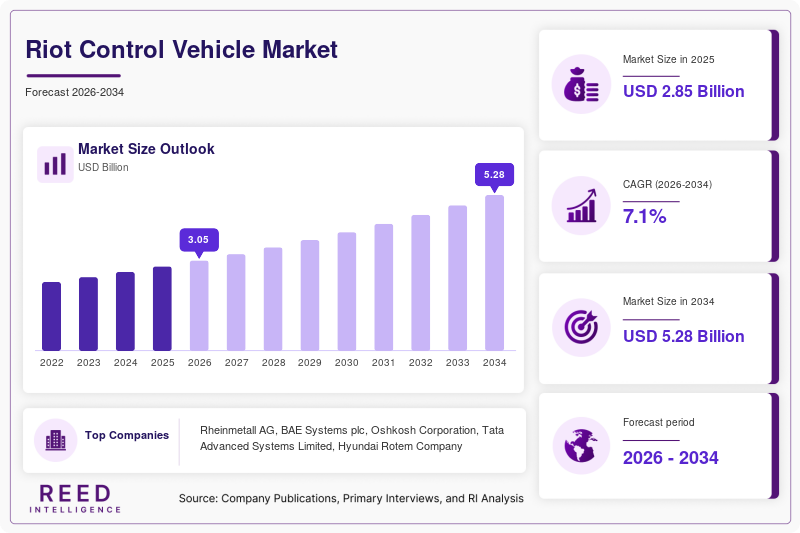
The Riot Control Vehicle Market size was valued at approximately USD 2.85 billion in 2026 and is projected to reach USD 4.92 billion by 2034, expanding at a CAGR of 7.1% during the forecast period (2026–2034). The market growth is primarily supported by the rising emphasis on public safety infrastructure and the modernization of law enforcement fleets across both developed and emerging economies. Governments are increasingly allocating budgetary resources toward advanced crowd management solutions, including armored vehicles equipped with non-lethal dispersal systems, surveillance technologies, and enhanced mobility capabilities. This sustained investment trend has created a stable demand environment for riot control vehicles globally.
A notable global factor supporting market expansion is the increasing frequency of urban protests, civil unrest, and large-scale public gatherings. Authorities are focusing on minimizing casualties while maintaining order, which has driven the adoption of vehicles designed with non-lethal technologies such as water cannons, tear gas dispensers, and acoustic devices. Additionally, advancements in vehicle engineering, including improved maneuverability, integrated communication systems, and enhanced protective features, are further contributing to the market’s growth trajectory.
Key Highlights
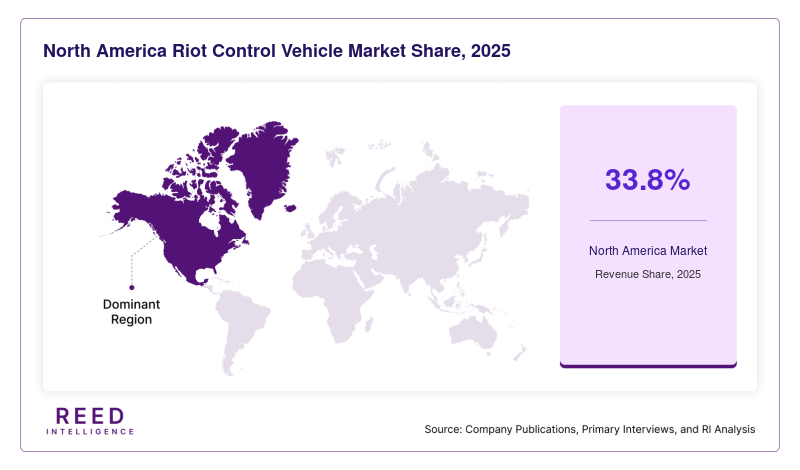
- North America dominated the market with a 33.8% share in 2025.
- Asia Pacific is expected to grow at the fastest CAGR of 8.4% during 2026–2034.
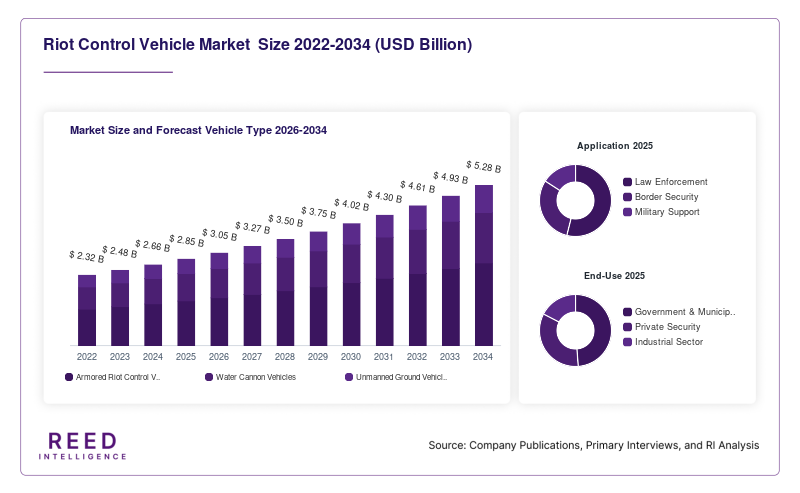
- By vehicle type, armored riot control vehicles accounted for the largest share of 42.6%, while unmanned ground vehicles are projected to grow at a CAGR of 9.1%.
- By application, law enforcement agencies led with a 47.3% share, whereas border security operations are expected to expand at a CAGR of 8.7%.
- The United States remained the dominant country, with market values of USD 520 million in 2024 and USD 575 million in 2025.
Market Trends
Integration of advanced surveillance and communication systems
A key trend shaping the Riot Control Vehicle Market is the integration of advanced surveillance and communication technologies into vehicle platforms. Modern riot control vehicles are increasingly equipped with high-definition cameras, thermal imaging sensors, real-time data transmission systems, and AI-based crowd monitoring tools. These features enable law enforcement agencies to gain situational awareness, track crowd movements, and respond with precision. The ability to collect and analyze real-time data has improved operational efficiency and decision-making processes during crowd control scenarios.
Furthermore, the adoption of network-enabled vehicles that can communicate with central command centers and other units is enhancing coordination during complex operations. This trend is particularly evident in developed regions where smart policing initiatives are gaining traction. As governments prioritize digital transformation in public safety, manufacturers are focusing on integrating interoperable communication systems and cloud-based analytics platforms. This evolution is expected to redefine how riot control vehicles are deployed, making them more than just physical deterrents and transforming them into mobile command units.
Rising adoption of non-lethal crowd control technologies
Another significant trend is the increasing adoption of non-lethal technologies integrated within riot control vehicles. Authorities are shifting toward solutions that reduce the risk of fatalities and injuries during crowd management operations. Vehicles equipped with water cannons, rubber bullet launchers, tear gas dispersal systems, and long-range acoustic devices are becoming standard across many regions. This shift aligns with growing public scrutiny and the need for compliance with international human rights standards.
The demand for non-lethal capabilities is also influencing vehicle design and functionality. Manufacturers are developing modular systems that allow easy integration of different crowd control tools based on operational requirements. Additionally, advancements in precision targeting and controlled dispersal mechanisms are improving the effectiveness of these technologies. As public accountability and transparency become more important, the adoption of non-lethal riot control solutions is expected to remain a defining trend in the market.
Market Drivers
Increasing urbanization and public gatherings
Rapid urbanization and the growing frequency of large-scale public events are major drivers of the Riot Control Vehicle Market. As urban populations expand, cities are witnessing an increase in protests, demonstrations, and social gatherings. These events require effective crowd management solutions to ensure public safety and prevent escalation into violence. Riot control vehicles provide mobility, protection, and operational efficiency, making them essential assets for law enforcement agencies operating in densely populated areas.
In addition, governments are investing in modern policing infrastructure to address the complexities of urban security. The need to manage diverse crowd scenarios, including political rallies, sports events, and emergency evacuations, is driving demand for versatile and technologically advanced vehicles. Emerging economies, in particular, are witnessing a surge in procurement activities as they strengthen their internal security frameworks. This ongoing urban expansion is expected to sustain demand for riot control vehicles over the forecast period.
Government investments in defense and internal security
Another critical driver is the increasing allocation of government budgets toward defense and internal security. Many countries are prioritizing the modernization of their law enforcement fleets to enhance operational readiness and response capabilities. Riot control vehicles are a key component of these modernization programs, offering a combination of protection, mobility, and crowd management tools.
In regions experiencing political instability or social unrest, governments are accelerating procurement efforts to strengthen their security forces. Additionally, international collaborations and defense agreements are facilitating the transfer of advanced technologies, further boosting market growth. The emphasis on homeland security and disaster response preparedness is also contributing to the adoption of these vehicles. As governments continue to focus on maintaining public order and safeguarding critical infrastructure, investments in riot control vehicles are expected to remain strong.
Market Restraint
High acquisition and maintenance costs
One of the primary restraints affecting the Riot Control Vehicle Market is the high cost associated with the acquisition and maintenance of these specialized vehicles. Riot control vehicles are typically equipped with advanced armor, surveillance systems, and non-lethal weaponry, which significantly increases their production costs. For many developing countries with limited defense budgets, the high upfront investment can be a major barrier to adoption. This often results in delayed procurement decisions or reliance on older, less efficient equipment.
In addition to acquisition costs, ongoing maintenance and operational expenses further add to the financial burden. These vehicles require regular servicing, specialized spare parts, and trained personnel to ensure optimal performance. Budget constraints can limit the ability of agencies to maintain their fleets effectively, potentially impacting operational readiness. For example, smaller municipalities or regional law enforcement units may struggle to justify the cost of advanced riot control vehicles, leading to uneven adoption across different regions. This cost-related challenge continues to restrain market growth, particularly in price-sensitive markets.
Market Opportunities
Development of unmanned and autonomous vehicles
The emergence of unmanned and autonomous technologies presents a significant opportunity for the Riot Control Vehicle Market. Unmanned ground vehicles (UGVs) designed for crowd control operations are gaining attention due to their ability to reduce risks to personnel. These vehicles can be deployed in high-risk environments, perform surveillance, and even disperse crowds using non-lethal methods without direct human involvement.
Advancements in robotics, artificial intelligence, and remote control systems are enabling the development of highly capable unmanned platforms. These vehicles can operate in hazardous conditions, such as riots involving violence or chemical threats, where human intervention may be dangerous. Governments and defense agencies are increasingly investing in research and development to explore the potential of autonomous riot control solutions. As technology matures, the adoption of unmanned vehicles is expected to create new growth avenues and transform traditional crowd management strategies.
Expansion in emerging markets
Emerging economies present a substantial growth opportunity for the Riot Control Vehicle Market. Countries in regions such as Asia Pacific, Latin America, and Africa are experiencing rapid urbanization and socio-political changes, leading to increased demand for effective crowd control solutions. Governments in these regions are investing in modernizing their law enforcement capabilities to address evolving security challenges.
The growing focus on infrastructure development, industrialization, and public safety is driving procurement activities in emerging markets. Additionally, favorable government policies, international funding, and partnerships with global manufacturers are facilitating the adoption of advanced riot control vehicles. Local production initiatives and technology transfer agreements are also helping reduce costs and improve accessibility. As these regions continue to develop economically and socially, the demand for riot control vehicles is expected to rise significantly, offering lucrative opportunities for market participants.
Segmental Analysis
By Vehicle Type
Armored riot control vehicles emerged as the dominant subsegment, accounting for approximately 42.6% of the market share in 2024. These vehicles are widely used due to their ability to provide enhanced protection to personnel while operating in high-risk environments. Equipped with reinforced armor, bullet-resistant glass, and advanced defense systems, armored vehicles are essential for managing violent protests and ensuring the safety of law enforcement officers. Their versatility in handling multiple operational scenarios, including urban and rural deployments, further contributes to their dominance.
Additionally, armored vehicles often integrate multiple crowd control tools such as water cannons, tear gas launchers, and surveillance systems, making them comprehensive solutions for law enforcement agencies. The demand for these vehicles is particularly strong in regions with high levels of civil unrest and security challenges. Their durability and long operational lifespan also make them a preferred choice for government procurement programs.Unmanned ground vehicles represent the fastest-growing subsegment, with a projected CAGR of 9.1% during the forecast period. The growth of this segment is driven by advancements in robotics and automation technologies. These vehicles offer the advantage of reducing risks to human personnel by enabling remote operation in hazardous environments. They are increasingly being used for surveillance, reconnaissance, and non-lethal crowd dispersal.
By Application
Law enforcement agencies accounted for the largest share of 47.3% in 2024, making them the dominant application segment. These agencies rely heavily on riot control vehicles to manage public gatherings, protests, and emergency situations. The need for efficient crowd management and rapid response capabilities drives the demand for these vehicles within the law enforcement sector.
Riot control vehicles used by law enforcement agencies are designed to provide mobility, protection, and operational flexibility. They are equipped with advanced communication systems, enabling coordination with other units and command centers. The increasing complexity of urban security challenges and the need for maintaining public order are key factors contributing to the dominance of this segment.Border security operations are expected to be the fastest-growing application segment, with a CAGR of 8.7%. The growth is driven by the need to monitor and control cross-border activities, including illegal migration and smuggling. Riot control vehicles equipped with surveillance and detection systems are being deployed to enhance border security operations.
By End-Use
Government and municipal agencies dominated the end-use segment, accounting for a significant share of the market in 2024. These agencies are responsible for maintaining public order and ensuring safety during large gatherings and emergencies. The procurement of riot control vehicles by government bodies is driven by the need to modernize public safety infrastructure and enhance operational efficiency.
These agencies often require customized vehicles tailored to specific operational needs, including urban policing and disaster response. The availability of funding and policy support further strengthens their position as the dominant end users. The increasing focus on smart city initiatives is also contributing to the adoption of advanced riot control vehicles.Private security and industrial sectors are emerging as the fastest-growing end-use segment, with a notable CAGR over the forecast period. The growth is driven by the need to secure large industrial facilities, infrastructure projects, and private events. Companies are investing in advanced security solutions to protect assets and ensure safety.
Regional Analysis
North America
North America accounted for approximately 33.8% of the Riot Control Vehicle Market share in 2025 and is expected to grow at a CAGR of 6.5% during the forecast period. The region benefits from well-established law enforcement infrastructure and significant investments in public safety technologies. The presence of leading manufacturers and continuous technological advancements contribute to the region’s strong market position. Demand is driven by the need for modernized crowd control solutions and enhanced operational efficiency.
The United States remains the dominant country in this region, supported by its extensive law enforcement network and high defense spending. A unique growth factor is the increasing adoption of smart policing initiatives, which integrate advanced surveillance and communication systems into riot control vehicles. These initiatives are aimed at improving response times and ensuring effective crowd management in complex urban environments.
Europe
Europe held a market share of around 27.4% in 2025 and is projected to grow at a CAGR of 6.8% through 2034. The region’s growth is driven by stringent regulations on public safety and the adoption of non-lethal crowd control technologies. Governments are focusing on maintaining order during protests and large gatherings while adhering to human rights standards. This has led to increased demand for advanced riot control vehicles.
Germany is a key contributor to the European market, benefiting from strong industrial capabilities and a focus on technological innovation. A unique growth factor in this region is the emphasis on sustainability and eco-friendly vehicle designs. Manufacturers are exploring hybrid and electric riot control vehicles to align with environmental regulations and reduce carbon emissions.
Asia Pacific
Asia Pacific is expected to be the fastest-growing region, with a CAGR of 8.4% during the forecast period, and accounted for 22.6% of the market share in 2025. Rapid urbanization, population growth, and increasing socio-political activities are driving demand for riot control vehicles. Governments are investing heavily in modernizing their law enforcement and security infrastructure to address emerging challenges.
China dominates the Asia Pacific market due to its large population and extensive investment in public security. A unique growth factor is the government’s focus on domestic manufacturing and technological self-reliance. This has led to the development of locally produced riot control vehicles equipped with advanced features, boosting market growth in the region.
Middle East & Africa
The Middle East & Africa region accounted for 9.3% of the market share in 2025 and is expected to grow at a CAGR of 7.2%. The region’s growth is driven by the need to maintain stability in areas experiencing political unrest and security challenges. Governments are prioritizing investments in advanced crowd control solutions to ensure public safety and protect critical infrastructure.
Saudi Arabia is a leading country in this region, supported by substantial defense spending and modernization initiatives. A unique growth factor is the increasing focus on large-scale events and tourism development, which requires effective crowd management solutions. This is driving demand for technologically advanced riot control vehicles.
Latin America
Latin America held a market share of 6.9% in 2025 and is projected to grow at a CAGR of 7.0% during the forecast period. The region is witnessing increasing demand for riot control vehicles due to rising urbanization and socio-economic challenges. Governments are focusing on strengthening their law enforcement capabilities to address public safety concerns.
Brazil is the dominant country in this region, benefiting from its large population and growing urban centers. A unique growth factor is the increasing frequency of public demonstrations and events, which necessitates effective crowd control measures. This is encouraging investments in modern riot control vehicles across the country.
Competitive Landscape
The Riot Control Vehicle Market is characterized by the presence of several established players competing on the basis of technology, product innovation, and global reach. The market is moderately consolidated, with key companies focusing on strategic collaborations, product development, and expansion into emerging markets to strengthen their positions. Leading manufacturers are investing in research and development to integrate advanced features such as AI-based surveillance, autonomous capabilities, and enhanced non-lethal systems into their vehicles.
One of the leading players in the market is Rheinmetall AG, which has established a strong presence through its advanced armored vehicle solutions and continuous innovation. The company recently introduced an upgraded riot control vehicle equipped with enhanced communication systems and modular non-lethal capabilities, aimed at improving operational efficiency. Other major players are also focusing on expanding their product portfolios and enhancing their global distribution networks to cater to the growing demand for riot control vehicles.
Key Players List
- Rheinmetall AG
- BAE Systems plc
- Oshkosh Corporation
- Tata Advanced Systems Limited
- Hyundai Rotem Company
- Streit Group
- Paramount Group
- INKAS Armored Vehicle Manufacturing
- JCB Ltd.
- Iveco Defence Vehicles
- Arquus
- Elbit Systems Ltd.
- Thales Group
- Norinco Group
- Otokar Otomotiv ve Savunma Sanayi
Recent Developments
- A major defense manufacturer launched a next-generation riot control vehicle featuring AI-enabled surveillance and real-time data analytics capabilities.
- A leading automotive defense company secured a contract to supply advanced water cannon vehicles to a national police force in Asia Pacific.
- An industry player introduced a hybrid-powered riot control vehicle aimed at reducing emissions and improving fuel efficiency while maintaining operational performance.
Riot Control Vehicle Market Segments
Vehicle Type
- Armored Riot Control Vehicles
- Water Cannon Vehicles
- Unmanned Ground Vehicles
Application
- Law Enforcement
- Border Security
- Military Support
End-Use
- Government & Municipal Agencies
- Private Security
- Industrial Sector
By Region
- North America
- Europe
- APAC
- Middle East and Africa
- LATAM