Riveting Tool Market Size, Share Demand Report By Type (Manual Riveting Tools, Pneumatic Riveting Tools, Hydraulic Riveting Tools), By Application (Automotive Assembly, Aerospace Fastening, Construction, Industrial Equipment Assembly), By End Use (Industrial Manufacturing, Construction Contractors), By Region & Segment Forecasts, 2026–2034
USD 3950
Market Overview
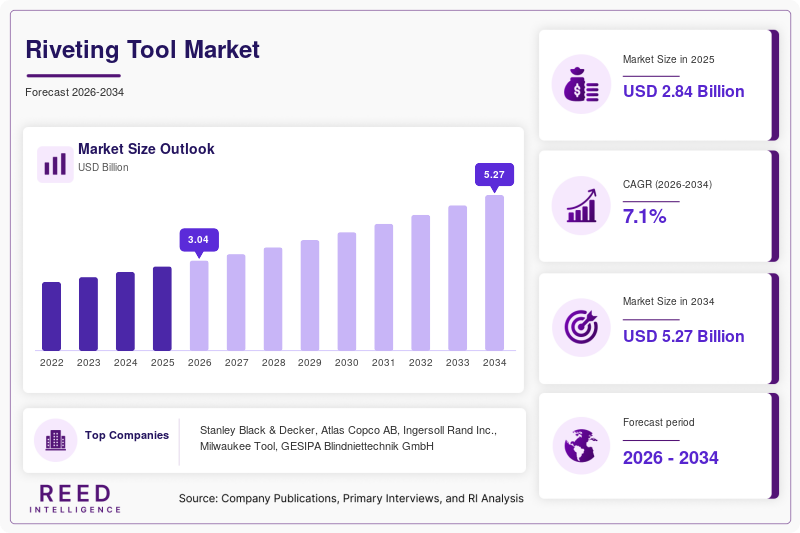
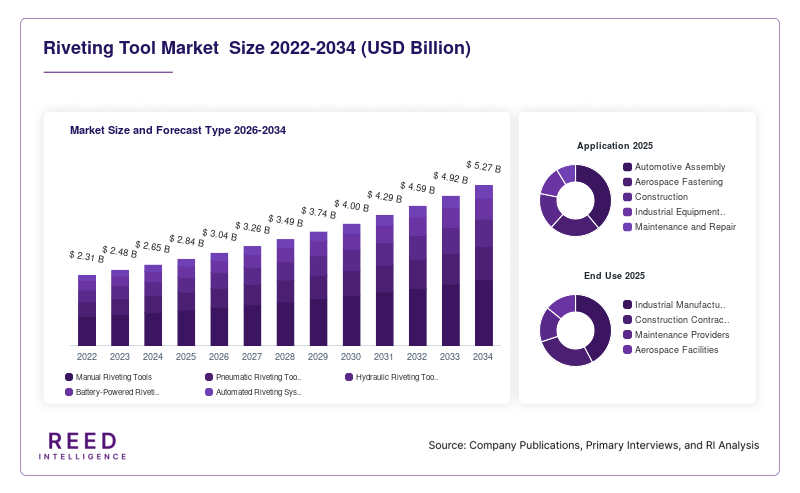
The global Riveting Tool Market size was valued at USD 2.84 billion in 2026 and is projected to reach USD 4.91 billion by 2034, expanding at a CAGR of 7.1% during the forecast period (2026–2034). The market has been supported by rising industrial automation across manufacturing environments, particularly in metal joining processes where efficiency, repeatability, and precision remain critical. A major global factor supporting market growth has been the broader expansion of industrial production, especially in automotive, aerospace, and heavy equipment sectors, which has increased the use of advanced riveting systems.
Riveting tools are widely used in fastening applications where durable mechanical joints are required. The market includes manual, pneumatic, hydraulic, battery-powered, and automated riveting systems designed for industrial assembly and maintenance operations. Demand has steadily shifted toward higher productivity tools with improved ergonomics, reduced downtime, and compatibility with advanced fastening materials.
Key Highlights
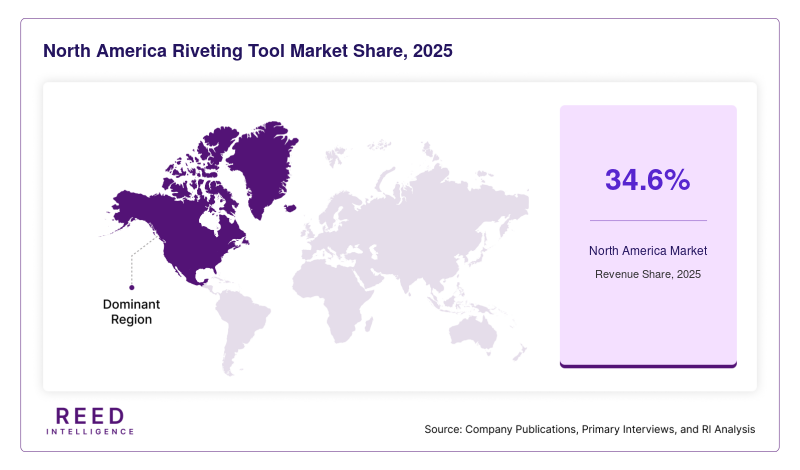
- North America held the dominant regional share of 34.6% in 2025, while Asia Pacific is projected to record the fastest CAGR of 8.4% through 2034.
- By type, pneumatic riveting tools held the leading share of 39.2% in 2025, while battery-powered riveting tools are projected to grow at 8.8% CAGR.
- By application, automotive assembly accounted for the dominant share of 31.7% in 2025, while aerospace fastening applications are projected to expand at 8.5% CAGR.
- By end use, industrial manufacturing held the leading share of 46.3% in 2025, while maintenance and repair operations are projected to grow at 7.9% CAGR.
- The United States, the dominant country, was valued at USD 712.5 million in 2024 and USD 754.1 million in 2025.
Market Trends
Growth in Automated Riveting Systems
A notable trend in the Riveting Tool Market is rising adoption of automated riveting systems in production facilities. Automated systems are increasingly used to improve precision, reduce labor intensity, and support consistent fastening outcomes in repetitive assembly environments. Integration with robotic systems and programmable production lines has accelerated demand for automated solutions.
Shift Toward Battery-Powered Portable Tools
Another major trend is the growing use of battery-powered riveting tools. End users are increasingly adopting cordless systems to improve portability, operator flexibility, and productivity in field operations. Advancements in battery performance and lightweight designs are strengthening adoption across industrial and construction applications.
Market Drivers
Rising Demand from Automotive Manufacturing
Growing automotive production has been a major driver for the Riveting Tool Market. Increased use of mechanical fastening in lightweight vehicle structures, body assembly, and structural joining applications has supported sustained demand for advanced riveting tools.
Expansion of Industrial Equipment Production
Increasing output across industrial machinery and heavy equipment manufacturing has also supported market growth. Rising demand for durable fastening tools in equipment assembly processes has contributed to broader product adoption.
Market Restraint
High Maintenance Requirements for Advanced Systems
A major restraint in the Riveting Tool Market is the maintenance burden associated with advanced hydraulic and automated systems. Calibration requirements, component wear, and service costs can limit adoption among smaller industrial users.
Market Opportunities
Expansion in Smart Fastening Technologies
Smart fastening technologies represent an emerging opportunity. Riveting tools with process monitoring, torque control, and connected diagnostics are expected to create value in precision-driven manufacturing environments.
Growth in Lightweight Material Assembly
Increasing use of aluminum composites and lightweight materials creates opportunities for specialized riveting solutions designed for newer structural applications.
Segmental Analysis
By Type
Pneumatic Riveting Tools Dominated the Market: Pneumatic riveting tools accounted for 39.2% share in 2025. Their dominance was supported by consistent performance, suitability for high-volume production, and widespread industrial use.
Battery-Powered Riveting Tools Will Grow Faster: Battery-powered riveting tools are projected to grow at 8.8% CAGR through 2034. Growth will be supported by mobility advantages and demand for cordless solutions in decentralized work environments.
By Application
Automotive Assembly Led Demand: Automotive assembly represented 31.7% share in 2025. This segment maintained leadership due to extensive use of riveting tools in structural fastening and vehicle body production.
Aerospace Fastening Will Expand Rapidly: Aerospace fastening applications are projected to grow at 8.5% CAGR. Growth will be supported by demand for precision joining tools compatible with advanced airframe materials.
By End Use
Industrial Manufacturing Held the Largest Share: Industrial manufacturing accounted for 46.3% share in 2025. Its leadership was supported by continuous use of riveting tools in machinery and component production.
Maintenance and Repair Operations Will Grow Faster: Maintenance and repair operations are projected to expand at 7.9% CAGR. Growth will be driven by rising demand for portable fastening tools in servicing applications.
By Power Source
Air-Powered Systems Dominated: Air-powered systems held 41.6% share in 2025. Their position reflected broad use in factory environments with existing pneumatic infrastructure.
Electric Cordless Systems Will Record Higher Growth: Electric cordless systems are projected to grow at 8.6% CAGR through 2034. Growth will be supported by increasing demand for portable fastening productivity.
By Distribution Channel
Direct Industrial Sales Led the Market: Direct industrial sales represented 44.8% share in 2025. Large industrial buyers continued to rely on direct procurement for technical support and product customization.
Online Industrial Supply Channels Will Grow Faster: Online industrial supply channels are projected to expand at 8.2% CAGR. Growth will be supported by broader digital procurement adoption and product accessibility.
Regional Analysis
North America
North America accounted for 34.6% of the Riveting Tool Market in 2025. The region benefited from strong manufacturing activity and high adoption of advanced fastening equipment. The market is projected to grow at a CAGR of 6.8% through 2034. The United States remained the dominant country due to growth in aerospace production requiring precision fastening solutions.
Europe
Europe represented 28.1% share of the Riveting Tool Market in 2025. Demand was supported by industrial automation investments and established mechanical assembly industries. The region is expected to expand at 6.7% CAGR. Germany remained the dominant country due to strong machinery manufacturing and demand for advanced industrial tools.
Asia Pacific
Asia Pacific held 23.9% share in 2025 and is projected to register the fastest CAGR of 8.4% during the forecast period. Growth will be supported by expanding industrial capacity and rising adoption of advanced fastening tools. China remained the dominant country due to broad manufacturing growth supporting equipment demand.
Middle East & Africa
Middle East & Africa accounted for 7.5% share in 2025. The market was supported by industrial maintenance demand and infrastructure-linked equipment usage. The region is projected to grow at 7.3% CAGR through 2034. Saudi Arabia remained the dominant country due to industrial development supporting fastening tool demand.
Latin America
Latin America captured 5.9% share in 2025. Demand was driven by manufacturing recovery and industrial maintenance activity. The region is forecast to grow at 7.0% CAGR. Brazil remained the dominant country due to equipment production supporting fastening tool usage.
Competitive Landscape
The Riveting Tool Market remains moderately fragmented, with global industrial tool manufacturers competing through product performance, application-specific design, and distribution strength. Companies continue to focus on expanding automated systems, cordless tool platforms, and smart fastening solutions. Competition is shaped by technology upgrades, industrial partnerships, and geographic expansion.
Stanley Black & Decker remained a leading participant due to its broad industrial fastening portfolio and established distribution network. A recent development included expansion of advanced battery-powered riveting systems designed for industrial and field fastening applications.
Other major participants such as Atlas Copco, Milwaukee Tool, Ingersoll Rand, and GESIPA have continued investing in productivity-focused innovations. Manufacturers are also increasing emphasis on lightweight tool construction, predictive maintenance features, and fastening systems aligned with industrial automation requirements. Emerging competition from regional manufacturers is contributing to broader product availability across mid-range industrial segments.
Key Players List
- Stanley Black & Decker
- Atlas Copco AB
- Ingersoll Rand Inc.
- Milwaukee Tool
- GESIPA Blindniettechnik GmbH
- Huck International
- POP Avdel
- Lobtex Co. Ltd.
- FAR S.r.l.
- Degometal
- Rivit S.r.l.
- AIRPRO Industry Corp.
- Arconic Fastening Systems
- Chicago Pneumatic
- Fuji Industrial Tools
Recent Developments
- Several manufacturers launched cordless riveting tools with higher battery efficiency for mobile assembly work in 2025.
- Industrial tool suppliers introduced sensor-enabled riveting systems for quality traceability in automated plants.
- Regional distributors expanded aftermarket servicing centers to improve tool uptime and maintenance response.
- Aerospace suppliers increased procurement of precision hydraulic riveting systems for new aircraft programs.
- Mid-sized manufacturers adopted compact pneumatic riveting stations to improve production throughput.
Riveting Tool Market Segments
Type
- Manual Riveting Tools
- Pneumatic Riveting Tools
- Hydraulic Riveting Tools
- Battery-Powered Riveting Tools
- Automated Riveting Systems
Application
- Automotive Assembly
- Aerospace Fastening
- Construction
- Industrial Equipment Assembly
- Maintenance and Repair
End Use
- Industrial Manufacturing
- Construction Contractors
- Maintenance Providers
- Aerospace Facilities
Distribution Channel
- Direct Industrial Sales
- Industrial Distributors
- Online Industrial Supply Channels
- Specialty Tool Dealers
By Region
- North America
- Europe
- APAC
- Middle East and Africa
- LATAM