Road Milling Machine Market Size, Share & Demand Report By Machine Type (Cold Milling Machines, Compact Milling Machines, Micro Milling Machines), By Application (Road Construction and Rehabilitation, Airport Runway Maintenance, Bridge Deck Rehabilitation, Industrial Pavement Maintenance), By End User (Construction Contractors, Government Agencies, Equipment Rental Companies, Industrial Infrastructure Developers), By Region & Segment Forecasts, 2026–2034
USD 3950
Market Overview
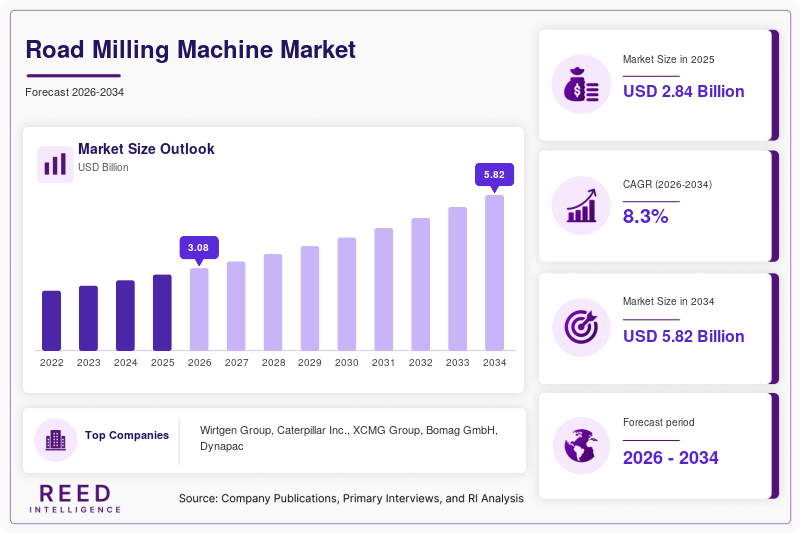
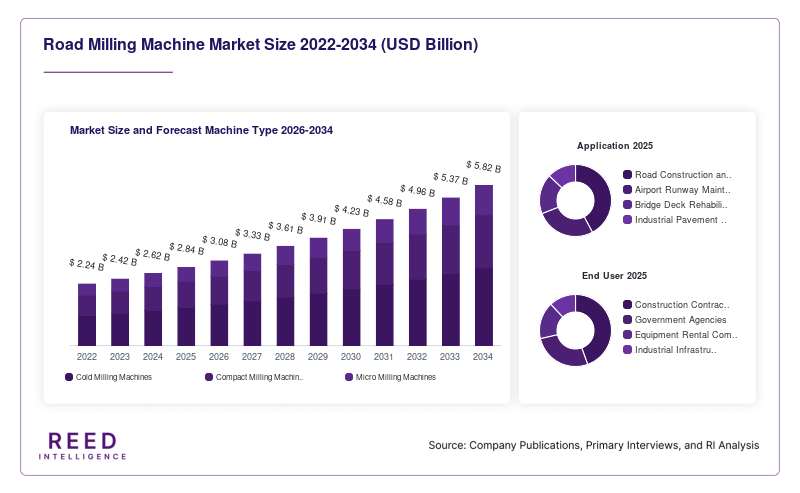
The global Road Milling Machine Market size was valued at USD 2.84 billion in 2026 and is projected to reach USD 5.37 billion by 2034, expanding at a CAGR of 8.3% during the forecast period. Growing investments in transportation infrastructure, road rehabilitation projects, and smart highway development programs are supporting steady market expansion across developed and emerging economies. Governments in several countries are increasing funding for road maintenance and resurfacing activities to improve traffic efficiency and reduce long-term repair costs. Road milling machines are widely used in asphalt and concrete surface removal, pavement recycling, and road preparation applications, making them essential equipment for modern infrastructure development.
The increasing adoption of sustainable construction practices is another factor supporting market growth. Contractors are using advanced milling machines equipped with automated depth control systems, telematics, and fuel-efficient engines to improve operational efficiency and reduce emissions. In addition, rising urbanization and industrialization in Asia Pacific, the Middle East, and Latin America are creating strong demand for road expansion and reconstruction projects. Equipment manufacturers are also introducing compact and versatile milling machines suitable for urban road repair operations where space limitations and traffic congestion require precise performance.
Key Highlights
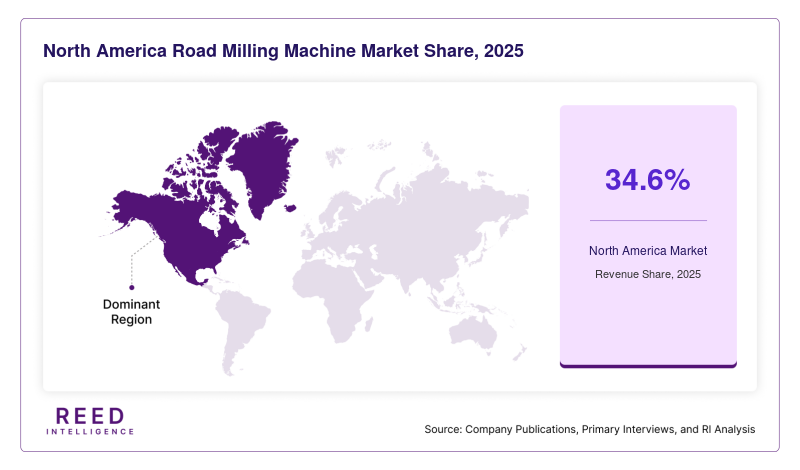
- North America dominated the market with a 34.6% share in 2025.
- Asia Pacific is expected to grow at the fastest CAGR of 10.9% during 2026–2034.
- By machine type, cold milling machines accounted for the largest share of 61.8%, while compact milling machines are projected to grow at a CAGR of 11.4%.
- By application, road construction and rehabilitation led with a 48.9% share, whereas airport runway maintenance is expected to expand at a CAGR of 10.7%.
- The United States remained the dominant country, with market values of USD 690 million in 2024 and USD 748 million in 2025.
Market Trends
Integration of Automation and Smart Control Technologies
The Road Milling Machine Market is witnessing a strong shift toward automation and digital control technologies. Manufacturers are integrating GPS guidance systems, real-time telematics, automated cutting depth controls, and predictive maintenance features into modern road milling machines. These technologies help contractors improve milling precision, reduce fuel consumption, and lower equipment downtime. Construction companies are increasingly adopting smart equipment to optimize project timelines and reduce operational errors during large-scale road rehabilitation activities. Fleet monitoring systems are also enabling contractors to track machine performance, maintenance schedules, and fuel usage across multiple project sites.
The growing demand for connected construction equipment is encouraging manufacturers to invest in intelligent machine platforms. Automated controls allow operators to maintain consistent milling depth and surface smoothness, which improves pavement quality and reduces material waste. In addition, digital reporting and machine analytics are helping contractors comply with infrastructure quality standards established by government agencies. These innovations are expected to increase the adoption of advanced road milling machines across highway projects, airport maintenance operations, and urban road resurfacing activities.
Rising Preference for Sustainable Pavement Recycling Solutions
Sustainability initiatives in the construction industry are significantly influencing the adoption of road milling machines. Governments and contractors are focusing on recycling existing asphalt materials to reduce raw material consumption and minimize construction waste. Cold milling machines are increasingly being used for asphalt reclamation processes that allow removed pavement materials to be reused in new road construction projects. This approach supports circular economy practices while lowering overall infrastructure development costs.
Construction companies are also investing in fuel-efficient road milling equipment equipped with low-emission engines to meet environmental regulations. The use of recycled asphalt pavement materials is expanding across highways, municipal roads, and industrial transportation networks. In addition, sustainability-focused procurement policies in Europe and North America are encouraging contractors to adopt environmentally efficient equipment. Manufacturers are responding by developing machines with improved dust suppression systems, reduced noise levels, and energy-efficient hydraulic technologies. These trends are expected to strengthen long-term market demand for advanced and eco-friendly road milling solutions.
Market Drivers
Expansion of Global Road Infrastructure Development Projects
Large-scale transportation infrastructure projects are driving growth in the Road Milling Machine Market. Governments worldwide are increasing investments in highway expansion, expressway modernization, bridge connectivity, and urban road reconstruction programs. Rapid urbanization and increasing vehicle ownership are creating pressure on existing transportation networks, leading to higher spending on road repair and resurfacing activities. Road milling machines play a critical role in removing damaged pavement layers before resurfacing, making them essential for road maintenance operations.
Developing economies in Asia Pacific, Latin America, and the Middle East are launching national infrastructure initiatives to improve logistics efficiency and trade connectivity. Developed economies are also investing in rehabilitation projects to extend the lifespan of aging road networks. The growing number of public-private partnership projects is supporting equipment procurement by contractors and infrastructure developers. Rising government funding for smart highways and sustainable transportation corridors is expected to sustain long-term demand for high-capacity road milling equipment across regional markets.
Growing Demand for Efficient and Cost-Effective Road Maintenance
Road maintenance agencies and contractors are increasingly focusing on cost-effective pavement rehabilitation methods, which is supporting demand for road milling machines. Milling technology allows damaged road surfaces to be removed selectively without completely rebuilding the pavement structure. This process reduces construction time, minimizes traffic disruption, and lowers material consumption compared to full-depth reconstruction methods.
The ability of road milling machines to improve surface smoothness and prepare pavements for overlay applications is increasing their use in municipal road maintenance projects. Airport operators are also adopting milling technologies to repair runways while maintaining operational efficiency. Advanced milling machines equipped with automated controls and high-performance cutting drums are helping contractors achieve faster project completion rates and improved productivity. Rental equipment providers are additionally contributing to market growth by offering flexible equipment access to small construction companies that prefer short-term equipment utilization instead of direct purchases.
Market Restraint
High Equipment Acquisition and Maintenance Costs
The high cost associated with purchasing and maintaining road milling machines remains a major restraint for market growth. Advanced milling equipment equipped with telematics, automated controls, and fuel-efficient engines requires significant capital investment, which can limit adoption among small and medium-sized contractors. In addition to the initial purchase cost, companies must also manage ongoing expenses related to maintenance, spare parts, operator training, and fuel consumption. These financial challenges are particularly significant in developing economies where infrastructure budgets and contractor resources are often limited.
Road milling machines operate under demanding construction conditions that lead to wear and tear of cutting drums, teeth, and hydraulic systems. Frequent maintenance requirements can increase operational downtime and affect project profitability. Contractors that operate aging fleets may also face higher repair costs and reduced productivity. Economic uncertainty and fluctuations in raw material prices can further impact equipment procurement decisions. For example, smaller municipal contractors in emerging markets often prefer renting milling equipment instead of purchasing new machines due to budget limitations. Although rental solutions provide temporary flexibility, they may reduce long-term direct equipment sales for manufacturers.
Market Opportunities
Increasing Adoption of Compact Milling Machines in Urban Projects
The growing number of urban road maintenance and utility repair projects is creating strong opportunities for compact road milling machines. Cities across the world are focusing on repairing damaged roads, improving drainage systems, and expanding smart city infrastructure. Compact milling machines are suitable for urban construction environments because they offer better maneuverability, lower operating noise, and improved performance in narrow spaces. Contractors increasingly prefer compact machines for residential roads, parking areas, bicycle lanes, and municipal rehabilitation activities.
The expansion of urban infrastructure projects in densely populated regions is expected to increase demand for small and medium-capacity milling equipment. Compact machines also support faster project execution with minimal traffic disruption, making them attractive for municipal authorities and local contractors. Equipment manufacturers are introducing models with enhanced operator visibility, advanced dust control systems, and lower fuel consumption to strengthen competitiveness in this segment. The growing preference for versatile and easy-to-transport equipment is likely to generate new growth opportunities for market participants during the forecast period.
Expansion of Airport and Industrial Pavement Rehabilitation Activities
Airport modernization and industrial infrastructure expansion are creating additional growth opportunities for the Road Milling Machine Market. Many airports are upgrading runways and taxiways to accommodate rising passenger traffic and larger aircraft operations. Road milling machines are widely used in runway rehabilitation projects because they ensure precise surface removal and improve pavement quality before resurfacing operations. Industrial facilities, logistics hubs, and ports are also investing in pavement maintenance to support heavy vehicle movement and improve operational efficiency.
The increasing importance of global trade and logistics infrastructure is encouraging governments and private operators to modernize transportation networks. Industrial pavement rehabilitation projects often require high-capacity milling equipment capable of handling durable concrete and asphalt surfaces. Manufacturers are responding by developing machines with improved cutting performance, durability, and automation capabilities. The expansion of industrial corridors and airport infrastructure projects in Asia Pacific and the Middle East is expected to create long-term opportunities for equipment suppliers and rental service providers.
Segmental Analysis
By Machine Type
Cold milling machines dominated the Road Milling Machine Market in 2024 with a share of 61.8%. These machines are widely used in highway rehabilitation, asphalt recycling, and pavement maintenance applications due to their operational efficiency and precision. Cold milling technology enables contractors to remove damaged pavement layers without heating the surface, reducing energy consumption and supporting sustainable construction practices. Large-scale infrastructure projects across developed and developing economies continue to increase the adoption of high-capacity cold milling equipment. Contractors prefer these machines because they improve surface preparation quality and reduce material waste during road resurfacing operations.
The segment is also benefiting from increasing investments in automated and fuel-efficient milling technologies. Manufacturers are integrating advanced cutting systems, telematics, and operator assistance features into modern cold milling machines to improve productivity and reduce downtime. These innovations are supporting adoption across municipal road projects, airports, and industrial infrastructure developments. The demand for reliable pavement recycling solutions is expected to sustain the dominant position of cold milling equipment throughout the forecast period.
By Application
Road construction and rehabilitation represented the largest application segment in 2024, accounting for 48.9% of the global market share. The increasing need to repair aging highways, urban roads, and transportation corridors is supporting strong demand for road milling machines in this segment. Governments are investing heavily in resurfacing projects to improve traffic flow, reduce accident risks, and extend pavement lifespan. Milling machines are widely used to remove damaged asphalt layers before overlay installation, ensuring better surface quality and improved road durability.
Large-scale infrastructure development projects in North America, Europe, and Asia Pacific continue to strengthen segment growth. Contractors prefer advanced milling equipment because it improves operational efficiency and reduces material wastage during pavement removal processes. The integration of automated depth control systems and telematics is also improving productivity in road rehabilitation projects. Growing adoption of recycled asphalt pavement practices is further supporting the expansion of this application segment.
By End User
Construction contractors held the largest share of the Road Milling Machine Market in 2024 with 54.3% of total revenue. Large contractors involved in highway construction, urban road rehabilitation, and industrial infrastructure projects are major users of road milling equipment. These companies require high-capacity and technologically advanced machines capable of operating efficiently across multiple project sites. Contractors are increasingly investing in modern equipment with automated systems to improve productivity, reduce labor costs, and meet strict infrastructure quality standards.
The expansion of government-funded infrastructure programs and public-private partnership projects is supporting equipment demand among construction firms. Contractors are also adopting telematics-enabled machines that allow real-time monitoring of fuel usage, maintenance schedules, and operational performance. Rising competition in the construction industry is encouraging companies to improve efficiency and reduce project completion time, which is strengthening the adoption of advanced road milling technologies.
Regional Analysis
North America
North America accounted for 34.6% of the global Road Milling Machine Market in 2025 and is expected to maintain a stable growth trajectory during the forecast period with a CAGR of 7.8%. The region benefits from extensive investments in highway rehabilitation, bridge modernization, and airport maintenance projects. Federal infrastructure funding programs in the United States and Canada are supporting the replacement of aging transportation assets. Contractors in the region are also rapidly adopting technologically advanced milling equipment equipped with telematics and automated control systems to improve operational productivity and reduce maintenance downtime.
The United States remained the dominant country in North America due to strong spending on transportation infrastructure and road resurfacing projects. The presence of established construction equipment manufacturers and rental service providers supports market expansion across the country. A major growth factor is the increasing focus on sustainable pavement recycling programs that encourage the reuse of reclaimed asphalt materials in road construction. State transportation departments are also emphasizing rapid road rehabilitation methods to minimize traffic congestion and improve highway safety standards.
Europe
Europe represented 27.1% of the global Road Milling Machine Market in 2025 and is projected to grow at a CAGR of 7.5% during the forecast period. The region is characterized by strong environmental regulations and advanced road maintenance practices. Countries across Western and Northern Europe are investing heavily in sustainable road rehabilitation solutions and recycling technologies. Demand for fuel-efficient and low-emission road milling machines is increasing as construction companies align with regional environmental standards. Public infrastructure modernization initiatives are also supporting market growth.
Germany remained the dominant country in the European market due to its extensive highway network and strong manufacturing base for construction equipment. The country continues to invest in road maintenance projects aimed at improving logistics efficiency and freight transportation. A unique growth factor in Germany is the increasing adoption of digital construction technologies, including connected equipment and automated pavement management systems. Contractors are integrating advanced milling machines into data-driven construction workflows to enhance operational accuracy and optimize project costs.
Asia Pacific
Asia Pacific held 24.8% of the Road Milling Machine Market in 2025 and is anticipated to register the fastest CAGR of 10.9% between 2026 and 2034. Rapid urbanization, industrial expansion, and rising infrastructure spending are supporting strong market growth across the region. Governments in countries such as China, India, Indonesia, and Vietnam are investing in highway construction, smart city development, and transportation corridor projects. The demand for road rehabilitation equipment is increasing as urban road networks experience higher traffic density and accelerated wear.
China dominated the Asia Pacific market due to extensive investments in transportation infrastructure and industrial development projects. The country continues to expand expressways, logistics corridors, and airport facilities to support economic growth and regional connectivity. A key growth factor is the increasing adoption of advanced construction machinery supported by government modernization programs. Domestic equipment manufacturers are also strengthening production capabilities and introducing cost-effective milling machines, making the technology more accessible to regional contractors and infrastructure developers.
Middle East & Africa
The Middle East & Africa region accounted for 7.2% of the global Road Milling Machine Market in 2025 and is projected to expand at a CAGR of 8.6% during the forecast period. Rising investments in transportation infrastructure, tourism development, and industrial projects are supporting market demand. Gulf countries are focusing on highway expansion and urban mobility projects to accommodate growing populations and economic diversification strategies. Road maintenance activities are also increasing due to harsh climatic conditions that accelerate pavement deterioration.
Saudi Arabia remained the dominant country in the regional market because of its large-scale infrastructure and smart city development initiatives. The country is investing heavily in road networks, industrial corridors, and tourism projects as part of long-term economic transformation programs. A major growth factor is the development of mega construction projects that require advanced road rehabilitation equipment for efficient transportation connectivity. Increasing investments in airport expansion and logistics infrastructure are also contributing to higher demand for modern milling machines.
Latin America
Latin America represented 6.3% of the Road Milling Machine Market in 2025 and is expected to grow at a CAGR of 8.1% during the forecast period. Governments across the region are focusing on improving transportation infrastructure to support economic recovery and trade activities. Road rehabilitation projects are increasing in countries with aging highway networks and expanding urban populations. Contractors are adopting modern milling technologies to reduce project completion time and improve pavement quality in both public and private infrastructure developments.
Brazil dominated the Latin American market due to its extensive road transportation network and growing investments in logistics infrastructure. The country is emphasizing road modernization projects aimed at improving freight movement and regional trade connectivity. A unique growth factor is the rising participation of private infrastructure investors in transportation projects through concession agreements and public-private partnerships. These investments are encouraging contractors to procure advanced construction equipment, including high-capacity road milling machines for long-distance highway rehabilitation projects.
Competitive Landscape
The Road Milling Machine Market is moderately consolidated, with global and regional manufacturers competing through product innovation, technology integration, and expansion of distribution networks. Leading companies are focusing on fuel-efficient engines, automation features, and advanced cutting technologies to strengthen market competitiveness. Strategic partnerships with construction contractors and rental service providers are also helping manufacturers expand their customer base across developing markets.
Wirtgen Group remained the leading company in the market due to its extensive product portfolio, strong global distribution network, and continuous investment in advanced road construction technologies. The company recently introduced upgraded cold milling machines equipped with enhanced digital control systems and optimized fuel efficiency features to improve operational productivity.
Other major participants such as Caterpillar, XCMG, Bomag, and Dynapac are expanding manufacturing capabilities and investing in intelligent machine technologies. Companies are also focusing on aftermarket services, spare parts availability, and operator training programs to improve customer retention. Regional manufacturers in Asia Pacific are increasingly offering cost-effective equipment solutions, intensifying competition within the global market.
Key Players
- Wirtgen Group
- Caterpillar Inc.
- XCMG Group
- Bomag GmbH
- Dynapac
- Volvo Construction Equipment
- SANY Group
- Roadtec Inc.
- LiuGong Machinery
- Fayat Group
- Astec Industries
- Zoomlion Heavy Industry Science & Technology
- Shantui Construction Machinery
- CMI Roadbuilding
- Sakai Heavy Industries.
Recent Developments
- Wirtgen Group launched an upgraded series of cold milling machines with advanced telematics and automated cutting depth systems in 2025.
- Caterpillar expanded its road construction equipment manufacturing capacity in Asia Pacific to support growing regional infrastructure demand in 2024.
- Bomag introduced fuel-efficient compact milling machines designed for urban rehabilitation projects and municipal road maintenance applications in 2025.
- XCMG partnered with regional infrastructure contractors to strengthen distribution and aftersales services across the Middle East in 2024.
Road Milling Machine Market Segments
Machine Type
- Cold Milling Machines
- Compact Milling Machines
- Micro Milling Machines
Application
- Road Construction and Rehabilitation
- Airport Runway Maintenance
- Bridge Deck Rehabilitation
- Industrial Pavement Maintenance
End User
- Construction Contractors
- Government Agencies
- Equipment Rental Companies
- Industrial Infrastructure Developers
By Region
- North America
- Europe
- APAC
- Middle East and Africa
- LATAM