Road Weather Information System Market Size, Share & Demand Report By Type (Fixed RWIS, Mobile RWIS), By Application (Highways, Urban Roads, Bridges, Airports), By End-Use (Government Agencies, Private Sector) By Region & Segment Forecasts, 2026–2034
USD 3950
Market Overview
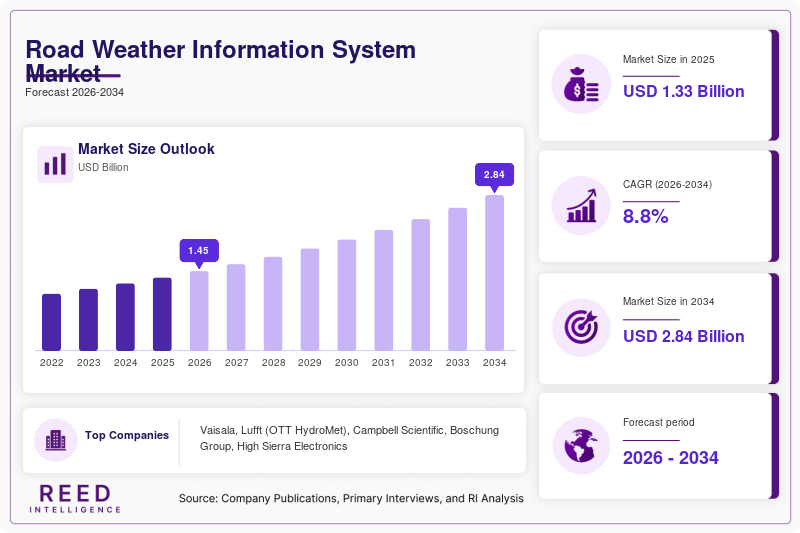
The Road Weather Information System Market size is estimated to reach a market size of USD 1.45 billion in 2026 and is projected to expand to approximately USD 2.85 billion by 2034, registering a compound annual growth rate (CAGR) of 8.8% during the forecast period (2026–2034). The market growth is primarily supported by the increasing need for intelligent transportation systems (ITS) to enhance road safety, optimize traffic management, and reduce weather-related disruptions. Governments across developed and developing economies are investing in advanced infrastructure solutions that integrate real-time weather monitoring with predictive analytics, enabling authorities to make timely decisions related to road maintenance, snow removal, and hazard alerts.
The adoption of smart city initiatives globally has also contributed significantly to market expansion. Road Weather Information Systems (RWIS) play a crucial role in these initiatives by providing accurate data on temperature, humidity, precipitation, and road surface conditions. This information helps transportation departments minimize accidents, reduce operational costs, and improve overall mobility efficiency. Additionally, advancements in sensor technologies, cloud computing, and IoT integration have enhanced system reliability and scalability, making RWIS more accessible to a broader range of end users.
Key Highlights
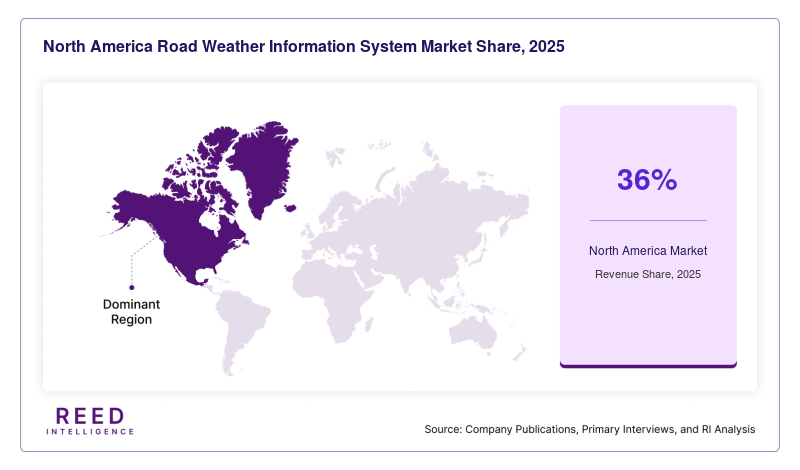
- North America dominated the market with a share of 36% in 2025.
- Asia Pacific is projected to register the fastest growth at a CAGR of 10.2%.
- Fixed RWIS stations emerged as the leading subsegment with a 58% share, whereas mobile RWIS systems are expected to grow at the fastest CAGR of 9.7%. In terms of application, highways accounted for the dominant share, while
- urban roads are projected to witness the fastest growth.
- The United States remained the dominant country, with market values of USD 420 million in 2024 and USD 455 million in 2025.
Market Trends
Integration of IoT and Advanced Analytics in Road Weather Monitoring
The integration of Internet of Things (IoT) technologies with Road Weather Information Systems is shaping the evolution of the market. Modern RWIS solutions now incorporate connected sensors that continuously collect environmental and road condition data, transmitting it to centralized cloud platforms for analysis. This shift allows transportation agencies to access real-time insights and predictive analytics, enabling proactive decision-making. The use of machine learning algorithms further enhances forecasting accuracy by analyzing historical weather patterns and traffic behavior. As a result, road authorities can optimize resource allocation, reduce maintenance costs, and improve response times during adverse weather events.
Another aspect of this trend is the increasing deployment of edge computing within RWIS infrastructure. Edge devices process data locally, reducing latency and ensuring faster alerts for critical conditions such as ice formation or heavy rainfall. This capability is particularly beneficial in remote or high-risk areas where immediate action is required. The growing demand for data-driven infrastructure management is expected to accelerate the adoption of IoT-enabled RWIS solutions, particularly in regions focusing on digital transformation and smart mobility initiatives.
Rising Adoption of Mobile and Portable RWIS Solutions
The market is witnessing a notable shift toward mobile and portable RWIS systems, driven by the need for flexible and cost-effective monitoring solutions. Unlike traditional fixed stations, mobile systems can be deployed quickly in temporary or high-risk locations, such as construction zones, event venues, or disaster-affected areas. These systems are often mounted on vehicles or trailers and provide real-time weather and road condition data, enabling dynamic decision-making for traffic management and safety operations.
Portable RWIS solutions are also gaining traction among smaller municipalities and developing regions that may lack the budget for large-scale infrastructure investments. These systems offer scalability and ease of deployment, making them suitable for pilot projects and incremental upgrades. Additionally, advancements in wireless communication technologies, such as 5G, are enhancing the performance and reliability of mobile RWIS units. As infrastructure planning becomes more adaptive and responsive, the demand for portable monitoring solutions is expected to grow steadily.
Market Drivers
Increasing Focus on Road Safety and Accident Prevention
The rising incidence of weather-related road accidents has intensified the demand for Road Weather Information Systems globally. Governments and transportation authorities are prioritizing safety measures to reduce fatalities and economic losses caused by adverse weather conditions such as snow, fog, and heavy rainfall. RWIS solutions provide critical real-time data that enables authorities to issue timely warnings, adjust speed limits, and deploy maintenance crews efficiently. This proactive approach significantly reduces accident risks and enhances overall road safety.
Furthermore, regulatory frameworks in many countries are mandating the implementation of intelligent monitoring systems as part of transportation infrastructure upgrades. Public awareness campaigns and insurance industry incentives are also encouraging the adoption of technologies that improve driving conditions. The integration of RWIS with traffic management systems and navigation platforms allows drivers to receive real-time updates, further contributing to safer travel experiences. These factors collectively drive the market’s steady growth.
Expansion of Smart Transportation and Infrastructure Investments
Global investments in smart transportation systems are playing a crucial role in driving the RWIS market. Governments are allocating substantial budgets toward modernizing road networks and integrating advanced technologies that improve efficiency and sustainability. RWIS solutions are a key component of these initiatives, providing essential data for traffic optimization, infrastructure maintenance, and environmental monitoring.
The growing emphasis on smart cities has further accelerated the adoption of RWIS technologies. Urban planners are incorporating weather monitoring systems into broader digital ecosystems that include traffic signals, surveillance systems, and public transportation networks. This integration enhances operational efficiency and enables data-driven decision-making. Additionally, public-private partnerships are facilitating the deployment of advanced RWIS infrastructure, particularly in emerging economies. The continuous expansion of smart infrastructure projects is expected to sustain market growth over the forecast period.
Market Restraint
High Initial Investment and Maintenance Costs
One of the primary challenges affecting the Road Weather Information System Market is the high cost associated with system installation and maintenance. Fixed RWIS stations require significant capital investment for sensors, communication networks, and data processing infrastructure. Additionally, ongoing maintenance costs, including calibration, repairs, and software updates, can be substantial. These financial barriers often limit adoption among smaller municipalities and developing regions with constrained budgets.
The complexity of integrating RWIS with existing transportation systems further adds to the cost burden. Organizations may need to upgrade legacy infrastructure or invest in specialized expertise to ensure seamless operation. For example, in regions with limited technical capabilities, the lack of skilled personnel can hinder system deployment and maintenance. This restraint impacts market penetration, particularly in cost-sensitive markets, and may slow the adoption rate despite the long-term benefits of improved safety and efficiency.
Market Opportunities
Growing Demand in Emerging Economies
Emerging economies present significant growth opportunities for the Road Weather Information System Market. Rapid urbanization, increasing vehicle ownership, and expanding road networks are driving the need for advanced traffic management solutions. Governments in regions such as Asia Pacific and Latin America are investing in infrastructure development to support economic growth and improve transportation efficiency. RWIS solutions are increasingly being recognized as essential tools for managing weather-related challenges and enhancing road safety.
In addition, international funding and development programs are supporting the deployment of intelligent transportation systems in these regions. The adoption of cost-effective and scalable RWIS solutions, such as mobile systems, is enabling wider implementation. As awareness of the benefits of real-time weather monitoring grows, emerging markets are expected to contribute significantly to overall market expansion.
Technological Advancements and Integration with Autonomous Vehicles
The advancement of autonomous and connected vehicle technologies is creating new opportunities for RWIS integration. Autonomous vehicles rely heavily on accurate environmental data to operate safely, making RWIS a critical component of future transportation ecosystems. By providing real-time information on road conditions, weather patterns, and potential hazards, RWIS systems enhance the reliability and safety of autonomous driving systems.
Moreover, the integration of RWIS with vehicle-to-infrastructure (V2I) communication systems enables seamless data exchange between vehicles and road networks. This capability allows for dynamic route optimization and improved traffic flow. As the adoption of autonomous vehicles increases, the demand for advanced RWIS solutions is expected to rise, creating new growth avenues for market participants.
Segmental Analysis
By Type
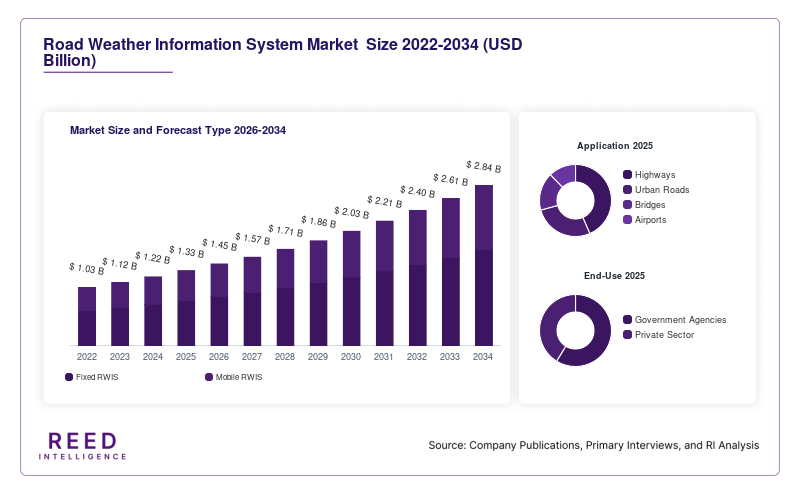
Fixed RWIS stations dominated the market in 2024, accounting for a share of 58%. These systems are widely used due to their ability to provide continuous and reliable data on weather and road conditions. Fixed stations are typically installed along highways and critical road segments, where consistent monitoring is essential for safety and maintenance. Their integration with centralized traffic management systems enables real-time data analysis and decision-making. Additionally, advancements in sensor technology have improved the accuracy and durability of fixed RWIS systems, making them a preferred choice for large-scale infrastructure projects.
Mobile RWIS systems are projected to be the fastest-growing subsegment, with a CAGR of 9.7%. These systems offer flexibility and cost efficiency, making them suitable for temporary deployments and smaller-scale projects. The ability to quickly deploy mobile units in high-risk areas or during emergencies enhances their value. Furthermore, technological advancements in wireless communication and battery efficiency are improving the performance of mobile RWIS systems. The growing demand for adaptable and scalable solutions is expected to drive the adoption of this subsegment.
By Application
Highways represented the dominant application segment in 2024, with a significant market share. RWIS systems are extensively used on highways to monitor weather conditions and ensure safe travel. The high volume of traffic and the critical nature of highway infrastructure make continuous monitoring essential. These systems help authorities manage snow removal, de-icing operations, and traffic flow during adverse weather conditions. The integration of RWIS with navigation systems further enhances its effectiveness by providing real-time updates to drivers.
Urban roads are expected to be the fastest-growing application segment, with a CAGR of 9.4%. The increasing focus on smart city development and urban mobility is driving the adoption of RWIS systems in urban areas. These systems enable efficient traffic management and improve safety in densely populated regions. The integration of RWIS with urban infrastructure, such as traffic signals and public transportation systems, enhances overall efficiency. As cities continue to expand, the demand for advanced monitoring solutions is expected to grow.
By End-Use
Government agencies dominated the end-use segment in 2024, accounting for a substantial market share. These agencies are responsible for managing transportation infrastructure and ensuring road safety. The adoption of RWIS systems enables them to monitor weather conditions, optimize maintenance operations, and reduce accident risks. Government funding and regulatory support play a crucial role in driving the adoption of these systems. Additionally, the integration of RWIS with national transportation networks enhances coordination and efficiency.
Private sector organizations are expected to be the fastest-growing end-use segment, with a CAGR of 9.1%. Companies involved in logistics, construction, and transportation are increasingly adopting RWIS solutions to improve operational efficiency and safety. These systems provide valuable data that helps organizations optimize routes, reduce delays, and minimize risks. The growing emphasis on data-driven decision-making and the adoption of advanced technologies are expected to drive the growth of this segment.
Regional Analysis
North America
North America accounted for a significant share of 36% in 2025 and is projected to grow at a CAGR of 7.9% during the forecast period. The region’s well-established transportation infrastructure and early adoption of intelligent systems have contributed to its dominant position. Government initiatives aimed at improving road safety and reducing traffic congestion are driving the deployment of RWIS solutions across highways and urban areas.
The United States leads the regional market, supported by strong investments in smart infrastructure and advanced technologies. A key growth factor in the country is the integration of RWIS with state-level traffic management systems, enabling real-time data sharing and coordinated responses to weather events. This approach enhances operational efficiency and ensures safer travel conditions.
Europe
Europe held a market share of 28% in 2025 and is expected to grow at a CAGR of 8.2%. The region’s focus on sustainability and environmental monitoring has driven the adoption of RWIS technologies. Stringent regulations related to road safety and emissions control further support market growth, encouraging the implementation of advanced monitoring systems.
Germany dominates the European market, driven by its strong automotive industry and technological capabilities. A unique growth factor in the country is the integration of RWIS with smart mobility solutions, including connected vehicles and digital traffic platforms. This integration enhances data accuracy and supports efficient transportation management.
Asia Pacific
Asia Pacific is projected to be the fastest-growing region, with a CAGR of 10.2% and a market share of 22% in 2025. Rapid urbanization and infrastructure development are key factors driving market growth. Governments are investing heavily in smart city projects, which include the deployment of RWIS systems to improve road safety and traffic management.
China leads the regional market, supported by large-scale infrastructure projects and technological advancements. A unique growth factor is the government’s focus on integrating RWIS with national transportation networks, enabling centralized monitoring and decision-making. This approach enhances efficiency and supports the region’s rapid economic growth.
Middle East & Africa
The Middle East & Africa region accounted for a market share of 8% in 2025 and is expected to grow at a CAGR of 9.1%. The region’s increasing focus on infrastructure development and smart city initiatives is driving the adoption of RWIS solutions. Harsh weather conditions, such as sandstorms and extreme heat, further highlight the need for effective monitoring systems.
Saudi Arabia dominates the regional market, driven by significant investments in smart infrastructure projects. A key growth factor is the integration of RWIS with large-scale urban development initiatives, enabling efficient management of transportation networks in challenging environmental conditions.
Latin America
Latin America held a market share of 6% in 2025 and is projected to grow at a CAGR of 8.7%. The region’s expanding road networks and increasing focus on safety are driving the adoption of RWIS technologies. Government initiatives aimed at improving transportation infrastructure are further supporting market growth.
Brazil leads the regional market, supported by investments in highway development and traffic management systems. A unique growth factor is the adoption of mobile RWIS solutions in remote and rural areas, enabling cost-effective monitoring and improving road safety across diverse terrains.
Competitive Landscape
The Road Weather Information System Market is characterized by the presence of several established players focusing on technological innovation and strategic partnerships. Companies are investing in research and development to enhance system accuracy, reliability, and integration capabilities. The market is moderately consolidated, with leading players holding a significant share.
A leading company in the market is Vaisala, known for its advanced weather monitoring solutions. The company recently introduced a next-generation RWIS platform that integrates AI-based analytics and cloud connectivity, enhancing real-time decision-making capabilities. Other key players are also focusing on expanding their product portfolios and strengthening their global presence through collaborations and acquisitions. The competitive landscape is expected to remain dynamic as companies continue to innovate and adapt to evolving market demands.
Key Players
- Vaisala
- Lufft (OTT HydroMet)
- Campbell Scientific
- Boschung Group
- High Sierra Electronics
- Teconer
- All Weather Inc.
- MeteoGroup
- Eko Instruments
- RWIS Inc.
- Sutron Corporation
- Columbia Weather Systems
- Vantage Controls
- Morcom International
- Scalemaster
Recent Developments
- Several companies have introduced AI-enabled RWIS platforms that enhance predictive analytics capabilities and improve decision-making accuracy.
- A major player expanded its operations in Asia Pacific by establishing new manufacturing and service facilities to cater to growing regional demand.
- Strategic partnerships between technology providers and government agencies have led to the deployment of integrated RWIS solutions in large-scale smart city projects.
Road Weather Information System Market Segments
Type
- Fixed RWIS
- Mobile RWIS
Application
- Highways
- Urban Roads
- Bridges
- Airports
End-Use
- Government Agencies
- Private Sector
By Region
- North America
- Europe
- APAC
- Middle East and Africa
- LATAM