Robot Teach Pendant Market Size, Share & Demand Report By Type (Wired Teach Pendant, Wireless Teach Pendant), By Application (Industrial Robot Programming, Maintenance and Diagnostics, Collaborative Robot Control, Material Handling Automation), By End-Use Industry (Automotive, Electronics and Semiconductor, Logistics and Warehousing, Healthcare, Food and Beverage, Metal and Machinery) By Region & Segment Forecasts, 2026–2034
USD 3950
Market Overview
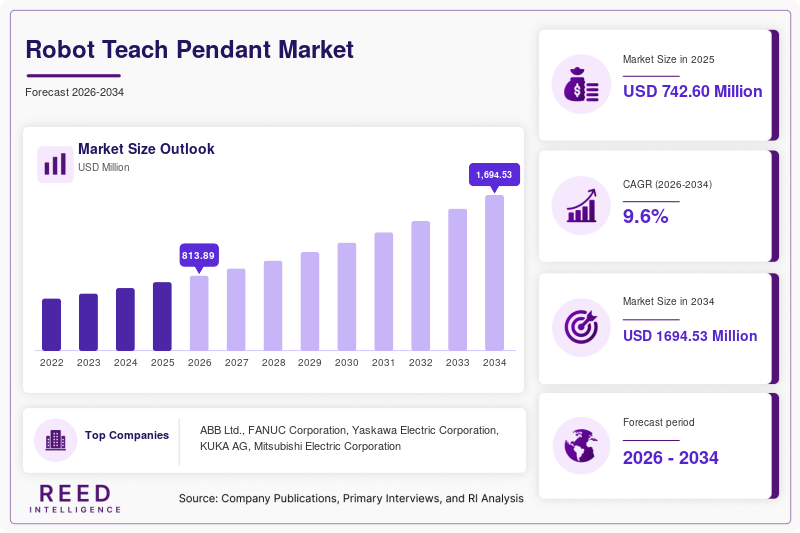
The global Robot Teach Pendant Market size was valued at USD 742.6 million in 2026 and is projected to reach USD 1.54 billion by 2034, expanding at a CAGR of 9.6% during the forecast period from 2026 to 2034. The market is witnessing consistent growth due to the rising deployment of industrial robots across automotive, electronics, logistics, healthcare, and food processing facilities. Teach pendants remain an essential interface for robot programming, manual control, diagnostics, and maintenance operations in automated production environments. Increasing adoption of collaborative robots and smart manufacturing systems has further strengthened demand for advanced portable control devices with touchscreen displays, wireless communication, and safety-enabled architectures.
A major global factor supporting market expansion is the rapid transition toward Industry 4.0 manufacturing frameworks. Manufacturers are investing in digitally connected robotic ecosystems to improve production efficiency, minimize downtime, and reduce labor dependency. Teach pendants equipped with intuitive interfaces, cloud connectivity, AI-assisted programming, and remote troubleshooting capabilities are becoming integral to modern factory operations. Demand is also increasing among small and medium-sized enterprises that are integrating flexible robotic automation into assembly and packaging applications.
Key Highlights
- North America dominated the market with a 35.1% share in 2025, while Asia Pacific is expected to grow at the fastest CAGR of 11.4% during 2026–2034.
- By type, wired teach pendants accounted for the largest share of 61.8%, while wireless teach pendants are projected to grow at a CAGR of 12.3%.
- By application, industrial robot programming led with a 44.5% share, whereas collaborative robot control is expected to expand at a CAGR of 12.7%.
- The United States remained the dominant country, with market values of USD 181 million in 2024 and USD 198 million in 2025.
Market Trends
Integration of Smart Human-Machine Interface Technologies
The Robot Teach Pendant Market is experiencing a noticeable shift toward smart human-machine interface technologies that improve usability and operational accuracy. Manufacturers are increasingly integrating touchscreen panels, gesture-based controls, voice assistance, and customizable user dashboards into teach pendants. These innovations simplify robot programming and reduce training requirements for operators working in complex manufacturing environments. Smart interfaces are particularly useful in automotive and electronics production facilities where robotic tasks frequently change and require rapid reconfiguration. The trend is also encouraging wider adoption among medium-sized manufacturers seeking user-friendly automation systems without extensive programming expertise.
Another aspect of this trend involves connectivity enhancements that support real-time diagnostics and predictive maintenance. Modern teach pendants are being designed with wireless communication protocols, cloud synchronization, and remote monitoring capabilities that allow technicians to access robot status information instantly. Industrial facilities are increasingly favoring connected robotic systems that improve workflow visibility and reduce machine downtime. Vendors are responding by developing rugged portable pendants compatible with industrial IoT platforms and advanced analytics software. This transition toward intelligent control systems is expected to reshape product differentiation strategies across the market during the forecast period.
Rising Adoption of Collaborative Robotics Across Industries
The growing deployment of collaborative robots is creating substantial momentum for the Robot Teach Pendant Market. Collaborative robots require flexible and intuitive programming interfaces because they operate alongside human workers in shared workspaces. Teach pendants designed for cobot systems are becoming more compact, lightweight, and easier to operate. Manufacturers are introducing simplified drag-and-drop programming interfaces that reduce setup complexity and allow operators without coding backgrounds to manage robotic functions efficiently. This trend is supporting broader automation adoption across sectors such as healthcare, consumer goods, warehousing, and food processing.
Demand for collaborative robotics is also increasing due to labor shortages and rising workplace safety requirements. Companies are investing in robotic systems that can handle repetitive tasks while improving operational consistency. Teach pendants play a critical role in configuring safety zones, movement speeds, and workflow adjustments within collaborative environments. Wireless and portable devices are gaining popularity because they enable technicians to move freely around robotic workstations during programming and maintenance procedures. As collaborative robotics continue expanding into new industries, demand for advanced teach pendant solutions is expected to rise steadily over the coming years.
Market Drivers
Expansion of Industrial Automation Investments Worldwide
The increasing adoption of industrial automation technologies is one of the primary factors driving the Robot Teach Pendant Market. Manufacturing companies are investing heavily in robotic systems to improve productivity, reduce operational errors, and maintain production continuity. Teach pendants serve as essential tools for configuring robotic movements, monitoring performance, and performing maintenance activities. Industries such as automotive, electronics, semiconductors, and metal fabrication are expanding their robotic infrastructure, which is directly supporting market growth. Rising labor costs and workforce shortages in developed economies are further encouraging companies to automate production processes using programmable robotic systems.
Automation investments are also accelerating in developing economies where governments are promoting smart manufacturing initiatives. Countries across Asia Pacific and Latin America are offering incentives to encourage digital transformation in industrial operations. This is increasing demand for advanced robot control devices that support multilingual interfaces and easy deployment. Vendors are focusing on developing durable and ergonomic teach pendants that improve operator efficiency in high-volume production facilities. The growing preference for automated assembly lines and intelligent manufacturing ecosystems is expected to sustain demand for robot teach pendants throughout the forecast period.
Increasing Need for Flexible Manufacturing Operations
Manufacturers are increasingly prioritizing flexible production systems capable of handling frequent product changes and customized manufacturing requirements. This shift is creating strong demand for robot teach pendants that enable rapid robot programming and process modification. Industries producing consumer electronics, electric vehicles, and packaged goods often require frequent operational adjustments to meet evolving market demand. Teach pendants allow operators to quickly reprogram robotic tasks without extensive system downtime, making them valuable tools in dynamic manufacturing environments.
The need for production flexibility has become more significant as manufacturers adopt smaller batch production strategies and faster product launch cycles. Portable teach pendants with intuitive software interfaces help technicians optimize robotic workflows efficiently while reducing setup times. Companies are also emphasizing worker safety and operational convenience, leading to higher adoption of wireless and touchscreen-based devices. Advanced pendants equipped with simulation capabilities and real-time diagnostics further improve manufacturing responsiveness. As industrial facilities continue modernizing production processes, the importance of flexible robotic control systems is expected to drive consistent market expansion.
Market Restraint
High Initial Integration Costs and Technical Complexity
The Robot Teach Pendant Market faces limitations related to high integration costs and technical complexities associated with robotic automation systems. Small and medium-sized enterprises often hesitate to invest in advanced robotic solutions because of substantial upfront expenses involving robots, control systems, software integration, and operator training. Teach pendants with advanced touchscreen interfaces, wireless communication modules, and safety-certified architectures further increase implementation costs. In industries operating with limited automation budgets, companies may delay modernization projects due to concerns regarding return on investment and system compatibility challenges.
Technical complexity is another significant challenge affecting adoption rates. Robot programming and maintenance require specialized expertise, especially in facilities operating multi-brand robotic systems. Incompatibility between legacy robotic infrastructure and modern teach pendant technologies can create operational inefficiencies and additional integration expenses. Manufacturers may also encounter cybersecurity concerns when deploying connected wireless pendants linked to cloud-based industrial networks. These factors can slow adoption among smaller industrial operators and organizations with limited technical capabilities. Although technological advancements are gradually improving ease of use, cost and integration barriers remain important challenges influencing market penetration.
Market Opportunities
Growing Demand for Wireless Teach Pendant Solutions
The increasing demand for wireless industrial control technologies presents significant opportunities for the Robot Teach Pendant Market. Wireless teach pendants offer improved mobility, flexibility, and operator convenience compared to traditional wired systems. Technicians can move freely around robotic workstations during programming, maintenance, and troubleshooting procedures, improving operational efficiency and reducing setup times. Industries with large-scale manufacturing facilities are increasingly adopting wireless solutions to simplify robotic operations and enhance workplace safety. This trend is encouraging manufacturers to develop advanced wireless pendants with secure connectivity and longer battery life.
Wireless technologies are also gaining attention because they support modern smart factory environments focused on real-time communication and connected automation systems. Companies are seeking portable devices that integrate seamlessly with industrial IoT platforms and centralized production management software. Vendors introducing rugged wireless teach pendants with improved signal stability and cybersecurity protection are expected to gain competitive advantages. Demand is likely to increase further as collaborative robots become more common in warehouses, logistics centers, and healthcare facilities where flexible mobility is essential for operational efficiency.
Expansion of Robotics Adoption in Emerging Industries
Emerging industries such as healthcare automation, pharmaceutical manufacturing, renewable energy equipment production, and warehouse logistics are creating new growth opportunities for the Robot Teach Pendant Market. These sectors are increasingly adopting robotic systems to improve operational accuracy, reduce manual intervention, and enhance production consistency. Teach pendants are essential for configuring robotic functions in environments where precision and reliability are critical. The healthcare industry, for example, is deploying robotic systems for laboratory automation and medical equipment manufacturing, increasing demand for easy-to-use robotic control interfaces.
Growth in e-commerce logistics and automated warehousing is another important opportunity area. Distribution centers are integrating robotic systems for material handling, packaging, and sorting applications to improve efficiency and reduce delivery timelines. Teach pendants capable of rapid programming and workflow customization are becoming increasingly valuable in these fast-changing operational environments. Manufacturers focusing on industry-specific control solutions with simplified interfaces and remote access features are expected to benefit from expanding robotics adoption across non-traditional industrial sectors during the forecast period.
Segmental Analysis
By Type
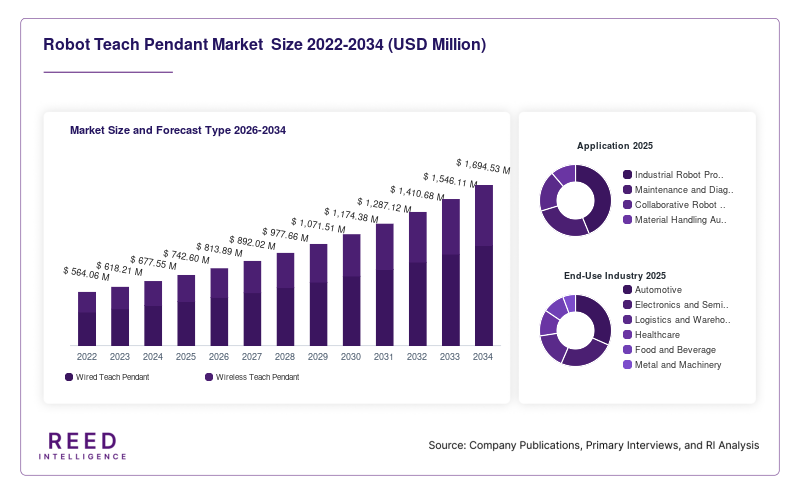
Wired teach pendants accounted for the largest share of the Robot Teach Pendant Market in 2024, representing approximately 61.8% of global revenue. These systems continue to maintain strong demand because of their stable connectivity, lower cybersecurity risks, and reliable communication performance in industrial environments. Wired pendants are widely used in automotive manufacturing, heavy machinery production, and welding applications where uninterrupted robot control is critical for maintaining operational precision. Industrial operators often prefer wired solutions in high-risk environments because they minimize signal interference and provide consistent performance during long production cycles. Manufacturers are also improving the ergonomics and durability of wired teach pendants by integrating high-resolution displays, programmable buttons, and enhanced safety features to support complex robotic programming operations.
Wireless teach pendants are projected to witness the fastest growth, registering a CAGR of 12.3% during the forecast period. Increasing preference for flexible and mobile robotic control systems is driving adoption across collaborative robotics and warehouse automation applications. Wireless systems enable technicians to move freely around robotic workstations while monitoring operations and performing troubleshooting procedures. Industries adopting smart factory frameworks are increasingly favoring wireless interfaces that integrate seamlessly with industrial IoT platforms and remote diagnostics systems. Vendors are focusing on improving battery performance, communication security, and connectivity reliability to address industrial requirements. Rising deployment of collaborative robots in electronics assembly, healthcare automation, and logistics facilities is expected to further accelerate demand for wireless teach pendant solutions.
By Application
Industrial robot programming emerged as the dominant application segment in 2024, accounting for approximately 44.5% of the global market share. Teach pendants are extensively used for configuring robotic motion paths, calibrating production sequences, and testing operational parameters in industrial automation environments. Automotive and electronics manufacturing facilities remain major adopters due to the complexity of robotic assembly and welding operations. Industrial robot programming requires accurate manual control and real-time monitoring capabilities, increasing reliance on advanced teach pendant systems with intuitive interfaces and safety controls. Manufacturers are continuously enhancing software compatibility and touchscreen functionality to simplify robot programming tasks and improve operational efficiency within large-scale manufacturing plants.
Collaborative robot control is anticipated to grow at the fastest CAGR of 12.7% through 2034 due to increasing deployment of human-friendly robotic systems across diverse industries. Collaborative robots are being adopted in packaging, logistics, healthcare, and consumer goods manufacturing because they can safely operate alongside human workers. Teach pendants designed for collaborative applications emphasize simplicity, portability, and rapid programming functionality. Many systems now include graphical user interfaces and drag-and-drop programming tools that reduce technical complexity for operators with limited coding expertise. Rising labor shortages and increasing focus on workplace safety are encouraging businesses to deploy collaborative robotics, which is expected to strengthen demand for specialized teach pendant solutions during the forecast period.
By End-Use Industry
The automotive industry held the largest share of the Robot Teach Pendant Market in 2024, contributing nearly 36.4% of total revenue. Automotive manufacturers extensively utilize industrial robots for welding, painting, material handling, and assembly operations that require precise programming and continuous monitoring. Teach pendants are critical for configuring robotic workflows and ensuring production accuracy within high-speed automotive manufacturing environments. Rising production of electric vehicles and increasing adoption of flexible manufacturing systems are supporting demand for advanced robotic control devices. Automotive companies are also integrating AI-enabled robotics and digital manufacturing platforms, creating additional opportunities for teach pendant suppliers offering intelligent programming and diagnostic capabilities.
The logistics and warehousing segment is expected to record the fastest CAGR of 13.1% during the forecast period. Growth in e-commerce activity and rising demand for automated material handling systems are encouraging distribution centers to adopt robotics technologies at a rapid pace. Robotic sorting systems, autonomous mobile robots, and palletizing robots require efficient control interfaces for deployment and maintenance procedures. Teach pendants designed for logistics applications emphasize mobility, user-friendly interfaces, and rapid workflow customization. Warehouse operators are increasingly adopting wireless robotic control systems to improve flexibility and operational visibility. Expansion of automated fulfillment centers and smart logistics infrastructure is expected to create substantial growth opportunities for market participants over the coming years.
Regional Analysis
North America
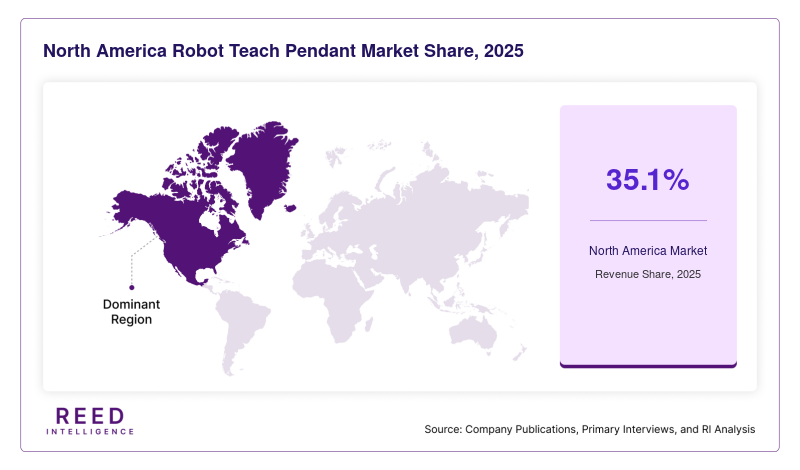
North America accounted for 35.1% of the global Robot Teach Pendant Market in 2025 and is expected to maintain a stable growth trajectory with a CAGR of 8.7% through 2034. The region benefits from extensive deployment of industrial robots across automotive, aerospace, semiconductor, and food processing industries. Manufacturers are increasingly upgrading automation systems with advanced human-machine interfaces that improve production efficiency and reduce operational downtime. Demand for wireless and touchscreen-enabled teach pendants is rising steadily as factories modernize production infrastructure and adopt smart manufacturing technologies.
The United States remains the dominant country in the regional market due to strong industrial automation investments and the presence of major robotics manufacturers. Automotive manufacturers in states such as Michigan and Ohio continue expanding robotic assembly operations to improve production consistency and labor efficiency. Rising investment in warehouse automation and logistics robotics is also contributing to demand for advanced teach pendant solutions. The country’s focus on industrial digitalization and AI-integrated manufacturing platforms is expected to sustain long-term market growth.
Europe
Europe represented a significant share of the Robot Teach Pendant Market in 2025 and is projected to grow at a CAGR of 8.9% during the forecast period. The region has a well-established industrial robotics ecosystem supported by strong automotive and machinery manufacturing sectors. Countries across Europe are investing in smart factory initiatives and sustainable industrial automation technologies to improve productivity and reduce energy consumption. Demand for ergonomic and safety-certified teach pendants is increasing as manufacturers prioritize worker-friendly automation environments.
Germany continues to dominate the European market due to its advanced manufacturing infrastructure and high concentration of industrial robot deployments. The country’s automotive and engineering industries are major users of robotic automation systems requiring sophisticated programming and control interfaces. German manufacturers are also emphasizing precision engineering and industrial cybersecurity, encouraging adoption of advanced wireless teach pendants with secure communication capabilities. Continued innovation in collaborative robotics and industrial IoT technologies is expected to strengthen regional market growth over the coming years.
Asia Pacific
Asia Pacific is anticipated to register the fastest CAGR of 11.4% in the Robot Teach Pendant Market from 2026 to 2034. Rapid industrialization, rising labor costs, and expanding electronics manufacturing activities are driving strong demand for robotic automation across the region. Countries including China, Japan, South Korea, and India are significantly increasing investments in industrial robotics to enhance manufacturing competitiveness. Teach pendant demand is rising alongside deployment of assembly robots, welding robots, and material handling systems in high-volume production facilities.
China remains the leading country in the regional market due to its large-scale manufacturing sector and government-backed automation initiatives. Chinese manufacturers are accelerating adoption of robotic systems in automotive, consumer electronics, and metal fabrication industries to improve operational efficiency. Domestic robotics companies are also expanding production of cost-effective teach pendants tailored for local industrial requirements. Increasing investment in smart factories and semiconductor manufacturing facilities is expected to further support market expansion across the country.
Middle East & Africa
The Middle East & Africa region is experiencing gradual growth in the Robot Teach Pendant Market and is forecast to expand at a CAGR of 7.5% through 2034. Industrial diversification initiatives and infrastructure modernization projects are encouraging adoption of automation technologies across manufacturing and logistics sectors. Countries in the Gulf region are increasingly investing in smart industrial facilities and warehouse automation systems to improve productivity and reduce operational dependency on manual labor. Demand for user-friendly robotic control devices is steadily increasing among industrial operators.
Saudi Arabia is emerging as the dominant country within the region due to ongoing industrial transformation programs and growing investment in advanced manufacturing technologies. The country is expanding automation deployment across petrochemical, food processing, and logistics industries as part of broader economic diversification strategies. Robotics adoption in industrial warehouses and energy-related manufacturing facilities is creating demand for reliable teach pendant solutions capable of operating in challenging industrial environments. These developments are expected to support long-term regional market growth.
Latin America
Latin America accounted for a smaller but steadily expanding portion of the Robot Teach Pendant Market in 2025 and is projected to grow at a CAGR of 7.9% during the forecast period. Manufacturing industries across the region are gradually increasing adoption of robotic automation to improve production quality and reduce labor-intensive operations. Automotive assembly, packaging, and food processing sectors are key contributors to demand for robotic programming and control systems. Industrial modernization efforts are encouraging companies to integrate flexible automation technologies into production lines.
Brazil remains the dominant country in the Latin American market due to its relatively large manufacturing base and growing automotive production sector. Industrial companies are increasingly investing in robotic systems to improve operational consistency and support export-oriented manufacturing activities. The country is also witnessing rising demand for collaborative robots in warehousing and packaging applications, creating opportunities for advanced teach pendant suppliers. Continued industrial expansion and digital manufacturing initiatives are expected to strengthen regional automation adoption over the forecast period.
Competitive Landscape
The Robot Teach Pendant Market is moderately competitive, with leading companies focusing on technological innovation, product customization, and strategic partnerships to strengthen their market positions. Major players are investing in touchscreen technologies, wireless communication systems, and AI-assisted robotic programming interfaces to improve user experience and operational efficiency. The market is characterized by continuous product upgrades aimed at supporting collaborative robotics, smart manufacturing systems, and industrial IoT integration.
ABB Ltd. remains one of the leading participants in the market due to its extensive industrial robotics portfolio and strong global distribution network. The company continues introducing advanced teach pendant solutions with improved safety features and intuitive programming capabilities. FANUC Corporation, Yaskawa Electric Corporation, and KUKA AG are also prominent competitors offering integrated robotic control systems for automotive and electronics manufacturing industries. Mitsubishi Electric Corporation has strengthened its market presence through investments in digital factory automation technologies and intelligent robotic interfaces.
Key Players
- ABB Ltd.
- FANUC Corporation
- Yaskawa Electric Corporation
- KUKA AG
- Mitsubishi Electric Corporation
- Kawasaki Heavy Industries Ltd.
- DENSO Corporation
- Omron Corporation
- Stäubli International AG
- Nachi-Fujikoshi Corp.
- Universal Robots A/S
- Epson Robots
- Comau S.p.A.
- Seiko Epson Corporation
- Toshiba Machine Co., Ltd.
Recent Developments
- ABB Ltd. introduced a next-generation wireless teach pendant platform in 2025 featuring cloud-enabled diagnostics and enhanced operator safety controls for collaborative robotic systems.
- FANUC Corporation expanded its robotic software compatibility portfolio in 2024 by launching advanced touchscreen teach pendants optimized for semiconductor manufacturing applications.
- KUKA AG partnered with industrial software providers in 2025 to integrate AI-assisted robot programming and predictive maintenance functionality into its teach pendant product line.
Robot Teach Pendant Market Segments
Type
- Wired Teach Pendant
- Wireless Teach Pendant
Application
- Industrial Robot Programming
- Maintenance and Diagnostics
- Collaborative Robot Control
- Material Handling Automation
End-Use Industry
- Automotive
- Electronics and Semiconductor
- Logistics and Warehousing
- Healthcare
- Food and Beverage
- Metal and Machinery
By Region
- North America
- Europe
- APAC
- Middle East and Africa
- LATAM