Robotic Bartender Market Size, Share & Demand Report By Component (Robotic Arms, Beverage Dispensing Systems, AI-Enabled Software Systems, Sensors and Vision Systems, Touchscreen Ordering Interfaces), By Application (Commercial Bars and Lounges, Hotels and Resorts, Airports and Transportation Hubs, Cruise Ships, Entertainment and Event Venues), By End Use (Hotels and Restaurants, Casinos and Nightclubs, Cruise Lines, Airports, Corporate Events and Exhibitions), By Region & Segment Forecasts, 202
USD 3950
Market Overview
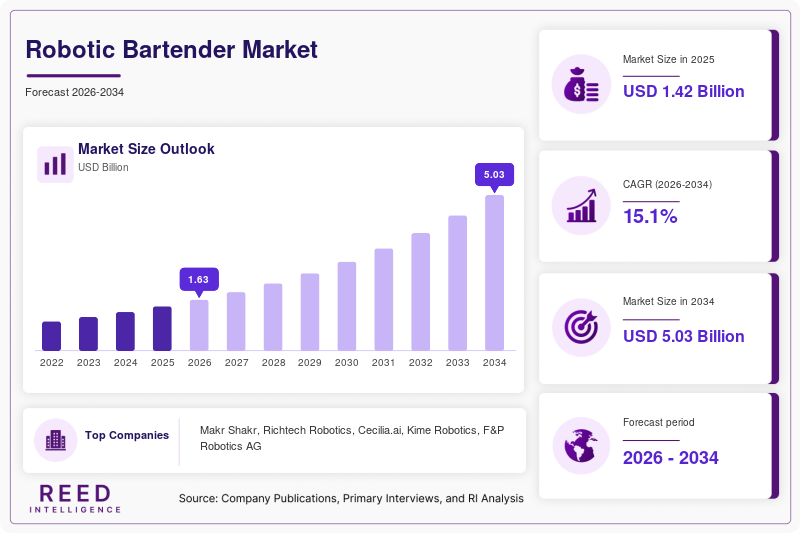
The global Robotic Bartender Market size was valued at USD 1.42 billion in 2026 and is projected to reach USD 4.38 billion by 2034, expanding at a CAGR of 15.1% during the forecast period from 2026 to 2034. The market is experiencing notable growth due to increasing automation across the hospitality industry and the rising demand for contactless customer service solutions in bars, restaurants, hotels, airports, and entertainment venues. Robotic bartending systems are gaining traction as hospitality operators focus on reducing operational costs, improving service consistency, and enhancing customer engagement through advanced automation technologies.
The growing integration of artificial intelligence, machine learning, and Internet of Things technologies into hospitality operations has supported market expansion globally. Hospitality businesses are increasingly adopting robotic bartender systems capable of preparing cocktails with precise ingredient measurement, maintaining hygiene standards, and delivering faster service during peak operating hours. The expansion of smart restaurants and automated entertainment venues has also accelerated product adoption. Furthermore, rising labor shortages in the foodservice industry across several developed economies have encouraged restaurants and bars to invest in robotic beverage preparation systems.
Key Highlights
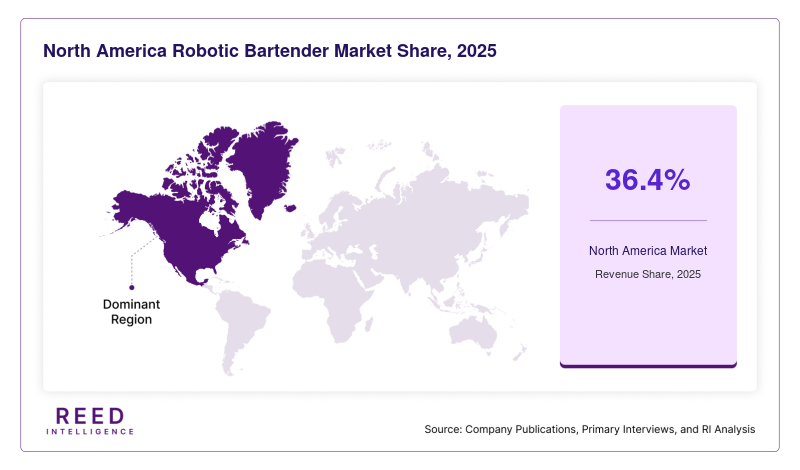
- North America dominated the market with a 36.4% share in 2025, while Asia Pacific is expected to grow at the fastest CAGR of 16.8% during 2026–2034.
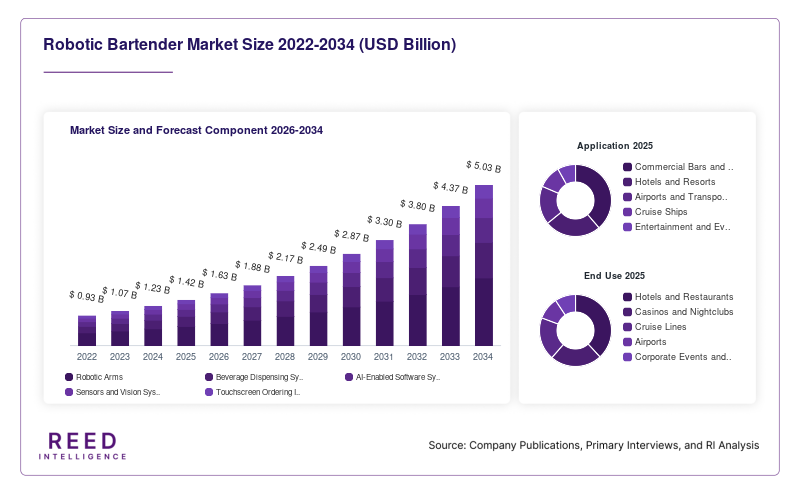
- By component, robotic arms accounted for the largest share of 39.2%, while AI-enabled software systems are projected to grow at a CAGR of 17.6%.
- By application, commercial bars and lounges led with a 44.8% share, whereas airports and transportation hubs are expected to expand at a CAGR of 16.9%.
- By end use, hotels and restaurants accounted for the dominant share of 41.3%, while cruise lines and entertainment venues are projected to witness a CAGR of 17.2%.
- The United States remained the dominant country, with market values of USD 420 million in 2024 and USD 486 million in 2025.
Market Trends
Integration of Artificial Intelligence and Personalized Beverage Preparation
The Robotic Bartender Market is witnessing increasing integration of artificial intelligence and predictive analytics technologies to improve beverage customization and customer interaction. Robotic bartender manufacturers are developing systems capable of recognizing customer preferences, recommending cocktails based on historical orders, and adjusting beverage preparation according to ingredient availability. AI-enabled robotic systems are also being integrated with facial recognition and digital payment platforms to simplify customer service operations in high-traffic hospitality venues. These advanced technologies help operators reduce waiting times while improving service consistency.
Hospitality brands are increasingly investing in interactive robotic bartenders that create personalized customer experiences through voice interaction, digital menus, and automated recipe generation. The trend is particularly visible in premium hotels, luxury cruise lines, and entertainment venues seeking differentiated customer engagement strategies. Furthermore, AI-based inventory management systems connected to robotic bartenders are helping businesses monitor ingredient consumption and minimize beverage wastage. This trend is expected to continue as operators seek technology-driven solutions that combine automation with enhanced customer satisfaction.
Expansion of Contactless Hospitality and Smart Entertainment Venues
The growing adoption of contactless hospitality services has become a major trend supporting the expansion of the Robotic Bartender Market. Restaurants, casinos, airports, and entertainment facilities are increasingly deploying robotic bartenders to provide fast, hygienic, and touch-free beverage preparation. Consumer preference for automated ordering and reduced physical interaction has encouraged hospitality companies to modernize their service infrastructure with robotic beverage systems. These systems improve operational efficiency during busy periods while supporting health and safety compliance.
Smart entertainment venues are also incorporating robotic bartenders as part of immersive customer experiences. Several nightlife destinations and event organizers are introducing robotic beverage stations that combine automation with digital displays, music synchronization, and interactive ordering systems. The trend is gaining momentum in urban centers where consumers actively seek technology-enabled dining and entertainment experiences. Additionally, the growth of smart hotels and automated retail concepts is contributing to increased deployment of robotic bartending solutions across global hospitality networks.
Market Drivers
Rising Labor Shortages and Increasing Operational Costs in Hospitality
The hospitality industry is facing persistent labor shortages across restaurants, hotels, bars, and entertainment venues, creating strong demand for automation technologies such as robotic bartenders. Hospitality operators are struggling to maintain staffing levels due to rising wage pressures, employee turnover, and limited availability of skilled workers. Robotic bartender systems help businesses reduce dependence on manual labor while ensuring consistent beverage preparation and faster customer service. These systems can operate continuously with minimal supervision, allowing hospitality businesses to improve productivity and reduce operational disruptions.
Growing Consumer Demand for Innovative Dining and Entertainment Experiences
Consumer preference for unique and technology-enabled dining experiences is supporting strong growth in the Robotic Bartender Market. Modern consumers, particularly younger demographics, are increasingly attracted to automated entertainment environments that combine digital interaction with hospitality services. Robotic bartenders create visually engaging beverage preparation experiences through synchronized robotic movements, touchscreen ordering systems, and customizable cocktail presentation features. These systems are helping hospitality businesses differentiate their brand identity and attract higher customer traffic.
Market Restraint
High Initial Installation Costs and Technical Integration Challenges
The high capital investment associated with robotic bartender systems remains a major restraint limiting broader market penetration, particularly among small and medium-sized hospitality businesses. Advanced robotic bartender installations require substantial spending on robotic arms, AI software platforms, cloud connectivity systems, beverage dispensing units, and customized infrastructure integration. Additional costs related to maintenance, system calibration, employee training, and software upgrades further increase the financial burden for operators. Many independent bars and restaurants continue to rely on traditional beverage preparation methods due to budget limitations and uncertain return on investment timelines.
Market Opportunities
Expansion of Robotic Bartenders Across Transportation and Travel Hubs
The increasing modernization of transportation infrastructure presents significant growth opportunities for the Robotic Bartender Market. Airports, railway terminals, cruise ports, and premium airline lounges are increasingly investing in automated beverage preparation systems to improve customer service efficiency and reduce operational congestion. Robotic bartenders are well suited for transportation environments due to their ability to provide fast, standardized, and contactless service throughout extended operating hours. Rising global passenger traffic and the expansion of luxury airport hospitality services are expected to create favorable conditions for robotic bartender deployment.
Increasing Adoption of Automation in Emerging Hospitality Markets
Emerging economies across Asia Pacific, Latin America, and the Middle East are creating new opportunities for robotic bartender manufacturers as hospitality infrastructure investment continues to rise. Rapid urbanization, growth in tourism activity, and increasing disposable income levels are encouraging restaurants, hotels, and entertainment venues to adopt modern automation technologies. Hospitality operators in emerging markets are increasingly exploring robotic bartenders as a way to attract technology-oriented consumers and differentiate their service offerings from competitors.
Segmental Analysis
By Component
Robotic arms accounted for the dominant share of the global Robotic Bartender Market in 2024, representing approximately 39.2% of total revenue. These systems form the operational foundation of automated beverage preparation by enabling accurate ingredient dispensing, bottle handling, and drink mixing functions. Hospitality operators prefer advanced robotic arms because they improve beverage consistency while reducing preparation time during peak operating hours. Manufacturers are increasingly developing robotic arms with enhanced motion precision, faster response times, and compact installation capabilities suitable for restaurants, hotels, casinos, and airport lounges. The growing focus on operational efficiency and customer engagement has accelerated adoption of robotic arm technologies across large hospitality establishments. Furthermore, improvements in collaborative robotics and sensor-based motion control systems continue to strengthen product performance and reliability.
By Application
Commercial bars and lounges represented the largest application segment in the Robotic Bartender Market in 2024, accounting for approximately 44.8% of total revenue. These establishments are adopting robotic bartender systems to improve service speed, reduce labor dependency, and create visually engaging customer experiences. Automated beverage preparation systems help bars maintain order consistency during high customer traffic periods while improving operational efficiency. Urban nightlife venues and premium cocktail lounges are particularly interested in robotic bartenders due to their entertainment value and ability to strengthen brand differentiation. In addition, robotic systems allow operators to monitor ingredient consumption more accurately, helping reduce beverage wastage and inventory losses. The expansion of themed restaurants and immersive entertainment concepts has also contributed to strong demand within the commercial bars and lounges segment.
By End Use
Hotels and restaurants accounted for the dominant share of the Robotic Bartender Market in 2024, representing approximately 41.3% of total revenue. Hospitality businesses within this segment are increasingly implementing robotic bartender systems to improve service quality, optimize staffing operations, and attract technology-oriented customers. Hotels are integrating robotic beverage systems into rooftop bars, luxury lounges, banquet facilities, and resort entertainment areas to create differentiated guest experiences. Restaurants are also deploying automated beverage preparation systems to reduce waiting times and improve operational consistency. Rising labor shortages and increasing wage expenses are encouraging hospitality operators to invest in automation technologies that support long-term cost optimization. Furthermore, robotic bartender installations help hospitality brands enhance their digital transformation strategies and strengthen customer engagement through interactive service experiences.
Regional Analysis
North America
North America accounted for the largest share of the global Robotic Bartender Market in 2025, representing approximately 36.4% of total revenue. The region is expected to maintain steady growth at a CAGR of 14.3% during the forecast period due to the strong presence of advanced hospitality infrastructure and increasing adoption of automation technologies. Restaurants, casinos, sports arenas, and luxury hotels across the United States and Canada are investing heavily in robotic beverage systems to improve operational efficiency and customer engagement. Rising labor costs and workforce shortages continue to encourage hospitality businesses to automate beverage preparation processes.
Europe
Europe represented a significant portion of the Robotic Bartender Market in 2025 and is projected to expand at a CAGR of 13.8% during the forecast period. The region benefits from the growing adoption of smart hospitality technologies across hotels, restaurants, and tourism destinations. European hospitality operators are focusing on improving operational productivity while addressing rising labor costs and stricter hygiene requirements. Robotic bartender systems are increasingly being introduced in luxury hotels, entertainment facilities, and convention centers to improve service quality and optimize staffing efficiency.
Asia Pacific
Asia Pacific is projected to witness the fastest growth in the global Robotic Bartender Market, expanding at a CAGR of 16.8% from 2026 to 2034. The region is benefiting from rapid urbanization, rising disposable income levels, and expanding hospitality infrastructure across major economies. Restaurants, shopping malls, hotels, and entertainment districts in countries such as China, Japan, South Korea, and India are increasingly adopting robotic service technologies to enhance customer experiences. The growing popularity of smart restaurants and automated retail concepts is creating strong demand for robotic bartenders.
Middle East & Africa
The Middle East & Africa region is experiencing gradual expansion in the Robotic Bartender Market and is expected to register a CAGR of 12.7% during the forecast period. Growth is primarily supported by increasing investment in luxury hospitality infrastructure, tourism diversification projects, and premium entertainment destinations. Countries within the Gulf Cooperation Council are adopting advanced hospitality technologies to strengthen tourism competitiveness and improve service quality. Robotic bartenders are increasingly being introduced in luxury hotels, cruise terminals, and integrated entertainment complexes.
Latin America
Latin America accounted for a moderate share of the Robotic Bartender Market in 2025 and is projected to grow at a CAGR of 12.1% throughout the forecast period. Hospitality operators across the region are gradually adopting robotic beverage systems to improve operational efficiency and attract technology-oriented consumers. Urban nightlife venues, tourism resorts, and premium hotels are increasingly exploring automation technologies to strengthen customer engagement and differentiate service offerings. The growth of international tourism and entertainment infrastructure development is also supporting regional market expansion.
Competitive Landscape
The global Robotic Bartender Market is moderately consolidated, with several technology providers and hospitality automation companies competing through product innovation, strategic partnerships, and international expansion initiatives. Market participants are focusing on integrating artificial intelligence, cloud connectivity, and advanced robotics capabilities into beverage preparation systems to strengthen their competitive position. Companies are also investing in customizable robotic bartender platforms suitable for hotels, airports, cruise lines, entertainment venues, and commercial restaurants.
Makr Shakr remains one of the leading companies in the market due to its strong global brand recognition and extensive deployment across premium hospitality environments. The company recently introduced an upgraded robotic beverage platform featuring enhanced AI-driven cocktail customization and cloud-based operational analytics capabilities. Other major players are focusing on strategic collaborations with hospitality chains and event management companies to expand commercial adoption.
Key Players
- Makr Shakr
- Richtech Robotics
- Cecilia.ai
- Kime Robotics
- F&P Robotics AG
- Barsys
- Monsieur
- RoboBar
- Rotender
- Party Robotics
- Cocktail Robotics
- Shenzhen OrionStar Technology
- Fanuc Corporation
- ABB Ltd.
- Universal Robots
Recent Developments
- In February 2026, Makr Shakr launched a next-generation robotic bartender platform with integrated AI-powered beverage recommendation software for luxury hospitality venues.
- In August 2025, Richtech Robotics partnered with a global hotel chain to deploy robotic bartender systems across multiple airport hotel properties in North America.
- In November 2025, Cecilia.ai introduced a compact robotic beverage preparation unit designed specifically for cruise ships and premium entertainment venues.
- In January 2026, ABB Ltd. expanded its hospitality robotics division by introducing collaborative robotic arms optimized for automated beverage dispensing applications.
- In September 2025, Barsys announced the integration of cloud-based inventory management capabilities into its robotic cocktail preparation systems for commercial restaurants and lounges.
Robotic Bartender Market Segments
Component
- Robotic Arms
- Beverage Dispensing Systems
- AI-Enabled Software Systems
- Sensors and Vision Systems
- Touchscreen Ordering Interfaces
Application
- Commercial Bars and Lounges
- Hotels and Resorts
- Airports and Transportation Hubs
- Cruise Ships
- Entertainment and Event Venues
End Use
- Hotels and Restaurants
- Casinos and Nightclubs
- Cruise Lines
- Airports
- Corporate Events and Exhibitions
By Region
- North America
- Europe
- APAC
- Middle East and Africa
- LATAM