Robotic Flexible Part Feeding System Market Size, Share & Demand Report By Component (Controllers, Robotic Arms, AI-Enabled Software Platforms), By Application (Medical Device Production, Packaging and Logistics, Consumer Goods Manufacturing), By End-Use Industry (Large Manufacturing Enterprises, Small and Medium-Sized Enterprises), By Region & Segment Forecasts, 2026–2034
USD 3950
Market Overview
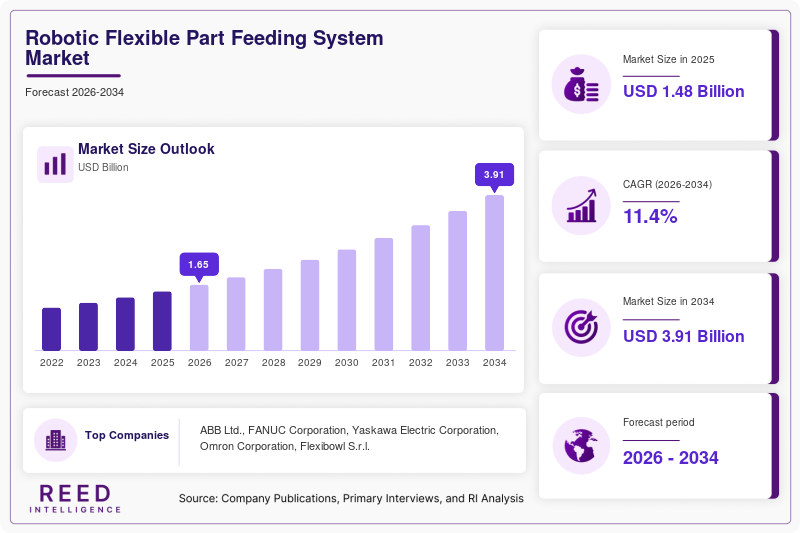
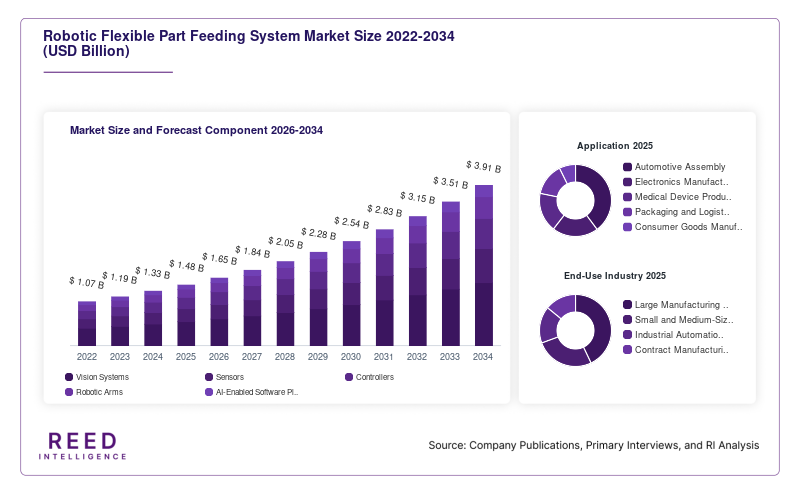
The global Robotic Flexible Part Feeding System Market size was valued at USD 1.48 billion in 2026 and is projected to reach USD 3.52 billion by 2034, expanding at a CAGR of 11.4% during the forecast period from 2026 to 2034. The market is experiencing stable growth due to the increasing adoption of industrial automation across manufacturing facilities, logistics centers, and electronics assembly operations. Companies are integrating robotic flexible feeding systems to reduce manual intervention, improve production consistency, and enhance operational throughput. The rapid expansion of smart factories and Industry 4.0 infrastructure has also accelerated demand for advanced robotic handling systems capable of adapting to multiple component shapes and production requirements.
Manufacturers are focusing on automated systems that support quick changeovers, real-time vision inspection, and precision orientation of parts. Flexible part feeding systems have become essential in industries where product customization and shorter production cycles require adaptable automation equipment. The growing use of collaborative robots, machine vision platforms, and AI-enabled control software is strengthening market expansion. In addition, increasing labor costs and ongoing workforce shortages in industrial economies are encouraging manufacturers to invest in robotic automation technologies that deliver long-term productivity gains.
Key Highlights
- North America dominated the market with a 34.2% share in 2025.
- Asia Pacific is expected to grow at the fastest CAGR of 12.1% during 2026–2034.
- By component, vision systems accounted for the largest share of 39.4%.
- while AI-enabled software platforms are projected to grow at a CAGR of 13.3%.
- By application, automotive assembly led with a 36.8% share.
- whereas electronics manufacturing is expected to expand at a CAGR of 12.8%.
- The United States remained the dominant country, with market values of USD 420 million in 2024 and USD 468 million in 2025.
Market Trends
Integration of Artificial Intelligence and Machine Vision Technologies
The Robotic Flexible Part Feeding System Market is witnessing significant adoption of artificial intelligence and machine vision technologies across manufacturing industries. Companies are deploying advanced vision-guided systems capable of identifying complex components, detecting orientation errors, and improving picking accuracy in high-speed production environments. AI-enabled feeding systems can analyze operational patterns and automatically adjust feeding sequences to minimize downtime and improve efficiency. This trend is becoming increasingly important in industries such as electronics, medical devices, and automotive manufacturing where precision and flexibility are critical. Manufacturers are investing in intelligent feeding systems that support predictive maintenance, self-learning capabilities, and adaptive robotic movements. These technologies reduce the need for manual calibration while improving productivity across multiple production lines. As factories continue to transition toward digital manufacturing ecosystems, the integration of AI and machine vision platforms is expected to remain a major market trend.
Rising Adoption of Collaborative and Modular Automation Systems
Industrial facilities are increasingly adopting collaborative robotic systems and modular automation platforms to support flexible manufacturing operations. Flexible part feeding systems are being designed with modular configurations that allow manufacturers to scale production capacity and adapt to changing product requirements. Collaborative robots are also gaining traction because they can operate safely alongside human workers while supporting repetitive assembly and feeding operations. The trend toward smaller batch production and customized manufacturing is encouraging companies to deploy compact robotic feeding systems that can be reconfigured quickly without major infrastructure changes. Manufacturers in the consumer electronics and packaging sectors are particularly focused on flexible automation systems that improve operational efficiency while reducing setup times. Additionally, modular feeding platforms support faster maintenance and lower installation costs, making them suitable for small and medium-sized enterprises. The growing preference for adaptable and collaborative automation solutions is expected to support long-term market growth.
Market Drivers
Expansion of Smart Manufacturing and Industry 4.0 Infrastructure
The rapid implementation of smart manufacturing technologies is a major factor driving the Robotic Flexible Part Feeding System Market. Manufacturing companies are modernizing production facilities through digital automation, connected machinery, and intelligent robotics to improve productivity and reduce operational inefficiencies. Flexible part feeding systems play an important role in automated production lines by ensuring accurate component orientation and uninterrupted material flow. Industry 4.0 initiatives are encouraging companies to integrate robotics, IoT sensors, and data analytics platforms into factory operations. This transition is creating strong demand for flexible feeding systems capable of supporting real-time communication and adaptive manufacturing processes. Automotive, electronics, and pharmaceutical manufacturers are among the leading adopters of automated feeding technologies. In addition, government support for industrial modernization and digital manufacturing initiatives in developed and emerging economies is strengthening investments in robotic automation infrastructure.
Increasing Demand for High-Speed and Precision Manufacturing
Manufacturers across multiple industries are under pressure to improve production speed, maintain product quality, and reduce operational costs. This has increased demand for robotic flexible feeding systems that provide high-speed handling and accurate positioning of components. Industries such as semiconductor manufacturing, electric vehicle production, and medical device assembly require highly precise automation systems to minimize production errors and material waste. Flexible feeding technologies enable companies to handle complex and delicate components without compromising speed or accuracy. Rising labor costs and ongoing shortages of skilled industrial workers are also motivating businesses to automate repetitive production tasks. In addition, growing consumer demand for customized products is encouraging manufacturers to adopt flexible automation systems capable of handling different part sizes and configurations. These operational requirements are expected to continue driving investments in robotic flexible feeding technologies over the forecast period.
Market Restraint
High Initial Investment and Integration Complexity
The adoption of robotic flexible part feeding systems is limited in some industries due to high installation costs and integration challenges. Advanced feeding systems equipped with AI software, machine vision technology, and precision robotic components require substantial capital investment. Small and medium-sized manufacturers often face financial constraints that reduce their ability to implement large-scale automation projects. In addition to equipment costs, businesses must allocate resources for system customization, workforce training, and ongoing maintenance. Integration complexity is another major concern because robotic feeding systems must operate seamlessly with existing production equipment and enterprise software platforms. In industries with legacy manufacturing infrastructure, integration can lead to production disruptions and extended deployment timelines. Companies may also encounter compatibility issues related to robotic controllers, communication protocols, and sensor systems. For example, automotive suppliers transitioning from conventional feeding systems to intelligent robotic platforms often require extensive process redesign and technical support. These challenges can delay automation investments and limit market penetration in cost-sensitive manufacturing environments.
Market Opportunities
Growing Automation Demand in Electric Vehicle Manufacturing
The global expansion of electric vehicle manufacturing presents a significant opportunity for the Robotic Flexible Part Feeding System Market. Electric vehicle production requires precise handling of batteries, electronic components, sensors, and lightweight structural parts. Manufacturers are increasingly investing in automated assembly systems that improve consistency and reduce production errors in high-volume manufacturing environments. Flexible feeding systems are particularly valuable in EV production because they support rapid model changes and varying component designs. As governments continue to promote sustainable transportation and clean energy initiatives, automotive manufacturers are expanding EV production capacity across North America, Europe, and Asia Pacific. This industrial expansion is expected to create strong demand for robotic feeding technologies integrated with vision inspection and intelligent motion control systems. In addition, battery manufacturing facilities are increasingly adopting automated handling systems to improve safety and operational efficiency.
Rising Adoption of Automation Among Small and Medium Enterprises
Small and medium-sized enterprises are gradually increasing investments in robotic automation technologies to improve operational competitiveness. The availability of compact, modular, and cost-efficient flexible feeding systems is making industrial automation more accessible for smaller manufacturers. Companies in packaging, consumer electronics, food processing, and medical device production are adopting robotic feeding platforms to reduce labor dependency and improve production accuracy. Advancements in collaborative robotics and cloud-based automation software are lowering implementation barriers for SMEs by reducing programming complexity and installation costs. Leasing models and robotics-as-a-service platforms are also encouraging smaller businesses to deploy automated feeding systems without major upfront investment. As supply chains become more competitive and manufacturers seek faster production cycles, SMEs are expected to emerge as an important customer segment for flexible robotic feeding system providers during the forecast period.
Segmental Analysis
By Component
Vision systems accounted for the largest share of the Robotic Flexible Part Feeding System Market in 2024, representing 39.4% of total revenue. These systems play a critical role in identifying, locating, and orienting components during automated manufacturing operations. Vision-based technologies improve feeding accuracy and reduce production errors, making them highly valuable in industries such as automotive, electronics, and medical device manufacturing. The increasing complexity of production environments has encouraged manufacturers to adopt high-resolution cameras, advanced sensors, and image-processing software to support automated inspection and robotic guidance. Companies are integrating vision systems with artificial intelligence platforms to improve operational adaptability and real-time decision-making capabilities. Additionally, rising demand for high-speed production lines and precision assembly processes is strengthening the adoption of machine vision technologies in robotic feeding applications.
AI-enabled software platforms are projected to register the fastest CAGR of 13.3% during the forecast period due to increasing demand for intelligent automation systems. These software solutions enable robotic feeding systems to optimize operational workflows, predict maintenance requirements, and support adaptive production processes. Manufacturers are increasingly deploying cloud-based analytics and machine learning algorithms to improve production flexibility and minimize downtime. Industries such as semiconductor manufacturing and electric vehicle assembly are investing in advanced software platforms capable of handling complex feeding operations with minimal human intervention. The growing integration of digital twins and predictive analytics in manufacturing facilities is also supporting demand for AI-driven automation software. In addition, software platforms provide scalability and remote monitoring capabilities, allowing manufacturers to improve productivity while reducing operational inefficiencies.
By Application
Automotive assembly emerged as the dominant application segment in 2024, accounting for 36.8% of the global market share. Automotive manufacturers rely heavily on robotic flexible feeding systems to manage high-volume production environments and maintain precision in component handling operations. These systems support efficient feeding of fasteners, electronic modules, lightweight structural parts, and battery components used in vehicle manufacturing. The transition toward electric vehicle production has further increased the need for flexible automation technologies capable of adapting to multiple vehicle platforms and component configurations. Automotive companies are investing in intelligent feeding systems integrated with machine vision and robotic guidance technologies to improve assembly accuracy and reduce operational downtime. Rising demand for automated quality inspection and real-time production monitoring is also contributing to segment growth across global automotive manufacturing facilities.
Electronics manufacturing is expected to witness the fastest CAGR of 12.8% during the forecast period because of increasing production of consumer electronics, semiconductor devices, and communication equipment. Electronics manufacturers require highly precise feeding systems to handle delicate and miniature components during assembly processes. Flexible robotic feeding technologies improve placement accuracy and reduce product defects in high-speed production lines. The rapid growth of semiconductor fabrication facilities and expansion of advanced electronics manufacturing in Asia Pacific are major factors supporting segment growth. Manufacturers are also adopting AI-enabled inspection systems and collaborative robotics to improve operational flexibility and minimize production errors. In addition, increasing demand for wearable devices, industrial sensors, and smart consumer products is expected to strengthen investments in robotic automation solutions for electronics assembly applications.
By End Use Industry
Large manufacturing enterprises held the dominant share of the Robotic Flexible Part Feeding System Market in 2024 due to their extensive automation investments and high-volume production capabilities. Large enterprises typically operate complex manufacturing facilities that require advanced robotic systems for efficient material handling and component feeding operations. These companies prioritize automation technologies that improve productivity, reduce labor dependency, and support consistent product quality across multiple production lines. Industries such as automotive, aerospace, and industrial machinery manufacturing are among the leading adopters of flexible feeding systems. Large enterprises also have greater financial resources to invest in AI-enabled robotics, predictive maintenance platforms, and advanced vision systems. In addition, multinational manufacturers are increasingly standardizing automation infrastructure across global production facilities, further supporting demand for robotic feeding technologies.
Small and medium-sized enterprises are projected to register the fastest CAGR of 12.5% during the forecast period as automation technologies become more affordable and accessible. SMEs are adopting compact robotic feeding systems to improve production efficiency, reduce manual errors, and enhance competitiveness in rapidly evolving industrial markets. The availability of modular automation solutions and robotics-as-a-service business models is lowering financial barriers for smaller manufacturers. Industries including food packaging, consumer electronics, and medical device production are increasingly deploying flexible feeding technologies to support precision assembly and shorter production cycles. Government incentives promoting industrial modernization and digital manufacturing transformation are also encouraging SMEs to invest in robotic automation systems. As collaborative robotics and cloud-based software platforms continue to evolve, smaller enterprises are expected to become a major growth segment within the market.
Regional Analysis
North America
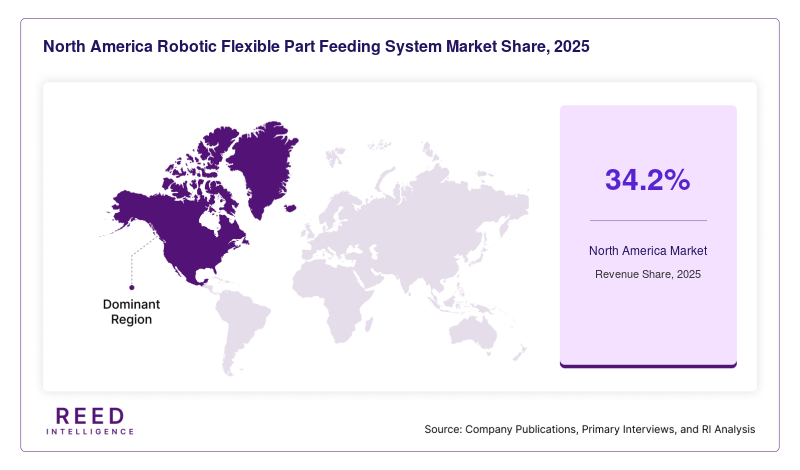
North America accounted for 34.2% of the global Robotic Flexible Part Feeding System Market in 2025 and is expected to maintain stable growth at a CAGR of 10.7% during the forecast period. The region benefits from strong industrial automation adoption across automotive, aerospace, electronics, and logistics industries. Manufacturers are investing heavily in smart factories and robotic production systems to improve productivity and reduce operational costs. The presence of advanced robotics manufacturers, strong research capabilities, and early adoption of AI-enabled automation technologies further support regional market expansion.
The United States remains the dominant country in North America due to widespread automation investments and strong demand from automotive and semiconductor manufacturers. Industrial companies are deploying flexible robotic feeding systems to support precision assembly and reduce labor dependency in high-volume manufacturing operations. Another important growth factor is the expansion of domestic semiconductor fabrication facilities supported by public and private investments. The increasing focus on reshoring manufacturing activities and improving supply chain resilience is also encouraging companies to adopt advanced robotic handling technologies.
Europe
Europe represented 27.6% of the global Robotic Flexible Part Feeding System Market in 2025 and is projected to grow at a CAGR of 10.3% through 2034. The region has a well-established industrial base supported by strong automotive, machinery, and electronics manufacturing sectors. European manufacturers are emphasizing energy-efficient and highly automated production systems to improve operational performance and meet sustainability targets. Demand for robotic feeding technologies is increasing due to labor shortages and the need for greater production flexibility in customized manufacturing environments.
Germany remains the leading market within Europe because of its advanced industrial automation infrastructure and strong engineering capabilities. The country has a large concentration of automotive and industrial machinery manufacturers that actively invest in robotic production systems. A unique growth factor supporting the German market is the increasing integration of collaborative robots and AI-driven vision systems in mid-sized manufacturing facilities. In addition, government initiatives focused on digital manufacturing transformation are supporting investments in smart factory technologies across the country.
Asia Pacific
Asia Pacific held 24.9% of the global Robotic Flexible Part Feeding System Market in 2025 and is anticipated to register the fastest CAGR of 12.1% during the forecast period. Rapid industrialization, expanding electronics manufacturing, and increasing investments in smart manufacturing infrastructure are supporting regional market growth. Countries across the region are adopting robotic automation technologies to improve production efficiency and address rising labor costs. The growth of semiconductor fabrication, consumer electronics production, and electric vehicle manufacturing is creating substantial demand for flexible robotic feeding systems.
China remains the dominant country in Asia Pacific due to its large-scale manufacturing ecosystem and extensive investments in industrial automation. The country is actively promoting intelligent manufacturing technologies to improve production quality and global competitiveness. A major growth factor in China is the rapid expansion of electric vehicle and battery manufacturing facilities that require highly automated assembly processes. Domestic robotics manufacturers are also increasing production of cost-efficient feeding systems, making automation more accessible for regional manufacturers.
Middle East & Africa
The Middle East & Africa accounted for 6.1% of the global Robotic Flexible Part Feeding System Market in 2025 and is expected to grow at a CAGR of 9.4% through 2034. The region is gradually increasing investments in industrial diversification and advanced manufacturing infrastructure. Governments are supporting automation initiatives to reduce dependency on oil-based economies and strengthen industrial productivity. Manufacturing sectors such as packaging, food processing, and industrial equipment assembly are adopting robotic feeding systems to improve operational consistency and reduce manual labor requirements.
Saudi Arabia remains the dominant country in the Middle East & Africa market due to increasing investments in industrial modernization and smart manufacturing projects. The country is promoting automation technologies through large-scale industrial development programs focused on manufacturing diversification. A unique growth factor supporting market expansion is the establishment of advanced logistics and industrial hubs that require automated material handling systems. Rising investments in industrial robotics training and technology partnerships are also contributing to regional automation adoption.
Latin America
Latin America captured 7.2% of the global Robotic Flexible Part Feeding System Market in 2025 and is forecast to expand at a CAGR of 9.8% during the study period. The region is experiencing gradual growth in industrial automation investments driven by automotive production, food processing, and packaging industries. Manufacturers are focusing on improving operational efficiency and reducing labor-intensive processes through robotic automation technologies. Growing awareness regarding the long-term cost benefits of automation is encouraging businesses to modernize production facilities and implement flexible feeding systems.
Brazil remains the dominant market in Latin America because of its strong automotive manufacturing sector and expanding industrial base. The country is witnessing increasing adoption of robotic automation solutions across automotive assembly plants and consumer goods manufacturing facilities. A key growth factor supporting the Brazilian market is the modernization of industrial production lines aimed at improving export competitiveness and manufacturing productivity. In addition, multinational companies operating in Brazil are increasing investments in smart manufacturing infrastructure and robotic integration projects.
Competitive Landscape
The Robotic Flexible Part Feeding System Market is moderately consolidated, with global automation companies focusing on product innovation, software integration, and strategic partnerships to strengthen market presence. Leading manufacturers are investing in AI-enabled robotic systems, advanced machine vision technologies, and modular automation platforms to address evolving industrial requirements. Companies are also expanding regional distribution networks and strengthening after-sales support capabilities to improve customer retention and operational efficiency.
ABB Ltd. remains one of the leading participants in the market due to its broad industrial robotics portfolio and strong global manufacturing presence. The company recently introduced upgraded AI-enabled robotic guidance systems designed for high-speed electronics and automotive assembly applications. Other major companies are focusing on collaborative robotics integration, cloud-based analytics, and compact automation solutions to support growing demand from small and medium-sized manufacturers. Strategic acquisitions, technology partnerships, and production facility expansions continue to shape competitive dynamics across the industry.
Key Players
- ABB Ltd.
- FANUC Corporation
- Yaskawa Electric Corporation
- Omron Corporation
- Flexibowl S.r.l.
- RNA Automation Ltd.
- Asyril SA
- Siemens AG
- Epson Robots
- Kawasaki Heavy Industries Ltd.
- Universal Robots A/S
- Bosch Rexroth AG
- Schneider Electric SE
- Rockwell Automation Inc.
- Mitsubishi Electric Corporation
Recent Developments
- In February 2026, ABB Ltd. launched an AI-enabled flexible feeding platform designed to improve precision handling for semiconductor and automotive production lines.
- In July 2025, Asyril SA expanded its production facility in Europe to increase manufacturing capacity for intelligent robotic feeding systems used in electronics assembly operations.
- In November 2025, FANUC Corporation introduced an upgraded machine vision solution integrated with collaborative robotic feeding systems to support high-speed packaging applications.
- In March 2026, Omron Corporation partnered with an industrial software provider to develop cloud-connected automation platforms for predictive maintenance and real-time robotic monitoring.
- In September 2025, Flexibowl S.r.l. introduced a modular feeding solution designed for small and medium-sized manufacturers seeking compact automation infrastructure.
Robotic Flexible Part Feeding System Market Segments
Component
- Vision Systems
- Sensors
- Controllers
- Robotic Arms
- AI-Enabled Software Platforms
Application
- Automotive Assembly
- Electronics Manufacturing
- Medical Device Production
- Packaging and Logistics
- Consumer Goods Manufacturing
End-Use Industry
- Large Manufacturing Enterprises
- Small and Medium-Sized Enterprises
- Industrial Automation Integrators
- Contract Manufacturing Facilities
By Region
- North America
- Europe
- APAC
- Middle East and Africa
- LATAM