Rock And Concrete Splitter Market Size, Share & Demand Report By Product Type (Hydraulic Splitters, Pneumatic Splitters, Electric Splitters, Manual Splitters), By Application (Mining and Quarrying, Infrastructure Construction, Building Demolition, Tunnel Excavation, Industrial Renovation), By End User (Construction Contractors, Mining Companies, Municipal Authorities, Industrial Facility Operators, Equipment Rental Providers), By Region & Segment Forecasts, 2026–2034
USD 3950
Market Overview
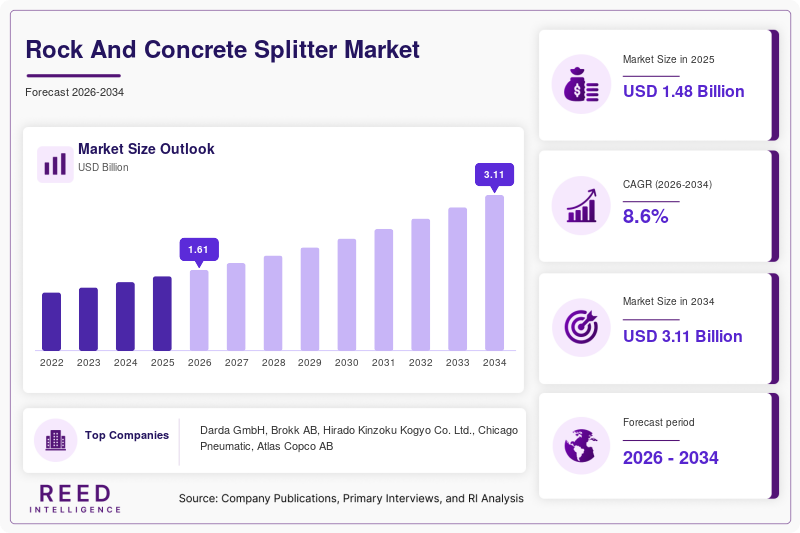
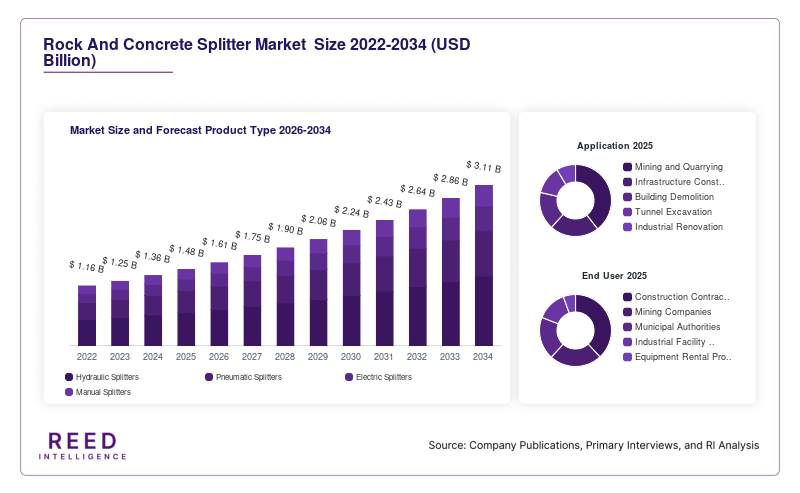
The global Rock And Concrete Splitter Market size was valued at approximately USD 1.48 billion in 2026 and is projected to reach nearly USD 2.86 billion by 2034, expanding at a CAGR of 8.6% during the forecast period. The market continues to gain momentum due to rising investments in urban infrastructure, underground mining operations, transportation projects, and controlled demolition activities across developed and developing economies. Rock and concrete splitters are widely used in applications where traditional blasting methods are restricted due to safety regulations, environmental concerns, or structural sensitivity. Contractors and mining operators increasingly prefer hydraulic and pneumatic splitting systems because they offer precision, lower vibration, and reduced operational noise.
The growing emphasis on sustainable construction and environmentally controlled excavation activities has also supported market expansion. Governments across North America, Europe, and Asia Pacific have introduced stricter regulations regarding blasting operations near residential areas and public infrastructure. As a result, contractors are shifting toward advanced splitting technologies that reduce dust generation and minimize structural damage. In addition, the expansion of tunneling projects, smart city initiatives, railway construction, and renewable energy infrastructure has created consistent demand for efficient rock breaking equipment.
Key Highlights
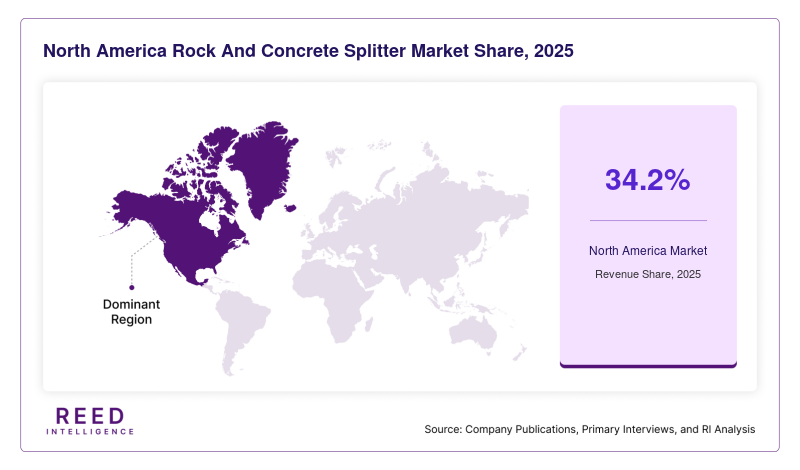
- North America dominated the market with a 34.2% share in 2025, while Asia Pacific is expected to grow at the fastest CAGR of 10.9% during 2026–2034.
- By product type, hydraulic splitters accounted for the largest share of 46.8%, while pneumatic splitters are projected to grow at a CAGR of 9.8%.
- By application, mining and quarrying led with a 39.6% share, whereas infrastructure construction is expected to expand at a CAGR of 10.4%.
- The United States remained the dominant country, with market values of USD 412 million in 2024 and USD 448 million in 2025.
Market Trends
Expansion of Low-Vibration Demolition Technologies
The increasing adoption of low-vibration demolition technologies has become a major trend shaping the Rock And Concrete Splitter Market. Construction firms and municipal authorities are focusing on demolition methods that minimize environmental impact and reduce structural disturbance in urban environments. Hydraulic splitters are increasingly preferred over conventional explosives and heavy-impact equipment because they produce lower noise levels and limit airborne dust. The trend is particularly visible in densely populated cities where infrastructure renovation projects require careful removal of aging concrete structures without damaging nearby buildings. Contractors are investing in portable and compact splitter systems that improve mobility in confined locations such as tunnels, bridges, and underground transit corridors. This trend is expected to strengthen as governments continue implementing stricter workplace safety and environmental standards.
Integration of Smart Hydraulic Monitoring Systems
Manufacturers operating in the Rock And Concrete Splitter Market are increasingly integrating digital monitoring systems into hydraulic splitting equipment. Smart hydraulic pressure monitoring, automated performance tracking, and remote-control operation features are improving equipment efficiency and operator safety. Contractors and mining companies are using connected splitter systems to monitor pressure distribution, optimize splitting force, and reduce equipment downtime during excavation activities. These technologies also support predictive maintenance by identifying wear patterns before major failures occur. The demand for intelligent splitting systems is particularly strong in large mining projects and infrastructure developments where operational efficiency directly affects project timelines and costs. Equipment manufacturers are also focusing on energy-efficient hydraulic systems that reduce fuel consumption while maintaining strong rock-breaking performance.
Market Drivers
Growth in Infrastructure Development and Urban Construction
Rapid infrastructure development across emerging and developed economies continues to drive demand within the Rock And Concrete Splitter Market. Governments are investing heavily in transportation networks, metro rail systems, bridges, tunnels, dams, and commercial buildings to support urban population growth and industrial expansion. These projects require controlled rock excavation and concrete demolition techniques that minimize environmental impact and ensure worker safety. Rock and concrete splitters are widely used in projects where conventional blasting methods are restricted due to noise regulations or structural limitations. The growing number of smart city initiatives in countries such as China, India, and the United Arab Emirates has also increased demand for compact and precision-oriented splitting equipment capable of operating in confined urban construction environments.
Rising Demand from Mining and Quarrying Operations
The expansion of mining and quarrying activities has become another major growth driver for the Rock And Concrete Splitter Market. Increasing demand for minerals, aggregates, and industrial raw materials has encouraged mining companies to adopt efficient and safer rock extraction technologies. Hydraulic and pneumatic splitters help mining operators reduce blasting-related risks while improving extraction precision in sensitive geological areas. The growing adoption of underground mining methods has further supported market growth because these operations require low-vibration equipment to maintain tunnel stability and worker safety. In addition, mining companies are increasingly prioritizing sustainable extraction methods that reduce dust emissions and operational noise. This transition toward environmentally responsible mining practices continues to strengthen demand for advanced splitting equipment globally.
Market Restraint
High Initial Equipment Costs and Maintenance Requirements
The relatively high acquisition and maintenance costs associated with advanced rock and concrete splitting equipment remain a key restraint affecting market expansion. Hydraulic splitters, remote-controlled systems, and high-capacity industrial models require significant capital investment, which limits adoption among small and medium-sized contractors. Maintenance requirements for hydraulic pumps, pressure hoses, and specialized components can also increase operational expenses over time. In developing economies, many construction firms continue relying on conventional demolition methods because of lower upfront costs despite their environmental limitations. Additionally, operators require technical training to safely handle high-pressure splitting equipment, creating additional workforce development expenses for contractors and mining companies. Delays in equipment servicing and spare part availability may further affect productivity in remote construction and mining locations. These financial and operational barriers can slow adoption rates, particularly in price-sensitive regional markets.
Market Opportunities
Increasing Demand for Tunnel and Underground Infrastructure Projects
The growing number of tunnel construction and underground infrastructure projects presents significant opportunities for the Rock And Concrete Splitter Market. Urban congestion and land availability challenges are encouraging governments to expand underground transportation systems, utility corridors, and water management infrastructure. Rock and concrete splitters are increasingly used in tunnel excavation because they generate limited vibration and support precise material removal in confined environments. Countries across Asia Pacific and Europe are investing in large-scale railway tunnels, hydropower projects, and underground metro systems that require efficient excavation technologies. Manufacturers are responding by developing compact and lightweight splitting equipment specifically designed for underground operations. This growing focus on subterranean infrastructure development is expected to create long-term opportunities for market participants.
Expansion of Equipment Rental and Leasing Services
The expansion of equipment rental and leasing services is creating new growth opportunities within the Rock And Concrete Splitter Market. Small and medium-sized contractors increasingly prefer renting specialized splitting equipment instead of making large capital investments in ownership. Rental providers are expanding their fleets with advanced hydraulic splitters, portable pumps, and automated demolition tools to meet rising demand from infrastructure and renovation projects. Leasing models also allow contractors to access technologically advanced equipment without bearing long-term maintenance costs. This trend is particularly important in developing regions where construction firms often operate with budget constraints. In addition, rental service providers are offering operator training and maintenance support, helping improve equipment adoption rates among first-time users and regional contractors.
Segmental Analysis
By Product Type
Hydraulic splitters accounted for the largest share of the Rock And Concrete Splitter Market in 2024, representing approximately 46.8% of total revenue. These systems are widely preferred because they provide high splitting force, operational precision, and reduced vibration during demolition and excavation activities. Hydraulic splitters are extensively used in infrastructure construction, mining, tunneling, and quarrying applications where controlled rock breaking is essential. Contractors increasingly favor hydraulic systems because they improve worker safety and reduce environmental impact compared to blasting methods. The availability of portable hydraulic splitters has further expanded adoption among urban construction projects where space limitations require compact and flexible equipment solutions. Manufacturers are also introducing advanced hydraulic pressure control systems that improve operational efficiency and reduce maintenance requirements.
Pneumatic splitters are expected to witness the fastest growth during the forecast period, expanding at a CAGR of 9.8%. Rising demand for lightweight and portable demolition equipment is contributing to increased adoption of pneumatic systems across smaller construction and renovation projects. Pneumatic splitters are commonly used in confined spaces and indoor demolition environments because they are easier to transport and operate compared to large hydraulic systems. The growing number of commercial renovation projects and municipal repair activities is creating strong demand for cost-effective pneumatic equipment. Manufacturers are focusing on improving air compression efficiency and reducing noise generation to strengthen product performance. In addition, expanding rental service availability is supporting adoption among contractors seeking lower-cost equipment alternatives.
By Application
Mining and quarrying represented the dominant application segment within the Rock And Concrete Splitter Market, accounting for nearly 39.6% of market revenue in 2024. Mining operators increasingly use rock splitting equipment to improve extraction precision and reduce the environmental impact associated with blasting operations. Hydraulic splitters are particularly valuable in underground mining applications where tunnel stability and worker safety are major operational priorities. Quarry operators also prefer controlled splitting systems because they minimize material waste and improve the quality of extracted stone blocks. The growing demand for industrial minerals, construction aggregates, and raw materials across infrastructure and manufacturing industries continues supporting equipment demand within this application segment. Advancements in high-pressure hydraulic systems have further improved the productivity and durability of mining-oriented splitter equipment.
Infrastructure construction is projected to record the fastest CAGR of 10.4% throughout the forecast period due to rising investments in transportation, utilities, and urban development projects. Governments worldwide are investing in metro rail systems, bridges, tunnels, highways, and water management infrastructure to support economic growth and urban expansion. Rock and concrete splitters are increasingly used in these projects because they enable controlled demolition and excavation in populated environments where noise and vibration restrictions apply. Contractors are adopting advanced splitter systems equipped with automated pressure monitoring and remote operation capabilities to improve efficiency and safety. The growing emphasis on sustainable construction practices is also accelerating the use of low-impact rock breaking technologies in major infrastructure developments.
By End User
Construction contractors held the largest share of the Rock And Concrete Splitter Market in 2024, accounting for approximately 44.1% of total revenue. Contractors engaged in residential, commercial, and infrastructure projects rely heavily on rock and concrete splitters for demolition, excavation, and structural modification activities. Urban redevelopment initiatives and increasing renovation projects have strengthened demand for compact and precision-oriented splitting equipment capable of operating in confined environments. Construction companies are increasingly adopting hydraulic splitters to comply with environmental regulations regarding dust, vibration, and noise emissions. In addition, the growing use of underground utility systems and tunnel infrastructure has expanded the role of controlled rock excavation technologies within the construction industry. Rental service partnerships are also helping contractors access advanced equipment without large capital investments.
Mining companies are anticipated to register the fastest CAGR of 9.6% during the forecast period due to increasing mineral extraction activities and growing emphasis on worker safety. Underground mining operations are adopting advanced rock splitting systems to reduce structural stress and improve excavation precision in confined environments. Mining companies are also prioritizing sustainable extraction practices that reduce environmental disruption and operational hazards associated with traditional blasting methods. Technological advancements in hydraulic pressure systems, remote operation features, and energy-efficient equipment designs are supporting adoption across large-scale mining projects. The expansion of critical mineral extraction activities related to renewable energy technologies and battery manufacturing is expected to create additional opportunities for splitter equipment suppliers targeting the mining sector.
Regional Analysis
North America
North America accounted for approximately 34.2% of the global Rock And Concrete Splitter Market in 2025 and continues to maintain a leading position due to extensive infrastructure modernization projects and mining activities. The regional market is projected to expand at a CAGR of 7.9% during the forecast period. Demand for hydraulic splitting equipment remains strong across the United States and Canada because contractors increasingly prefer controlled demolition methods over conventional blasting systems. The region also benefits from stringent environmental regulations regarding vibration, noise, and dust emissions during excavation and demolition activities.
The United States remained the dominant country within North America due to strong investments in highway rehabilitation, bridge reconstruction, and underground utility infrastructure. Large-scale transportation modernization programs and renewable energy projects continue supporting equipment demand across the country. Mining operations in western states also contribute to steady market growth by adopting precision-oriented rock splitting systems to improve operational safety. Additionally, the growing adoption of equipment rental services has increased accessibility to advanced splitter technologies for regional contractors.
Europe
Europe represented nearly 26.5% of the global Rock And Concrete Splitter Market in 2025 and is expected to witness a CAGR of 7.4% through 2034. The market is supported by increasing renovation activities involving aging transportation infrastructure, tunnels, and historical buildings across the region. European construction firms are increasingly adopting low-noise and low-vibration demolition technologies to comply with strict environmental and worker safety regulations. Countries across Western Europe continue investing in underground transportation systems and energy infrastructure, supporting stable demand for hydraulic and pneumatic splitter equipment.
Germany emerged as the dominant country within the European market due to its advanced construction sector and strong engineering capabilities. The country has experienced rising demand for controlled demolition equipment in urban redevelopment projects and railway modernization programs. German contractors are increasingly using precision splitting technologies for bridge repair and tunnel excavation applications. In addition, the country’s focus on sustainable infrastructure development and reduced environmental impact has accelerated adoption of energy-efficient hydraulic splitter systems across commercial and municipal projects.
Asia Pacific
Asia Pacific held approximately 24.8% of the global Rock And Concrete Splitter Market in 2025 and is projected to register the fastest CAGR of 10.9% during the forecast period. Rapid urbanization, industrial expansion, and large-scale infrastructure investments continue driving regional demand for rock splitting equipment. Governments across China, India, Japan, and Southeast Asian countries are investing heavily in metro rail networks, hydropower facilities, highways, and smart city developments. The increasing number of underground construction projects has also encouraged contractors to adopt precision excavation equipment capable of operating efficiently in densely populated urban environments.
China dominated the Asia Pacific market due to extensive infrastructure spending and large-scale mining operations. The country continues investing in transportation corridors, tunnel construction, and renewable energy infrastructure projects that require advanced rock excavation technologies. Chinese mining companies are also transitioning toward safer and more environmentally controlled extraction methods, supporting demand for hydraulic splitters. Additionally, the rapid expansion of local equipment manufacturing capabilities has improved affordability and availability of splitting systems across regional construction and mining industries.
Middle East & Africa
The Middle East & Africa region accounted for around 7.1% of the global Rock And Concrete Splitter Market in 2025 and is anticipated to grow at a CAGR of 8.1% through 2034. Infrastructure diversification strategies, mining investments, and urban development initiatives continue supporting regional market growth. Governments across the Gulf region are investing in transportation systems, tourism infrastructure, and smart city projects that require controlled rock excavation and demolition technologies. In Africa, expanding mining activities and quarrying operations are increasing demand for efficient and low-vibration rock splitting equipment.
Saudi Arabia remained the dominant country within the Middle East & Africa market due to large-scale construction projects linked to economic diversification programs. Major investments in urban development, tourism infrastructure, and transportation networks have increased demand for precision demolition technologies. The country is also investing in underground utility systems and tunnel construction projects that require advanced hydraulic splitters. Additionally, the expansion of mining operations focused on industrial minerals and aggregates continues to create opportunities for equipment manufacturers operating in the region.
Latin America
Latin America captured nearly 7.4% of the global Rock And Concrete Splitter Market in 2025 and is forecast to grow at a CAGR of 7.6% during the assessment period. Infrastructure development, mining expansion, and increasing commercial construction activities continue supporting regional demand. Countries across the region are focusing on highway expansion, hydroelectric projects, and urban transportation improvements that require controlled rock excavation technologies. Construction firms are increasingly adopting hydraulic splitting equipment because of its operational safety advantages and ability to reduce environmental disruption in populated areas.
Brazil emerged as the leading country within the Latin American market due to extensive mining operations and ongoing infrastructure modernization projects. The country’s mining sector continues investing in safer and more efficient rock extraction technologies to improve productivity and regulatory compliance. Infrastructure rehabilitation initiatives involving bridges, tunnels, and transportation corridors are also contributing to equipment demand. Additionally, the growth of regional equipment rental networks has improved access to advanced splitting technologies for mid-sized construction contractors throughout Brazil.
Competitive Landscape
The Rock And Concrete Splitter Market is characterized by moderate competition with the presence of international manufacturers and regional equipment suppliers focusing on product durability, operational efficiency, and technological innovation. Leading companies are investing in advanced hydraulic systems, lightweight equipment designs, and remote-control technologies to strengthen their market positions. Strategic partnerships with construction contractors, mining operators, and equipment rental providers remain an important competitive strategy across the industry.
Darda GmbH continues to maintain a leading position within the market due to its extensive portfolio of hydraulic rock and concrete splitting systems used in demolition and mining applications. The company has focused on expanding compact splitter solutions designed for confined construction environments. Brokk AB, Hirado Kinzoku Kogyo Co. Ltd., and Chicago Pneumatic are also strengthening their presence through product innovation and international distribution expansion.
Key Players
- Darda GmbH
- Brokk AB
- Hirado Kinzoku Kogyo Co. Ltd.
- Chicago Pneumatic
- Doofor Inc.
- Furukawa Rock Drill Co. Ltd.
- Atlas Copco AB
- Tramac Equipment Ltd.
- Holmatro Industrial Equipment
- Junjin CSM Co. Ltd.
- Toku Pneumatic Co. Ltd.
- Yantai Keer Construction Machinery Co. Ltd.
- Prodrill Equipment Co. Ltd.
- Guangdong YG Machinery Co. Ltd.
- Cembre S.p.A.
Recent Developments
- Darda GmbH introduced a new compact hydraulic splitter series in 2025 designed for tunnel excavation and urban demolition projects requiring low-vibration operations.
- Brokk AB expanded its remote-controlled demolition equipment portfolio in 2024 by integrating advanced hydraulic monitoring systems for improved operational safety and productivity.
- Atlas Copco AB announced a strategic partnership with regional rental service providers in Asia Pacific during 2025 to strengthen distribution of portable rock splitting equipment.
- Hirado Kinzoku Kogyo Co. Ltd. launched an upgraded pneumatic splitter line in 2024 focused on lightweight construction and reduced air consumption for commercial renovation projects.
- Furukawa Rock Drill Co. Ltd. invested in research and development activities during 2025 to improve energy efficiency and durability within its hydraulic splitting equipment portfolio.
Rock And Concrete Splitter Market Segments
Product Type
- Hydraulic Splitters
- Pneumatic Splitters
- Electric Splitters
- Manual Splitters
Application
- Mining and Quarrying
- Infrastructure Construction
- Building Demolition
- Tunnel Excavation
- Industrial Renovation
End User
- Construction Contractors
- Mining Companies
- Municipal Authorities
- Industrial Facility Operators
- Equipment Rental Providers
By Region
- North America
- Europe
- APAC
- Middle East and Africa
- LATAM