Rockfall Radar Market Size, Share & Demand Report By Type (Ground-Based Radar Systems, Drone-Mounted Radar Systems), By Application (Transportation Infrastructure, Mining, Construction), By End-Use Industry (Transportation, Mining, Government & Defense), By Technology (Continuous Wave Radar, FMCW Radar), By Region & Segment Forecasts, 2025–2034
USD 3950
Market Overview
The global Rockfall Radar Market size was valued at approximately USD 185 million in 2025 and is projected to reach USD 412 million by 2034, expanding at a compound annual growth rate (CAGR) of 9.3% during the forecast period (2025–2034). The market growth is being shaped by increasing investments in infrastructure safety systems, particularly across mountainous and geologically unstable regions where rockfall hazards pose significant risks to transportation networks, mining operations, and public safety.
A key global factor supporting the expansion of the Rockfall Radar Market is the growing emphasis on real-time hazard monitoring technologies. Governments and private stakeholders are increasingly prioritizing early warning systems to mitigate risks associated with landslides and rockfalls. This has led to the integration of radar-based monitoring systems into highways, railways, and mining sites, ensuring continuous surveillance and rapid response mechanisms.
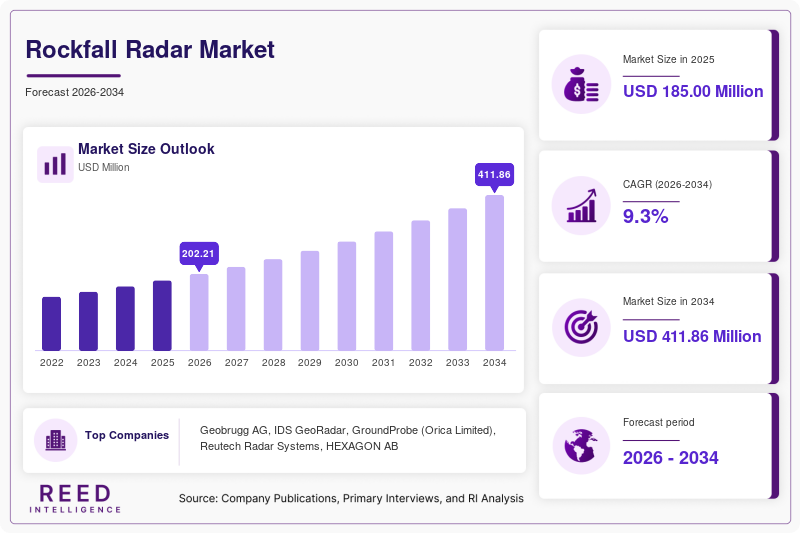
Key Highlights
- Europe dominated the market with a 34% share in 2025, while Asia Pacific is expected to register the fastest CAGR of 10.8% through 2034.
- Ground-based radar systems emerged as the leading subsegment with a 58% share, while drone-mounted radar systems are projected to grow at a CAGR of 11.6%.
- Transportation infrastructure accounted for the largest application share at 46%, whereas mining applications are expected to grow at a CAGR of 10.9%.
- Switzerland led the market with USD 28 million in 2025 and is estimated to reach USD 30 million in 2026.
Market Trends
Integration of AI and Predictive Analytics
The Rockfall Radar Market is witnessing a shift toward intelligent monitoring systems equipped with artificial intelligence and predictive analytics. These advanced systems analyze historical and real-time data to predict potential rockfall events before they occur. This trend is enhancing decision-making capabilities for infrastructure managers and reducing false alarms. AI-enabled radar systems are also improving operational efficiency by automating risk classification and alert generation, making them increasingly attractive for large-scale deployments.
Adoption of Remote and Autonomous Monitoring Solutions
Another notable trend shaping the Rockfall Radar Market is the increasing adoption of remote and autonomous monitoring technologies. These systems allow continuous observation of high-risk zones without requiring on-site human intervention. With the integration of IoT connectivity and cloud-based platforms, stakeholders can access real-time data from remote locations. This trend is particularly relevant in hazardous and inaccessible terrains, where manual monitoring is challenging. The growing reliance on automation is expected to enhance safety standards and reduce operational costs over the forecast period.
Market Drivers
Rising Infrastructure Development in High-Risk Areas
The expansion of transportation networks such as highways, tunnels, and railways in mountainous regions is driving the demand for rockfall radar systems. Governments are increasingly investing in infrastructure projects in geographically challenging terrains, necessitating robust monitoring solutions to ensure safety and operational continuity. The Rockfall Radar Market is benefiting from these developments as radar systems provide continuous surveillance and early warning capabilities, reducing the likelihood of accidents and infrastructure damage.
Increasing Focus on Worker and Public Safety
Growing awareness regarding occupational safety and public protection is another major driver of the Rockfall Radar Market. Industries such as mining and construction are adopting advanced monitoring technologies to comply with safety regulations and minimize risks associated with geological hazards. Radar-based systems offer precise detection and real-time alerts, enabling timely evacuation and preventive measures. This increased focus on safety standards is expected to sustain market growth across multiple end-use industries.
Market Restraint
High Initial Investment and Maintenance Costs
One of the primary challenges restraining the growth of the Rockfall Radar Market is the high initial cost associated with system installation and ongoing maintenance. Advanced radar systems require significant capital investment, which can be a barrier for small and medium-sized enterprises as well as budget-constrained government bodies. Additionally, the need for skilled personnel to operate and maintain these systems further increases operational costs.
The complexity of integrating radar systems with existing infrastructure and monitoring frameworks also adds to the overall expenditure. In regions with limited financial resources, stakeholders may opt for less expensive alternatives, thereby limiting market penetration. Furthermore, periodic calibration and maintenance requirements can lead to downtime and additional expenses, affecting the long-term adoption of rockfall radar technologies.
Market Opportunities
Expansion in Emerging Economies
Emerging economies present significant growth opportunities for the Rockfall Radar Market due to increasing investments in infrastructure development and disaster management systems. Countries in Asia Pacific and Latin America are focusing on improving transportation safety and resilience against natural hazards. The adoption of radar-based monitoring systems in these regions is expected to rise as governments allocate funds for advanced safety technologies.
Integration with Smart Infrastructure Systems
The integration of rockfall radar systems with smart infrastructure platforms offers a promising opportunity for market growth. Smart cities and intelligent transportation systems are incorporating advanced monitoring solutions to enhance safety and efficiency. Rockfall radar systems can be integrated with centralized control systems, enabling real-time data sharing and coordinated response strategies. This integration is expected to drive demand for technologically advanced radar solutions and create new revenue streams for market players.
Segmental Analysis
By Type
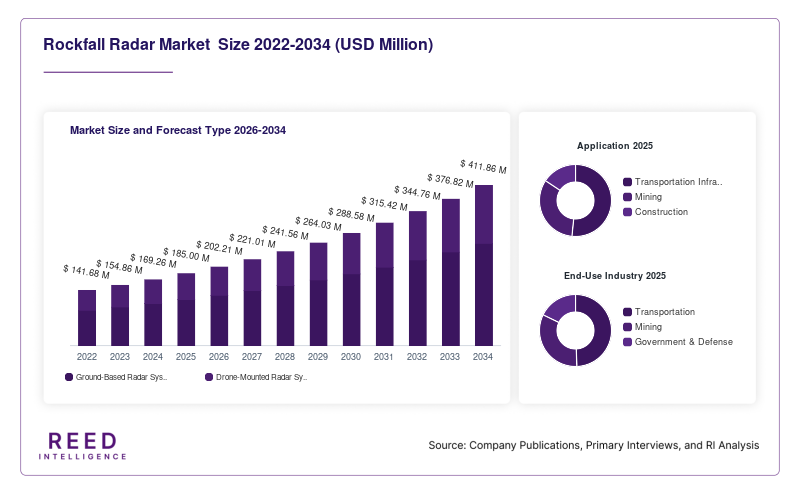
Ground-based radar systems dominated the Rockfall Radar Market in 2025, accounting for 58% of the total share. These systems were widely adopted due to their high accuracy and ability to provide continuous monitoring over large areas. Their effectiveness in detecting small movements and providing real-time alerts made them the preferred choice for infrastructure and mining applications.
Drone-mounted radar systems are expected to grow at the fastest CAGR of 11.6% during the forecast period. Their ability to access remote and hazardous locations provides a unique advantage. These systems will gain traction as industries seek flexible and cost-effective monitoring solutions.
By Application
Transportation infrastructure emerged as the dominant application segment, holding a 46% share in 2025. The widespread use of rockfall radar systems in highways and railways for safety monitoring contributed to this dominance. The increasing need to prevent accidents and ensure uninterrupted transportation supported segment growth.
Mining applications are projected to grow at a CAGR of 10.9% through 2034. The demand for advanced monitoring systems in mining operations will increase due to safety concerns and regulatory requirements. Radar systems will play a crucial role in preventing accidents and improving operational efficiency.
By End-Use Industry
The transportation sector dominated the market in 2025 with a 49% share, driven by the need for continuous monitoring of critical infrastructure. The implementation of radar systems in tunnels, bridges, and roads contributed to this dominance.
The mining industry is expected to grow at the fastest CAGR of 10.5%. Increasing investments in mining projects and the need for worker safety will drive the adoption of radar systems in this segment.
By Technology
Continuous wave radar technology held the largest share of 54% in 2025 due to its reliability and efficiency in detecting movements. Its widespread adoption across various applications supported its dominance.
Frequency-modulated continuous wave (FMCW) radar is anticipated to grow at a CAGR of 11.2%. Its advanced capabilities in providing high-resolution data and improved accuracy will drive its adoption.
Regional Analysis
North America
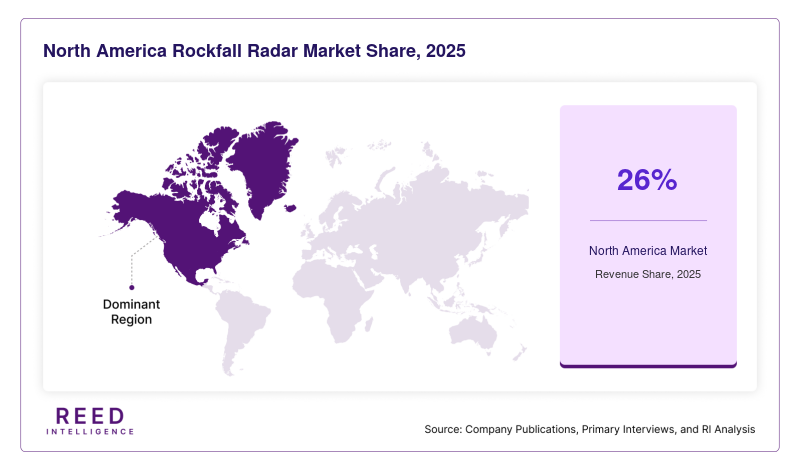
North America accounted for approximately 26% of the Rockfall Radar Market share in 2025 and is expected to grow at a CAGR of 8.7% during the forecast period. The region’s growth is driven by the presence of advanced infrastructure and increasing adoption of monitoring technologies in transportation and mining sectors. The United States dominated the regional market due to its extensive highway network and focus on infrastructure safety. Investments in modernizing transportation systems and implementing hazard mitigation measures are supporting market expansion.
Europe
Europe held the largest share of 34% in 2025 and will continue to grow at a CAGR of 9.1% through 2034. The region’s dominance is attributed to stringent safety regulations and the presence of mountainous terrains prone to rockfall incidents. Switzerland emerged as the leading country due to its advanced adoption of monitoring technologies and strong emphasis on infrastructure safety. Government initiatives aimed at reducing geological risks are further driving the market.
Asia Pacific
Asia Pacific captured around 22% of the Rockfall Radar Market share in 2025 and is projected to grow at the fastest CAGR of 10.8% during the forecast period. Rapid infrastructure development and increasing investments in transportation projects are fueling market growth. China led the region due to large-scale construction activities in mountainous areas. The government’s focus on disaster management and infrastructure resilience is boosting the adoption of radar systems.
Middle East & Africa
The Middle East & Africa region accounted for 10% of the market share in 2025 and is expected to grow at a CAGR of 8.2%. The region’s growth is supported by mining activities and infrastructure development in challenging terrains. South Africa dominated the regional market due to its extensive mining sector. The adoption of advanced monitoring technologies is increasing as companies prioritize safety and operational efficiency.
Latin America
Latin America held an 8% share of the Rockfall Radar Market in 2025 and is projected to grow at a CAGR of 8.9% through 2034. The region’s growth is driven by expanding mining operations and infrastructure projects. Chile emerged as the leading country due to its significant mining industry. The need for reliable monitoring systems in high-risk areas is supporting market expansion.
Competitive Landscape
The Rockfall Radar Market is moderately fragmented, with several global and regional players competing based on technology innovation and product reliability. Key companies are focusing on enhancing radar accuracy, integrating AI capabilities, and expanding their geographic presence.
Geobrugg AG is recognized as a leading player in the market, offering advanced rockfall monitoring solutions. The company recently introduced an upgraded radar system with enhanced detection capabilities and remote monitoring features, strengthening its market position.
Other prominent players are investing in research and development to introduce cost-effective and high-performance solutions. Strategic collaborations with government agencies and infrastructure companies are also shaping the competitive landscape.
Key Players List
- Geobrugg AG
- IDS GeoRadar
- GroundProbe (Orica Limited)
- Reutech Radar Systems
- HEXAGON AB
- Topcon Corporation
- Leica Geosystems
- Geosense Ltd.
- Senceive Ltd.
- Sixense Group
- Trimble Inc.
- Terra Insights
- RST Instruments Ltd.
- Campbell Scientific Inc.
- Fugro N.V.
Recent Developments
- In 2025, Geobrugg AG launched an advanced AI-enabled rockfall radar system for real-time hazard detection.
- IDS GeoRadar expanded its product portfolio with improved remote monitoring solutions.
- GroundProbe introduced a new radar platform tailored for mining applications.
- HEXAGON AB invested in integrating radar systems with smart infrastructure platforms.
- Trimble Inc. enhanced its monitoring solutions with cloud-based analytics capabilities.
Rockfall Radar Market Segments
Type
- Ground-Based Radar Systems
- Drone-Mounted Radar Systems
Application
- Transportation Infrastructure
- Mining
- Construction
End-Use Industry
- Transportation
- Mining
- Government & Defense
Technology
- Continuous Wave Radar
- Frequency-Modulated Continuous Wave (FMCW) Radar
By Region
- North America
- Europe
- APAC
- Middle East and Africa
- LATAM